Chang'e 2
CNSA (China) · Orbiter · 2010Success

Mapped the Moon at 7 m through 2011, reached Sun-Earth L2, flew by asteroid Toutatis Dec 13, 2012; contact faded after 2014, now a silent derelict in solar orbit.
TL;DR· 7 min read
Chang'e 2 launched on October 1, 2010 on Chang'e 1's backup hardware and mapped the entire Moon at 7 meters per pixel, dropping to a 15 km perilune to scout the planned Chang'e 3 landing region. It then left lunar orbit for Sun-Earth L2, the first spacecraft to reach L2 directly from the Moon, and on December 13, 2012 flew past asteroid 4179 Toutatis at 770 plus or minus 120 meters. Contact faded after 2014 and it is now a silent derelict in solar orbit.
Chang'e 2 is the Moon mission that refused to stop at the Moon. Flown on Chang'e 1's backup hardware, it mapped the entire lunar surface at 7 meters per pixel and dove to 15 km to scout the planned Chang'e 3 landing region, then left lunar orbit to become the first spacecraft ever to reach Sun-Earth L2 from the Moon, and finished by making China the fourth space agency to visit an asteroid with its December 13, 2012 flyby of 4179 Toutatis. One correction up front: the 3.2 km flyby distance still quoted across English coverage is the stale first-day figure; the peer-reviewed Chinese measurement is 770 plus or minus 120 meters from the asteroid's surface.
Facts as of July 20, 2026, from the sources listed below.
7m/px
resolution of its full-Moon map, the sharpest complete lunar map published to that date (Feb 2012)
770m
closest approach to asteroid Toutatis (plus or minus 120 m), measured from the surface
10.73km/s
relative speed of the Toutatis flyby
3
destinations on one spacecraft: lunar orbit, Sun-Earth L2, and an asteroid
Commonly wrong. Four persistent errors in English coverage. (1) The flyby distance: '3.2 km' was the figure circulated in the first days after the encounter and it is still on Wikipedia and across English media as of July 2026, but the peer-reviewed Chinese analysis (Huang et al. 2013, Scientific Reports) measured closest approach at 770 plus or minus 120 m from Toutatis' surface; a separate navigation reconstruction (Cao et al., Advances in Space Research) gives 1,564 m from the asteroid's center of mass, and the two figures agree once Toutatis' roughly kilometer-scale half-width along the flyby geometry is subtracted. (2) 'First spacecraft at L2': NASA's WMAP and ESA's Herschel and Planck worked at Sun-Earth L2 first; Chang'e 2's genuine record is first to arrive at L2 directly from lunar orbit, making China the third agency to operate there. (3) The Sinus Iridum mixup: Chang'e 3 did not land on the terrain Chang'e 2 famously photographed from 15 km; the 2013 landing was retargeted east into northern Mare Imbrium, so 'Chang'e 2 imaged the Chang'e 3 landing site' is true of the planned region and false of the eventual touchdown point. (4) 'Toutatis images at 10 m resolution': that was the early estimate; the published analysis puts the best frames at better than 3 m.
01Mission facts
Launch
October 1, 2010, 10:59:57 UTC, Long March 3C from Xichang Satellite Launch Center LC-2↗
Spacecraft
2,480 kg on the DFH-3 series bus (DFH-3A in Gunter's listing), flown from Chang'e 1's backup hardware with upgraded instruments; six-month design life↗
Camera
Three-line-array CCD stereo camera: 10 m resolution from the 100 km orbit, 1.5 m from the 15 km perilune passes↗
Chang'e 3 site reconnaissance
Perilune lowered to 15 km on October 26, 2010 for meter-class imaging of Sinus Iridum, the then-planned Chang'e 3 landing region↗
Global map
7 m per pixel full-Moon map released February 6, 2012, built from over 700 frames taken October 2010 to May 2011; announced by SASTIND as the highest-resolution published map of the entire lunar surface to that date↗
Sun-Earth L2 record
Arrived August 25, 2011 after a 77-day cruise: the first spacecraft to reach Sun-Earth L2 directly from lunar orbit↗
Toutatis flyby
December 13, 2012: closest approach 770 plus or minus 120 m from the asteroid's surface at 10.73 km/s relative speed↗
Flyby camera
A small engineering camera installed to monitor the solar panel, with a 1024-pixel-square detector shooting up to 5 frames per second, took the flyby images instead of the lunar mapping camera↗
Flyby conditions
Encounter occurred more than 7 million km from Earth, over 20 times the design range of the communication system, on a 20 kb/s downlink through the probe's 0.6 m antenna↗
Toutatis results
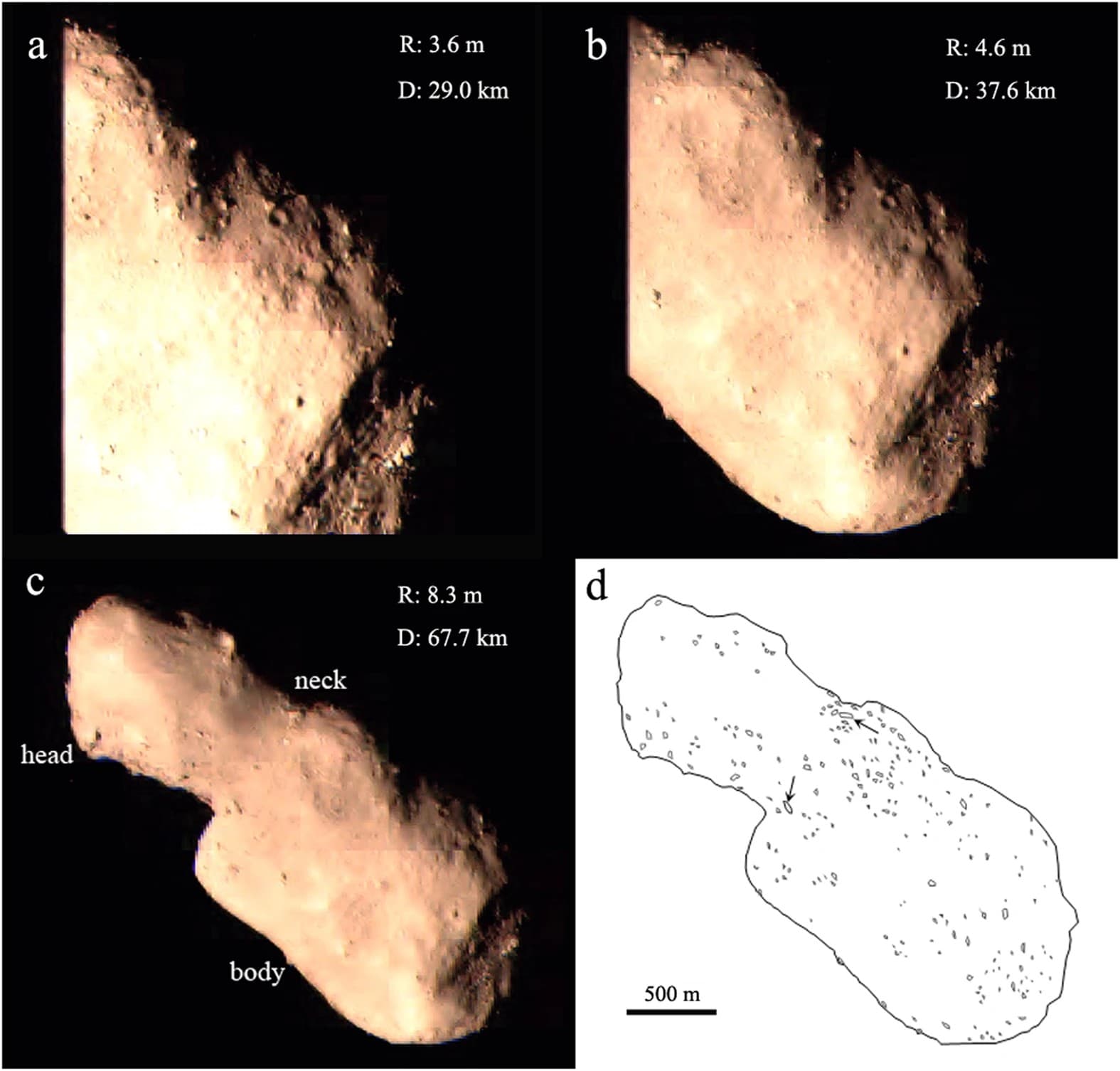
Images better than 3 m resolution showed a bifurcated contact binary about 4.75 x 1.95 km (plus or minus 10 percent) with a giant basin at the big end and boulders and regolith suggesting a rubble-pile structure↗
Asteroid first
First Chinese asteroid encounter; China became the fourth space agency to study an asteroid up close, after the United States, Europe, and Japan↗
Deep-space coda
China's national space science data center lists the spacecraft more than 200 million km from Earth as of 2016, with the extended cruise used to exercise the country's deep-space tracking network↗
02Mission timeline
1 Oct 2010
Launched on a Long March 3C from Xichang on China's National Day, riding the country's first direct translunar trajectory
6 Oct 2010
Braked into lunar orbit after a transfer of under five days
9 Oct 2010
Settled into the 100 km circular polar working orbit
26 Oct 2010
Perilune dropped to 15 km; low passes image Sinus Iridum, the planned Chang'e 3 landing region, at meter scale
8 Nov 2010
First Sinus Iridum close-ups published in Beijing
9 Jun 2011
Fires its engine and departs lunar orbit for Sun-Earth L2, its primary mapping mission complete
25 Aug 2011
Arrives at Sun-Earth L2 after a 77-day cruise, the first spacecraft to reach it directly from lunar orbit
6 Feb 2012
SASTIND releases the 7 m per pixel map of the entire Moon assembled from Chang'e 2 imagery
15 Apr 2012
Leaves L2 on an eight-month intercept of near-Earth asteroid 4179 Toutatis
13 Dec 2012
Flies past Toutatis at 770 plus or minus 120 m and 10.73 km/s, more than 7 million km from Earth: China's first asteroid encounter
2014
Tracked beyond 100 million km from Earth as controllers exercise China's deep-space network
Around 2029
The silent derelict's solar orbit is projected to bring it back through Earth's neighborhood
Teal dots: events that physically happened in flight or on the Moon. Grey: announcements, namings, contracts, and targets.
03The mission
Chang'e 2 began as insurance. It was built as the backup to Chang'e 1, China's first lunar orbiter, and when that mission succeeded in 2007-2009 the spare was upgraded and repurposed as a technology pathfinder for the Chang'e 3 landing. It launched on a Long March 3C from Xichang on October 1, 2010, China's National Day, and took the country's first direct translunar trajectory: under five days to the Moon, against the nearly two weeks of phasing orbits Chang'e 1 had needed. By October 9 it was circling in a 100 km polar orbit, a 2,480 kg spacecraft carrying seven improved instruments, with a design life of six months.
The mapping campaign had a sharper purpose than its predecessor's. The three-line-array CCD stereo camera resolved about 10 meters from the 100 km orbit and about 1.5 meters from low passes, and on October 26, 2010 controllers dropped the perilune to 15 km to photograph Sinus Iridum, the Bay of Rainbows, then the planned Chang'e 3 landing region; the first close-ups were published in Beijing on November 8, 2010. The full product arrived on February 6, 2012, when China released a 7-meter-per-pixel map of the entire Moon assembled from more than 700 frames, a 17-fold jump over Chang'e 1's 120-meter map and, per the program's deputy chief commander Liu Dongkui, the highest-resolution image of the complete lunar surface published to that date.
With its primary mission done and fuel to spare, Chang'e 2 left the Moon. On June 9, 2011 it departed lunar orbit, and after a 77-day cruise it arrived at the Sun-Earth L2 point on August 25, 2011, the first spacecraft ever to reach L2 directly from lunar orbit and the first Chinese spacecraft to operate that deep in space. NASA and ESA observatories had worked at L2 before it. What was new was the route and the operator: China became the third agency to fly a spacecraft there, and used the eight-month stay to wring out the new deep-space tracking stations that its later lunar and planetary missions would depend on.
The encore was audacious. Departing L2 on April 15, 2012, Chang'e 2 spent eight months chasing down the near-Earth asteroid 4179 Toutatis, and on December 13, 2012 flew past it at a relative speed of 10.73 km/s, by the published Chinese analysis just 770 plus or minus 120 meters from the surface. The imaging came not from the lunar mapping camera, which was useless at that closing speed, but from a small CMOS engineering camera originally installed to watch the solar array deploy, shooting roughly 400 frames in 25 minutes while the spacecraft worked more than 7 million km from Earth, over 20 times its designed communication range, on a 20 kb/s downlink. The pictures resolved the ginger-root asteroid at better than 3 meters: a bifurcated contact binary about 4.75 by 1.95 km, with a large basin at the big end and boulders and regolith arguing for a rubble-pile interior. It was the first Chinese asteroid encounter, and it made China the fourth space agency to explore an asteroid up close, after the United States, Europe, and Japan.
After Toutatis the mission simply kept receding, recast as a live-fire test of China's deep-space network. Controllers tracked it past 100 million km in 2014, China's national space science data center later listed it beyond 200 million km, and engineers estimated its remaining propellant could keep it functioning out to 300 million km. Contact faded as the distance grew, and the derelict now loops the Sun on an orbit projected to bring it back through Earth's neighborhood around 2029. Its fingerprints are all over what followed: the landing-site reconnaissance and X-band operations fed straight into Chang'e 3's 2013 touchdown, the L2 and asteroid legs rehearsed the tracking network that later flew Tianwen-1 to Mars, and China's first asteroid sample-return mission, Tianwen-2, launched in May 2025, descends directly from the flyby this repurposed lunar orbiter pulled off in 2012.
04In pictures
Tap a photo to enlarge.
05Sources
- Huang et al. 2013, Scientific Reports: The Ginger-shaped Asteroid 4179 Toutatis (flyby date, 770 plus or minus 120 m, 10.73 km/s, better than 3 m imaging, dimensions, basin, rubble pile)
- Jiang et al. 2015, Scientific Reports: Boulders on asteroid Toutatis as observed by Chang'e-2 (CC BY 4.0 source of the hostable flyby images)
- eoPortal: Chang'e-2 / CE-2 (launch, mass, direct transfer, orbit dates, 15 km perilune, L2 first-from-lunar-orbit record, instrument suite)
- China National Space Science Data Center (English): Chang'e-2 (camera specs 10 m / 1.5 m, seven payloads, 200 million km status)
- phys.org: China unveils high resolution global moon map (Feb 6, 2012 release, 7 m, 700+ frames, Liu Dongkui highest-resolution claim)
- The Planetary Society, Emily Lakdawalla: Imaging results from the Chang'e 2 Toutatis flyby (solar-panel monitoring camera, 5 fps, 1024-pixel detector; 770 m vs 1,564 m distance reconciliation)
- IEEE Spectrum: Details Emerge of Chang'e-2 Asteroid Encounter (CMOS monitoring camera, 7 million km range, 20 kb/s downlink, caution on the 3.2 km figure)
- Astronomy.com, Dec 13, 2025: Chang'e 2 flies by Toutatis (about 400 photos in 25 minutes; fourth agency to study an asteroid up close)
- Gunter's Space Page: Chang'e 2 (Chang'e 1 backup heritage, DFH-3 series bus, six-month design life, June 9, 2011 lunar-orbit departure)
- China Space Report: Chang'e 2 (mission timeline, Nov 8, 2010 Sinus Iridum image release, propellant-to-300-million-km estimate)
- Space.com: China's Chang'e Program (third agency at Sun-Earth L2, projected return to Earth's vicinity around 2029)
- Cao et al., Advances in Space Research: Navigation of the Chang'E-2 asteroid exploration mission and the minimum distance estimation (1,564 m center-of-mass distance)
- Wikipedia: Chang'e 2 (launch time 10:59:57 UTC, 2,480 kg, cost about 900 million yuan, 100 million km by 2014; note its 3.2 km flyby figure is superseded)
- LROC Featured Image 294: Sinus Iridum - Next Destination? (Oct 15, 2010; regional context and image source)
azmth is independent and is not affiliated with or endorsed by NASA, CNSA, Roscosmos, ISRO, JAXA, or any other space agency or company named on this page.