ARTEMIS P1 and P2
NASA (US) · Orbiter · 2011Operating
Operating: 15 years in lunar orbit, with fresh magnetometer files on Berkeley's public data server through September 27, 2026 for P2 and September 25, 2026 for P1 (as of September 28, 2026).
TL;DR· 7 min read
ARTEMIS P1 and P2 are two recycled THEMIS probes that have orbited the Moon since 2011, measuring the solar wind, the lunar plasma wake and the Moon's patchy crustal magnetism. The hardware launched on February 17, 2007 and took the ARTEMIS name in 2008, eleven years before NASA's crewed Artemis program borrowed it. P1 was the first spacecraft ever to orbit an Earth-Moon Lagrange point. Both probes were still returning data in September 2026, the oldest spacecraft still doing science at the Moon.
NASA has flown two things called Artemis, and this is the one nobody means. ARTEMIS P1 and P2 are a pair of recycled THEMIS heliophysics probes that have orbited the Moon since mid-2011, measuring the solar wind, the lunar plasma wake and the Moon's patchy crustal magnetism, and they took the name in 2008, eleven years before the crewed Artemis program borrowed the goddess. As of September 2026 both probes are still returning data from hardware launched more than two years before LRO.
Facts as of September 28, 2026, from the sources listed below.
2
recycled heliophysics probes in lunar orbit
15years
in lunar orbit, as of September 2026
1st
spacecraft ever to orbit an Earth-Moon Lagrange point
307m/s
delta-V left on P1 for the entire Moon transfer, forcing the slow low-energy route
Commonly wrong. Three recurring errors in English coverage. (1) The name: this ARTEMIS is unrelated to NASA's crewed Artemis program and predates it by eleven years (the acronym came with the extension NASA approved in May 2008; the astronaut program was named in May 2019), yet search engines, news aggregators and even NASA's own site conflate them, and as of September 2026 the URL science.nasa.gov/mission/artemis, the address the probes' name would suggest, redirects to the crewed program's page while the probes live at science.nasa.gov/mission/themis-artemis. (2) "ARTEMIS launched in 2011": nothing launched in 2011; the hardware launched on February 17, 2007 as THEMIS B and C, and 2011 is when the two probes entered lunar orbit. (3) "first spacecraft to orbit a Lagrange point" needs its qualifier: ISEE-3 orbited the Sun-Earth L1 point in 1978; ARTEMIS P1's genuine first is orbiting an Earth-Moon Lagrange point, and it went on to hold position around both L2 and L1.
01Mission facts
Launch
February 17, 2007, at 6:01 p.m. EST on a Delta II from Cape Canaveral pad 17-B; all five THEMIS probes rode a single rocket↗
Two acronyms
THEMIS is Time History of Events and Macroscale Interactions during Substorms; the lunar extension is ARTEMIS, Acceleration, Reconnection, Turbulence and Electrodynamics of the Moon's Interaction with the Sun↗
Which probes
THEMIS B became ARTEMIS P1 and THEMIS C became ARTEMIS P2 under the lunar extension NASA approved, announced May 19, 2008; THEMIS A, D and E stayed in Earth orbit↗
Why they left Earth orbit
The two outermost probes were drifting into ever longer eclipse seasons that would have frozen the solar-powered spacecraft; orbit-raising maneuvers to escape began July 20, 2009↗
Fuel budget
At the start of the lunar transfer P1 had 14.5 kg of hydrazine (307 m/s of delta-V) and P2 had 21.1 kg (450 m/s), so navigators flew a low-energy route lasting well over a year, with lunar and solar gravity doing most of the work↗
Lagrange point first
P1 is the first spacecraft ever to navigate to and hold orbit around the Earth-Moon L1 and L2 Lagrange points↗
Arrival milestones
P1 reached the L2 Lagrange point on August 25, 2010, and P2 reached L1 on October 22, 2010; P1 entered lunar orbit June 27, 2011, and P2 followed July 17, 2011↗
Lunar orbits
Stable, equatorial, high-eccentricity orbits of roughly 100 by 19,000 kilometers altitude with periods near 26 hours, one probe prograde and one retrograde so their apsides sweep the full circle of local times↗
Instruments
Five per probe: an Electric Field Instrument, Fluxgate Magnetometer, Search Coil Magnetometer, Electrostatic Analyzer and Solid State Telescope, giving two-point plasma and field measurements around the Moon↗
2023 senior review
The review found every minor sensor anomaly recovered or worked around, with sensors returning to full science capability on all probes; the panel called ARTEMIS support for the crewed Artemis program and Lunar Gateway compelling, noting continuation costs far less than launching replacement spacecraft to the Moon↗
FY2026 closeout scare
NASA's May 2025 budget request ordered THEMIS, and with it ARTEMIS, to implement mission closeout↗
Congress said no
The enacted FY2026 appropriations rejected the proposed science cuts and funded NASA heliophysics at $874.8 million, with NASA science at $7.25 billion↗
Still returning data
Berkeley's public data server holds P2 fluxgate magnetometer files through September 27, 2026 and P1 files through September 25, 2026, both posted on September 28, 2026 (as of September 28, 2026)↗
02Mission timeline
17 Feb 2007
Five THEMIS probes launch on a single Delta II from Cape Canaveral pad 17-B
Feb 2008
The five-probe constellation catches magnetic reconnection triggering an auroral substorm, the parent mission's headline result
19 May 2008
Berkeley announces NASA's approval: THEMIS B and C will go to the Moon under the new name ARTEMIS
20 Jul 2009
Orbit-raising maneuvers begin, pulling the two probes out of Earth orbits whose deepening eclipses would have frozen them
25 Aug 2010
P1 becomes the first spacecraft ever to orbit an Earth-Moon Lagrange point, arriving at L2
22 Oct 2010
P2 arrives at the L1 Lagrange point on the Earth-facing side of the Moon
27 Jun 2011
P1 enters lunar orbit after a two-year transfer flown mostly on gravity assists
17 Jul 2011
P2 enters lunar orbit; the pair settle into opposing elliptical orbits for two-point measurements
2013 to 2014
Coordinated observations support NASA's LADEE exosphere mission from lunar orbit
May 2019
NASA names its crewed lunar program Artemis, eleven years after these probes took the name
2023
Heliophysics senior review endorses continued operations, with sensors back at full science capability on all probes after minor recovered anomalies
May 2025
The FY2026 budget request orders THEMIS mission closeout
23 Jan 2026
The FY2026 appropriations minibus H.R. 6938 is signed into law, sealing Congress's rejection of the science cuts
27 Sep 2026
P2's latest magnetometer file on Berkeley's public server is for this date (as of September 28, 2026); 15 years in lunar orbit and both probes still working
Teal dots: events that physically happened in flight or on the Moon. Grey: announcements, namings, contracts, and targets.
03The mission
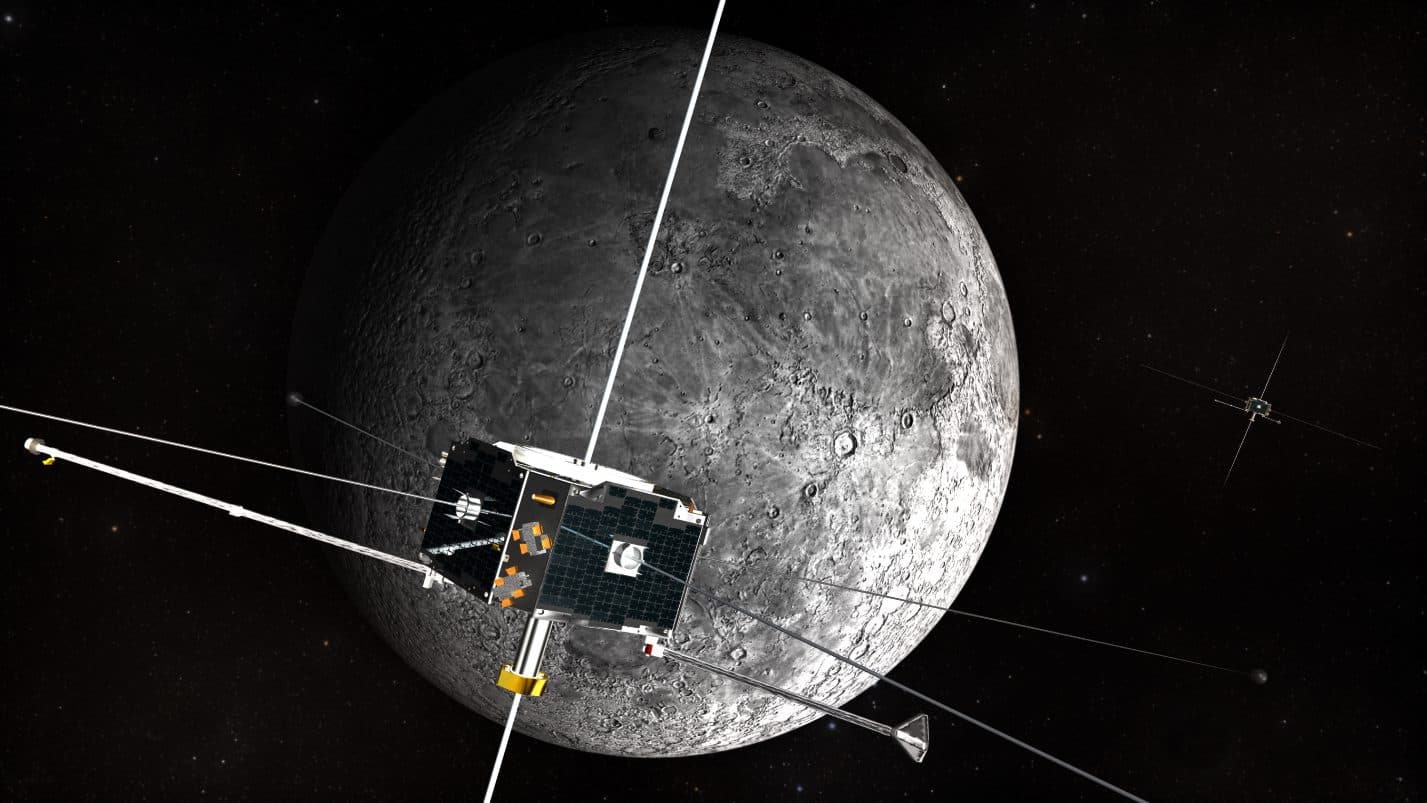
Search "NASA Artemis" and you will get astronauts. This page is about the other one: two small spinning probes, ARTEMIS P1 and P2, each about 84 centimeters across and 128 kilograms, that have been quietly orbiting the Moon since the summer of 2011. The name is an acronym, Acceleration, Reconnection, Turbulence and Electrodynamics of the Moon's Interaction with the Sun, chosen in 2008, and the collision with NASA's later crewed program is now so total that the NASA science-site address the probes' name suggests, science.nasa.gov/mission/artemis, redirects to the astronaut program's page; the probes live under the combined THEMIS-ARTEMIS page instead. The probes predate the name clash by more than a decade and never had anything to do with landing people on the Moon.
They began life as two fifths of THEMIS, a five-probe constellation launched on one Delta II on February 17, 2007, to figure out what triggers the explosive auroral substorms in Earth's magnetotail. THEMIS answered its question, but success created a problem: the orbits of the two outermost probes were drifting toward eclipse seasons long enough to freeze the solar-powered spacecraft. UC Berkeley's Space Sciences Laboratory and NASA navigators plotted an escape that began with thruster firings on July 20, 2009. With only 307 and 450 m/s of delta-V left on the two probes, a direct transfer was impossible, so the trajectory rode lunar flybys and solar gravity through a series of enormous loops. The payoff came in 2010, when P1 became the first spacecraft ever to orbit an Earth-Moon Lagrange point, arriving at L2 on August 25 with P2 reaching L1 on October 22, and both later holding position around these balance points. P1 dropped into lunar orbit on June 27, 2011; P2 followed on July 17.
At the Moon they fly stable, highly eccentric near-equatorial orbits in opposite directions, one prograde and one retrograde, looping from roughly 100 kilometers up to 19,000 kilometers every 26 hours or so. Each probe carries five field and plasma instruments, and the two-point geometry lets them measure how the solar wind slams into an unmagnetized, airless body: the refilling of the plasma wake behind the Moon, the small magnetic bubbles above crustal anomalies, the electrodynamics of the wispy exosphere. They flew coordinated observations with NASA's LADEE mission in 2013 and 2014, and they double as an upstream solar wind monitor at the Moon, which is why the 2023 heliophysics senior review called their support for the crewed Artemis program and Lunar Gateway compelling, adding that keeping them alive costs far less than launching replacements to do the same job.
As of September 2026 the mission is a survivor twice over. The 2023 senior review found every sensor on every probe back at full science capability after minor, recovered anomalies. Then the May 2025 budget request ordered THEMIS, and with it ARTEMIS, into mission closeout; Congress disagreed, and the appropriations law signed on January 23, 2026 restored NASA science funding with heliophysics at $874.8 million. The probes never stopped working through any of it: Berkeley's public data server carries magnetometer files from both probes into late September 2026 (as of September 28, 2026). Nineteen years after launch and fifteen years into lunar orbit, these two 2007-vintage spacecraft, launched more than two years before LRO, are the oldest spacecraft still doing science at the Moon; only the passive laser retroreflectors left by Apollo crews and by the Soviet Lunokhod 1 and 2 rovers are older working hardware there.
04In pictures
Tap a photo to enlarge.
05Sources
- NASA Science: THEMIS-ARTEMIS mission page (active mission, acronyms, Lagrange arrivals, lunar orbit insertion dates)
- UCLA ARTEMIS mission site: overview and goals (acronym, L1/L2 stationkeeping first, science objectives, LADEE coordination)
- UCLA ARTEMIS mission site: orbits page (final lunar orbits ~100 x 19,000 km altitude, 26 hr period, equatorial, prograde/retrograde pair)
- UC Berkeley research news, Sept 2010: Out of THEMIS, ARTEMIS (eclipse threat, July 20, 2009 maneuvers, SSL operations, PI Vassilis Angelopoulos)
- AIAA 2010-2352: Navigating THEMIS to the ARTEMIS low-energy lunar transfer trajectory (Table 1 fuel loads and remaining delta-V, maneuver counts, Earth-orbit periods at ARTEMIS start)
- SpaceNews, June 27, 2011: First ARTEMIS Spacecraft Successfully Enters Lunar Orbit
- eoPortal: THEMIS (probe specifications: 84 x 84 x 51 cm bus, 128 kg; stable prograde and retrograde lunar orbits achieved July 2011)
- 2023 NASA Heliophysics Senior Review final report (instrument list, sensor health and recovered anomalies, Artemis/Gateway support finding, replacement-cost comparison)
- NASA FY 2026 Budget Request technical supplement, May 2025 (THEMIS mission closeout language)
- The Planetary Society, Jan 2026: You just saved NASA's budget (H.R. 6938 passage, science funding restored, heliophysics $874.8M, NASA science $7.25B)
- House Appropriations Committee press release, Jan 23, 2026: President Trump signs H.R. 6938 into law (FY2026 signing date)
- UC Berkeley SSL THEMIS data server: ARTEMIS P2 (THC) level-2 fluxgate magnetometer files, 2026 directory (live operations evidence)
- Wikipedia: THEMIS (May 19, 2008 ARTEMIS approval announcement, probe redesignations, Feb 2008 substorm result)
- NASA images: Delta II THEMIS launch photo and caption (launch time, pad, five probes on one rocket)
- Space.com, May 2019: NASA names new Moon landing program Artemis (the later, unrelated crewed program)
- NASA SVS 10636: ARTEMIS Orbits Magnetic Moon (visualizations of the transfer and lunar orbits)
azmth is independent and is not affiliated with or endorsed by NASA, CNSA, Roscosmos, ISRO, JAXA, or any other space agency or company named on this page.