GRAIL (Ebb and Flow)
NASA (US) · Orbiter · 2011Success
Complete: twin orbiters mapped the Moon's gravity through 2012, then struck a far-northern mountain on Dec 17, 2012; NASA named the site for Sally Ride.
TL;DR· 7 min read
GRAIL weighed the Moon. Twin orbiters named Ebb and Flow by Montana fourth graders chased each other around the lunar poles through 2012, radio-ranging the change in their separation to build what NASA called the highest-resolution gravity map of any celestial body at the time. It showed a crust only 34 to 43 km thick and buried dikes hundreds of kilometers long. Out of fuel, both twins struck a mountain near the north pole on December 17, 2012, at a site NASA named for Sally Ride.
GRAIL is the mission that weighed the Moon. Two washing-machine-sized twins named Ebb and Flow by fourth graders chased each other around the lunar poles for most of 2012, measuring the wobble in the distance between them to build what NASA called the highest-resolution gravity map of any celestial body at the time. When the fuel ran out they were flown into a mountain near the north pole, and NASA named the spot for Sally Ride, America's first woman in space, who had run the mission's student camera program until her death that July.
Facts as of July 20, 2026, from the sources listed below.
$496M
total mission cost including launch and operations
34-43km
average crustal thickness GRAIL measured, 10 to 20 km thinner than earlier estimates
115,000+
MoonKAM images taken on targets picked by middle school students
1.7km/s
speed at which Ebb and Flow struck the mountain named for Sally Ride
Commonly wrong. Three recurring errors in English coverage. (1) "GRAIL discovered the Moon's mascons": the mass concentrations were discovered in 1968 by a JPL team using Lunar Orbiter tracking data; GRAIL mapped them in unprecedented detail and, in May 2013, explained their origin. (2) "Sally Ride crater": there is no crater named for Ride. NASA's December 17, 2012 announcement named the impact location the Sally K. Ride Impact Site as an agency tribute, the two 5 m craters themselves remain unnamed, and no IAU-approved lunar feature carries her name as of July 2026. (3) The site geography is usually given only as "near Goldschmidt crater", NASA's own shorthand; the LROC-located craters sit on the southern slope of an unnamed massif that LROC describes as south of Mouchez crater and northeast of Philolaus, with Goldschmidt itself well to the east, so maps that pin the impacts on Goldschmidt are wrong.
01Mission facts
Launch
September 10, 2011, 13:08:52 UT, on a Delta II 7920H (Heavy) from Space Launch Complex 17B, Cape Canaveral↗
Spacecraft
Identical twins on Lockheed Martin's XSS-11-derived bus: 307 kg fueled, 201 kg dry, with a science payload derived from the GRACE Earth-gravity mission↗
Leadership
Principal investigator Maria Zuber (MIT), the first woman to lead a robotic planetary mission for NASA; project management at JPL↗
Cruise and arrival
3.5-month low-energy cruise via the Sun-Earth Lagrange point 1; Ebb entered lunar orbit December 31, 2011, Flow on January 1, 2012↗
Names
Ebb and Flow, announced January 17, 2012, proposed by Nina DiMauro's fourth-grade class at Emily Dickinson Elementary in Bozeman, Montana, winners of a contest that drew nearly 900 classrooms and over 11,000 students↗
Technique
Lunar Gravity Ranging System: a Ka-band radio link between the twins measured changes in their separation velocity to about 4.5 micrometers per second↗
Mapping campaigns
Primary mapping March to May 29, 2012 from about 55 km altitude in three 27.3-day cycles; extended mission August 30 to December 14, 2012 at 23 km average, dipping to 11 km↗
Cost
About $496.2 million total, covering spacecraft development, instruments, launch services, operations and science processing↗
Headline result
The highest-resolution gravity map of any celestial body at the time, released December 5, 2012, resolving mascons and gravity signatures of craters, rilles and mountains↗
Crust results
Average crustal thickness of 34 to 43 km, 10 to 20 km thinner than previously thought, plus buried linear dikes hundreds of kilometers long (Science, December 2012)↗
MoonKAM
Each twin carried a MoonKAM education camera; imaging targets were proposed by middle school students, who received more than 115,000 images through the program run by Sally Ride Science↗
Impact and naming
December 17, 2012, at 22:28:51 and 22:29:21 UTC, both twins hit the southern face of a 2.5 km-tall mountain near Goldschmidt crater at 1.7 km/s; NASA named the location the Sally K. Ride Impact Site the same day↗
Site: 75.6090°N, 26.5930°W · Sally K. Ride Impact Site (Ebb's crater), southern slope of an unnamed massif near Goldschmidt crater (source)
02Mission timeline
10 Sep 2011
Launch at 13:08:52 UT on a Delta II Heavy from Cape Canaveral SLC-17B, the last Delta II to fly from the Cape
31 Dec 2011
Ebb (GRAIL-A) enters lunar orbit on New Year's Eve after the 3.5-month low-energy cruise
1 Jan 2012
Flow (GRAIL-B) joins its twin in lunar orbit on New Year's Day
17 Jan 2012
GRAIL-A and GRAIL-B become Ebb and Flow, names proposed by Bozeman, Montana fourth graders
Mar 2012
Primary gravity mapping begins from about 55 km; the first student-commanded MoonKAM images come down mid-month
29 May 2012
Primary mission complete after three full mapping cycles
30 Aug 2012
Extended mission mapping begins at 23 km average altitude, half the primary height, later dipping to 11 km
5 Dec 2012
NASA releases the gravity map and three Science papers: a thinner, battered crust and giant buried dikes
14 Dec 2012
Extended mission science collection ends; the nearly empty twins are set up for disposal
17 Dec 2012
Final depletion burns (Ebb 4 min 3 s, Flow 5 min 7 s), then both twins strike the mountainside at 1.7 km/s, 22:28:51 and 22:29:21 UTC; NASA names the site for Sally Ride
28 Feb 2013
LROC stereo images taken this day locate both impact craters, about 5 m across and 2,210 m apart, each with odd dark ejecta
19 Mar 2013
LRO's LAMP spectrograph reports mercury and atomic hydrogen in the impact plumes it watched rise into sunlight
30 May 2013
GRAIL data solve the 45-year mascon mystery: dense gravity bumps are the signature of ancient giant impacts into a hotter Moon
Teal dots: events that physically happened in flight or on the Moon. Grey: announcements, namings, contracts, and targets.
03The mission
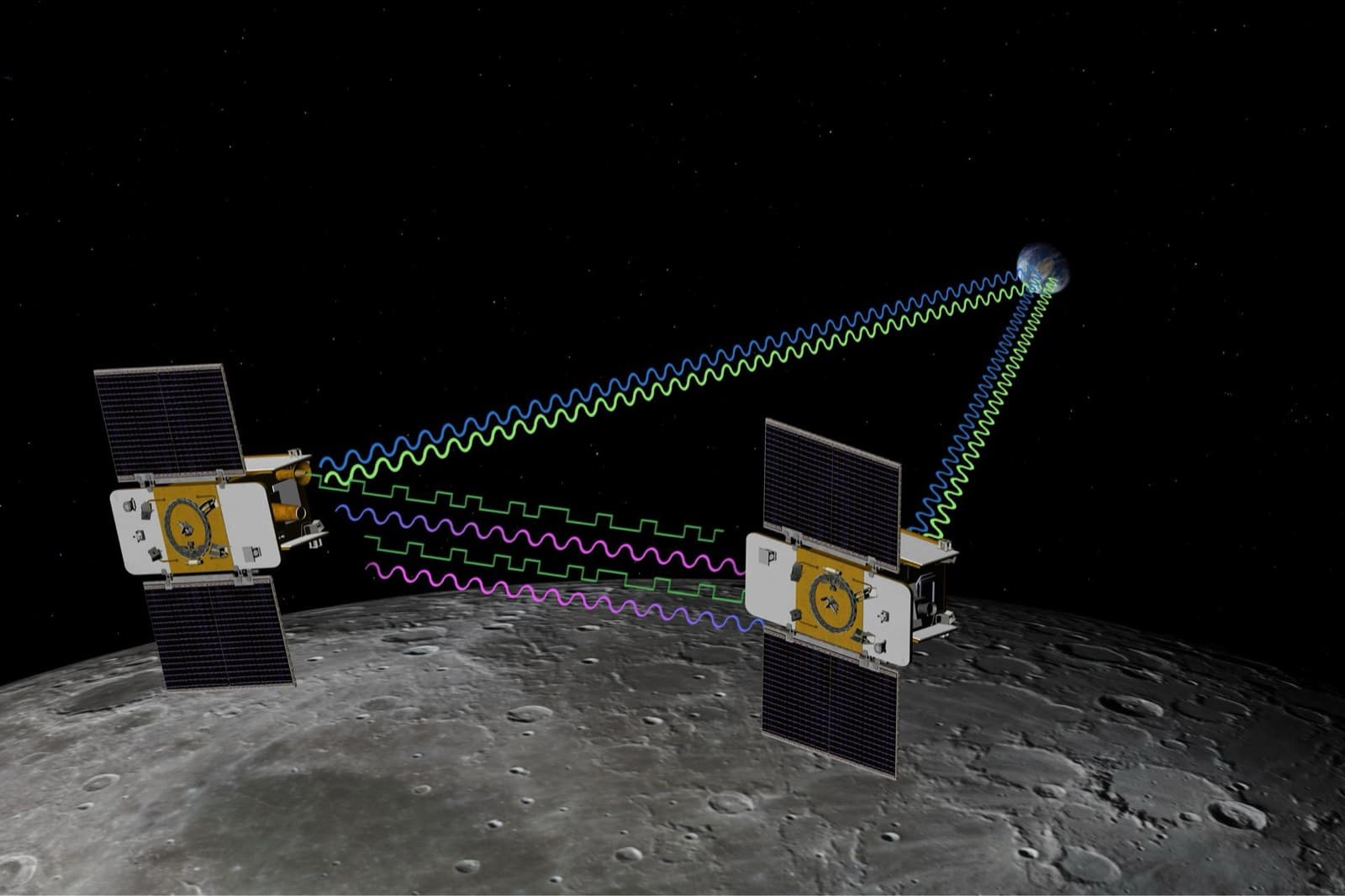
GRAIL (Gravity Recovery and Interior Laboratory) took a trick proven at Earth and flew it to the Moon. NASA's GRACE mission had shown that two satellites chasing each other, radio-ranging the tiny stretch and squeeze in their separation, could map a planet's gravity far better than any single spacecraft. GRAIL's twins, each 307 kg fueled and built by Lockheed Martin around a science payload derived from GRACE, launched together on September 10, 2011, the last Delta II ever to fly from Cape Canaveral. Instead of a three-day sprint they took a 3.5-month low-energy cruise out past the Sun-Earth Lagrange point 1, arriving in lunar polar orbit one at a time: GRAIL-A on New Year's Eve 2011, GRAIL-B on New Year's Day 2012.
By then the twins needed names, and NASA handed the job to America's classrooms. Nearly 900 classrooms and more than 11,000 students entered; Nina DiMauro's fourth graders at Emily Dickinson Elementary in Bozeman, Montana won with Ebb and Flow, reasoning that lunar gravity moves Earth's tides. The contest was run with Sally Ride, America's first woman in space, whose company Sally Ride Science also operated the mission's other classroom hook: each spacecraft carried a MoonKAM camera, and middle school students proposed targets and received over 115,000 images, with the day-to-day operations run by undergraduates at UC San Diego. Ride died of pancreatic cancer in July 2012, midway through the mission she had helped make a teaching instrument.
The science worked exactly as designed. From March to May 29, 2012, Ebb and Flow mapped the Moon from about 55 km up, their Ka-band link registering separation-velocity changes of a few micrometers per second as mascons and mountains tugged at each spacecraft in turn. On December 5, 2012, NASA released what it described as the highest-resolution gravity field of any celestial body at the time, alongside three Science papers: the lunar crust averages just 34 to 43 km thick, 10 to 20 km less than earlier estimates; the upper crust is far more porous and battered than assumed; and buried beneath the surface run ancient solidified dikes hundreds of kilometers long. Five months later, GRAIL data settled a 45-year-old puzzle by showing how giant impacts into a young, hot Moon produced the mascons that have perturbed every lunar orbiter since they were discovered in 1968. Goddard's final GRAIL gravity model, GRGM1200A, resolves the field to spherical harmonic degree and order 1200, and it is why the Moon now has the best-known gravity field of any body in the solar system.
An extended mission from August 30 to December 14, 2012 flew the formation at 23 km average altitude, half the primary height, with final passes down to 11 km. That precision came at the cost of constant orbit maintenance, and by mid-December the tanks were nearly dry. On December 17, 2012, after firing their engines to depletion in a last engineering experiment (4 minutes 3 seconds for Ebb, 5 minutes 7 seconds for Flow), the twins hit the southern face of a 2.5 km-tall mountain near Goldschmidt crater at 1.7 km/s, 30 seconds apart, at 22:28:51 and 22:29:21 UTC. The site was in darkness, but NASA's Lunar Reconnaissance Orbiter had been repositioned to watch: its LAMP ultraviolet spectrograph caught mercury and atomic hydrogen in the plumes as they climbed into sunlight. That same day NASA announced the mountainside would be known as the Sally K. Ride Impact Site.
LROC photographed the aftermath on February 28, 2013: two fresh craters roughly 5 m across, 2,210 m apart on the slope, Ebb's at 75.609 N, 333.407 E and Flow's at 75.651 N, 333.168 E, each surrounded by dark ejecta, the opposite of the bright splash fresh impacts usually make, probably carbon from the spacecraft themselves mixed into the soil. The craters are barely bigger than the spacecraft were, but the mission's real monument is invisible: every lander that has navigated to the lunar surface since, from Chang'e to Chandrayaan to the commercial fleet, descends through a gravity field GRAIL measured.
04In pictures
Tap a photo to enlarge.
05Sources
- NASA Science: GRAIL mission page (launch, twins, phases, impact, highest-resolution gravity map claim)
- JPL news, Dec 17, 2012: NASA's GRAIL Lunar Impact Site Named for Astronaut Sally Ride (impact times, speed, depletion burns, MoonKAM figures)
- GRAIL Launch Press Kit, August 2011 (cost $496.2M, masses, Delta II 7920H-10C, SLC-17B, low-energy cruise, arrival dates, GRACE heritage)
- JPL news, Jan 1, 2012: NASA's Twin Grail Spacecraft Reunite in Lunar Orbit (Ebb insertion Dec 31 at 2 p.m. PST, Flow insertion Jan 1 at 2:43 p.m. PST)
- LROC featured image: GRAIL impact craters located (stereo pair acquired Feb 28, 2013; crater sizes, separation, precise coordinates, terrain)
- NASA Science resource: GRAIL Impact Sites (before/after image, dark ejecta, coordinates)
- eoPortal: GRAIL (LGRS Ka-band ranging accuracy, mapping cycle dates and altitudes, extended mission)
- NASA: Montana Students Pick Winning Names for Moon Craft (Ebb and Flow naming contest; page dateline shows 2011 due to a migration artifact, release was Jan 17, 2012)
- NASA/JPL release via Phys.org, Dec 5, 2012: GRAIL creates most accurate Moon gravity map (crustal thickness 34-43 km, dikes)
- JPL news, Mar 19, 2013: Lunar Reconnaissance Orbiter Sees GRAIL's Explosive Farewell (LAMP mercury and hydrogen detection)
- JPL news, May 30, 2013: NASA's GRAIL Mission Solves Mystery of Moon's Surface Gravity (mascon origin; mascons first identified 1968 at JPL)
- NASA GSFC Planetary Geodesy Data Archive: GRGM1200A lunar gravity model (degree/order 1200; Moon the best-known gravity field, first dedicated gravity planetary mission)
- NASA Science: Maria Zuber (first woman to lead a robotic planetary mission for NASA)
- UC San Diego Today, April 3, 2012: From UC San Diego to the Moon (27 UCSD undergraduates staffed the campus MoonKAM operations center)
- Cape Canaveral Space Force Museum: Delta rocket program (GRAIL as the final Delta launch from the Cape)
- Zuber et al. 2013, Science: Gravity Field of the Moon from GRAIL (primary-mission gravity field)
- Wieczorek et al. 2013, Science: The Crust of the Moon as Seen by GRAIL (thinner, more porous crust)
azmth is independent and is not affiliated with or endorsed by NASA, CNSA, Roscosmos, ISRO, JAXA, or any other space agency or company named on this page.