Chang'e 3 and Yutu
CNSA (China) · Rover · 2013Success

Landed Dec 14, 2013 in Mare Imbrium; Yutu operated 972 days to Jul 31, 2016; lander signals still confirmed Dec 31, 2025
TL;DR· 6 min read
Chang'e 3 landed in northern Mare Imbrium on 14 December 2013, the first soft landing on the Moon by any nation since Luna 24 in 1976, and it made China the third country to manage one. Its Yutu rover lost mobility after 114.8 m in January 2014 but kept returning science for 972 days, then the longest run of any lunar rover. The lander is still alive: radio observers logged its 8470 MHz X-band carrier on 31 December 2025.
When Chang'e 3 settled onto northern Mare Imbrium on December 14, 2013, it ended a 37-year drought: no spacecraft from any nation had soft-landed on the Moon since the Soviet Luna 24 in August 1976, and China became only the third country to do it. Two corrections up front: the Yutu rover did not die when it stopped rolling in January 2014 (it kept transmitting science for two and a half more years, 972 days in all), and the lander itself is still not entirely dead, with its X-band signal confirmed by radio observers as recently as December 31, 2025.
Facts as of July 20, 2026, from the sources listed below.
37years
since any nation had soft-landed on the Moon (Luna 24, 1976)
972days
Yutu operated, then the longest-serving lunar rover ever
114.8m
driven by Yutu before its drive mechanism froze
12+years
lander lifetime, with signals still confirmed in Dec 2025
Commonly wrong. Three recurring errors in English sources. (1) 'Yutu died in early 2014 when it stopped moving': it lost mobility on January 25, 2014, but kept waking and transmitting science every lunar day until July 31, 2016, 972 days in all, then the longest-operating lunar rover ever (even Wikipedia's Chang'e 3 article says Yutu 'ceased to transmit data in March 2015', contradicted by China's official August 2016 retirement announcement). (2) 'Chang'e 3 landed in Sinus Iridum': Sinus Iridum was the originally publicized target, but LROC images fix the actual site in northern Mare Imbrium, east of Sinus Iridum. (3) 'The mission is long dead': the lander still wakes after lunar sunrise and locks its 8470 MHz X-band carrier to Chinese ground stations, confirmed by independent radio observers through December 31, 2025, though the LUT telescope stopped routine science observations years ago and now gets monthly on-off checks. One figure to treat with care: Yutu's mass is given as 140 kg in most accounts but 120 kg in eoPortal and Gunter's Space Page.
01Mission facts
Launch
December 1, 2013, 17:30 UTC, Long March 3B from Xichang LC-2↗
Lunar orbit insertion
December 6, 2013, 09:53 UTC↗
Landing
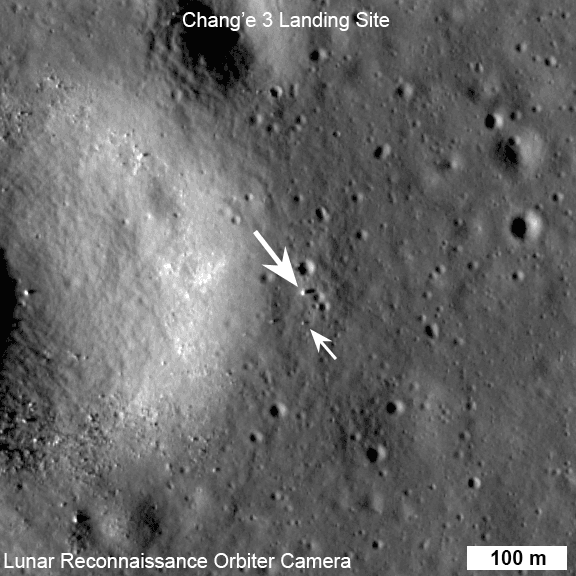
December 14, 2013, 13:11 UTC, northern Mare Imbrium, east of a 450 m crater↗
Landing coordinates (LROC-derived)
44.1214 N, 340.4884 E (19.5116 W), elevation -2640 m↗
Historic first
First lunar soft landing by any nation since Luna 24 in August 1976; China third country to soft-land↗
Launch mass / lander mass
3,780 kg at launch; lander about 1,200 kg↗
Yutu rover mass
140 kg including 20 kg science payload (some technical references list 120 kg)↗
Yutu deployed
December 14, 2013, 20:35 UTC, about 7 hours after touchdown↗
Yutu distance driven
114.8 m before mobility loss↗
Yutu mobility lost
Mechanical control abnormality announced January 25, 2014, near end of second lunar day↗
Yutu end of operations
July 31, 2016, after 972 days (design life 3 months); announced August 3, 2016↗
Yutu longevity record
Surpassed Lunokhod 1's 322 days; world's longest-serving lunar rover until Yutu 2↗
LUT telescope
150 mm F/3.75 Ritchey-Chretien, 245-345 nm near-UV, limiting magnitude 13; first long-term lunar-surface astronomical observatory↗
Rover radar
Ground-penetrating radar: 60 MHz channel to below 100 m, 500 MHz channel to below 30 m↗
Key science result
New ilmenite-rich basalt type unlike Apollo or Luna samples; radar showed layered young volcanic terrane, magma activity to about 3 billion years ago↗
Site name
Guang Han Gong (Moon Palace), IAU-approved, 154 m diameter feature; nearby craters Zi Wei, Tian Shi, Tai Wei; announced January 5, 2016↗
Status at 7 years (Sep 2020)
Lander operational, LUT reported still working by its manager Jing Wang (NAOC); powered by solar panels plus radioisotope heater unit↗
Radio confirmation 2024
X-band carrier at 8470 MHz observed February 28, 2024, switching on after lunar sunrise and locking to a Chinese ground station (DF2MZ)↗
Radio confirmation 2025
AMSAT-DL reported the lander still transmitting on December 31, 2025, twelve years after landing↗
Site: 44.1214°N, 19.5116°W · Guang Han Gong, northern Mare Imbrium (source)
02Mission timeline
1 Dec 2013
Launch at 17:30 UTC on Long March 3B from Xichang
6 Dec 2013
Lunar orbit insertion
14 Dec 2013
Soft landing in northern Mare Imbrium at 13:11 UTC, first by anyone since 1976
14 Dec 2013
Yutu rolls onto the surface at 20:35 UTC
25 Dec 2013
NASA's LRO images lander and rover from orbit (NAC M1142582775R)
25 Jan 2014
Yutu mobility failure announced after 114.8 m of driving; instruments keep working
Oct 2015
Yutu passes Lunokhod 1 to become the longest-operating lunar rover
Dec 2015
New ilmenite-rich basalt type from Yutu data published in Nature Communications
5 Jan 2016
IAU-approved landing site name Guang Han Gong announced
31 Jul 2016
Yutu ceases operating after 972 days, about 10x its 3-month design life
Sep 2020
Lander confirmed still operating at 7 years; LUT telescope reported working
28 Feb 2024
DF2MZ logs the lander's 8470 MHz X-band carrier locking to a ground station
31 Dec 2025
AMSAT-DL reports the lander still transmitting, 12 years after landing
Teal dots: events that physically happened in flight or on the Moon. Grey: announcements, namings, contracts, and targets.
03The mission
Chang'e 3 launched on a Long March 3B from Xichang Satellite Launch Center at 17:30 UTC on December 1, 2013, and entered lunar orbit on December 6. The landing on December 14 at 13:11 UTC was fully autonomous: laser and microwave sensors fed a guidance system that paused the descent to hover near 100 m altitude for hazard avoidance, then cut the engine at about 4 m for a free-fall touchdown. The 1,200 kg lander came down in northern Mare Imbrium just east of a 450 m crater, a detail worth stating precisely because many English accounts still place it in Sinus Iridum, the originally targeted region to the west. The LROC team later fixed the position at 44.1214 N, 340.4884 E (19.5116 W), elevation -2640 m, and in January 2016 the IAU-approved name Guang Han Gong (Moon Palace), a 154 m diameter site designation, was announced for the spot.
The 140 kg Yutu (Jade Rabbit) rover rolled onto the regolith at 20:35 UTC the same day, about seven hours after touchdown, and the two machines photographed each other's national flags the next day. Yutu's driving career was short: a mechanical control abnormality announced on January 25, 2014, near the end of the second lunar day, froze it in place after just 114.8 m. But immobile is not dead. The rover kept waking each lunar morning and returning data, passed Lunokhod 1's 322-day longevity mark in October 2015 to become the longest-operating lunar rover to that date, and finally fell silent on July 31, 2016, after 972 days, a retirement announced by Chinese authorities on August 3, 2016. Its record stood until China's own Yutu 2 surpassed it.
The stationary years were scientifically productive. Yutu's dual-frequency ground-penetrating radar (60 MHz probing beyond 100 m, 500 MHz beyond 30 m) revealed a stack of at least nine subsurface layers, evidence of a geologically complex site where volcanism persisted until roughly 3 billion years ago and the upper mantle is far less uniform than Earth's. Combining the arm-mounted alpha particle X-ray spectrometer with the visible/near-infrared imaging spectrometer, Chinese teams identified a new type of ilmenite-rich basalt unlike any sample returned by Apollo or the Soviet Luna missions, published in Nature Communications in December 2015.
The lander carried its own firsts. The 150 mm, F/3.75 Ritchey-Chretien Lunar-based Ultraviolet Telescope (LUT) became the first long-term astronomical observatory operated from the lunar surface, monitoring variable stars in the 245-345 nm band down to magnitude 13, imaging the Pinwheel Galaxy M101, and setting an unprecedented upper limit on water in the sunlit lunar exosphere. An extreme ultraviolet camera imaged Earth's plasmasphere at 30.4 nm, a vantage point no Earth-orbiting instrument can match.
Longevity is the quiet headline. Warmed through lunar nights by a radioisotope heater unit and powered by solar panels, the lander was reported still operating with a working LUT at its seventh anniversary in September 2020, though by then routine science observations had wound down to monthly on-off maintenance cycles. Independent evidence keeps arriving: German radio amateur DF2MZ has repeatedly logged the lander's X-band carrier at 8470 MHz switching on after lunar sunrise and locking to Chinese ground stations (Kashi, Jiamusi, and Zapala in Argentina), most recently on February 28, 2024, and AMSAT-DL reported the lander still transmitting on December 31, 2025, twelve years after landing. Chang'e 3 is the oldest spacecraft still alive on the lunar surface.
04In pictures
Tap a photo to enlarge.
05Sources
- LROC Featured Image: Chang'e 3 Lander and Rover From Above (Dec 30, 2013)
- LROC Featured Image: What a Blast! Revisiting the Chang'e 3 Landing Site (May 13, 2016)
- LROC image use terms
- eoPortal: Chang'e-3 Moon-landing Mission (technical specs)
- Gunter's Space Page: Chang'e 3, 4 / Yutu 1, 2
- Spaceflight Now: China's Yutu rover dies on the moon (Aug 4, 2016)
- CGTN America: Jade Rabbit finishes 972-day exploration (Aug 3, 2016)
- CNSA English: Chang'e-3 landing site named Guang Han Gong
- CNSA English: Yutu sets record for longest stay (Oct 2015)
- Space.com / A. Jones: Chang'e 3 lander still going strong after 7 years (Sep 23, 2020)
- DF2MZ: amateur X-band observations of Chang'e 3 (2022-2024)
- AMSAT-DL on X: Chang'e 3 still transmitting (Dec 31, 2025)
- Planetary Society: Chang'e 3 update, both rover and lander alive (Jul 21, 2014)
- Zhou et al., Advances in Astronomy 2016: LUT photometry (150 mm telescope specs)
- Space.com: The Moon's history is surprisingly complex, Chinese rover finds (Mar 12, 2015)
- Wikipedia: Chang'e 3 (cross-check aggregate)
- Wikipedia: Yutu rover (cross-check aggregate)
azmth is independent and is not affiliated with or endorsed by NASA, CNSA, Roscosmos, ISRO, JAXA, or any other space agency or company named on this page.