LADEE
NASA (US) · Orbiter · 2013Success
Impacted the lunar far side near Sundman V crater April 18, 2014 (04:30-05:22 UTC window); LROC located the sub-3 m crater in October 2014.
TL;DR· 6 min read
LADEE took the census of the Moon's exosphere and its dust. Launched September 7, 2013 on the first Minotaur V, the 383 kg Ames-built orbiter counted more than 140,000 dust impacts and revealed a permanent, lopsided dust cloud, found the exosphere to be mostly helium, argon and neon, and confirmed neon for the first time. Its laser terminal set a 622 Mbps record from lunar orbit. It was steered into the far side on April 18, 2014, leaving a crater under 3 m across on the rim of Sundman V.
LADEE is the mission that weighed the Moon's almost-nothing: five months skimming the equator to census an atmosphere so thin its molecules never collide, and to map the permanent dust cloud that shrouds the Moon. It is remembered for three things that all checked out: the frog its rocket threw into one launch photo, the laser that pushed a record 622 megabits per second from lunar orbit, and a planned farewell impact whose crater, smaller than a compact car, LRO later found on the rim of Sundman V.
Facts as of July 20, 2026, from the sources listed below.
622Mbps
record laser downlink from lunar orbit, more than six times faster than the best radio flown to the Moon
140,000+
dust impacts counted by LDEX, revealing the Moon's permanent, lopsided dust cloud
383kg
launch mass of the first Modular Common Spacecraft Bus, built at NASA Ames
<3m
width of the impact crater LROC found on the rim of Sundman V
Commonly wrong. Four recurring errors in English coverage. (1) Two impact dates circulate, and both are right: NASA confirmed impact between 9:30 and 10:22 p.m. PDT on Thursday, April 17, 2014, which is 04:30 to 05:22 UTC on April 18; pages that flatly say "April 17" or "April 18" without a time zone are describing the same event. (2) Two speeds circulate too: about 3,600 mph was NASA's figure at the impact announcement, while the LROC crater analysis published 1,699 m/s (about 3,800 mph); the entry keeps both, labeled. (3) "LADEE solved the Apollo horizon-glow mystery" overstates the result. LDEX discovered the permanent impact-generated dust cloud, but that cloud is far too tenuous for an astronaut to see, and the mission found no evidence of the dense, electrostatically lofted fine-grain population the glow would require, so the mystery remained open. (4) "LADEE discovered the Moon's atmosphere": the exosphere was known since the Apollo era; LADEE's contribution was characterizing its composition (mostly helium, argon and neon) and confirming neon for the first time. Bonus wobble: the 622 Mbps record is sometimes credited to LADEE's radio; it was a dedicated laser terminal (LLCD, built by MIT Lincoln Laboratory) talking to a ground telescope in New Mexico.
01Mission facts
Launch
September 7, 2013, 03:27 UTC (September 6, 11:27 p.m. EDT), Minotaur V from Pad 0B, Mid-Atlantic Regional Spaceport, Wallops Flight Facility, Virginia↗
Firsts at launch
First flight of the Minotaur V and the first deep-space mission launched from Wallops↗
Spacecraft
383 kg (844 lb) fully fueled at launch; mission cost approximately $280 million including spacecraft development, science instruments, launch services and mission operations↗
Builder
Designed, developed, built and tested at NASA Ames Research Center; first flight of the Modular Common Spacecraft Bus↗
Payload
Three science instruments (Neutral Mass Spectrometer, Ultraviolet-Visible Spectrometer, Lunar Dust Experiment) plus the LLCD laser-communications technology demonstration↗
Lunar orbit insertion
October 6, 2013, followed by burns on October 9 and 12 into a 235 x 250 km checkout orbit↗
LLCD laser record
622 Mbps downlink and error-free 20 Mbps uplink between lunar orbit and White Sands, New Mexico, October 2013; terminal built by MIT Lincoln Laboratory↗
Science orbit
Equatorial orbit about 20 x 60 km above the surface, entered November 20, 2013↗
Dust cloud result
LDEX recorded more than 140,000 dust impacts over the mission, revealing a permanent, asymmetric dust cloud sustained by interplanetary particle impacts (Nature, June 17, 2015)↗
Exosphere result
The exosphere is mostly helium, argon and neon; LADEE confirmed neon's presence for the first time (announced August 17, 2015)↗
Impact
April 18, 2014, between 04:30 and 05:22 UTC (9:30-10:22 p.m. PDT April 17), on the lunar far side at about 3,600 mph, planned to avoid all historic landing sites↗
Crater (found Oct 2014)
Under 3 m across at 11.8494 N, 266.7507 E, on the eastern rim of Sundman V about 780 m from the crater rim, roughly 295 m north of the predicted point; measured impact speed 1,699 m/s↗
Site: 11.8494°N, 93.2493°W · Eastern rim of Sundman V crater, lunar far side (source)
02Mission timeline
7 Sep 2013
Launch at 03:27 UTC on the first Minotaur V from Pad 0B, Wallops Flight Facility
6 Oct 2013
Lunar orbit insertion burn places LADEE in an initial elliptical lunar orbit with a 24-hour period
18 Oct 2013
In the early morning hours, LLCD transmits from lunar orbit to Earth at a record 622 Mbps, more than six times faster than any radio system flown to the Moon
20 Nov 2013
Enters the 20 x 60 km equatorial science orbit
Mar 2014
100-day primary science phase complete; NASA extends mission operations for a final stretch of ever-lower passes
15 Apr 2014
Survives the total lunar eclipse, hours of darkness and cold beyond its design case
18 Apr 2014
Planned impact on the far side near Sundman V, confirmed in the 04:30-05:22 UTC window, at about 3,600 mph
28 Oct 2014
LROC team releases before-and-after images pinpointing the sub-3 m impact crater on Sundman V's eastern rim
17 Jun 2015
Nature publishes the LDEX result: the Moon flies inside a permanent, asymmetric dust cloud
17 Aug 2015
NASA announces LADEE's first-ever confirmation of neon in the lunar exosphere
15 Apr 2019
Nature Geoscience study of LADEE mass-spectrometer data shows meteoroid streams releasing ancient water from the lunar soil
Teal dots: events that physically happened in flight or on the Moon. Grey: announcements, namings, contracts, and targets.
03The mission
The Lunar Atmosphere and Dust Environment Explorer (NASA pronounced it "laddie") went after two of the oldest open questions from Apollo: what exactly makes up the Moon's surface boundary exosphere, an atmosphere so tenuous its molecules almost never collide, and what caused the glow Apollo crews sketched above the sunrise horizon, where an airless world should have shown a knife-sharp edge. It was also a bet on cheaper spacecraft. LADEE was the first spacecraft designed, developed, built, integrated and tested at NASA Ames, the first flight of the center's carbon-composite Modular Common Spacecraft Bus, a couch-sized 383 kg orbiter that cost about 280 million dollars including development, launch services and operations. It carried three science instruments, a neutral mass spectrometer, an ultraviolet-visible spectrometer and the LDEX dust detector, plus a laser-communications terminal built by MIT Lincoln Laboratory.
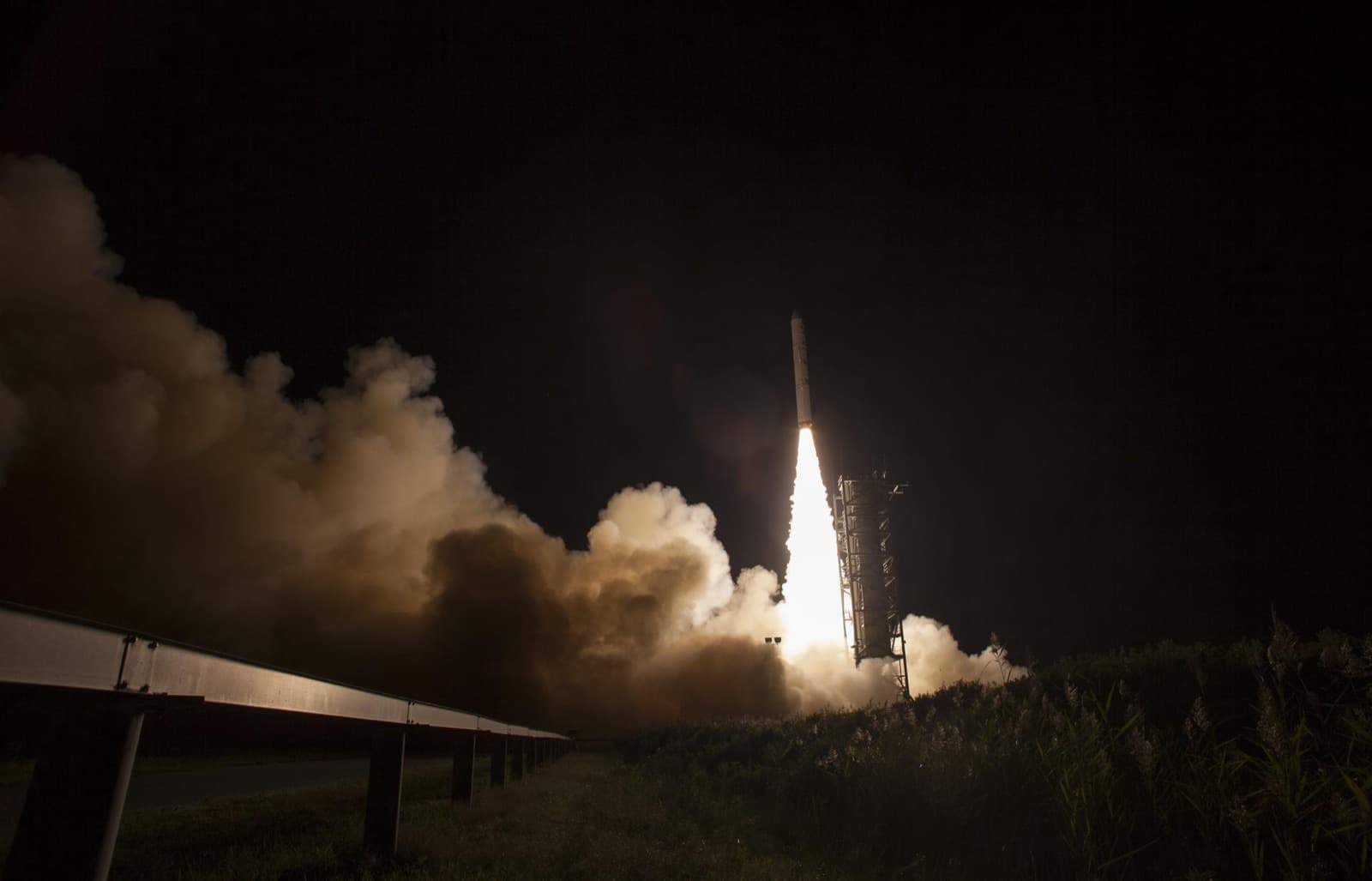
The ride up was a first of its own: the maiden flight of the five-stage Minotaur V, built around retired Peacekeeper missile stages, and the first deep-space mission ever launched from NASA's Wallops Flight Facility in Virginia. The night launch on September 6, 2013 (September 7, 03:27 UTC) was visible up and down the US East Coast, and a sound-triggered remote camera at Pad 0B caught a frog flung skyward beside the rocket, a picture that went viral worldwide within hours. After a month of long phasing orbits, LADEE fired its engine into lunar orbit on October 6, 2013, with much of NASA furloughed by the government shutdown. Before science began, the Lunar Laser Communication Demonstration made history: 622 megabits per second downlink from lunar orbit to White Sands, New Mexico, more than six times faster than the best radio system flown to the Moon, plus an error-free 20 Mbps uplink.
On November 20, 2013 LADEE dropped into its working orbit, a retrograde equatorial track roughly 20 to 60 kilometers up, low enough that the Moon's lumpy gravity demanded constant maintenance. From there LDEX counted more than 140,000 dust impacts over the mission and revealed something new: the Moon flies inside a permanent, lopsided cloud of dust, kicked up by the ceaseless rain of high-speed interplanetary particles, densest on the dawn-facing side and swelling during meteor streams like the Geminids (Nature, June 17, 2015). The mass spectrometer pinned down the exosphere itself, mostly helium, argon and neon, confirming neon's long-suspected presence for the first time, and in 2019 a reanalysis of its data showed meteoroid streams shaking ancient water out of the soil with each passage.
On the Apollo mystery, LADEE returned a verdict nobody wanted but everyone needed: the dust cloud it measured is orders of magnitude too sparse for an astronaut to see, and the spacecraft found no sign of the dense, electrostatically lofted population of fine grains that the horizon glow would require. The glow stayed unexplained, and lunar dust models have been rebuilt on LADEE's numbers ever since.
The endgame was flown as aggressively as the science. After the 100-day primary mission wrapped in early March 2014, NASA extended operations into April on ever-lower passes, eventually skimming about 300 meters above the surface, and the spacecraft survived the April 15, 2014 total lunar eclipse, hours of cold and battery drain it was never designed to endure. Out of fuel, LADEE was steered into the far side, away from every historic landing site, and hit at about 3,600 mph in the confirmation window of 04:30 to 05:22 UTC on April 18, 2014. That October the LROC team found the grave: a crater under 3 meters across on the eastern rim of Sundman V, about 295 meters from the predicted point. The laser link it demonstrated became the template for NASA's optical communications program, from the LCRD relay launched in 2021 to the deep-space laser tested on the Psyche mission.
04In pictures
Tap a photo to enlarge.
05Sources
- NASA Science: LADEE In Depth (launch time, LOI, orbit history, LLCD date, end of mission)
- NASA Science: LADEE mission page (first Minotaur V payload, first deep-space launch from Wallops)
- NASA Science: LADEE spacecraft (Ames-built, Modular Common Spacecraft Bus)
- NASA Science: LADEE science and instruments (NMS, UVS, LDEX, LLCD, horizon-glow goal)
- NASA LADEE launch press kit, August 2013 (383 kg fueled mass; ~$280M cost including development, instruments, launch services and operations; carbon-composite bus; retrograde equatorial insertion orbit)
- NASA release, April 2014: NASA Completes LADEE Mission with Planned Impact on Moon's Surface
- NASA release 13-309, October 2013: laser communication record, 622 Mbps down / 20 Mbps error-free up
- NASA, October 28, 2013: Historic Demonstration Proves Laser Communication Possible (record set in the early morning of Oct 18; more than six times faster than radio systems flown to the Moon)
- NASA, October 28, 2014: LRO spacecraft captures images of LADEE's impact crater
- LROC Featured Image 822: LADEE Impact Crater Found! (coordinates 11.8494 N, 266.7507 E; 1,699 m/s)
- Horanyi et al. 2015, Nature: A permanent, asymmetric dust cloud around the Moon
- CU Boulder, June 17, 2015: Moon engulfed in permanent, lopsided dust cloud (140,000+ LDEX impacts)
- NASA, August 17, 2015: LADEE spacecraft finds neon in lunar atmosphere
- NASA Science, April 2019: Meteoroid strikes eject precious water from Moon (Benna et al., Nature Geoscience)
- Universe Today (Ken Kremer), September 2013: mission cost ~$280 million, couch-sized 383 kg spacecraft, MCSB, instruments
azmth is independent and is not affiliated with or endorsed by NASA, CNSA, Roscosmos, ISRO, JAXA, or any other space agency or company named on this page.