Chang'e 5-T1 (Xiaofei)
CNSA (China) · Flyby · 2014Success

Circumlunar free-return flight test, 23 to 31 October 2014: the Xiaofei capsule proved the high-speed skip reentry for Chang'e 5 and landed in Inner Mongolia; the service module flew on to Earth-Moon L2 and then into lunar orbit.
TL;DR· 7 min read
Chang'e 5-T1 flew a free-return loop around the Moon from 23 to 31 October 2014 and proved the skip reentry, its Xiaofei capsule dipping into the atmosphere at better than 11 km/s before landing in Inner Mongolia. It also carried 4M, the first commercial payload ever sent around the Moon. The service module then flew on to Earth-Moon L2, a Chinese first, and later braked into lunar orbit to rehearse the rendezvous geometry Chang'e 5 would need.
Chang'e 5-T1 is usually filed as "the reentry test," one line on the road to Chang'e 5, and that undersells a mission that quietly logged several firsts. Its Xiaofei capsule flew a free-return loop around the Moon and came home at better than 11 km/s, skipping off the top of the atmosphere once to bleed off speed before the final descent, the maneuver that made a robotic lunar sample return survivable. It carried the first commercial payload ever sent around the Moon. And its service module did not stop when the capsule landed: it flew out to the Earth-Moon L2 point, China's first operation there, then dropped back into lunar orbit to rehearse the exact rendezvous geometry Chang'e 5 would need six years later.
Facts as of July 20, 2026, from the sources listed below.
11+km/s
reentry speed the skip maneuver had to survive, near Earth escape velocity
8days
from launch to Xiaofei's touchdown in Inner Mongolia (8 d 4 h 42 m)
14kg
the 4M payload, first commercial spacecraft sent around the Moon
1st
Chinese operation at the Earth-Moon L2 libration point
Commonly wrong. Several things get garbled in short write-ups. (1) "It orbited the Moon." The primary Chang'e 5-T1 flight was a free-return flyby: the capsule looped around the Moon and came straight home without ever entering lunar orbit. Only the leftover service module later became a lunar orbiter, and it went to Earth-Moon L2 first, reaching the Moon only afterwards. (2) "The capsule reentered like Shenzhou." It did not; the whole point was a skip reentry from lunar velocity (over 11 km/s), a maneuver no Chinese capsule had flown before, dipping into the atmosphere and bouncing back out once to survive the heat. (3) "Xiaofei is the official mission name." Xiaofei (little flyer) is a social-media nickname for the return capsule; the mission is Chang'e 5-T1, also called the reentry-return flight-test vehicle. (4) "China crashed a booster into the Moon in 2022." The 4 March 2022 double crater is the leading-identification impact of this mission's Long March 3C upper stage, but China officially disputes it, saying the stage reentered Earth's atmosphere; the identification rests on independent tracking, and neither China nor NASA has confirmed ownership.
01Mission facts
Launch
23 October 2014, 18:00 UTC, Long March 3C/G2 from Xichang Satellite Launch Center LC-2↗
Purpose
Preparatory flight test for Chang'e 5: validate atmospheric skip reentry of a capsule returning at lunar velocity, plus deep-space navigation and rendezvous rehearsal↗
Spacecraft mass
About 3,300 kg at launch; DFH-3A-derived service module, with a 335 kg return capsule (some accounts list a larger capsule mass)↗
Trajectory
Lunar free-return (circumlunar) flyby, no orbit insertion on the primary leg; closest approach roughly 12,000 to 13,000 km above the lunar far side on 28 October 2014↗
Skip reentry
Return capsule entered the atmosphere at better than 11 km/s, skipped back out to shed heat and speed, then reentered for a total reentry path of about 6,000 km, the technique later used by Chang'e 5 and Chang'e 6↗
Capsule return
Xiaofei (little flyer) landed 31 October 2014, 22:42 UTC (06:42 Beijing time, 1 November) in Siziwang Banner, Inner Mongolia, after a flight of 8 days, 4 hours, 42 minutes↗
4M commercial payload
Manfred Memorial Moon Mission (4M), a 14 kg LuxSpace payload named for late OHB founder Manfred Fuchs, bolted to the Long March 3C upper stage; the first commercial payload ever flown around the Moon↗
4M radio beacon
Transmitted JT65B digital messages on 145.980 MHz at 1.5 W; carried an iC-Malaga radiation dosimeter; received by more than 60 radio amateurs worldwide, transmitting until 11 November 2014, 01:35 UTC↗
Service module to L2
After capsule separation, the service module flew out to the Earth-Moon L2 point (China's first operation there), reaching a Lissajous parking orbit around L2 on 27 November 2014↗
Service module to lunar orbit
Departed L2 on 4 January 2015 and braked into a 5,300 by 200 km lunar orbit on 11 January 2015, later circularized near 200 km↗
Chang'e 5 rehearsal
In March 2015 the service module lowered to about 18 km altitude to rehearse Chang'e 5 rendezvous geometry, ran virtual-target docking tests, and imaged the candidate landing zone in Oceanus Procellarum↗
Upper stage lunar impact (2022)
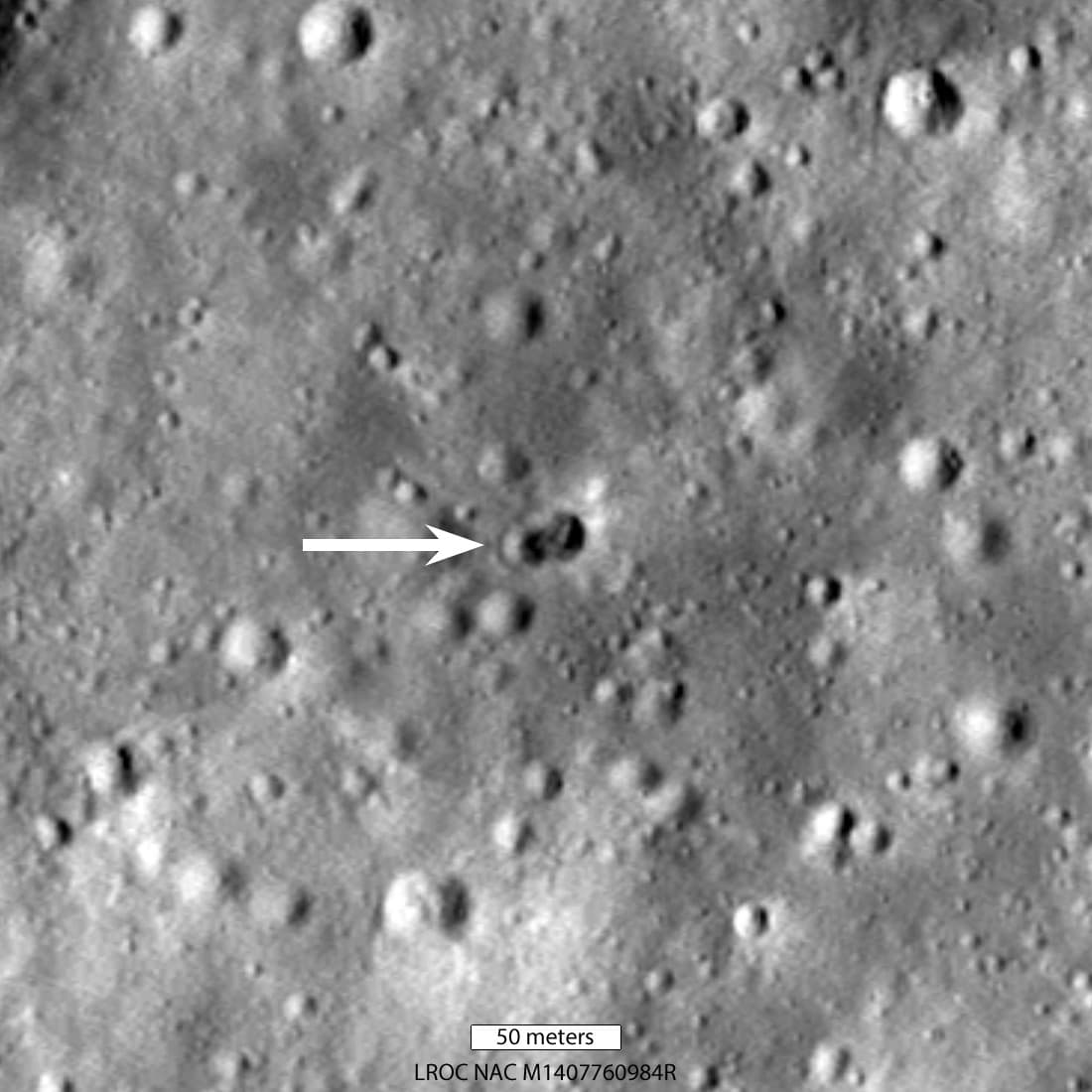
The mission's Long March 3C upper stage is the leading identification for the object that struck the lunar far side on 4 March 2022, leaving an unusual double crater (18 m and 16 m, about 29 m across) at 5.226 N, 234.486 E near Hertzsprung basin; China disputed the attribution↗
02Mission timeline
23 Oct 2014
Launch at 18:00 UTC on a Long March 3C/G2 from Xichang, carrying the 4M commercial payload on the upper stage
28 Oct 2014
Free-return lunar flyby, closest approach roughly 12,000 to 13,000 km above the far side
31 Oct 2014
Xiaofei capsule performs the skip reentry at better than 11 km/s and lands in Siziwang Banner, Inner Mongolia, at 22:42 UTC
11 Nov 2014
The 4M payload sends its final transmission at 01:35 UTC after four times its design life
27 Nov 2014
Service module reaches a Lissajous parking orbit around the Earth-Moon L2 point, a first for China
11 Jan 2015
Service module departs L2 and brakes into lunar orbit
Mar 2015
Service module descends to about 18 km to rehearse Chang'e 5 rendezvous geometry and image the Oceanus Procellarum landing zone
4 Mar 2022
The mission's Long March 3C upper stage (leading identification) strikes the lunar far side, leaving a double crater near Hertzsprung basin
Teal dots: events that physically happened in flight or on the Moon. Grey: announcements, namings, contracts, and targets.
03The mission
Chang'e 5-T1 existed to answer one nervous question: could a Chinese capsule survive coming home from the Moon? A sample-return spacecraft reenters at close to Earth escape velocity, near 11.2 km/s, far faster than a capsule dropping from low orbit, and that speed turns the heat shield and the deceleration g-loads into a hard engineering problem. Rather than gamble the whole Chang'e 5 mission on an untried reentry, CNSA flew a dedicated rehearsal. The spacecraft, built on a DONGFANGHONG-3 (DFH-3A) bus with a small conical return capsule, launched on a Long March 3C from Xichang at 18:00 UTC on 23 October 2014 and was aimed on a free-return trajectory: a single loop around the Moon that would sling it straight back to Earth without ever needing to fire into lunar orbit.
The capsule, nicknamed Xiaofei (little flyer) on Chinese social media, rounded the lunar far side on 28 October at a distance of roughly 12,000 to 13,000 km and fell back toward home. Its signature moment came over the atmosphere on 31 October. Instead of plunging straight in, Xiaofei used a skip reentry: it dipped into the upper atmosphere to bleed off energy, bounced back out briefly, then reentered a second time, spreading the heating and deceleration over a reentry path of about 6,000 km. It touched down in Siziwang Banner in Inner Mongolia, the same grasslands that recover Shenzhou crews, eight days and about four and a half hours after launch. The skip technique it proved is exactly what Chang'e 5 flew home in 2020 and Chang'e 6 flew in 2024.
Riding to the Moon on the Long March 3C's upper stage was a passenger with nothing to do with China's plans. The Manfred Memorial Moon Mission, 4M for short, was a 14 kg payload built by LuxSpace of Luxembourg and named for Manfred Fuchs, the founder of parent company OHB, who had died earlier in 2014. It carried a radiation dosimeter from Spain's iC-Malaga and a radio beacon that broadcast JT65B digital messages on 145.980 MHz at just 1.5 watts. More than 60 radio amateurs around the world tracked its faint signal past the Moon and back into an elliptical Earth orbit, where it kept transmitting until 11 November, roughly four times its planned life. It was the first commercial payload ever sent around the Moon, a footnote that quietly opened the door to the privately funded lunar traffic of the 2020s.
The part most summaries drop is what happened after the capsule landed. The service module still had most of its propellant, so controllers turned it into a bonus mission. It flew outward to the Earth-Moon L2 libration point, reaching a Lissajous parking orbit there on 27 November 2014, the first time China had operated a spacecraft at that gravitational balance point beyond the Moon. In January 2015 it left L2, braked into a 5,300 by 200 km lunar orbit, and then spent the spring standing in for Chang'e 5: descending to about 18 km, running virtual-target rendezvous and docking tests, and photographing the intended landing region in northern Oceanus Procellarum. In effect the whole Chang'e 5 architecture, minus the actual scooping, was flown and checked five years early.
There is a coda that keeps Chang'e 5-T1 in the news. The Long March 3C upper stage that lofted the mission was left drifting in cislunar space, and on 4 March 2022 an abandoned rocket body struck the lunar far side near Hertzsprung basin, gouging an unusual double crater about 29 m across. Independent trajectory and spectral analysis identified the impactor as this upper stage and ruled out the SpaceX Falcon 9 stage first suspected. China's foreign ministry disputed the finding, stating that the 5-T1 upper stage had burned up in Earth's atmosphere, while US Space Command said it never reentered. NASA's Lunar Reconnaissance Orbiter photographed the fresh double crater, and it remains the only known case of a rocket body hitting the Moon and leaving two craters, a signature that hints at two heavy masses on the stage's ends.
04In pictures
Tap a photo to enlarge.
05Sources
- Wikipedia: Chang'e 5-T1 (mission overview, masses, skip reentry, service module, booster impact)
- China Space Report: Chang'e 5-T1 (detailed chronology, L2, lunar orbit, rehearsal)
- eoPortal: Chang'e-5 / CE-5 (includes the 5-T1 precursor and its objectives)
- The Planetary Society (E. Lakdawalla): Chang'e 5 test vehicle Xiaofei lands (landing time and location)
- Wikipedia: Manfred Memorial Moon Mission (4M payload, LuxSpace, frequency, dosimeter, timeline)
- ARRL: 4M Lunar Flyby Spacecraft Amateur Radio Payload Now in Silent Earth Orbit (transmission details)
- Gunter's Space Page: Chang'e 5-T1 (spacecraft specs)
- NASA LRO: Lunar Reconnaissance Orbiter Spots Rocket Impact Site on Moon (4 March 2022 double crater)
azmth is independent and is not affiliated with or endorsed by NASA, CNSA, Roscosmos, ISRO, JAXA, or any other space agency or company named on this page.