Lunar Gateway
NASA-led with ESA, JAXA, CSA, MBRSC (UAE) · Program · 2017In development
Paused in its current form since Mar 24, 2026; HALO under stop-work, PPE repurposed for the SR-1 Freedom Mars mission, partners re-planning (as of Jul 18, 2026)
TL;DR· 8 min read
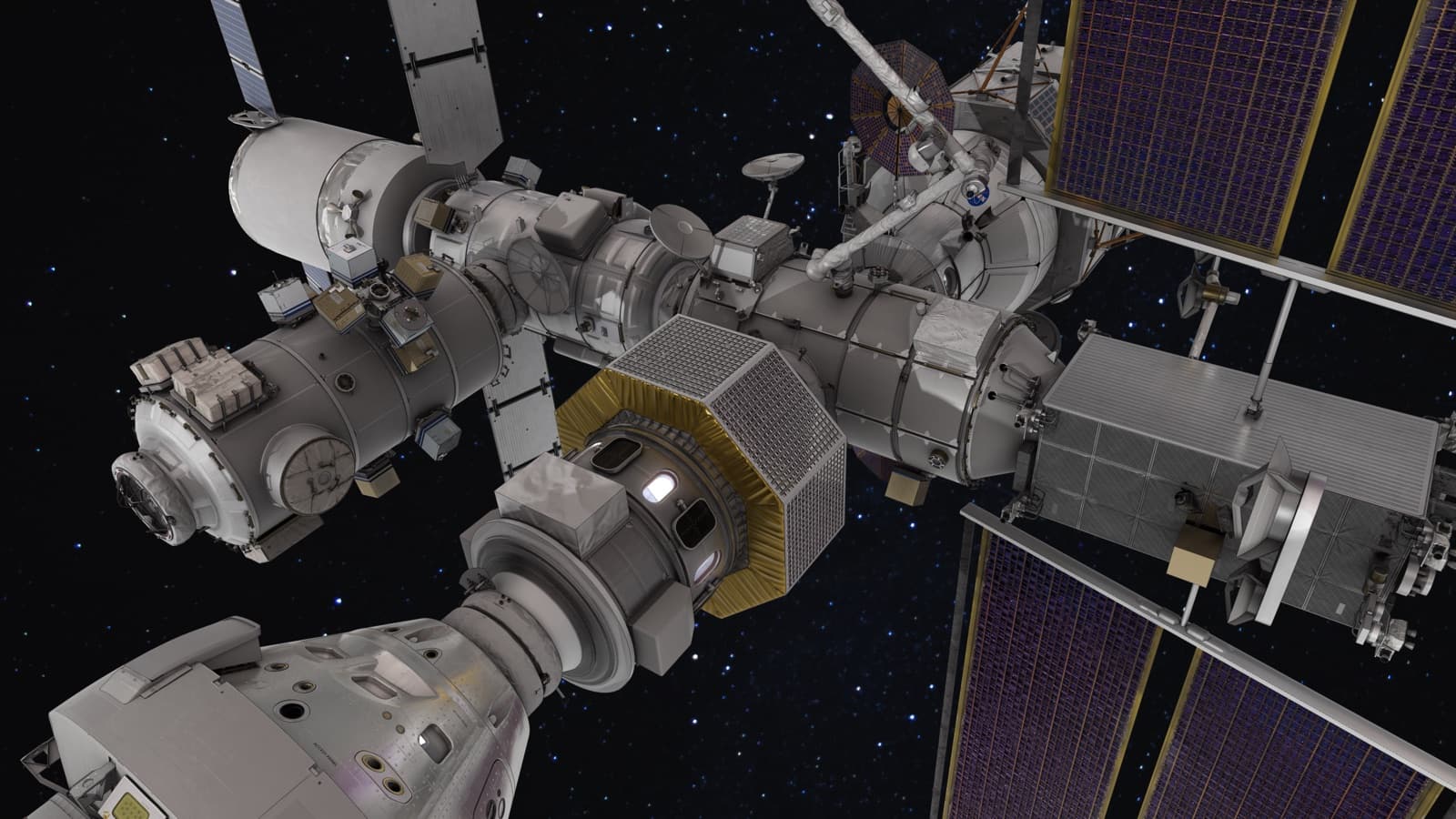
Gateway was to be the first crewed outpost beyond low Earth orbit, a NASA-led station in a halo orbit around the Moon built with Europe, Japan, Canada and the UAE. On March 24, 2026 NASA announced it intends to pause Gateway in its current form and shift to a lunar surface base; HALO is under a stop-work order and no element is assigned to fly as part of Gateway. The Power and Propulsion Element survives, repurposed as the bus of the nuclear electric SR-1 Freedom, with launch targeted for late 2028 (as of September 28, 2026).
Gateway was to be humanity's first space station beyond low Earth orbit: a small NASA-led outpost in a halo orbit around the Moon, built with Europe, Japan, Canada and the UAE. On March 24, 2026 NASA announced it "intends to pause Gateway in its current form" and redirect the effort toward a lunar surface base; the program is on pause without a formal cancellation, and its most mature hardware is being repurposed rather than scrapped. The Power and Propulsion Element is now slated to become the bus of Space Reactor-1 Freedom, a nuclear electric spacecraft with launch targeted for late 2028 (as of September 28, 2026).
Facts as of July 20, 2026, from the sources listed below.
70,000km
farthest point of Gateway's planned halo orbit above the Moon
60kW
solar electric power of the PPE, now bound for Mars instead
$1.9B
HALO contract value at the April 2026 stop-work, up from $935M in 2021
4
partner agencies left re-planning: ESA, JAXA, CSA and the UAE's MBRSC
Targets are the operator's current plan (as of July 20, 2026) and can change.
In development. Completed milestones on this page are historical record; future dates are targets from official announcements, tagged with when they were made, and can change.
Commonly wrong. Four corrections. (1) Headlines saying NASA "cancelled" Gateway overstate the official position: the March 24, 2026 announcement says NASA "intends to pause Gateway in its current form," and Isaacman has said it could be revisited, though the OIG does treat the HALO contract as canceled, so honest coverage needs both halves. (2) NASA's own Gateway reference page (nasa.gov/reference/gateway-about) still described assembly starting with Artemis IV "no earlier than September 2028" as of mid-July 2026; that plan is superseded and was arguably fiction anyway, since the OIG found HALO would not have been deliverable until about 2031. (3) The claim that "corrosion killed Gateway" is too simple: ESA publicly noted the corrosion on I-Hab was less severe and technically manageable, and that US-supplied subsystems (life support, thermal control pump) were also badly delayed; cost growth and the strategy pivot drove the decision. (4) English sources still routinely credit the PPE to "Maxar": the builder is Lanteris Space Systems (the renamed Maxar Space Systems), an Intuitive Machines subsidiary since January 13, 2026. Also keep the June 2026 cost figures straight: the OIG memo's own printed aggregate is contract growth from nearly $2.8 billion to $5.9 billion (with estimated completion costs of at least $8.1 billion) across four elements, of which only HALO is Gateway hardware; the widely quoted "more than $5.3 billion in overruns" is Douglas Messier's derivation from the memo; the OIG never printed that figure.
01Mission facts
Concept unveiled
2017, as the Deep Space Gateway; renamed Lunar Orbital Platform-Gateway in 2018, then simply Gateway in 2019↗
PPE contract
Awarded May 23, 2019 to Maxar Technologies; total value including options $375 million↗
PPE spec
60-kilowatt solar electric propulsion spacecraft supplying Gateway's power, communications and orbit control↗
Launch contract
Feb 9, 2021: SpaceX Falcon Heavy to launch PPE and HALO together from LC-39A, approx $331.8 million, then targeted no earlier than May 2024↗
HALO contract
$935 million firm-fixed-price finalized with Northrop Grumman on July 9, 2021; design derived from the Cygnus cargo ship↗
Planned orbit
Near-rectilinear halo orbit (NRHO), roughly 7-day period, about 3,000 km over the north pole at closest and 70,000 km at farthest↗
International elements
ESA: Lunar I-Hab (with JAXA life support), Lunar View, Lunar Link; CSA: Canadarm3; MBRSC (UAE): Crew and Science Airlock, announced Jan 7, 2024↗
HALO arrives in US
April 1, 2025 at Phoenix-Mesa Gateway Airport, after primary-structure fabrication by Thales Alenia Space in Turin; moved to Northrop Grumman's Gilbert, Arizona facility for outfitting↗
Corrosion problem
After the 2025 delivery, Northrop Grumman found widespread corrosion throughout HALO's primary structure; Northrop's own estimated delivery slipped to July 2028, and NASA's OIG projected that had work continued, HALO would not have been delivered until about July 2031, with Gateway not operational until at least 2032 (counterfactual projections; no plan ever carried these dates)↗
Contract growth
HALO grew from a $935M fixed-price deal (2021) to a cost-plus contract at $1.8B (Sept 2024) and $1.9B by the April 2026 stop-work order↗
The pause
March 24, 2026, at the "Ignition" rollout: Administrator Jared Isaacman said NASA "intends to pause Gateway in its current form and shift focus to infrastructure that enables sustained surface operations"↗
Stop-work chain
NASA issued a HALO stop-work order in April 2026; in June 2026 Northrop Grumman told its HALO subcontractors to stop work and reassigned staff↗
OIG accounting
June 24, 2026 OIG interim memo (Report No. ML-26-002): combined contract values for four canceled Artemis elements (HALO, Mobile Launcher 2, Exploration Upper Stage, Universal Stage Adapter) ballooned from nearly $2.8B to $5.9B, with delivery dates extended by up to 7 years and estimated completion costs of at least $8.1B; the widely cited 'over $5.3B in overruns' is analyst Douglas Messier's derivation from those numbers, a total the memo itself never prints↗
PPE's new life
The PPE becomes the electric-propulsion bus of Space Reactor-1 Freedom, announced March 24, 2026 and billed by NASA as humanity's first fission-powered interplanetary spacecraft: 20 kWe Brayton-cycle reactor, 12-kW Hall thruster, launch targeted for late 2028 (as of September 28, 2026); whether it flies by Mars or enters orbit was undecided at announcement↗
PPE builder
Lanteris Space Systems, the former Maxar Space Systems; Intuitive Machines completed its $800M acquisition of Lanteris on Jan 13, 2026↗
ESA disposition
June 17, 2026 ESA Council: Lunar I-Hab continues through critical design review then repurposing assessment; Lunar View slows down; Lunar Link studied as a standalone comms asset or part of ESA's Moonlight constellation; roadmap decisions due at the interim ministerial ESA has set for December 2026 in Italy↗
Canada's position
CSA's Canadarm3 contract with MDA Space is unchanged; MDA says the robotic arm, still in design phase, can pivot to low Earth orbit, cislunar or lunar surface roles↗
UAE's position
MBRSC reaffirmed its commitment to Artemis and its NASA partnership after the pause (March 2026)↗
Artemis renumbering
Under the architecture NASA announced on February 27, 2026, a month before the Gateway pause, Artemis III became an Earth-orbit integrated test in 2027 and the crewed lunar landings moved to Artemis IV and V↗
02Mission timeline
2017
NASA unveils the concept as the Deep Space Gateway
23 May 2019
Maxar wins the Power and Propulsion Element contract ($375M including options)
Oct 2020
NASA and ESA sign the Gateway memorandum of understanding (I-Hab and ESPRIT contributions)
9 Feb 2021
SpaceX Falcon Heavy chosen to launch PPE and HALO together (approx $331.8M)
9 Jul 2021
NASA finalizes the $935M HALO contract with Northrop Grumman
7 Jan 2024
UAE joins: MBRSC to build the Crew and Science Airlock, with an Emirati astronaut to fly to Gateway
1 Apr 2025
HALO's primary structure lands in Arizona from Turin for final outfitting
2025
Widespread corrosion found throughout HALO's primary structure after arrival
24 Mar 2026
Ignition rollout: NASA announces it intends to pause Gateway in its current form and build a lunar surface base instead
Apr 2026
NASA issues a stop-work order on the HALO contract, then valued at $1.9B
17 Jun 2026
ESA Council: I-Hab continues to critical design review, Lunar View slows, Lunar Link may join Moonlight; an interim ministerial in Italy in December 2026 to set Europe's course
24 Jun 2026
NASA OIG interim memo ML-26-002: contract values for the four canceled Artemis elements grew from nearly $2.8B to $5.9B (estimated completion costs at least $8.1B); HALO stood at $1.9B at stop-work
Targeted late 2028
Launch of SR-1 Freedom, the Mars-bound nuclear electric spacecraft built around Gateway's repurposed PPE (as of September 28, 2026)
Teal dots: events that physically happened in flight or on the Moon. Grey: announcements, namings, contracts, and targets.
03The mission
Gateway was conceived in 2017 (first as the Deep Space Gateway, renamed Gateway in 2019) as a small station in a near-rectilinear halo orbit swinging from about 3,000 km over the Moon's north pole out to 70,000 km. It was to be the first crewed outpost beyond low Earth orbit and the staging point for later Artemis landings. The buildout was unusually international from the start: ESA signed on in October 2020 for the Lunar I-Hab habitat (with JAXA supplying life support), the Lunar View refueling module and the Lunar Link comms system, Canada committed Canadarm3, and in January 2024 the UAE's MBRSC joined to build the Crew and Science Airlock in exchange for an Emirati astronaut seat.
The hardware got real. Maxar (whose space division became Lanteris Space Systems, bought by Intuitive Machines for $800M in a deal completed January 13, 2026) won the 60-kilowatt Power and Propulsion Element contract in May 2019 at $375 million including options. Northrop Grumman's HALO habitat, a Cygnus derivative, was finalized at $935 million fixed-price in July 2021, and a Falcon Heavy was booked for roughly $331.8 million to launch the two together. Thales Alenia Space welded HALO's primary structure in Turin, and the module arrived in Arizona on April 1, 2025 for final outfitting. Then the program's troubles compounded: Northrop found widespread corrosion throughout the primary structure, the contract (converted to cost-plus in September 2024) hit $1.9 billion, Northrop's own estimated delivery slipped to July 2028, and NASA's inspector general later projected that, had work continued, HALO would not have been delivered until about July 2031, with Gateway not operational until at least 2032.
On March 24, 2026, at the "Ignition" strategy rollout, Administrator Jared Isaacman announced that NASA "intends to pause Gateway in its current form and shift focus to infrastructure that enables sustained surface operations": a three-phase lunar base plan reported at roughly $20 billion over seven years, opening with an accelerated robotic-lander campaign from 2027. The rollout built on the architecture NASA had announced on February 27, 2026, which re-scoped Artemis III into a 2027 Earth-orbit integrated test and moved the crewed landings to Artemis IV and V. The paperwork followed fast: NASA issued a HALO stop-work order in April 2026, Northrop stood down its subcontractors in June, and a June 24, 2026 OIG interim memo (ML-26-002) found the four canceled elements' combined contract values had ballooned from nearly $2.8 billion to $5.9 billion, with estimated completion costs of at least $8.1 billion; the widely quoted figure of more than $5.3 billion in overruns is analyst Douglas Messier's derivation from the memo, which prints no such aggregate of its own.
The most consequential survivor is the PPE. Rather than being shelved, it is being repurposed as the electric-propulsion bus of Space Reactor-1 Freedom, which NASA describes as humanity's first fission-powered interplanetary spacecraft: a 20-kilowatt-electric Brayton-cycle reactor mated to the PPE's 12-kW Hall thruster system, flying a Mars mission that would deploy three Ingenuity-derived helicopters, with launch targeted for late 2028 (as of September 28, 2026; the mission was announced by Administrator Jared Isaacman on March 24, 2026, part of the same Ignition rollout that paused Gateway). Isaacman called it a '70 percent solution', and whether the spacecraft flies by Mars or enters orbit was undecided at announcement; whether the date holds is one of the biggest open questions in the post-Gateway plan.
The partners were not consulted in advance (ESA's Director General said he received no advance briefing) and each is now charting its own course. At the June 17, 2026 ESA Council, Europe opted to finish I-Hab's design through critical design review before deciding how to repurpose it, slow Lunar View, and study folding Lunar Link into the Moonlight lunar-comms constellation, with an interim ministerial set for December 2026 in Italy; three European astronaut seats tied to Gateway remain unresolved. Canada's CSA says the unchanged Canadarm3 contract can pivot to other destinations, MBRSC reaffirmed its Artemis commitment, and JAXA's pressurized rover was explicitly written into the new surface-base plan. Gateway itself remains paused in its current form, and Isaacman has said it could be revisited, but as of mid-July 2026 no element of the original station is assigned to fly as part of it.
04In pictures
Tap a photo to enlarge.
05Sources
- NASA release 26-025, Ignition initiatives (Mar 24, 2026, primary source for pause wording)
- SpacePolicyOnline: NASA Rolls Out New Moon Plan (budget figures, Artemis renumbering)
- NASA Gateway reference page (elements, partners, orbit; note: stale on assembly schedule)
- NASA: Space Reactor-1 Freedom mission page (PPE repurposing, late-2028 target)
- NASA PPE contract release (May 23, 2019, $375M Maxar)
- NASA HALO contract release (Jul 9, 2021, $935M Northrop Grumman)
- NASA Falcon Heavy launch contract release (Feb 9, 2021, $331.8M)
- NASA-UAE airlock announcement (Jan 7, 2024)
- NASA: HALO module arrival in US (Apr 2025, photos)
- SpaceNews: canceled NASA exploration projects and overruns (HALO stop-work chain, Jun 2026)
- Space.com: OIG audit of canceled Artemis hardware (Jun 2026)
- Doug Messier: OIG interim memo detail ($5.3B+ overruns, HALO $1.9B, 2031/2032 dates)
- NASA Watch: OIG cleanup memo (Jun 24, 2026 date)
- European Spaceflight: ESA next steps for Gateway contributions (Jun 23, 2026)
- European Spaceflight: ESA on corrosion claims (Apr 24, 2026)
- SpaceNews: ESA to decide by June on Gateway contributions
- SpaceQ: CSA ready to adapt as Artemis evolves (Canadarm3 status)
- Gulf News: MBRSC reaffirms role after Gateway pause (Mar 2026)
- Intuitive Machines: Lanteris acquisition completed (Jan 13, 2026)
- Wikipedia: Lunar Gateway (program history, agreement dates, NRHO parameters)
- NASA OIG interim memo, Report No. ML-26-002 (June 24, 2026; source of the verified $1.9B, $2.8B-to-$5.9B, July 2031 and 2032 figures)
azmth is independent and is not affiliated with or endorsed by NASA, CNSA, Roscosmos, ISRO, JAXA, or any other space agency or company named on this page.