Queqiao-1 and the Longjiang microsatellites
CNSA / Harbin Institute of Technology (China) · Relay · 2018Partial
Launched 20 May 2018 as three spacecraft: Queqiao-1 reached the Earth-Moon L2 halo orbit and relayed Chang'e 4 for over five years (relay duty handed to Queqiao-2 in 2024); Longjiang-2 succeeded and was deliberately impacted 31 Jul 2019; Longjiang-1 failed to reach lunar orbit.
TL;DR· 7 min read
The 20 May 2018 launch put up three spacecraft. Queqiao-1 reached a halo orbit around the Earth-Moon L2 point, about 65,000 km beyond the Moon, and relayed every bit Chang'e 4 sent from the far side until Queqiao-2 took over in 2024. Longjiang-1 was lost a day after launch to a thruster-control-logic fault, while Longjiang-2 reached lunar orbit, took the famous far-side-and-Earth photograph pulled down through the Dwingeloo dish, and was steered into the far side on 31 July 2019.
English coverage remembers this launch as one spacecraft, the relay that made the first far-side landing possible. It was actually three. Queqiao-1 ('Magpie Bridge') went to a halo orbit beyond the Moon to become the first dedicated lunar far-side communications relay, and riding with it were two suitcase-sized amateur-radio microsatellites, Longjiang-1 and Longjiang-2. One of them died on the way out and is almost never mentioned; the other, run partly through a Dutch amateur radio dish, took one of the most beautiful photographs of the space age before being steered into the far side on purpose.
Facts as of July 20, 2026, from the sources listed below.
1stL2 halo
dedicated lunar far-side communications relay
65,000km
Queqiao-1 halo orbit distance beyond the Moon at Earth-Moon L2
4.2m
Queqiao-1 deployable relay dish, the largest flown on a deep-space spacecraft at the time
3 / 2
spacecraft launched versus mission successes (Longjiang-1 failed)
Commonly wrong. Several persistent errors. (1) 'Queqiao was the mission.' The 20 May 2018 launch put up three spacecraft, not one: the Queqiao-1 relay plus two Longjiang microsatellites. (2) 'Both Longjiang satellites worked' or, conversely, the whole microsatellite venture is ignored. In fact Longjiang-1 failed the day after launch (thruster-control-logic fault during its first correction burn) and never reached lunar orbit, while Longjiang-2 succeeded; the outcome is genuinely mixed. (3) 'Longjiang-2 crashed' framed as an accident. Its impact on 31 July 2019 was a deliberate, controlled disposal after 432 days; nothing had malfunctioned. (4) The famous Earth-and-Moon photo is often uncredited or credited only to 'China'; it was taken by a Saudi KACST camera, downloaded through the volunteer-run Dwingeloo radio telescope in the Netherlands, and processed by MingChuan Wei at the Harbin Institute of Technology, a genuinely international amateur effort. (5) 'Queqiao orbits the Moon.' It does not; it sits in a halo orbit around the Earth-Moon L2 point, tens of thousands of kilometers beyond the Moon, which is precisely what lets it see the far side and Earth at once. (6) 'Queqiao-1 still relays Chang'e 4.' Since 2024 that job has passed to Queqiao-2.
01Mission facts
Launch
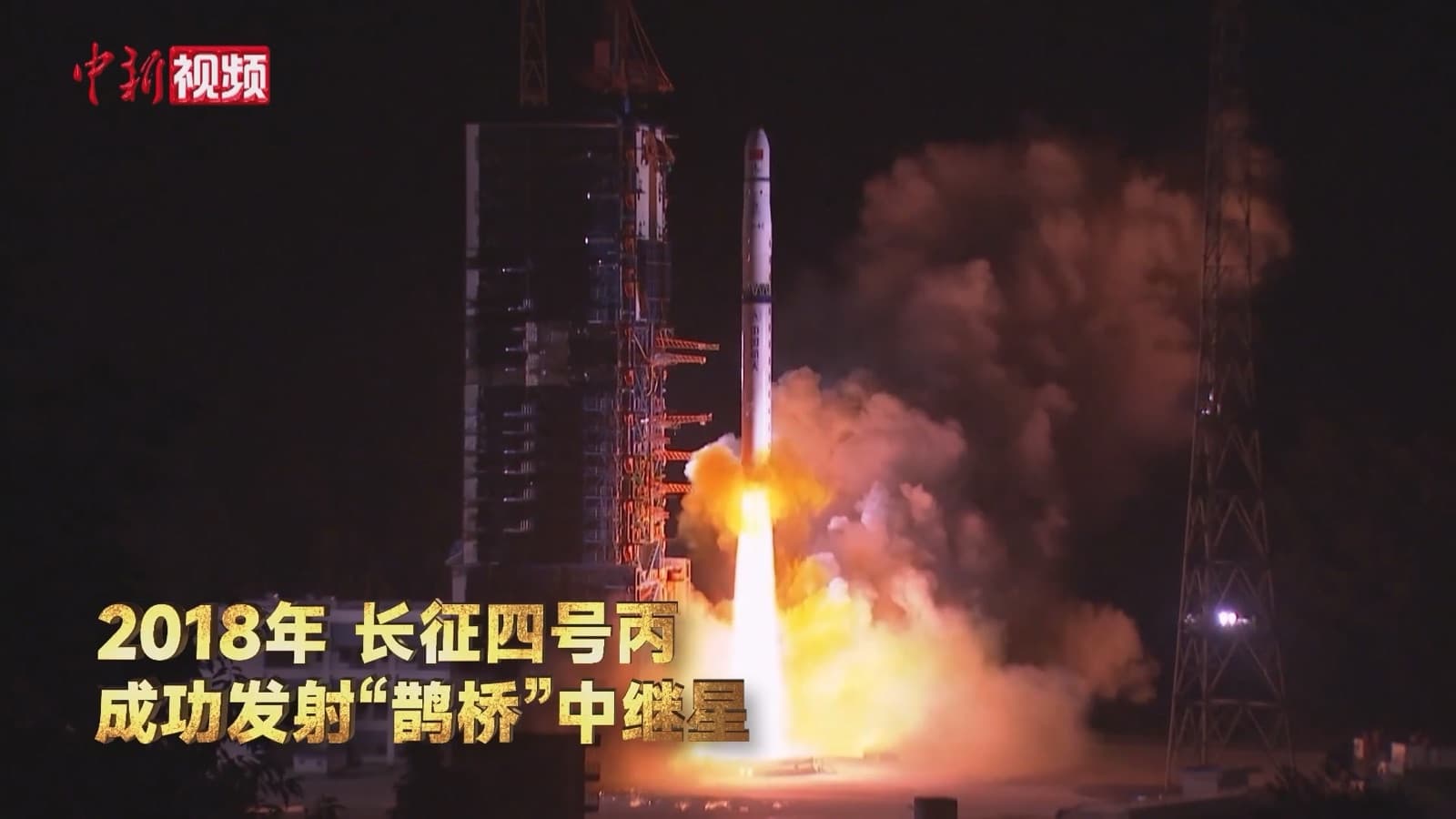
20 May 2018, 21:28 UTC (05:28, 21 May Beijing time), Long March 4C from Xichang, LC-3; carried Queqiao-1 plus the Longjiang-1 and Longjiang-2 microsatellites↗
Queqiao-1 spacecraft
About 425 kg (Wikipedia infobox: 448.7 kg launch, 325 kg dry), CAST100 small-satellite bus, based on the Chang'e 2 heritage design↗
Relay antenna
4.2 m deployable parabolic dish; receives X-band from the far-side lander and rover and relays to Earth ground stations on S-band↗
Mission orbit
Halo orbit around the Earth-Moon L2 point, about 65,000 km beyond the Moon; entered after a final adjustment burn on 14 Jun 2018 following a lunar swing-by↗
Why L2
The far side never faces Earth, so a lander there has no direct radio line of sight; from the L2 halo Queqiao-1 can see both the far side and Earth at once, the geometry that made a far-side landing possible↗
NCLE payload
Netherlands-China Low-Frequency Explorer, a three-monopole radio-astronomy instrument covering 80 kHz to 80 MHz, exploiting the radio-quiet far-side vantage; antennas deployed in Nov 2019↗
Longjiang microsatellites
Twin ~45 kg microsatellites built by Harbin Institute of Technology (DSLWP-A1/A2, later Lunar-OSCAR LO-93 and LO-94) to test low-frequency radio-astronomy interferometry from lunar orbit↗
Longjiang-1 failure
Lost during the first trajectory correction maneuver due to a thruster-control-logic fault; it never left the initial transfer trajectory and did not reach lunar orbit↗
Longjiang-2 success
Corrected logic patched in; entered an elliptical lunar orbit (about 350 km by 13,700 km) on 25 May 2018 under its own propulsion, becoming the smallest spacecraft to independently enter lunar orbit at the time↗
The famous photo
Longjiang-2 carried a Saudi KACST micro-optical camera, a student-built 'Inory Eye' camera and an amateur-radio system open to hobbyists; the KACST camera's full-disc view of the far side with a distant Earth was taken 3 Feb 2019, downloaded via the Dwingeloo radio telescope in the Netherlands the next day, and processed by MingChuan Wei of Harbin Institute of Technology↗
Longjiang-2 deliberate impact
Steered into the far side at 14:20 UTC on 31 Jul 2019 after 432 days in orbit, a planned end-of-life disposal to avoid becoming debris; LROC located the 4 by 5 m crater at 16.6956 N, 159.5170 E↗
Relay handover
Queqiao-1 outlived its roughly 5-year design life; CNSA said the successor Queqiao-2 (launched 20 Mar 2024) took over relay services for Chang'e 4 and later polar missions↗
Site: 16.6956°N, 159.5170°E · Longjiang-2 deliberate impact crater, lunar far side (4 by 5 m, located by LROC) (source)
02Mission timeline
20 May 2018
Long March 4C lifts off from Xichang carrying Queqiao-1 and the two Longjiang microsatellites
21 May 2018
Longjiang-1 is lost during its first trajectory correction after a thruster-control-logic fault; it never reaches lunar orbit
25 May 2018
Longjiang-2 fires its own engine and enters an elliptical lunar orbit, the microsatellite half of the mission salvaged
14 Jun 2018
Queqiao-1 completes its final burn and settles into the Earth-Moon L2 halo orbit, ready to relay far-side signals
3 Jan 2019
Chang'e 4 lands in Von Karman crater and phones home through Queqiao-1, the first-ever far-side landing
3 Feb 2019
Longjiang-2's Saudi KACST camera captures the far side with Earth beyond; the image is downloaded via the Dwingeloo dish the next day
31 Jul 2019
Longjiang-2 is deliberately steered into the far side at 14:20 UTC after 432 days, a controlled end-of-life disposal
5 Oct 2019
LRO images the fresh 4 by 5 m Longjiang-2 impact crater on the far side, confirming the location
Mar 2024
Queqiao-2 launches and takes over relay duty for Chang'e 4 and later missions; Queqiao-1 had already exceeded its design life
Teal dots: events that physically happened in flight or on the Moon. Grey: announcements, namings, contracts, and targets.
03The mission
The engineering problem behind Chang'e 4 was not the landing, it was the phone line. The Moon's far side never faces Earth, so a spacecraft sitting on it has no direct radio path home. China solved this the way it had planned years in advance: it pre-positioned a relay. Queqiao-1, named for the 'Magpie Bridge' of a Chinese folk tale in which magpies form a bridge across the Milky Way so two separated lovers can meet, launched on 20 May 2018 on a Long March 4C, more than six months before the lander it existed to serve. It took a slow, fuel-saving route, swinging past the Moon and coasting outward, and on 14 June 2018 settled into a halo orbit around the Earth-Moon L2 point, roughly 65,000 km beyond the Moon. From there its 4.2 m dish, the largest antenna then flown on a deep-space spacecraft, could see the far side and Earth at the same time. When Chang'e 4 touched down in Von Karman crater on 3 January 2019, every bit it sent came through Queqiao-1.
Queqiao-1 did not fly alone. Bolted to the same rocket were two microsatellites the size of carry-on luggage, Longjiang-1 and Longjiang-2, built by students and staff at the Harbin Institute of Technology. The pair were meant to fly in lunar orbit together and test ultra-long-wavelength radio-astronomy interferometry, the kind of observation only the radio-quiet far side allows. It did not go to plan. Longjiang-1 was lost on 21 May, one day after launch, when a fault in its thruster-control logic corrupted its first trajectory-correction burn; it never made it to the Moon and is the part of this story almost no English summary mentions. Engineers patched the same logic on its twin, and on 25 May Longjiang-2 fired its own small engine and slipped into an elliptical lunar orbit, at the time the smallest spacecraft to reach lunar orbit under its own power.
Longjiang-2 then became one of the most charming spacecraft of the era. It carried a Saudi-built KACST optical camera, a student-made 'Inory Eye' camera, and an amateur-radio system, and its telemetry and images were made open to radio hobbyists around the world. Amateurs in Germany uploaded commands; the 25 m Dwingeloo radio telescope in the Netherlands, run largely by volunteers, tracked the tiny craft and pulled down its pictures over dozens of sessions, sometimes in the middle of the night. On 3 February 2019 the KACST camera took the image the mission is remembered for: the cratered far side of the Moon curving across the frame with Earth hanging small and blue beyond it, downloaded through Dwingeloo the following day and processed by MingChuan Wei at Harbin. It is one of very few full-disc far-side-plus-Earth photographs ever made, and it came from a 45 kg amateur-radio satellite.
Both the microsatellite mission and the relay ended by choice; neither was brought down by failure. Rather than leave Longjiang-2 to drift and eventually crash uncontrolled, controllers lowered its orbit and, on 31 July 2019 at 14:20 UTC, steered it into the far side after 432 days aloft, a tidy end-of-life disposal. In October 2019 NASA's Lunar Reconnaissance Orbiter photographed the fresh scar, a crater only about 4 by 5 m across at 16.6956 N, 159.5170 E, close to where amateur trackers had predicted it would fall. Queqiao-1 itself kept working far past its roughly five-year design life, relaying Chang'e 4 and hosting the Netherlands-China NCLE radio-astronomy instrument, until the larger Queqiao-2, launched in March 2024, took over relay duty for the far side and the coming polar missions.
Read together, the three spacecraft are a compact portrait of how China ran its lunar program in this period: a patient, purpose-built piece of infrastructure that most people never think about, launched ahead of the mission it enabled, plus a pair of cheap, high-risk experiments that were allowed to fly, fail, and delight. The relay is why the far-side landing is possible at all. The microsatellites are why a corner of the internet fell in love with a Dutch dish and a Chinese student's camera. Both halves are the mission, and the honest version includes the one that did not make it.
04In pictures
Tap a photo to enlarge.
05Sources
- Queqiao-1 - Wikipedia (masses, bus, NCLE, L2 orbit, Longjiang summary)
- Gunter's Space Page: Queqiao 1 (launch, 425 kg, 4.2 m dish, Xichang)
- Gunter's Space Page: DSLWP A1/A2 (Longjiang 1 & 2 specs, HIT, KACST camera, LO-93/94)
- The Planetary Society: How Queqiao arrived in its final orbit (L2 halo, swing-by, Longjiang-2 orbit)
- The Planetary Society: Chang'e 4 relay satellite, Queqiao (why L2, relay geometry)
- The Planetary Society: Longjiang-2 Smashes into Moon (deliberate impact, 14:20 UTC, 432 days, Dwingeloo)
- The Planetary Society: full-disc Moon and Earth from Longjiang-2 (3 Feb 2019 photo, Wei, Dwingeloo)
- Nature Communications: Design and flight results of the VHF/UHF system of the Longjiang microsatellites (Longjiang-1 thruster-logic failure, radio system)
- LROC: Longjiang-2 Impact Site Found! (crater 4x5 m at 16.6956 N, 159.5170 E; NAC M1324916226L)
- Queqiao-2 - Wikipedia (Mar 2024 launch, takes over Chang'e 4 relay)
- Space.com: China launches Queqiao relay satellite (X-band/S-band relay, 4.2 m dish, magpie-bridge name)
azmth is independent and is not affiliated with or endorsed by NASA, CNSA, Roscosmos, ISRO, JAXA, or any other space agency or company named on this page.