Beresheet
SpaceIL / Israel Aerospace Industries (Israel, nonprofit-commercial) · Lander · 2019Failure

Crashed on Mare Serenitatis during landing on 11 Apr 2019; reached lunar orbit but a reset command to a failed IMU cut the main engine. First privately funded lunar landing attempt.
TL;DR· 6 min read
Beresheet was the first privately funded spacecraft to reach lunar orbit and the first private venture to attempt a Moon landing, built for about $100 million by the Israeli nonprofit SpaceIL with Israel Aerospace Industries. On 11 April 2019 one inertial measurement unit failed during descent, and a ground command sent to reset it cascaded into resetting the main computer and shutting down the main engine. The lander struck Mare Serenitatis at roughly 1 km/s, which is why counting Israel as the fourth nation to land on the Moon is wrong.
Beresheet was the first privately funded spacecraft to reach lunar orbit and the first private venture to attempt a Moon landing, built for about $100 million by the Israeli nonprofit SpaceIL with Israel Aerospace Industries. On 11 April 2019 it entered its descent, then a single inertial-measurement unit failed; a ground command meant to reset it triggered a chain reaction that shut down the main engine, and the lander struck Mare Serenitatis at roughly 1 km/s. It is often miscounted as making Israel the fourth nation to land on the Moon: it crashed, it did not land.
Facts as of July 20, 2026, from the sources listed below.
100US$ million
Total project cost, almost entirely private
6.5million km
Distance flown to the Moon over ~49 days
1st
Privately funded lunar landing attempt
~1km/s
Impact speed on Mare Serenitatis
Commonly wrong. English coverage frequently says Beresheet made Israel 'the fourth country to land on the Moon.' It did not land; it crashed. What it actually achieved was becoming the first privately funded spacecraft to enter lunar orbit and the first private venture to attempt a landing. The failure is often reduced to a single 'gyro failure' or 'engine failure'; the accepted account is a chain reaction: one IMU failed, and a ground command sent to reset it reset the main computer and shut off the main engine. Impact speed is sometimes quoted as ~500 km/h (that figure was the last telemetry near 150 m altitude); the actual impact was roughly 1 km/s at a shallow angle. The tardigrades aboard are often said to be 'living on the Moon,' but a 2021 impact study put the tardigrade survival cutoff near 0.9 km/s, below Beresheet's crash speed, so survival is unlikely, and they cannot metabolize or reproduce without water regardless. Finally, some outlets still list Beresheet 2 as 'planned for 2025'; SpaceIL suspended (froze) it in April 2025 after funding collapsed.
01Mission facts
Launch
22 February 2019, 01:45 UTC, on a SpaceX Falcon 9 Block 5 from SLC-40, Cape Canaveral, as a rideshare secondary payload with the Nusantara Satu (PSN-6) telecom satellite↗
Builders / operator
SpaceIL (Israeli nonprofit, a former Google Lunar XPRIZE team) with Israel Aerospace Industries (IAI); major private financier Morris Kahn↗
Mass
585 kg wet / 150 kg dry; roughly 1.5 m tall and 2 m across with legs deployed↗
Cost
About $100 million, overwhelmingly privately funded (Israeli government share only ~$2 million)↗
Route to the Moon
Roughly 6.5 million km over about 49 days via phasing loops around Earth, which SpaceIL/IAI describe as the longest path ever flown to the Moon (dictated by the tiny propellant load)↗
Lunar orbit insertion
4 April 2019 (7th nation or entity, and first private venture, to orbit the Moon)↗
Crash
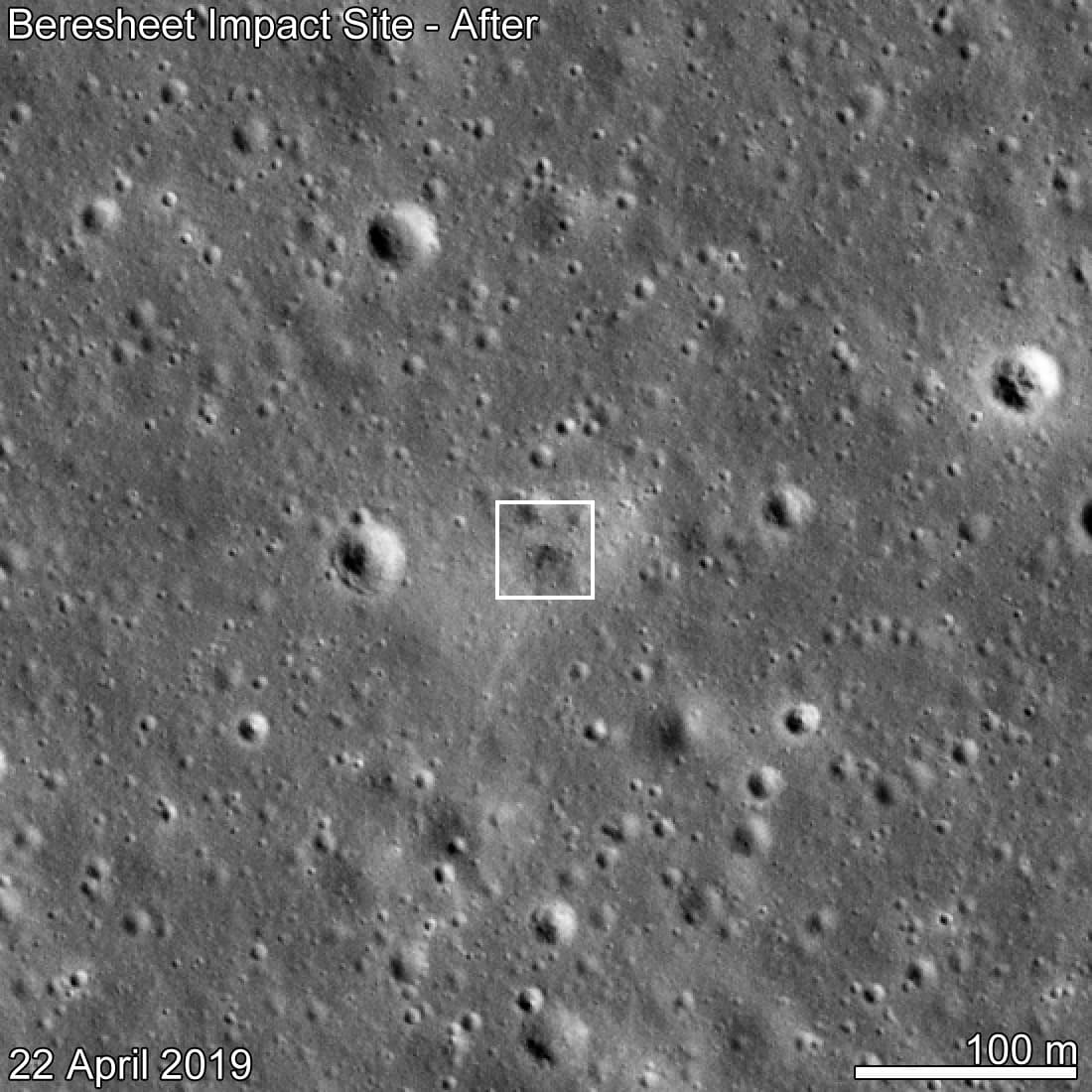
11 April 2019, on Mare Serenitatis; low-angle impact (<10 degrees) at about 1,000 m/s. NASA LRO imaged the site on 22 April 2019 from 90 km altitude↗
Failure cause
During braking, one inertial measurement unit (IMU) failed; a command sent to reset it triggered a cascade that reset the main computer and shut off the main engine, which restart attempts could not recover in time↗
Payloads
NASA-provided laser retroreflector array; a magnetometer (Weizmann Institute/UCLA); a time capsule; and the Arch Mission Foundation 'Lunar Library' nanofiche archive that also carried dehydrated tardigrades↗
Impact site coordinates
32.5956 N, 19.3496 E (LROC team solution, 95% confidence ~20 m x 8 m)↗
Recognition
Awarded the $1 million XPRIZE 'Moonshot Award' (announced 11 April 2019, presented October 2019) for reaching lunar orbit and attempting the first private landing↗
Beresheet 2
Announced 9 December 2020, the redesigned three-craft architecture (an initial Beresheet 2 concept had been floated in mid-2019); lead donors withdrew in mid-2023 and, after the funding deadline lapsed in March 2025, SpaceIL suspended engineering work in April 2025 (about 25 staff/consultants laid off), calling it a freeze rather than cancellation↗
Site: 32.5956°N, 19.3496°E · Mare Serenitatis (Sea of Serenity), lunar nearside (source)
02Mission timeline
22 Feb 2019
Launch (Falcon 9, rideshare)
4 Apr 2019
Lunar orbit insertion (first private craft to orbit the Moon)
11 Apr 2019
IMU failure and reset command during descent; main engine cut off; crash on Mare Serenitatis
17 Apr 2019
Preliminary crash findings released (manual reset command chain)
22 Apr 2019
NASA LRO images the impact site from 90 km up
15 May 2019
LROC publishes 'Beresheet Crash Site Spotted!' with the impact coordinates
9 Dec 2020
Beresheet 2 announced (orbiter + two landers)
May 2021
Impact study finds tardigrades unlikely to have survived ~1 km/s crash
Mid-2023
Lead donors (Drahi, Kahn) withdraw from Beresheet 2
Apr 2025
SpaceIL suspends Beresheet 2 development for lack of funding, calling it a freeze rather than a cancellation
Teal dots: events that physically happened in flight or on the Moon. Grey: announcements, namings, contracts, and targets.
03The mission
Beresheet (Hebrew for 'in the beginning', the first word of the Book of Genesis) grew out of SpaceIL's entry in the Google Lunar XPRIZE. When that competition ended in 2018 with no winner, SpaceIL and Israel Aerospace Industries pressed on privately, funding the roughly $100 million project almost entirely from philanthropy, led by businessman Morris Kahn, with only a token government contribution. The result was a compact lander of 585 kg fully fueled but just 150 kg dry, small enough to fly as a Falcon 9 rideshare rather than on a dedicated rocket.
That small size forced an unusual trajectory. With tiny propellant tanks, Beresheet could not fly a direct transfer; instead it raised its orbit around Earth in a series of loops totaling about 6.5 million km over roughly 49 days, which SpaceIL and IAI billed as the longest path ever flown to the Moon. It launched on 22 February 2019 alongside the Nusantara Satu telecom satellite, and on 4 April 2019 it slipped into lunar orbit, making it the first privately funded spacecraft to do so and only the seventh nation or entity to orbit the Moon.
The landing on 11 April 2019 came apart in the final minutes. During the braking burn, one of the lander's inertial measurement units failed. Controllers in Yehud sent a command intended to reset it, but that command set off a chain reaction that reset the main flight computer and, critically, shut down the main engine. By the time the engine was brought back, Beresheet had built up too much speed to recover, and it struck Mare Serenitatis at roughly 1 km/s. The last telemetry, near 150 m altitude, showed a descent already far too fast to survive.
NASA's Lunar Reconnaissance Orbiter photographed the site on 22 April 2019 from about 90 km up, and the LROC team published the results on 15 May 2019. The images show a dark smudge about 10 m across surrounded by a brighter halo of disturbed regolith, with a ray of ejecta running roughly 100 m south, consistent with a shallow, high-speed impact rather than a crater-forming vertical hit. The team fixed the impact at 32.5956 N, 19.3496 E, the coordinate used here for the globe pin. Because Beresheet's own agency did not free-license spacecraft photography, these public-domain NASA/LROC frames are the workhorse imagery for the page.
Beresheet carried more than instruments. Alongside a NASA laser retroreflector and a magnetometer, it held the Arch Mission Foundation's 'Lunar Library', a nanofiche archive that also contained thousands of dehydrated tardigrades. This spawned headlines that Earth life now lives on the Moon, but a 2021 impact study put the tardigrade survival cutoff near 0.9 km/s, below Beresheet's crash speed, and the animals cannot metabolize or reproduce without water in any case. Despite the crash, XPRIZE granted SpaceIL a $1 million 'Moonshot Award' for reaching lunar orbit and attempting the first private landing.
SpaceIL immediately promised a second try, and on 9 December 2020 announced Beresheet 2, an ambitious architecture of one orbiter and two small landers. Funding proved the undoing: lead donors including the Drahi family foundation and Morris Kahn withdrew in mid-2023 amid economic strain, and after the board repeatedly extended fundraising deadlines that were never met (the last lapsed in March 2025), SpaceIL suspended engineering development in April 2025, laying off around 25 staff and consultants and freezing supplier contracts. Officials stress the project is frozen and has not been abandoned, and its educational programs continue, but as of mid-2026 no funding source has been secured to revive it.
04In pictures
Tap a photo to enlarge.
05Sources
- NASA - Beresheet Impact Site Spotted (LRO feature, 15 May 2019; canonical URL)
- LROC Featured Image - 'Beresheet Crash Site Spotted!' (coordinates + imagery, 15 May 2019)
- Wikipedia - Beresheet (mission facts, masses, timeline, payloads)
- The Planetary Society - Software command doomed Beresheet (failure chain, Jason Davis)
- Spaceflight Now - Errant command doomed Israeli moon lander (18 Apr 2019)
- XPRIZE - $1M Moonshot Award to SpaceIL
- Ynetnews - SpaceIL halts Beresheet 2 lunar mission
- Wikipedia - Beresheet 2 (announcement, architecture, funding history)
- The Forward - Morris Kahn withdraws funding for Beresheet 2
- Astrobiology (2021) via PMC - Tardigrade survival limits in high-speed impacts
- CTech/Calcalist - long 6.5 million km / 49-day route to the Moon
- Wikimedia Commons - File:Spacecraft_03.jpg (CC BY-SA 4.0 render)

azmth is independent and is not affiliated with or endorsed by NASA, CNSA, Roscosmos, ISRO, JAXA, or any other space agency or company named on this page.