Chandrayaan-2
ISRO (India) · Orbiter · 2019Partial

Partial: the Vikram lander crashed during descent on Sep 6, 2019 (UTC); the orbiter is still operating in its ~100 km polar orbit as of July 2026, in its seventh year on a one-year design life.
TL;DR· 7 min read
Only the landing failed. Vikram crashed during descent on September 6, 2019 (UTC), and NASA's LRO published the impact site with a citizen scientist's help. But the 2,379 kg orbiter, which carries most of the mission's science payload, reached its 100 km polar orbit and is still working in its seventh year on a one-year design life, flying the sharpest lunar orbiter camera ever at 0.25 m per pixel and reporting radar evidence of subsurface polar ice in May 2026.
Chandrayaan-2 is filed in casual memory as India's failed Moon landing, and that shorthand misses most of the mission. Vikram did crash on September 6, 2019 (UTC), and NASA's LRO later pinned the impact site with a citizen scientist's help. But the mission's 2,379 kg orbiter slipped into its 100 km polar orbit and never stopped working: as of July 2026 it is in its seventh year at the Moon on a one-year design life, carrying the sharpest camera ever flown around it (ISRO's 0.25 m per pixel OHRC) and still producing new results, including radar evidence of subsurface polar ice published in May 2026.
Facts as of July 20, 2026, from the sources listed below.
7th
year in lunar orbit, on a one-year design life (as of July 2026)
0.25m/px
OHRC imaging resolution, the sharpest of any lunar orbiter camera
2.1km
altitude at which contact with the Vikram lander was lost
Rs 978 cr~$140M
total mission cost including launch
Commonly wrong. Three recurring errors in English coverage, plus a geography note. (1) "Chandrayaan-2 failed": only the landing did. The orbiter, which carries most of the mission's science payload, has operated for nearly seven years as of July 2026 and was still generating new peer-reviewed results in 2026 (subsurface-ice radar signatures, npj Space Exploration, May 2026). (2) "NASA found Vikram": the LROC team confirmed and published the impact site, but the first debris identification came from Shanmuga Subramanian, a Chennai engineer combing public LROC images on his own; NASA's December 2, 2019 release credits him by name. ISRO's earlier claim that its own orbiter had located Vikram with a thermal camera was never substantiated with released imagery. (3) Water-credit slippage: the discovery of widespread lunar hydration belongs to Chandrayaan-1 (2008-2009); Chandrayaan-2's IIRS refined it by unambiguously separating H2O from hydroxyl in the 3 micron band, and DFSAR added radar evidence of subsurface polar ice in 2026. Finally, like Chandrayaan-3 after it, Vikram's target near 70.9 S is routinely called "the south pole"; it is roughly 600 km from the pole itself.
01Mission facts
Launch
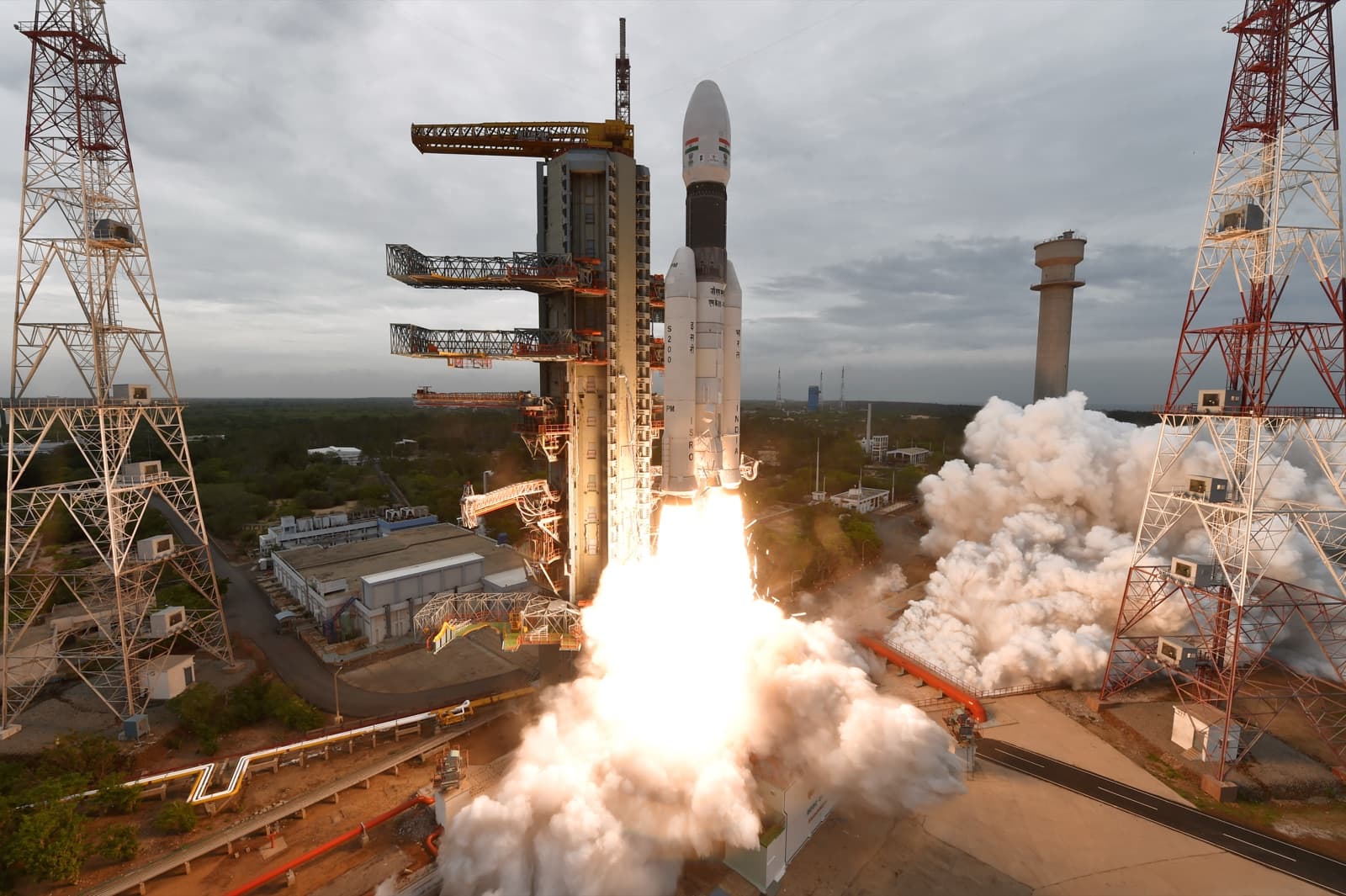
July 22, 2019, 14:43 IST (09:13 UT), GSLV Mk III-M1 from Satish Dhawan Space Centre, Sriharikota↗
Launch scrub
First attempt on July 15, 2019 called off 56 minutes before liftoff after a technical snag in the launch vehicle system; ISRO rescheduled to July 22 at 14:43 IST↗
Stack and masses
3,850 kg at launch: 2,379 kg orbiter, 1,471 kg Vikram lander carrying the 27 kg Pragyan rover (JPL Horizons object data)↗
Orbit
Lunar orbit insertion August 20, 2019; the orbiter operates in a 100 km x 100 km polar orbit↗
Landing attempt
Descent late September 6, 2019 UTC (September 7 IST); ISRO: performance normal down to 2.1 km altitude, then communication from the lander was lost↗
Official cause
Written Lok Sabha reply, November 21, 2019: second-phase velocity reduction was more than the designed value, so fine braking began beyond its planned parameters and Vikram hard landed within 500 m of the designated site↗
Impact site
70.8810 S, 22.7840 E, elevation 834 m, about 600 km from the south pole; debris field found in LROC images and announced December 2, 2019, with Chennai engineer Shanmuga Subramanian credited for the first debris identification↗
Mission cost
Rs 978 crore: Rs 603 crore for the orbiter, lander, rover, navigation and ground support, plus Rs 375 crore for the GSLV Mk III launch↗
Orbiter payloads
Eight: TMC-2 (terrain camera), OHRC (high-resolution camera), CLASS (X-ray spectrometer), XSM (solar X-ray monitor), IIRS (infrared spectrometer), DFSAR (dual-frequency radar), CHACE-2 (mass spectrometer), DFRS (radio science)↗
OHRC
0.25 m ground sampling from 100 km altitude, the highest spatial resolution among all lunar orbiter missions (twice LRO NAC's 0.5 m)↗
IIRS hydration result
Unambiguous detection of OH and H2O between 29 N and 62 N using the 3 micron hydration feature with physics-based thermal correction (Current Science, August 10, 2021)↗
Still operating (2025-2026)
DFSAR Level-3C polar mosaics released November 2025; PRL-led npj Space Exploration paper reporting subsurface ice in four doubly shadowed craters published May 27, 2026; JPL Horizons trajectory fit to tracking data through June 28, 2026↗
Site: 70.8810°S, 22.7840°E · Vikram impact site, highland plain between Manzinus C and Simpelius N craters (source)
02Mission timeline
2007 to 2013
Conceived as a joint mission with Russia providing the lander; ISRO takes the lander in-house after Roscosmos drops out following the Fobos-Grunt failure
15 Jul 2019
First launch attempt called off 56 minutes before liftoff over a technical snag in the launch vehicle system
22 Jul 2019
Launch at 14:43 IST on GSLV Mk III-M1 from Sriharikota
20 Aug 2019
Lunar orbit insertion; the orbiter is later circularized to a ~100 km polar orbit
2 Sep 2019
Vikram separates from the orbiter at 07:45 UTC
6 Sep 2019
Powered descent toward 70.9 S; normal performance to 2.1 km, then loss of communication; Vikram impacts the surface (UTC)
21 Nov 2019
Government tells the Lok Sabha the second descent phase braked more than designed; Vikram hard landed within 500 m of the target
2 Dec 2019
NASA's LROC team announces the impact site (70.8810 S, 22.7840 E) and debris field, crediting Shanmuga Subramanian for the first debris identification
10 Aug 2021
IIRS result published in Current Science: unambiguous OH and H2O detection between 29 N and 62 N
18 Oct 2021
Fires thrusters in ISRO's first collision avoidance manoeuvre at the Moon, dodging a predicted Oct 20 close approach with NASA's LRO (about 3 km, under 100 m radial separation)
Oct 2022
CLASS delivers the first global map of sodium on the Moon (Astrophysical Journal Letters)
21 Aug 2023
Establishes a two-way link with the arriving Chandrayaan-3 lander ("Welcome, buddy!"), adding a backup communication route for the landing
Nov 2025
ISRO releases DFSAR Level-3C polarimetric mosaics of both poles (80-90 degrees latitude, ~1,400 datasets)
27 May 2026
PRL-led npj Space Exploration study reports DFSAR radar signatures of subsurface ice beneath four doubly shadowed south polar craters
28 Jun 2026
Still tracked in lunar orbit: JPL Horizons carries a trajectory fit to tracking data through this date (record revised June 30, 2026)
Teal dots: events that physically happened in flight or on the Moon. Grey: announcements, namings, contracts, and targets.
03The mission
Chandrayaan-2 was India's second Moon mission and its first attempt to land. It began in 2007 as a joint project in which Russia would supply the lander, and ISRO took the lander in-house after Roscosmos dropped out in the wake of the 2011 Fobos-Grunt failure, which is why the mission flew a decade after Chandrayaan-1. The 3,850 kg stack, a 2,379 kg orbiter carrying the 1,471 kg Vikram lander with the 27 kg Pragyan rover inside, launched on GSLV Mk III-M1 from the Satish Dhawan Space Centre, Sriharikota, on July 22, 2019 at 14:43 IST, one week after a first attempt was called off 56 minutes before liftoff over a technical snag in the launch vehicle. The whole mission, launch included, cost Rs 978 crore, roughly $140 million at 2019 exchange rates.
Lunar orbit insertion came on August 20, 2019, and Vikram separated on September 2. Late on September 6 UTC (the small hours of September 7 IST), the lander began its powered descent toward a highland plain between the craters Manzinus C and Simpelius N at about 70.9 degrees south, farther south than any landing attempted before it. ISRO's public account is spare: performance was normal down to an altitude of 2.1 km, then communication was lost. The government's written explanation to the Lok Sabha that November said the second descent phase braked harder than designed, so the fine braking phase began outside its planned envelope and Vikram hard landed within 500 m of the designated site. ISRO initially said its own orbiter had spotted the lander with a thermal camera but never released those images. The definitive answer came from NASA's Lunar Reconnaissance Orbiter: on December 2, 2019 the LROC team published the impact point at 70.8810 S, 22.7840 E along with a scattered debris field, crediting Chennai engineer Shanmuga Subramanian, who had found the first fragment by combing the publicly released LROC images on his own.
What the crash overshadowed is that most of Chandrayaan-2, by mass and by instrument count, is the orbiter, and it works. Its eight payloads include OHRC, which resolves the surface at 0.25 m per pixel from 100 km, the sharpest imaging of any lunar orbiter camera and twice the resolution of LRO's NAC; the IIRS infrared spectrometer, which in 2021 delivered an unambiguous separation of water and hydroxyl signatures using the full 3 micron hydration band; CLASS, whose X-ray fluorescence data produced the first global map of sodium on the Moon (Astrophysical Journal Letters, 2022); CHACE-2, which profiled argon-40 in the tenuous exosphere; XSM, which turned lunar orbit into a solar X-ray observatory and watched elemental abundances shift during B-class flares; and DFSAR, the first radar to map the Moon in full-polarimetric L-band, built to look into the permanently shadowed polar craters.
The orbiter was designed for one year; a precise launch and efficient orbit-raising left propellant for what ISRO estimated at almost seven years, and it has spent that time becoming a fixture of cislunar operations. On October 18, 2021 it fired its thrusters in ISRO's first collision avoidance manoeuvre at another world, stepping aside from NASA's LRO ahead of a predicted October 20 close approach of about 3 km with under 100 m of radial separation near the lunar north pole. In August 2023 it became greeter and backup relay: ISRO announced "Welcome, buddy!" as the orbiter established a two-way link with the arriving Chandrayaan-3 lander, adding a communication route for the landing that finished Chandrayaan-2's unfinished business.
As of July 2026 the orbiter is still operating in its roughly 100 km polar orbit, and its data pipeline is still producing. ISRO released DFSAR Level-3C polarimetric mosaics of both poles in November 2025, built from about 1,400 radar datasets spanning latitudes 80 to 90 degrees, and in May 2026 a PRL-led study in npj Space Exploration used DFSAR to report radar signatures of subsurface ice beneath four doubly shadowed craters near the south pole. JPL's Horizons system carries a live trajectory for the orbiter (ID -152) fit to tracking data through June 28, 2026, the ephemeris behind its moving pin on this site's globe. July 22, 2026 marks seven years since launch, the far end of ISRO's original fuel estimate, so every further month is a bonus; meanwhile its polar radar and spectrometer maps feed directly into landing site work for the missions following it, including the ISRO-JAXA Chandrayaan-5/LUPEX rover.
04In pictures
Tap a photo to enlarge.
05Sources
- ISRO: Chandrayaan-2 mission page (descent normal to 2.1 km, orbiter life of almost seven years)
- ISRO: Chandrayaan-2 science results (eight payloads, 100 km x 100 km orbit, argon-40, solar flare results)
- ISRO: Chandrayaan-2 launch rescheduled to July 22, 2019 at 14:43 IST
- NASA image article: Vikram Lander Found (Dec 2, 2019; impact coordinates; Shanmuga Subramanian credit)
- LROC Featured Image 1131: Vikram Lander Found (image acquisition dates, debris detail)
- eoPortal: Chandrayaan-2 (launch time, component masses, LOI date, instrument suite)
- JPL Horizons object data, Chandrayaan-2 orbiter ID -152 (3,850 kg launch mass; separation time; trajectory fit to tracking through June 28, 2026)
- The News Minute: Lok Sabha written reply on the hard landing (Nov 21, 2019)
- The News Minute: Chandrayaan-2 cost Rs 978 crore (Rs 603 crore + Rs 375 crore launch)
- Down To Earth: launch called off 56 minutes before liftoff (July 15, 2019)
- Current Science (Aug 10, 2021): Unambiguous detection of OH and H2O from Chandrayaan-2 IIRS
- Outlook India: CLASS maps sodium on the Moon for the first time (ApJL, Oct 2022)
- Onmanorama (Manorama English): Chandrayaan-2 avoids near collision with NASA's LRO (CAM Oct 18, 2021; Oct 20 conjunction near the lunar north pole, about 3 km, under 100 m radial)
- Business Today: "Welcome, buddy!" two-way link with the Chandrayaan-3 lander (Aug 21, 2023)
- Swarajya: DFSAR Level-3C polar data products released (Nov 2025)
- ISRO: DFSAR observations reveal subsurface ice in lunar south polar regions (May 27, 2026)
- npj Space Exploration: Sinha et al. 2026, subsurface ice in doubly shadowed craters from Chandrayaan-2 DFSAR
- LPSC 2021 abstract: high-resolution DEM generation from Chandrayaan-2 OHRC (0.25 m GSD, highest among lunar orbiter missions)
- Jatan Mehta: Chandrayaan-2, India's first Moon landing attempt (Russia partnership backstory)
azmth is independent and is not affiliated with or endorsed by NASA, CNSA, Roscosmos, ISRO, JAXA, or any other space agency or company named on this page.