Chang'e 4 (Yutu-2 rover and Queqiao-1 relay)
CNSA (China) · Rover · 2019Operating

Landed Jan 3, 2019 in Von Kármán crater, first-ever far-side landing; lander and Yutu-2 last officially reported working in Sep 2024, Yutu-2 largely stationary since Mar 2024 with last official odometer 1,613 m (no later official status found as of Sep 28, 2026)
TL;DR· 6 min read
Chang'e 4 made the first landing in history on the Moon's far side on 3 January 2019, touching down in Von Kármán crater inside the South Pole-Aitken basin. It worked only because China had already parked the Queqiao-1 relay satellite beyond the Moon at Earth-Moon L2. The lander germinated a cotton seed, the first plant to sprout on the Moon, and Yutu-2 became the longest-lived lunar rover, its last official odometer reading 1,613 m in September 2024.
Chang'e 4 made the first landing in history on the Moon's far side on January 3, 2019, a feat that required China to pre-position a dedicated relay satellite, Queqiao-1, at the Earth-Moon L2 point because the far side never faces Earth. Its rover Yutu-2 became the longest-lived lunar rover ever, and the lander germinated a cotton seed, the first plant ever to sprout on the Moon. Note the misnomer: people say "dark side", but this is the far side; it receives just as much sunlight as the near side, it is simply radio-shadowed from Earth.
Facts as of July 20, 2026, from the sources listed below.
1stJan 3, 2019
landing ever on the lunar far side
1,613m
Yutu-2 odometer, longest-lived lunar rover (last official figure, Sep 2024)
7.5+yr
years on the far side; lander last officially reported working in Sep 2024
65,000km
km beyond the Moon: Queqiao-1 relay halo orbit at Earth-Moon L2
Commonly wrong. Three recurring errors in English coverage. (1) The "dark side of the Moon": the far side gets exactly as much sunlight as the near side; what it loses is the radio path to Earth, which is why Queqiao-1 was needed. (2) "Yutu-2 is still roving" appears in 2025-2026 articles, but the last official odometer reading is 1,613 m from September 2024, LRO imagery shows essentially no motion after March 2024, and the small 2025 movements claimed by forum analyses are unofficial and unconfirmed by CNSA. (3) The cotton sprout is often inflated to "first plant grown in space"; plants had grown on space stations for decades, and this was the first germination on the Moon, with the sprout dead within days of the first lunar night. Bonus nuance: Von Kármán crater is at 45 degrees south inside the South Pole-Aitken basin; Chang'e 4 was not a polar landing.
01Mission facts
Queqiao-1 relay launch
May 20, 2018 UTC, Long March 4C from Xichang; 425 kg, 4.2 m relay dish↗
Queqiao-1 mission orbit
Earth-Moon L2 halo orbit, about 65,000 km beyond the Moon; entered June 14, 2018↗
Chang'e 4 launch
December 7, 2018, 18:23 UTC, Long March 3B from Xichang; total launch mass 3,780 kg↗
Landing
January 3, 2019, 02:26 UTC (10:26 Beijing time), floor of Von Kármán crater (186 km diameter), South Pole-Aitken basin↗
Landing site coordinates
45.4561 S, 177.5885 E, elevation -5,927 m (LROC NAC stereo DTM)↗
Site name
Statio Tianhe, IAU-approved February 15, 2019, only the second "Statio" on the Moon after Apollo 11's Statio Tranquillitatis↗
Yutu-2 rover
140 kg, solar powered, 3-month design life; deployed about 12 hours after landing; passed the Soviet Lunokhod 1 longevity record in late 2019↗
Last official odometer
1,613 m, reported by Chinese media September 2024; no official update since↗
LRO mobility analysis
Motion slowed through 2023 and stopped in March 2024 per LRO image analysis by Phil Stooke (published Jan 14, 2025)↗
First plant on the Moon
Cotton seed sprouted in the Chongqing University mini-biosphere, announced Jan 15, 2019; the sprout froze during the first lunar night↗
First far-side radiation measurement
German LND instrument measured about 60 microsieverts per hour equivalent dose on the surface (Science Advances, Sep 25, 2020)↗
Possible mantle material
Yutu-2's VNIS spectrometer found olivine and low-calcium pyroxene consistent with excavated upper-mantle material (Li et al., Nature, May 2019)↗
Relay handover
Queqiao-1 exceeded its roughly 5-year design life; CNSA said Queqiao-2 (launched Mar 20, 2024) takes over Chang'e 4 relay services↗
Companion microsats
Longjiang-1 failed to reach lunar orbit; Longjiang-2 operated in lunar orbit until a deliberate impact on July 31, 2019↗
International payloads
LND dosimeter (Kiel University/DLR, Germany) on the lander, ASAN neutrals analyzer (Sweden) on Yutu-2, NCLE low-frequency radio experiment (Netherlands) on Queqiao-1↗
Site: 45.4561°S, 177.5885°E · Statio Tianhe, Von Kármán crater (South Pole-Aitken basin) (source)
02Mission timeline
20 May 2018
Queqiao-1 relay satellite launches on a Long March 4C from Xichang
14 Jun 2018
Queqiao-1 enters its Earth-Moon L2 halo orbit, ready to relay far-side signals
7 Dec 2018
Chang'e 4 launches at 18:23 UTC on a Long March 3B from Xichang
3 Jan 2019
First-ever soft landing on the lunar far side at 02:26 UTC in Von Kármán crater; Yutu-2 rolls off about 12 hours later
15 Jan 2019
China announces a cotton seed has sprouted on board, the first plant germinated on the Moon; it dies in the lunar night cold
30 Jan to 1 Feb 2019
NASA's LRO images the lander, then resolves both lander and rover from 82 km altitude
15 Feb 2019
IAU names the landing site Statio Tianhe, with nearby craters Zhinyu, Hegu and Tianjin and peak Mons Tai
15 May 2019
Nature paper reports VNIS detection of possible mantle-derived olivine and pyroxene in Von Kármán crater
31 Jul 2019
Companion microsatellite Longjiang-2 ends its mission with a deliberate lunar impact
25 Sep 2020
LND team publishes the first systematic radiation dose measurements from the lunar surface, about 60 microsieverts per hour
Mar 2024
Yutu-2 stops moving per later LRO image analysis; the same month Queqiao-2 launches to take over relay duties
Sep 2024
Last official odometer report: 1,613 m driven; Chinese media mark Yutu-2 as the world's longest-working lunar rover
14 Jan 2025
SpaceNews reports LRO imagery shows no rover motion since March 2024, suggesting Yutu-2 can no longer drive
2025
Unofficial analyses of 2025 LRO frames report small movements; CNSA has published no odometer update, so the rover's mobility remains unconfirmed (as of Sep 2026)
Teal dots: events that physically happened in flight or on the Moon. Grey: announcements, namings, contracts, and targets.
03The mission
For sixty years of lunar exploration, every landing had happened on the side of the Moon that faces Earth, for a simple reason: a lander on the far side cannot talk to Earth directly, because the Moon itself blocks the radio path. China solved the problem in two launches. In May 2018 it sent Queqiao-1, a 425 kg relay satellite with a 4.2 m dish, to a halo orbit around the Earth-Moon L2 point about 65,000 km beyond the Moon, where it can see both the far side and Earth at all times. With the relay in place, Chang'e 4 launched on December 7, 2018 and touched down on January 3, 2019 at 02:26 UTC on the floor of Von Kármán crater, the first spacecraft ever to land on the lunar far side.
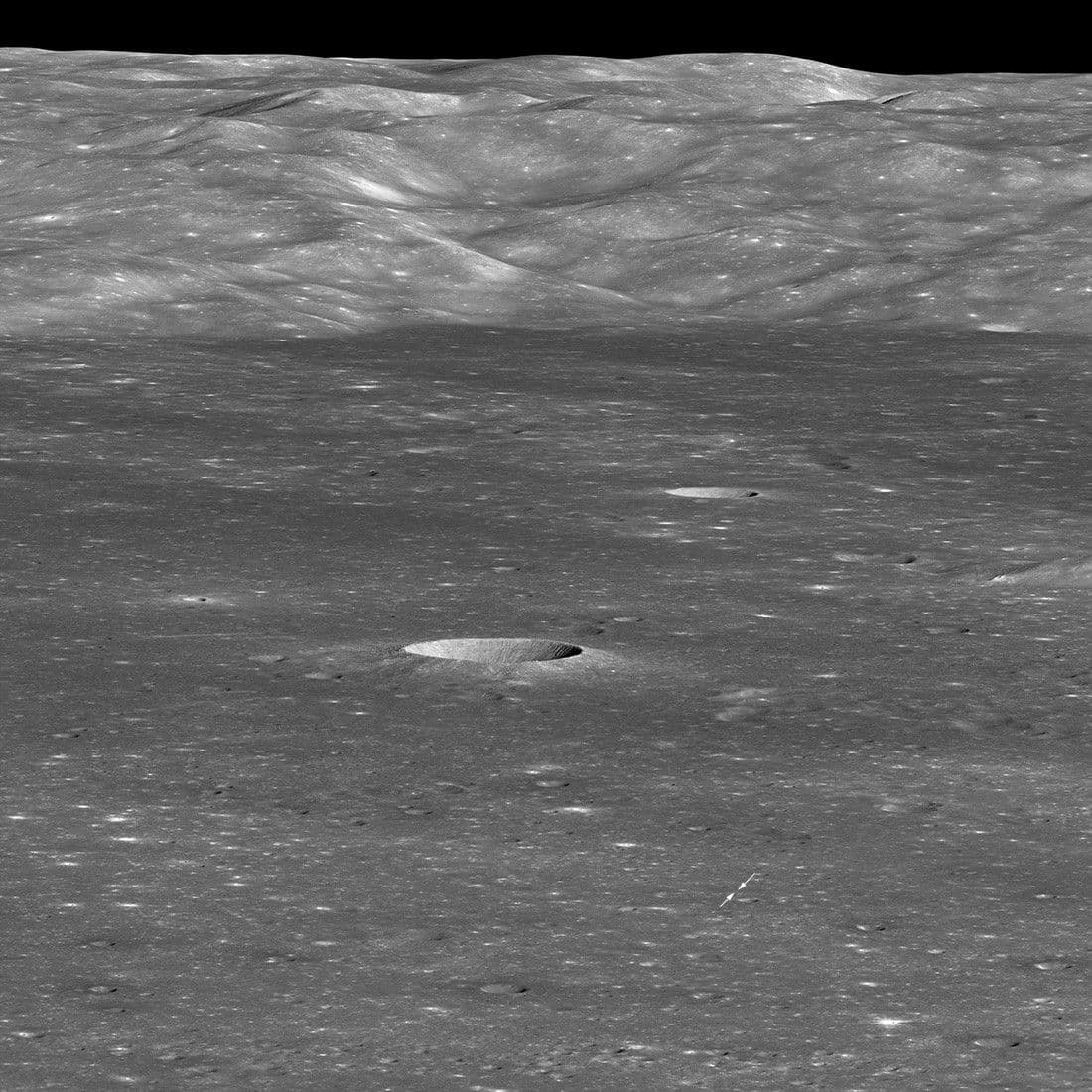
The site was chosen for science as much as for spectacle. Von Kármán, a 186 km crater sitting inside the South Pole-Aitken basin, the largest and oldest confirmed impact structure on the Moon, offered a chance to sample material excavated from deep in the crust or upper mantle. NASA's LRO pinned the lander at 45.4561 S, 177.5885 E, some 5,927 m below the lunar reference radius. In February 2019 the IAU named the spot Statio Tianhe, after the ancient Chinese name for the Milky Way; the only other "Statio" on lunar maps is Tranquility Base.
The mission's science delivered. Yutu-2's imaging spectrometer found olivine and low-calcium pyroxene consistent with mantle-derived material thrown out by the nearby Finsen impact, published in Nature in May 2019. Its ground-penetrating radar mapped roughly 40 m of layered ejecta and regolith beneath the traverse, and the German-built LND dosimeter made the first systematic radiation measurements on the lunar surface, about 60 microsieverts per hour, data that feeds directly into planning for crewed missions. The lander also carried a Chongqing University mini-biosphere in which a cotton seed germinated, the first plant ever to sprout on the Moon, though the seedling froze when the two-week lunar night hit.
Yutu-2 is the longest-lived lunar rover in history, but its later years need honest telling. The last official odometer figure, 1,613 m, dates to September 2024, and independent analysis of LRO orbital imagery by planetary cartographer Phil Stooke found the rover's drives shrank from about 40 m per lunar day in early 2023 to nothing after March 2024, suggesting it could no longer move. Unofficial analyses of 2025 LRO frames reported by enthusiasts claim small movements resumed, but CNSA has published no odometer update since September 2024, so claims that Yutu-2 is "still roving" outrun the evidence. The last official status report found, from CCTV in September 2024, had Yutu-2 completing its 71st lunar day, and the deputy chief designer of the mission's ground application system said the lander was of course also still 'alive'. No later official status has been found (as of September 28, 2026).
The relay architecture proved the more consequential legacy. Queqiao-1 outlived its roughly five-year design life, and in March 2024 China launched the larger Queqiao-2, which CNSA says takes over relay service for Chang'e 4 while Queqiao-1 serves as backup. That relay line made Chang'e 6's far-side sample return possible in 2024 and anchors China's plans for its south-polar International Lunar Research Station. Chang'e 4 also carried a small international manifest, with German, Swedish and Dutch instruments, plus two student microsatellites: Longjiang-1 was lost en route, while Longjiang-2 orbited the Moon until a deliberate disposal impact in July 2019.
04In pictures
Tap a photo to enlarge.
05Sources
- NASA Science: First Look: Chang'e 4 (Feb 6, 2019)
- LROC: Chang'e 4 Lander Coordinates (Jan 11, 2019)
- LROC: Topographic Map of the Chang'e 4 Site, accepted coordinates and elevation (Apr 30, 2019)
- LROC: Above the Landing Site (Feb 15, 2019)
- LROC: Yutu-2 Still on the Move! (Jun 27, 2019)
- SpaceNews: Yutu-2 likely immobile after historic mission (Jan 14, 2025)
- Global Times: Yutu-2 becomes world's longest-working lunar rover, 1,613 m odometer (Sep 18, 2024)
- CNSA English: Queqiao-2 launch, Queqiao-1 past design life, relay handover (Mar 20, 2024)
- Gunter's Space Page: Queqiao 1 specifications
- Nature News: Plant sprouts on the Moon for first time ever (Jan 2019)
- Li et al., Nature: initial identification of far-side mantle-derived materials (May 2019)
- DLR: How intense and dangerous is cosmic radiation on the Moon (Sep 25, 2020)
- phys.org / IAU: landing site named Statio Tianhe (Feb 15, 2019)
- EarthSky: Chang'e 4 lands on Moon's far side, 02:26 UTC timing (Jan 2019)
- Wikipedia: Chang'e 4 (launch time, masses, payload manifest; secondary)
- Wikipedia: Yutu-2 (rover specs, 2025 movement claim sourced to forum analyses; secondary)
azmth is independent and is not affiliated with or endorsed by NASA, CNSA, Roscosmos, ISRO, JAXA, or any other space agency or company named on this page.