Chang'e 8
CNSA (China) · Lander · 2029Planned

In development: CNSA's published target is a launch around 2029 to the Leibnitz-Beta Plateau (Mons Mouton) with an ISRU lunar-brick 3D-printing demo. SpaceNews reported on 10 Sep 2026 that China appears to be reconfiguring its robotic Moon program, Chang'e 8 included; no Chinese official source has announced a change (as of 9 Oct 2026).
TL;DR· 5 min read
Chang'e 8 is China's construction rehearsal for a Moon base: a lander, rover and operations robot that will try to 3D-print bricks from lunar regolith using concentrated sunlight, with no water or binder brought from Earth. CNSA has targeted a launch around 2029 since April 2025, although a large share of English coverage still prints 2028. SpaceNews reported on 10 September 2026 that China appears to be reconfiguring the mission, which no Chinese official source had announced as of 9 October 2026. The site is the Leibnitz-Beta Plateau near the south pole, which the IAU named Mons Mouton in 2022, and 10 international payloads were picked from 41 proposals.
Chang'e 8 is China's construction-tech rehearsal for a Moon base: a lander, rover and operations robot that will try to 3D-print bricks out of lunar regolith using concentrated sunlight, on the Leibnitz-Beta Plateau near the south pole. Contrary to the '2028' date many English outlets still print, CNSA's official target since April 2025 has been 'around 2029', although SpaceNews reported on 10 September 2026 that China appears to be reconfiguring its robotic Moon program, Chang'e 8 included, and no Chinese official source has announced a change (as of 9 October 2026). Together with Chang'e 7 it forms the basic model of the International Lunar Research Station.
Facts as of July 20, 2026, from the sources listed below.
~2029
targeted launch (CNSA, as of Apr 2025)
200kg
payload capacity reserved for international partners
10
international projects selected from 41 proposals
6km
height of Mons Mouton, the ~100 km-wide target plateau
Targets are the operator's current plan (as of July 20, 2026) and can change.
Not yet flown. Dates on this page are the operator's current targets, tagged with when they were announced, and can change.
Commonly wrong. Two persistent errors. (1) The launch year: a large share of English coverage (including major outlets' 2025 pieces) says Chang'e 8 launches in '2028', but CNSA's official line since April 24, 2025 is 'around 2029'; the 2028 figure is a stale earlier target. (2) The place name: Chinese sources say 'Leibnitz-Beta Plateau', and some English articles treat that as the feature's name, but the IAU formally named it Mons Mouton in 2022 after NASA mathematician Melba Roy Mouton; they are the same feature, and it is also IM-2's landing site and VIPER's planned one.
01Mission facts
Status (as of 9 Oct 2026)
In development; launch targeted around 2029 per CNSA (announced April 24, 2025). SpaceNews reported on 10 Sep 2026 that China appears to be reconfiguring its robotic Moon program, Chang'e 8 included; no Chinese official source has announced a change, and CNSA's chief engineer said on 3 Sep 2026 that China is continuing to advance Chang'e 8↗
Launch vehicle and site
Long March 5 from Wenchang (planned)↗
Landing target
Leibnitz-Beta Plateau (IAU name: Mons Mouton, ~84.6 S / 31 E, named 2022 for NASA mathematician Melba Roy Mouton); site selection narrowed to the plateau as of April 2025↗
Core elements
Lander, ~100 kg rover, and robotic units including two 5 kg micro-rovers↗
ISRU headline experiment
3D printing bricks from lunar regolith using focused solar energy, no water or binders; DSEL (Hefei) showed a prototype brick-making machine in April 2025↗
International payloads
10 projects selected from 41 proposals on April 24, 2025, spanning 11 countries/regions plus one international organization, within a 200 kg allocation↗
Partner hardware
Hong Kong multi-functional robot with mobile charging station; Pakistani rover (~35 kg, MoU Feb 5, 2025); Turkish micro-rovers; South Africa-Peru radio astronomy array; Italian laser retroreflector; Russian plasma-dust analyzer; Thai neutron analyzer; Bahrain-Egypt imager; Iranian lunar potential monitor↗
ILRS role
Chang'e 7 + Chang'e 8 form the ILRS 'basic model'; ILRS counted 17 countries/international organizations and 50+ institutions as of April 2025, with construction planned for the 2030s↗
Neighborhood
Mons Mouton already hosts IM-2 Athena (landed on its side at 84.7906 S in March 2025) and is the planned VIPER landing region↗
Site: 84.6000°S, 31.0000°E · Targeted region: Leibnitz-Beta Plateau (Mons Mouton), exact site not yet announced (source)
02Mission timeline
5 Feb 2025
Pakistan rover MoU (SUPARCO, ~35 kg rover)
Apr 2025
ISRU brick-machine prototype shown, Deep Space Exploration Laboratory, Hefei
24 Apr 2025
CNSA confirms mission profile: launch around 2029, Leibnitz-Beta Plateau target, 10 international payloads selected
Targeted Around 2029
Launch (CNSA target as of Apr 2025; no official change announced as of 9 Oct 2026, though SpaceNews reported a reconfiguration on 10 Sep 2026)
Targeted 2030s
ILRS basic model construction planned, built on the Chang'e 7 and 8 groundwork
Teal dots: events that physically happened in flight or on the Moon. Grey: announcements, namings, contracts, and targets.
03The mission
If Chang'e 7 asks whether the south pole has water, Chang'e 8 asks whether you can build there. Announced targets, per CNSA at the 2025 Space Day of China ceremony on April 24, 2025: launch around 2029, land on the Leibnitz-Beta Plateau near the lunar south pole, and run in-situ resource utilization (ISRU) experiments that lay the groundwork for the International Lunar Research Station (ILRS), the Chinese-led counterpart to Artemis whose basic form is slated for construction in the 2030s.
The headline experiment is brick-making. Chang'e 8 is to test 3D printing of bricks from lunar regolith, melting soil with focused solar energy and molding it into structural blocks with no water or binder brought from Earth. A working prototype of the lunar soil brick-making machine was shown by the Deep Space Exploration Laboratory in Hefei in April 2025. Proving that habitats can be built from local dirt, rather than launched at thousands of dollars per kilogram, is arguably the single most consequential technology demo of the late-2020s Moon race.
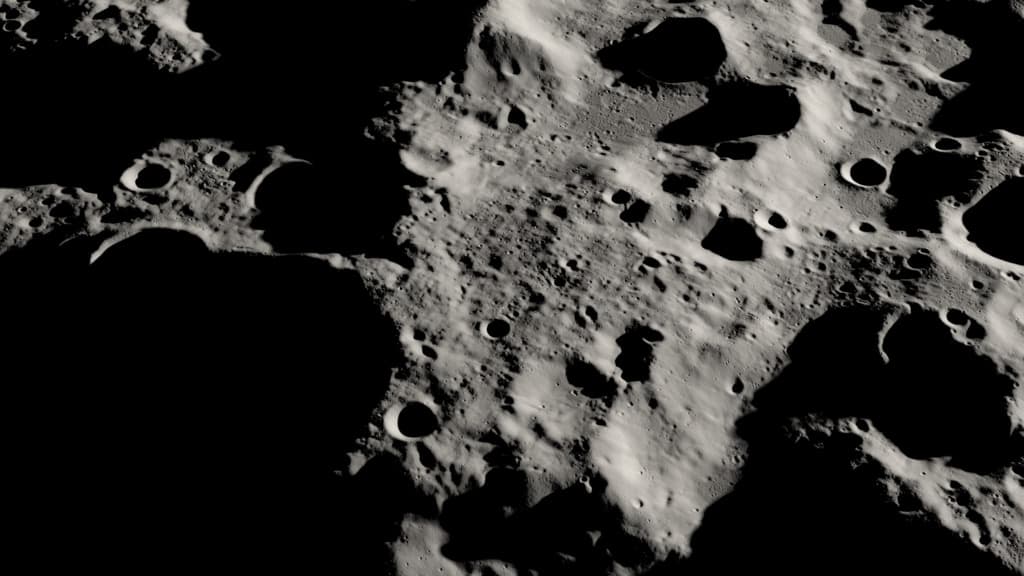
The landing target carries a naming quirk: Chinese sources say 'Leibnitz-Beta Plateau', but the IAU formally named this flat-topped massif Mons Mouton in 2022, after NASA mathematician Melba Roy Mouton. The plateau rises about 6 km and spans nearly 100 km at roughly 84.6 S, 31 E, and it is contested real estate: Intuitive Machines' IM-2 Athena landed on it (on its side, in a small crater at 84.79 S) in March 2025, and NASA's VIPER rover has been slated for the same feature. A final Chang'e 8 site has not been announced; as of April 2025 CNSA had narrowed its focus to the plateau.
Chang'e 8 is also the most international Chinese lunar mission to date. CNSA allocated 200 kg of payload capacity to partners and, on April 24, 2025, selected 10 projects from 41 proposals spanning 11 countries and regions plus one international organization: a Hong Kong-led multi-functional robot with a mobile charging station, a roughly 35 kg Pakistani rover (MoU signed February 5, 2025), Turkish micro-rovers, a South Africa-Peru radio astronomy array, an Italian laser retroreflector, a Russian plasma-dust analyzer, a Thai neutron analyzer, a Bahrain-Egypt imaging system and an Iranian lunar potential monitor. The core Chinese hardware is a lander, a roughly 100 kg rover and robotic units.
Strategically, Chang'e 7 and Chang'e 8 together form the 'basic model' of the ILRS, which counted 17 countries and international organizations and more than 50 research institutions as of April 2025. Chang'e 8 is the bridge between China's robotic program and its crewed lunar ambitions: the same south-polar region, the same infrastructure logic, and a targeted timeline that runs just ahead of China's stated goal of landing astronauts on the Moon before 2030.
04In pictures
Tap a photo to enlarge.
05Sources
- CNSA (English): Chang'e-8 around 2029, international payloads (Apr 25, 2025)
- SpaceNews: international payloads selected for Chang'e-8 (Apr 25, 2025)
- Wikipedia: Chang'e 8 (architecture, Pakistan MoU, site focus)
- Wikipedia: Mons Mouton (coordinates, naming, dimensions)
- NASA SVS: Mons Mouton visualization (coords context, imagery)
- Space.com: China to 3D-print bricks from lunar soil
- LROC: IM-2 Athena on Mons Mouton, landing coordinates (Mar 2025)
- english.gov.cn mirror of the Chang'e-8 announcement
- SpaceNews: China alters Chang'e-8 lunar south pole mission amid lunar program reorganization (Sep 10, 2026)
- China News Service: CNSA chief engineer Li Guoping says China is continuing to advance Chang'e 7 and Chang'e 8 (Chinese, Sep 3, 2026)
azmth is independent and is not affiliated with or endorsed by NASA, CNSA, Roscosmos, ISRO, JAXA, or any other space agency or company named on this page.