LUPEX (Lunar Polar Exploration)
JAXA (Japan) and ISRO (India) · Rover · 2028In development
In development, not launched: India's government cleared its share on March 10, 2025 and the two agencies signed the implementing arrangement on August 29, 2025; joint design work is underway (fifth technical interface meeting, December 2025) with launch targeted no earlier than 2028, which JAXA's Japanese page gives as Japanese fiscal year 2028, April 2028 to March 2029 (as of Sep 2026). No landing site fixed yet.
TL;DR· 7 min read
LUPEX, also called Chandrayaan-5, is a joint JAXA and ISRO polar rover mission still in development, with launch targeted no earlier than 2028. It inverts the Chandrayaan-3 roles: Japan supplies the roughly 350 kg rover and the H3-24L launch, while India builds the lander. The rover is designed to drill up to 1.5 metres near the lunar south pole and settle how much water ice is there and in what form. No landing site is fixed and no total cost has been published.
LUPEX, also called Chandrayaan-5, is the mission that inverts the usual Chandrayaan pattern: India, which built the rover for Chandrayaan-3, here builds the lander, while Japan supplies the roughly 350 kg rover, the H3 rocket and the launch. It is designed to reach the lunar south pole, drill up to 1.5 metres into the regolith, and settle the question Chandrayaan-1 first raised from orbit and Chandrayaan-3 sampled from the surface: how much water ice is actually there, in what form, and can it be reached. Most English coverage still calls the joint polar rover 'Chandrayaan-4', a name reassigned in September 2024 to India's all-Indian sample return; the ISRO-JAXA rover is now Chandrayaan-5. Japan had been ready to fly this for years. The pacing item was India's own approval, which finally came in March 2025.
Facts as of September 28, 2026, from the sources listed below.
~350kg
JAXA rover, including its science instruments
6.5t
total launch mass on Japan's H3-24L
1.5m
auger drill depth for subsurface regolith and ice
2028+
targeted launch, no earlier than 2028 per JAXA (as of Sep 2026)
Targets are the operator's current plan (as of September 28, 2026) and can change.
Not yet flown. Dates on this page are the operator's current targets, tagged with when they were announced, and can change.
Commonly wrong. Several recurring errors in English coverage. (1) The name is the biggest one: for years the ISRO-JAXA polar rover was called 'Chandrayaan-4', so much older writing and even some current pages use that name, but since September 2024 Chandrayaan-4 is India's all-Indian sample return and this joint rover is Chandrayaan-5/LUPEX. (2) Who builds what: reports routinely say ISRO builds the rover (as it did for Chandrayaan-3), but here JAXA provides the rover, built by Mitsubishi Heavy Industries, plus the H3 launch, while ISRO provides the lander. (3) The rover mass: a widely quoted 250 kg traces to a misstatement; the consistent JAXA and ISRO figure is about 350 kg. (4) The approval: 'India approved LUPEX in 2025' is true but incomplete, because Japan had already funded and approved its side years earlier and was waiting on India, and the exact Indian date is reported variously as March 10, 13 or 14, 2025 (and it was a government/space-establishment clearance, not always described as a full Union Cabinet item like Chandrayaan-4). (5) The launch date: '2026' and '2027' still circulate, but JAXA's English page says no earlier than 2028 and its Japanese page gives Japanese fiscal year 2028 (April 2028 to March 2029). (6) Treat any single hard cost figure with suspicion: no official total budget for LUPEX has been published.
01Mission facts
Status (as of Sep 2026)
In joint design and development; not launched. India's government cleared its part on March 10, 2025; implementing arrangement signed August 29, 2025; fifth technical interface meeting held in Japan December 15 to 17, 2025; an ISRO delegation visited Tanegashima in April 2026↗
Who builds what
JAXA provides the H3 launch vehicle and the rover (built by Mitsubishi Heavy Industries) plus instruments; ISRO provides the lander and several rover instruments. This inverts Chandrayaan-3, where ISRO built both lander and rover↗
Mission goal
Land near the lunar south pole and determine the quantity and quality of water ice, including in permanently shadowed regions, using a rover that drills to about 1.5 m and analyzes samples in place↗
Launch vehicle
Japan's H3-24L (the configuration JAXA calls its standard H3, with the long fairing), from Tanegashima Space Center; the H3-24L variant was confirmed at the third technical interface meeting in May 2025↗
Rover
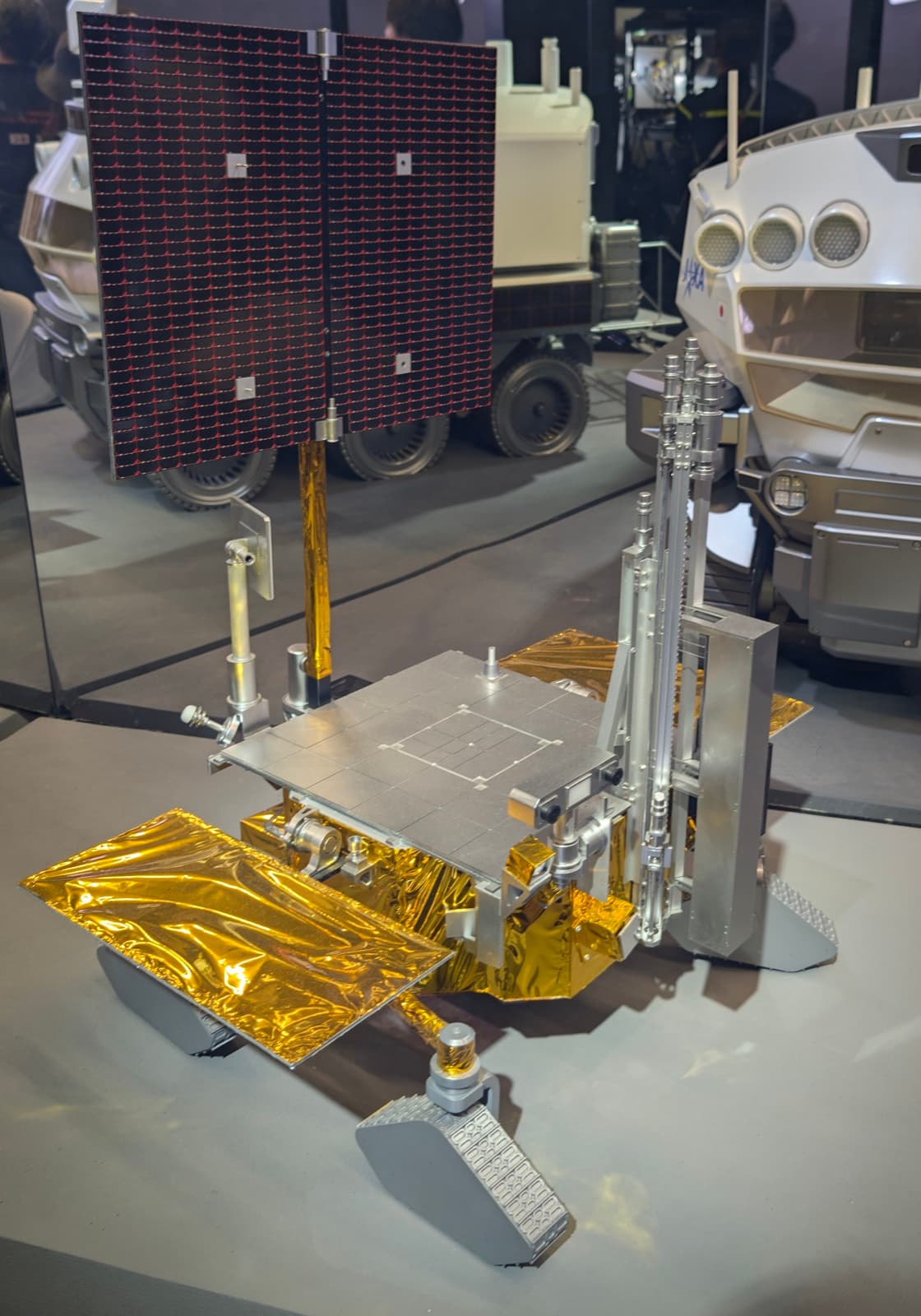
About 350 kg including instruments, roughly 2.0 x 1.8 x 3.3 m, able to climb 25-degree slopes; built by Mitsubishi Heavy Industries. It carries a 1.5 m earth-auger drill and, after a redesign that found it overweight, drops radioisotope heater units for a passive insulating scheme to survive the lunar night↗
Lander and new engine
ISRO develops the lander (about 6,000 kg), which will use a new L9 3.1 kN liquid-fuel engine from the Liquid Propulsion Systems Centre; a prototype L9 was hot-fired in 2025 per ISRO's 2025-26 annual report↗
International payload
The rover carries Japanese instruments (LTGA, TRITON, ADORE, ALIS), Indian instruments (ISAP, PRATHIMA, WaSSPeR, MIR), a NASA neutron spectrometer (subsurface hydrogen to about 1 m), and ESA's EMS-L mass spectrometer, originally built for Russia's Luna-27 and redirected after the 2022 invasion of Ukraine↗
India's approval
India's government cleared its participation on March 10, 2025 (some accounts say March 13 or 14), the gating step; Japan had funded and greenlit its side years earlier↗
Implementing arrangement
ISRO and JAXA signed the LUPEX/Chandrayaan-5 implementing arrangement during Prime Minister Modi's Tokyo visit on August 29, 2025, formalizing the partnership↗
Operating lifetime
Designed to operate at least about 3.5 months on the surface, up to a maximum of about one year; the mission concept is planned to last well over 100 days↗
Target launch
No earlier than 2028: JAXA's English project page says no earlier than 2028 and its Japanese page gives Japanese fiscal year 2028 (April 2028 to March 2029), while some Indian summaries say 2027-2028 (as of Sep 2026). No firm date is manifested↗
Cost
No public total-cost figure has been released for LUPEX, unlike the Rs 2,104 crore Chandrayaan-4 approval; India's share was cleared without a published budget line↗
Landing site
Not fixed as of September 2026: candidate sites in the south polar region, near permanently shadowed regions, were still under discussion at the December 2025 technical interface meeting↗
02Mission timeline
2019
JAXA and ISRO begin joint study of a polar rover mission, then widely referred to as Chandrayaan-4; Japan proceeds toward funding while India's approval stays pending for years
10 Mar 2025
India's government clears its participation in LUPEX/Chandrayaan-5, the long-pending gating step (some accounts date it March 13 or 14)
13 to 14 May 2025
Third technical interface meeting in India; the H3-24L is confirmed as the launch vehicle and landing-site options are deliberated
29 Aug 2025
ISRO and JAXA sign the LUPEX/Chandrayaan-5 implementing arrangement during PM Modi's Tokyo visit
2025
ISRO hot-fires a prototype of the lander's new L9 3.1 kN liquid-fuel engine, per its 2025-26 annual report
15 to 17 Dec 2025
Fifth technical interface meeting held in Japan: development progress reviews, H3 interface coordination with Mitsubishi Heavy Industries, and lander-rover interface adjustments
Apr 2026
An ISRO delegation visits Tanegashima Space Center to prepare development activity
Targeted 2028
Launch on H3-24L from Tanegashima; JAXA gives no earlier than 2028 on its English project page and Japanese fiscal year 2028 on its Japanese page (as of Sep 2026)
Teal dots: events that physically happened in flight or on the Moon. Grey: announcements, namings, contracts, and targets.
03The mission
LUPEX is the completeness partner to India's Chandrayaan record, and it flips the roles that made Chandrayaan-3 famous. In 2023 ISRO built both the Vikram lander and the little Pragyan rover; in LUPEX, Japan builds the rover and India builds the lander. JAXA also brings the ride: the H3-24L rocket, the configuration JAXA calls its standard H3, lifting a stack of about 6.5 tonnes from Tanegashima. The rover itself, about 350 kg including its instruments and built by Mitsubishi Heavy Industries, is more than thirteen times the mass of Chandrayaan-3's 26 kg Pragyan, though less than half the 756 kg of the Soviet Lunokhod 1, which drove on the Moon in 1970. Its job is to carry a 1.5 meter drill and a suite of water-hunting instruments across the polar terrain and into the cold traps at the edge of permanently shadowed regions.
The science question is old and specific. Chandrayaan-1's Moon Mineralogy Mapper found the spectral signature of water and hydroxyl across the lunar surface in 2009; Chandrayaan-3's Vikram measured the polar regolith directly in 2023. What nobody has done is drill into the polar subsurface and measure how much water ice is there, how it is bound, and whether it is concentrated enough to be a resource. LUPEX's rover is built to answer exactly that: an auger pulls samples from up to 1.5 m down, onboard instruments analyze them, a NASA neutron spectrometer sniffs subsurface hydrogen to about a meter, and ESA's mass spectrometer, a hardware refugee originally built for Russia's Luna-27 and redirected after the 2022 invasion of Ukraine, reads the volatiles that boil off. Japanese, Indian, American and European instruments ride the same deck.
The multipolar cooperation story is the honest headline. This is not a hosted payload or a data-sharing memo; it is a shared spacecraft with divided hardware responsibility and a joint operations plan, exactly the kind of program that is hard to build across borders. It also carries a small piece of history: the mission spent years as 'Chandrayaan-4' in Indian planning, and Japan had already funded and approved its side while India's government deliberated. When ISRO's sample-return mission took the Chandrayaan-4 name in September 2024, the joint rover became Chandrayaan-5, and India's own approval finally landed in March 2025. The implementing arrangement was signed during Prime Minister Modi's Tokyo visit on August 29, 2025.
Hardware is now moving on both sides. ISRO is developing a new lander around the L9, a 3.1 kN liquid-fuel engine from the Liquid Propulsion Systems Centre, and hot-fired a prototype in 2025. JAXA's rover went through a redesign after it came out overweight, dropping its radioisotope heater units in favour of a passive insulating scheme to survive the roughly two-week lunar night. The two agencies have been meeting face to face on a regular cadence: the fifth technical interface meeting ran in Japan from December 15 to 17, 2025, working through H3 launch-vehicle interfaces with Mitsubishi Heavy Industries and the physical fit between lander and rover, and an ISRO delegation visited Tanegashima in April 2026.
The caveats are the schedule and the site. No landing coordinates exist yet; candidate south-polar sites near permanently shadowed regions were still being deliberated at the December 2025 meeting, which is why this entry carries no coordinate pin. The launch target is soft: JAXA's English project page says no earlier than 2028 and its Japanese page gives Japanese fiscal year 2028 (April 2028 to March 2029), some Indian summaries say 2027-2028, and no firm date is manifested (as of September 2026). And unlike Chandrayaan-4, no public total-cost figure has been released, so any rupee or yen number circulating for LUPEX should be treated with care. What is firm is the shape of the thing: a Japanese rocket, a Japanese rover, an Indian lander, four space agencies' instruments, and a drill aimed at the Moon's coldest, most valuable ground.
04In pictures
Tap a photo to enlarge.
05Sources
- JAXA (English): Lunar Polar Exploration (LUPEX) project page, roles, rover, drill, lifetime, target
- JAXA (Japanese): LUPEX technical project page
- JAXA (English): TIM-5 technical interface meeting held in Japan, December 15 to 17, 2025
- JAXA (English): LUPEX project underway, working with India to investigate lunar water
- ISRO: ISRO and JAXA gear up for joint Chandrayaan-5/LUPEX mission (technical interface meet)
- DD News: PM Modi welcomes ISRO-JAXA collaboration, implementing arrangement signed Aug 29, 2025
- Jatan.space Indian Space #25-26: LUPEX will drill for water and aid Artemis (architecture, science, approval nuance)
- Civilsdaily: Chandrayaan-5/LUPEX enters preliminary design phase (approval date, roles, launch window)
- Wikipedia: Lunar Polar Exploration Mission (module masses, instruments, L9 engine, launch window)
azmth is independent and is not affiliated with or endorsed by NASA, CNSA, Roscosmos, ISRO, JAXA, or any other space agency or company named on this page.