Chandrayaan-4
ISRO (India) · Sample return · 2028In development
In development, not launched: Cabinet-approved Sep 18, 2024 (Rs 2,104.06 crore); launch targeted by 2028 (as of July 2026), with an April 2026 parliamentary review flagging launch-vehicle readiness as the pacing risk.
TL;DR· 6 min read
Chandrayaan-4 is India's first lunar sample-return attempt: five modules on two LVM3 rockets, docked together in Earth orbit, aiming to bring roughly 2 to 3 kg of south-polar regolith home from a candidate site on Mons Mouton. The Union Cabinet approved it on September 18, 2024 at Rs 2,104.06 crore. It has not launched; the official target is by 2028, and an April 2026 parliamentary review flagged the upgraded LVM3 as the pacing risk. Success would make India the fourth country to return Moon samples.
Chandrayaan-4 is India's first lunar sample-return attempt: five modules launched on two LVM3 rockets, assembled by docking in Earth orbit, targeting a candidate landing site on Mons Mouton near 84.3 degrees south, and aiming to bring roughly 2 to 3 kg of south-polar regolith home. The Union Cabinet approved it on September 18, 2024 at Rs 2,104.06 crore (roughly $250 million). It has not launched: the official target is launch by 2028 (as of July 2026), and an April 2026 parliamentary review flagged the upgraded LVM3 it now needs, reportedly not flight-ready before 2028-29, as the pacing item. Success would make India the fourth country to return Moon samples, after the US, the Soviet Union and China.
Facts as of July 20, 2026, from the sources listed below.
₹2,104 cr
Cabinet-approved cost (about $250M), September 2024
5
modules launched on two LVM3 rockets
2-3kg
of south-polar regolith targeted for return
84.3°S
latitude of MM-4 on Mons Mouton, the leading candidate site
Targets are the operator's current plan (as of July 20, 2026) and can change.
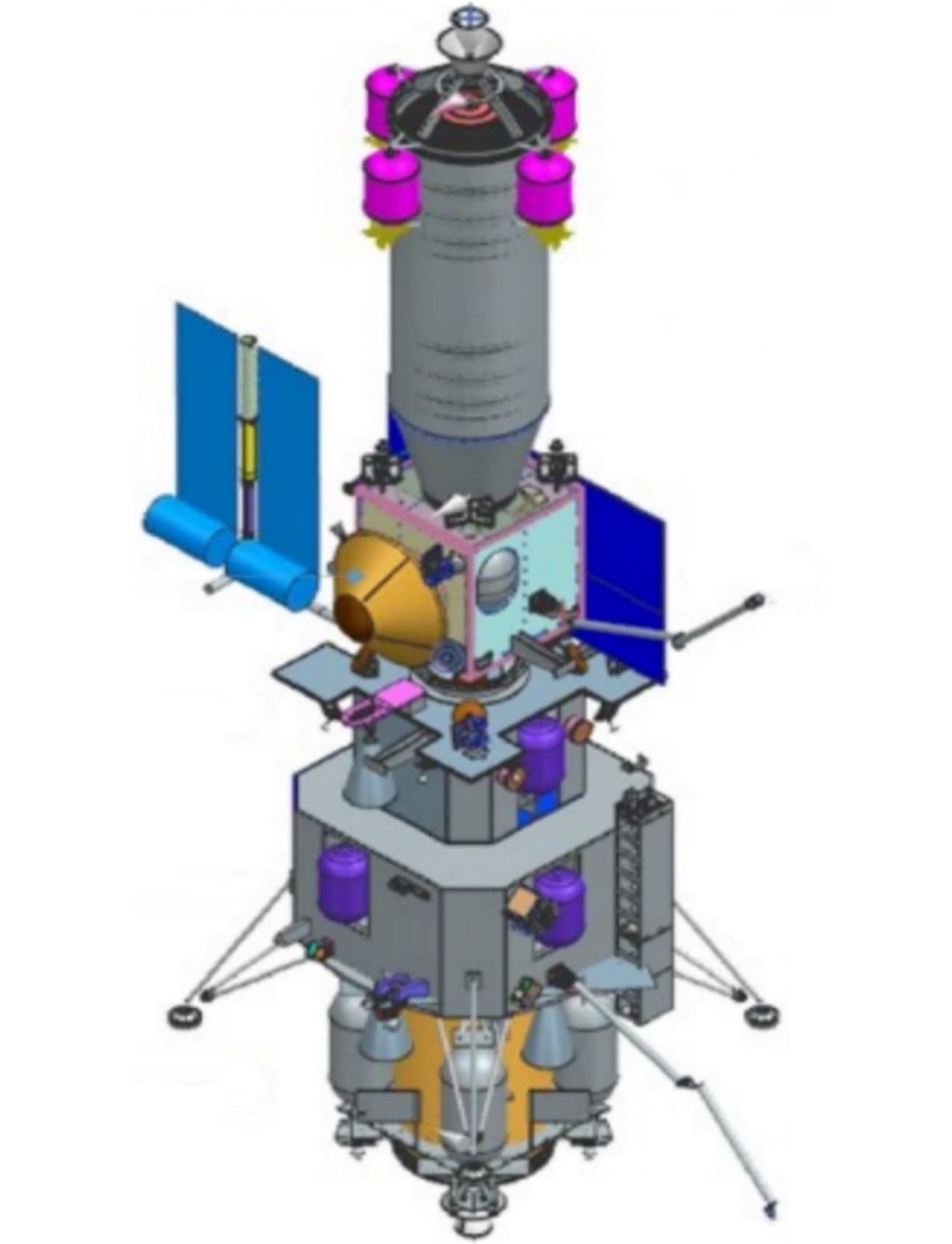
Not yet flown. Dates on this page are the operator's current targets, tagged with when they were announced, and can change.
Commonly wrong. Three recurring confusions in English coverage. (1) Mission identity: for years 'Chandrayaan-4' meant the proposed ISRO-JAXA polar rover mission; since the September 2024 approvals that joint mission is Chandrayaan-5/LUPEX, and Chandrayaan-4 is the all-Indian sample return, so pre-2024 articles describe a different mission under this name. (2) The schedule: '2027' still circulates from the 36-month approval arithmetic and ISRO's science-meet page says 2027-2028, but the chairman's line since December 2025 is 'by 2028', and April 2026 parliamentary reporting says the upgraded LVM3 the mission now needs will not be flight-ready until 2028-29. (3) The landing site: early statements pointed near Chandrayaan-3's Statio Shiv Shakti, but the 2026 OHRC study moved the shortlist to Mons Mouton at 84-86 S, and MM-4 leads the candidates in that single study, with no final site yet confirmed. Sample-mass figures also wobble between 2 and 3 kg across ISRO statements; treat any single hard number with care.
01Mission facts
Status (as of July 2026)
In design and development; not launched. Launch targeted by 2028 (as of July 2026), reaffirmed by ISRO chairman V. Narayanan on Dec 12, 2025↗
Approval
Union Cabinet, Sep 18, 2024; Rs 2,104.06 crore (about $250 million) covering spacecraft, two LVM3 launch-vehicle missions, deep-space network support and design-validation tests; completion envisaged within 36 months↗
Mission goal
Land near the lunar south pole, collect roughly 2 to 3 kg of scooped plus drilled regolith, and return it to Earth; India's first sample-return mission↗
Modules
Five: propulsion module (PM), descender (DM), ascender (AM), transfer module (TM) and re-entry module (RM); the combined DM+AM stack soft-lands↗
Docking plan
Two stacks launch on separate LVM3s and dock in Earth orbit to form the integrated spacecraft; after sampling, the ascender docks with the transfer module in lunar orbit, a robotic maneuver only China has performed (Chang'e 5 and 6)↗
Combined mass
About 9,200 kg across the two stacks↗
Landing region
Mons Mouton, 84-86 S; four candidate zones characterized with Chandrayaan-2 OHRC stereo imagery at better than 32 cm per pixel; MM-4 (84.289 S, 32.808 E) ranked best with 9.89 percent hazard area, 5-degree mean slope and mean elevation 5,334 m↗
Docking heritage
SpaDeX made India the fourth country to demonstrate orbital docking (first docking Jan 16, 2025; second docking announced April 21, 2025), technology the government explicitly ties to Chandrayaan-4↗
Rehearsals already flown
Chandrayaan-3's hop experiment (Sep 2023) previewed ascent-stage liftoff, and its propulsion module returned from lunar orbit to Earth orbit as an explicit sample-return operations rehearsal↗
Launch vehicle risk
Mid-development switch to an upgraded LVM3 with the SE2000 semi-cryogenic engine core stage, reported not flight-ready until 2028-29 (April 2026 parliamentary standing-committee review)↗
Spending pace
Rs 34.6 crore of the Rs 150 crore 2025-26 allocation utilized by January 2026, with materials procurement deferred amid launch-vehicle uncertainty, per parliamentary-committee reporting↗
Science preparation
National Science Meet held April 16, 2025: about 50 scientists from ISRO and 12 research and academic institutions planning landing-site science, sample analysis and a curation facility↗
Site: 84.2890°S, 32.8080°E · Targeted candidate site MM-4, Mons Mouton summit plateau (preliminary, not final) (source)
02Mission timeline
18 Sep 2024
Union Cabinet approves Chandrayaan-4, at Rs 2,104.06 crore with a 36-month completion goal
30 Dec 2024
SpaDeX docking demonstrator launches on PSLV-C60 from Sriharikota
16 Jan 2025
India's first space docking: SpaDeX satellites SDX01 and SDX02 dock in Earth orbit, the core Chandrayaan-4 technology; India becomes the fourth country to do it
21 Apr 2025
Second SpaDeX docking announced, after the March 13 undocking, with further experiments to follow
16 Apr 2025
National Science Meet: about 50 scientists begin sample-analysis and curation planning
12 Dec 2025
ISRO chairman reaffirms the target: "Chandrayaan-4, Chandrayaan-5, as per approval, by 2028 we have to launch"
Feb to Mar 2026
MM-4 candidate site identified: ISRO Space Applications Centre OHRC study, presented at LPSC 2026, ranks MM-4 on Mons Mouton (84.289 S, 32.808 E) as the leading site
Apr 2026
Parliamentary review flags schedule risk: deferred procurement and a mid-development switch to an upgraded LVM3 reported not flight-ready until 2028-29
Targeted 2028
Launch, on two LVM3 flights (as of Jul 2026)
Teal dots: events that physically happened in flight or on the Moon. Grey: announcements, namings, contracts, and targets.
03The mission
Chandrayaan-4 is the step India's lunar program has been building toward since Chandrayaan-3's landing: stop visiting the Moon and start bringing it back. The Union Cabinet approved the mission on September 18, 2024 with a total outlay of Rs 2,104.06 crore covering spacecraft development, two LVM3 launch-vehicle missions, deep-space network support and special design-validation tests, with completion envisaged within 36 months and all critical technologies developed indigenously. The government framed it explicitly as the foundational technology run for an Indian crewed lunar landing by 2040.
The architecture is unlike anything ISRO has flown. Five modules (a propulsion module, descender, ascender, transfer module and re-entry module, about 9,200 kg combined) go up as two stacks on two LVM3 rockets and dock in Earth orbit to form one integrated spacecraft. At the Moon, the descender-ascender pair separates and soft-lands; a surface sampling robot scoops regolith while a drill pulls subsurface material. The ascender then lifts off, the first rocket launch India will ever attempt from another world, and docks with the transfer module in lunar orbit, a robotic feat only China has performed, with Chang'e 5 and 6. The sample container moves to the re-entry module for the ride home, and the capsule lands in India.
The destination moved during development. Early statements pointed near Chandrayaan-3's Statio Shiv Shakti, but by early 2026 ISRO's Space Applications Centre had shifted the shortlist to Mons Mouton, the flat-topped mountain 84 to 86 degrees south named for NASA mathematician Melba Roy Mouton, the same summit where Intuitive Machines' IM-2 Athena toppled in March 2025 and where NASA plans to send its VIPER rover. Using Chandrayaan-2 orbiter OHRC stereo imagery sharper than 32 cm per pixel, the team characterized four candidate zones (a fifth, MM-2, sat in shadow and was dropped) and ranked MM-4, at 84.289 S, 32.808 E on the summit plateau, as the leading site: 9.89 percent hazard area, mean slope of 5 degrees, mean elevation 5,334 m, and the most safe landing grids. No sample in any collection on Earth comes from the lunar polar regions, which is the scientific point of going.
The enabling technology is being retired one risk at a time. SpaDeX, launched on PSLV-C60 on December 30, 2024, made India the fourth country to demonstrate orbital docking when its two 220 kg satellites joined up on January 16, 2025; they undocked on March 13 and completed a second docking announced April 21, 2025, with the government explicitly citing Chandrayaan-4 as the beneficiary. Chandrayaan-3 had already rehearsed the other end of the mission in 2023: its Vikram lander's hop experiment previewed an ascent-stage liftoff, and its propulsion module flew itself from lunar orbit back to Earth orbit as a return-trajectory dress rehearsal. On the science side, ISRO convened a National Science Meet on April 16, 2025, where about 50 scientists from ISRO and 12 research institutions began planning sample analysis and a lunar sample curation facility.
The schedule is the honest caveat. The 36-month approval arithmetic once pointed at late 2027, and ISRO's own science-meet page says 2027-2028, but chairman V. Narayanan's line since December 12, 2025 is "Chandrayaan-4, Chandrayaan-5, as per approval, by 2028 we have to launch." April 2026 reporting on a parliamentary standing-committee review added the risk detail: ISRO switched mid-development to an upgraded LVM3 whose core stage uses the new SE2000 semi-cryogenic engine, a configuration reportedly not flight-ready until 2028-29, and the uncertainty deferred materials procurement, with only Rs 34.6 crore of the Rs 150 crore 2025-26 allocation spent by January 2026. As of July 2026 no launch date is manifested; by 2028 remains the official target (as of July 2026), with slip risk into 2028-29 acknowledged in parliamentary reporting.
04In pictures
Tap a photo to enlarge.
05Sources
- PIB: Union Cabinet approves Chandrayaan-4 (Sep 18, 2024, Rs 2,104.06 crore, 36 months)
- LPSC 2026 abstract 1198: OHRC landing-site characterization, MM-4 selection (Amitabh et al., SAC/ISRO)
- Republic World: ISRO chairman Narayanan, Chandrayaan-4 and 5 by 2028 (Dec 12, 2025)
- Jatan.space Moon Monday 241: architecture, docking plan and science case
- Moon and Beyond blog: independent reproduction of the OHRC MM-4 site analysis (Feb 21, 2026)
- News Karnataka via Dailyhunt: parliamentary review of Chandrayaan-4 delays and LVM3 switch (April 2026)
- ISRO: National Science Meet on Chandrayaan-4 lunar sample return (April 16, 2025)
- ISRO: SpaDeX mission page (launch, first docking, fourth country to dock)
- DD News: SpaDeX completes second docking, cited for Chandrayaan-4 (April 21, 2025)
- Indian Defence News: ISRO identifies hazard-free Mons Mouton site (Feb 2026)
- Wikipedia: Chandrayaan-4 (module breakdown, combined mass, sample target)
- UNOOSA: India Space Exploration Roadmap presentation with Chandrayaan-4 CAD (June 2024)
azmth is independent and is not affiliated with or endorsed by NASA, CNSA, Roscosmos, ISRO, JAXA, or any other space agency or company named on this page.