LCROSS
NASA (US) · Impactor · 2009Success

Impacted Cabeus crater Oct 9, 2009; water ice confirmed Nov 13, 2009, quantified at 155 kg in the plume (Science, Oct 2010).
TL;DR· 6 min read
LCROSS turned the question of water at the lunar poles into a measured number. On October 9, 2009 it drove a spent 2,305 kg Centaur stage into Cabeus crater at 2.5 km/s and flew its Shepherding Spacecraft through the plume; the peer-reviewed Science result of 2010 put 155 kg of water vapor and ice in the instruments' view, from regolith about 5.6 percent ice by mass. Live TV showed no flash, but the cameras caught a debris cloud 6 to 8 km wide, and ShadowCam and Mini-RF located the 22 m crater in 2024.
LCROSS is the mission that turned "is there water at the lunar poles?" into a measured number, and every south-pole lander since is chasing the deposit it proved. Casual memory files it as the impact that "showed nothing" on live TV, but the spacecraft's own instruments caught the flash and a sunlit ejecta plume, and the peer-reviewed result was unambiguous: 155 kg of water vapor and ice in the instruments' view, from regolith about 5.6 percent water ice by mass.
Facts as of July 20, 2026, from the sources listed below.
155kg
water vapor and ice measured in the ejecta plume (± 12 kg)
5.6%
water ice by mass in Cabeus regolith (± 2.9%)
2.5km/s
impact speed of the 2,305 kg Centaur stage
$79M
total mission cost, riding shotgun on LRO's rocket
Commonly wrong. Four persistent errors in English coverage. (1) "The impact was a dud." The live NASA TV feed showed no visible flash, and 2009 coverage of disappointed sidewalk astronomy events hardened into a flop narrative. In fact the Shepherding Spacecraft imaged the plume 20 seconds after impact, a debris cloud that spread 6 to 8 km wide as it climbed into sunlight, and every science objective was met. (2) The stale water figure: "about 25 gallons" (or "a dozen 2-gallon buckets") was the preliminary November 13, 2009 estimate; the peer-reviewed 2010 Science result is 155 ± 12 kg in the field of view and 5.6 ± 2.9% ice by mass, and NASA's own later framing is "hundreds of millions of tons" of ice across the polar regions when combined with LRO data. (3) "The impact crater has never been seen." True until 2024; Fassett et al. located the 22 m crater with ShadowCam and Mini-RF (published September 2024), so pages still calling it unseen are stale. (4) "LCROSS hit the dark side of the Moon." Cabeus is on the near side; permanently shadowed crater floors at the poles are a different thing from the far side, and the plume was observed from Earth-facing geometry.
01Mission facts
Launch
June 18, 2009, 21:32 UT, Atlas V 401 from Cape Canaveral (shared with LRO)↗
Impactor
Spent Centaur upper stage, nominal 5,081 lb (2,305 kg) at impact↗
Impact speed
1.55 miles per second (2.5 km/s)↗
Centaur impact
October 9, 2009, 11:31 UT, Cabeus crater floor↗
Shepherding Spacecraft impact
October 9, 2009, 11:36 UT, after flying through the plume↗
Water detected
155 ± 12 kg of water vapor and ice in the instrument field of view↗
Regolith ice concentration
5.6 ± 2.9% water ice by mass at the impact site↗
Mission cost
$79 million (cost-capped secondary payload, launch shared with LRO)↗
Science payload
Nine instruments on the 621 kg (dry) Shepherding Spacecraft: 5 cameras, 3 spectrometers, 1 photometer↗
Management / builder
NASA Ames Research Center (mission), Northrop Grumman, Redondo Beach (spacecraft)↗
Crater (measured 2024)
About 22 m diameter at 84.6780 S, 48.6926 W, located with ShadowCam and Mini-RF (Fassett et al. 2024, GRL, gold open access), roughly 80 m from the earlier Marshall et al. weighted-average estimate and well within its error bars↗
Results announced
November 13, 2009: NASA confirms water in the plume spectra↗
Site: 84.6780°S, 48.6926°W · Cabeus crater floor (permanently shadowed region), lunar south pole (source)
02Mission timeline
Apr 2006
NASA selects LCROSS as LRO's low-cost, fast-track companion mission
18 Jun 2009
Launch at 21:32 UT on Atlas V 401 from Cape Canaveral, with LRO
22 Aug 2009
Inertial reference unit fault triggers thruster firings that burn ~140 kg of propellant, more than half the remaining fuel
29 Sep 2009
Impact target switched from Cabeus A to Cabeus proper on hydrogen data from LRO, Lunar Prospector, Chandrayaan-1 and Kaguya
9 Oct 2009
Centaur impacts Cabeus at 11:31 UT at 2.5 km/s; Shepherding Spacecraft flies through the plume and impacts at 11:36 UT
13 Nov 2009
NASA announces the mission found water in the permanently shadowed crater
22 Oct 2010
Science publishes the quantified result: 155 ± 12 kg of water in the field of view, 5.6 ± 2.9% ice by mass
Sep 2024
ShadowCam and Mini-RF finally locate the 22 m Centaur crater inside the Cabeus permanently shadowed region
Teal dots: events that physically happened in flight or on the Moon. Grey: announcements, namings, contracts, and targets.
03The mission
LCROSS (Lunar Crater Observation and Sensing Satellite) was NASA's bargain shot at the Moon's permanently shadowed craters. Selected in April 2006 as a low-cost, fast-track companion to Lunar Reconnaissance Orbiter, it was cost-capped at 79 million dollars, managed by NASA Ames, built by Northrop Grumman in Redondo Beach, and rode the same Atlas V 401 as LRO from Cape Canaveral on June 18, 2009 at 21:32 UT. Its central trick was thrift: instead of discarding the rocket's spent Centaur upper stage, LCROSS kept it attached for months and aimed it at the Moon as a 2,305 kg kinetic impactor.
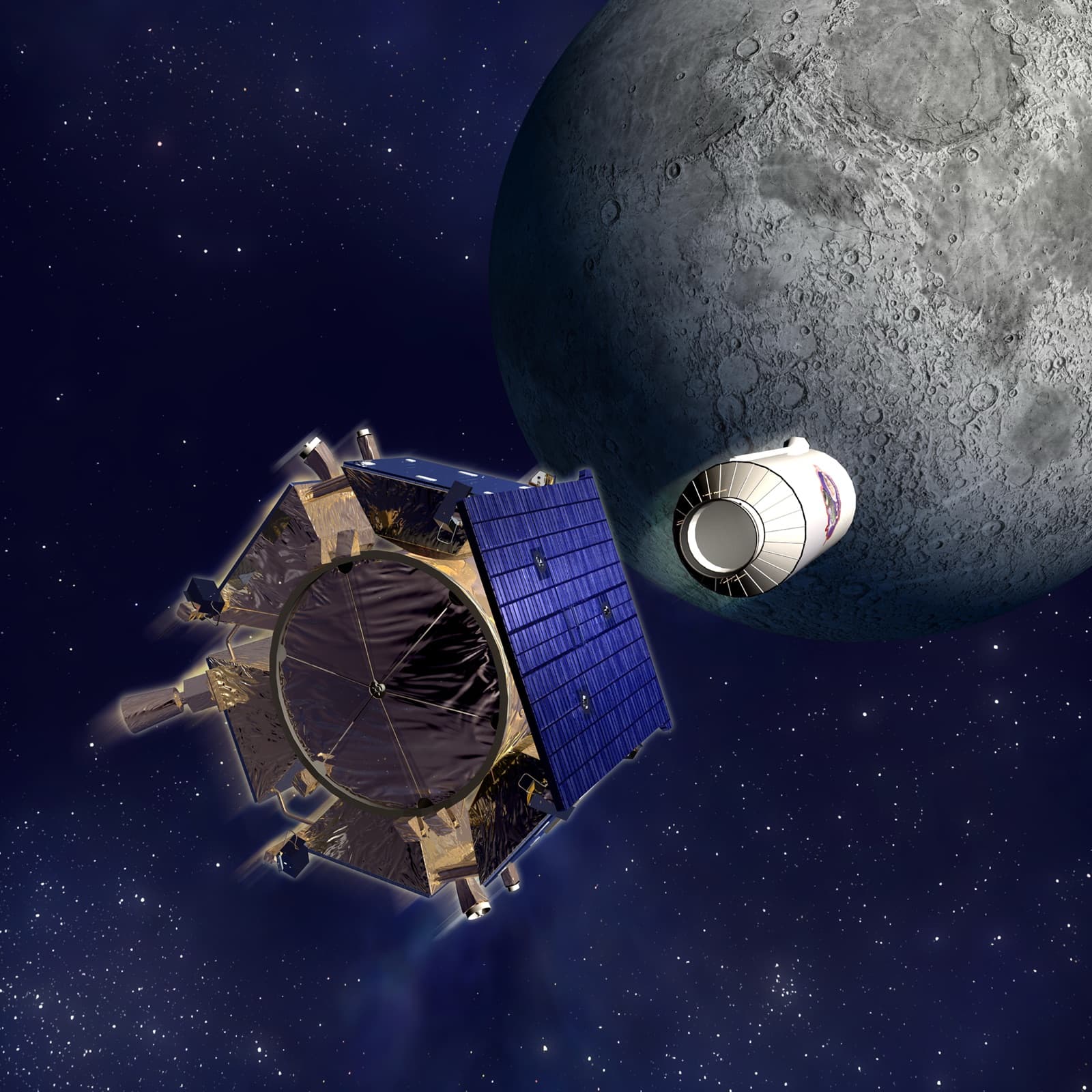
The choreography on October 9, 2009 was a two-body relay. The Shepherding Spacecraft separated from the Centaur about nine hours and 40 minutes before impact, then trailed it down. The Centaur struck the floor of Cabeus crater, a permanently shadowed region near the south pole, at 11:31 UT moving 2.5 km/s. Four minutes later the Shepherding Spacecraft flew through the rising debris with nine science instruments recording, and impacted itself at 11:36 UT. Models had suggested roughly 350 metric tons of regolith would be displaced, with a crater around 20 meters across.
The mission nearly died six weeks earlier. On August 22, 2009 a fault involving the spacecraft's inertial reference unit caused thrusters to fire continuously, burning an estimated 140 kg of propellant, more than half of what remained. Controllers caught it, reprogrammed the fault-protection logic, and flew the rest of the mission on razor-thin margins. The target also moved late: Cabeus A was announced first, then on September 29, 2009 NASA switched to Cabeus proper, where hydrogen maps from LRO, Lunar Prospector, Chandrayaan-1 and Kaguya agreed the signal was strongest, and terrain models showed a gap in the rim ridge that would let the plume climb into sunlight.
The public event underwhelmed: the live NASA TV feed showed no visible splash, and headlines called it a flop. The data said otherwise. The Shepherding Spacecraft's visible camera caught the ejecta plume about 20 seconds after impact: a debris cloud 6 to 8 km across in NASA's released image, and by the peer-reviewed measurement (Colaprete et al. 2010) a sunlit ejecta cloud growing from about 4 km to about 8 km in diameter between 8 and 20 seconds; debris needed to climb only about 833 m to reach sunlight above the shadowed floor. On November 13, 2009 NASA announced the spectra showed water. The full result, published across papers in Science in October 2010, put 155 plus or minus 12 kg of water vapor and ice in the instrument field of view, implying a regolith concentration of 5.6 plus or minus 2.9 percent water ice by mass, along with hydroxyl, light hydrocarbons, carbon dioxide, ammonia, sodium, mercury and silver.
The crater itself stayed hidden for 15 years because it sits in permanent darkness, beyond LROC's reach. In September 2024, researchers using ShadowCam (the NASA-funded camera on Korea's Danuri orbiter) together with LRO's Mini-RF radar finally located it: a roughly 22-meter crater, formed partly atop a pre-existing 32-meter crater, at 84.6780 S, 48.6926 W, about 80 m from the spot Marshall and colleagues had pinned from impact-night imagery and well within their error bars.
LCROSS is the foundation document of the current south-pole race. Artemis surface missions, China's polar plans and a queue of commercial landers all target the volatile-bearing terrain LCROSS certified. The most direct heir is NASA's VIPER ice-mapping rover: cancelled in July 2024, it was revived in September 2025 with Blue Origin contracted to deliver it near the south pole on a Blue Moon MK1 lander, targeted for late 2027 (as of the September 2025 award), though the prerequisite first Blue Moon MK1 test flight had slipped to early 2027 as of mid-2026.
04In pictures
Tap a photo to enlarge.
05Sources
- NASA Science: LCROSS mission page (launch, impact times, ejecta, spacecraft facts)
- NASA: What is LCROSS? (narrative history, Nov 13 2009 announcement, images)
- LRO/LCROSS Press Kit, May 2009 (cost, masses, nine instruments, separation timing, impact speed)
- Colaprete et al. 2010, Science: Detection of Water in the LCROSS Ejecta Plume (155 ± 12 kg, 5.6 ± 2.9%)
- AAAS news summary of the Science LCROSS results
- Marshall et al., Locating the LCROSS Impact Craters (weighted-average coordinates 84.6796 S, 48.7093 W)
- Fassett et al. 2024, GRL: The LCROSS Impact Crater as Seen by ShadowCam and Mini-RF (22 m crater at 84.6780 S, 48.6926 W; gold open access CC-BY)
- SpaceNews: LCROSS Mission on Track Despite Propellant Binge (Aug 22, 2009 anomaly)
- NASA release via Phys.org: LCROSS Mission Changes Impact Crater (Sept 29, 2009 target switch)
- Space.com: NASA Finally Spots Plume from Moon Impact (Oct 2009; its 'high' phrasing mislabeled the 6-8 km plume width as a height)
- NASA release: NASA Selects Blue Origin to Deliver VIPER Rover to Moon's South Pole (Sept 2025)
- NASA images library: KSC-2009-3766 launch photo
- NASA Science image detail: LCROSS impact site LOLA map
azmth is independent and is not affiliated with or endorsed by NASA, CNSA, Roscosmos, ISRO, JAXA, or any other space agency or company named on this page.