Pioneer Lunar Program (1958-1959)
USA (ARPA/USAF, NASA, Army-JPL) · Program · 1958Partial
A completed, mostly failed campaign, Aug 1958 to Mar 1959: five lunar probes, four failures and one partial success. None reached the Moon; only Pioneer 4 escaped Earth's gravity, and it still circles the Sun today.
TL;DR· 8 min read
Between August 1958 and March 1959 the United States tried five times to reach the Moon and never got there. Pioneer 0, 1 and 2 were Air Force Able probes flown on Thor-Able; Pioneer 3 and 4 were tiny Army and JPL cones on Juno II. Pioneer 1 set a distance record at 113,800 km before falling back, Pioneer 3 helped establish the outer Van Allen belt, and Pioneer 4 escaped Earth's gravity but passed the Moon at about 60,000 km, too far to trigger its sensor.
The Pioneer lunar probes are usually remembered as "America's first Moon shots", which is true, and as a NASA program, which is only half true. The first three (Pioneer 0, 1, 2) were built for the Air Force before NASA existed, and the last two (Pioneer 3, 4) belonged to the Army's von Braun rocket team and JPL. Across seven months the United States tried five times to reach the Moon and failed every time: no Pioneer ever got there. Pioneer 1 climbed higher than any object had before, then fell back and burned up; Pioneer 3 died on the way up but caught the outer Van Allen belt on the way; and Pioneer 4, the one "success", sailed past the Moon twice as far out as intended, too distant to trip its own camera trigger.
Facts as of July 20, 2026, from the sources listed below.
5
lunar probes launched in seven months, four outright failures and one partial success
1
reached escape velocity: Pioneer 4, the first US craft to leave Earth's gravity
113,800km
Pioneer 1 peak altitude, a record at the time but only about a third of the way to the Moon
60,000km
Pioneer 4 lunar flyby distance, about twice too far to trigger its Moon sensor
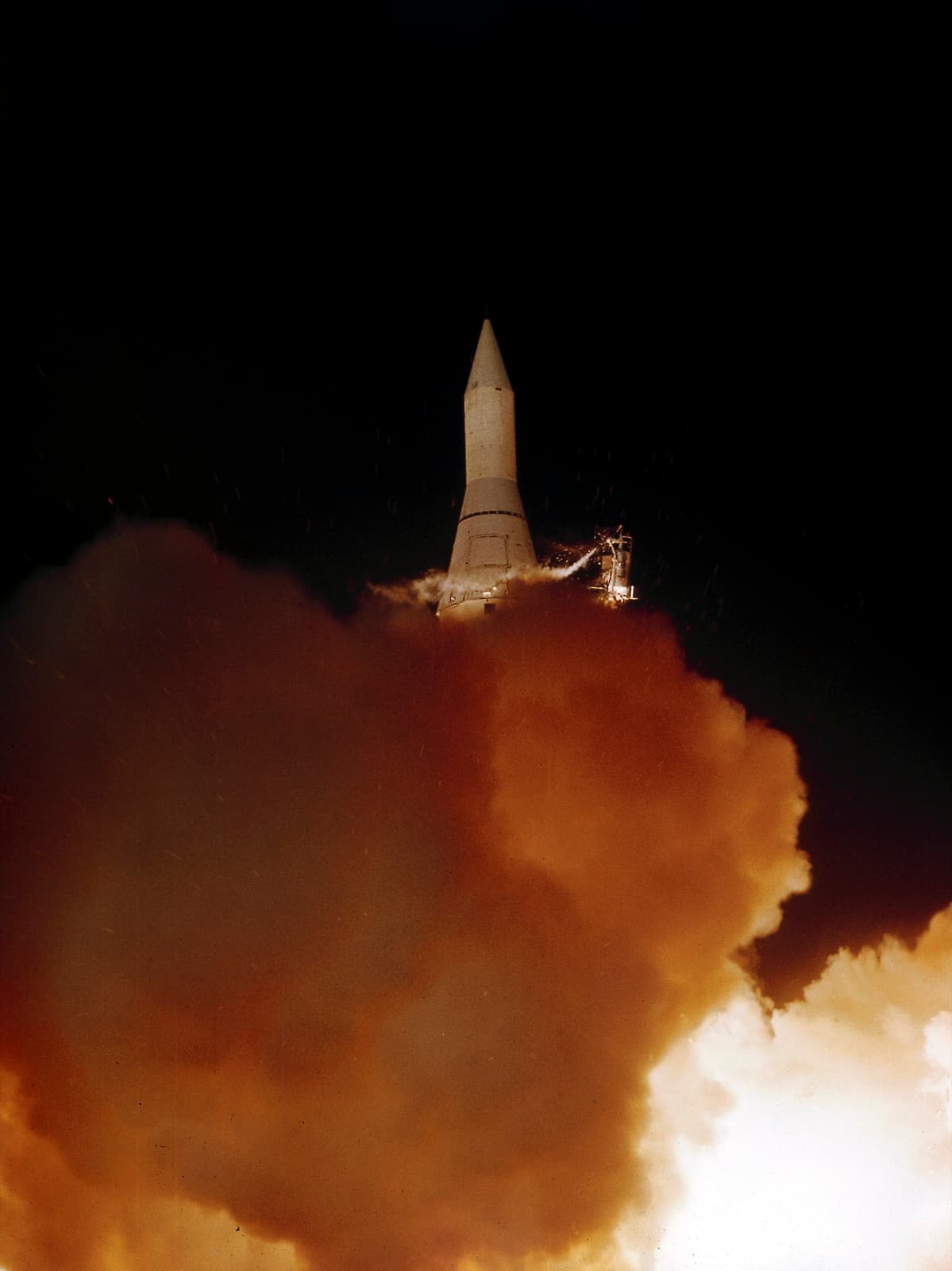
Commonly wrong. Several persistent errors. (1) "The Pioneer program was NASA's first Moon effort": the first three probes (Pioneer 0, 1, 2) were Air Force / ARPA missions begun before NASA existed; NASA only opened on 1 Oct 1958, which is why the first spacecraft flown under NASA is Pioneer 1 (11 Oct 1958) and Pioneer 0 does not count. (2) Treating all five as one team's spacecraft: Pioneer 0-2 were Space Technology Laboratories Able probes on Thor-Able, while Pioneer 3-4 were JPL cones flown by the Army on Juno II, a completely different design. (3) "Pioneer 4 was a full success that reached the Moon": it flew by at about 60,000 km, roughly twice the ~30,000 km its photoelectric sensor needed to trigger, so it took no pictures and detected no lunar radiation; it succeeded only as an escape-velocity and tracking demonstration. (4) The exact Pioneer 0 explosion time varies by source between about 73.6 and 77 seconds; NSSDCA gives 77 seconds at roughly 16 km. (5) The famous photo of three men holding a satellite over their heads (von Braun, Pickering, Van Allen) is Explorer 1 from Jan 1958; there is no Pioneer in it. (6) Later 1959-1960 probes labeled Pioneer P-1, P-3 (Atlas-Able) and Pioneer 5 belong to follow-on efforts and are often mixed up with this first 1958-1959 set.
01Mission facts
Pioneer 0 (Thor-Able 1)
Launched 17 Aug 1958, 12:18 UT from Cape Canaveral; the first US lunar attempt and the first attempted launch beyond Earth orbit by any nation. The Thor first stage exploded about 77 seconds after liftoff at roughly 16 km altitude. An Air Force / ARPA mission: NASA did not yet exist.↗
Pioneer 1
Launched 11 Oct 1958, 08:42:13 UT on a Thor-Able; NASA's very first spacecraft, flown 10 days after the agency opened. An upper-stage error left it on a ballistic arc peaking at 113,800 km; it reentered over the South Pacific on 13 Oct 1958 at 03:46 UT after about 43 hours.↗
Pioneer 2
Launched 8 Nov 1958, 07:30:21 UT on a Thor-Able; the third stage separated but never ignited. Reached only 1,550 km before reentering over northwest Africa. It returned a small amount of data on near-Earth radiation and micrometeorites.↗
Pioneer 3
Launched 6 Dec 1958, 05:45 UT on a Juno II by the Army Ballistic Missile Agency with NASA; a 5.87 kg cone-shaped JPL probe. Its first stage cut off about 3.7 seconds early, so it fell short at 102,360 km altitude and reentered over Africa on 7 Dec 1958.↗
Pioneer 3's real prize
Its two Geiger-Mueller tubes (James Van Allen's experiment) sampled the radiation on the way up and on the way down, and the data showed the trapped radiation was structured as two distinct belts, helping establish the existence of a second, outer Van Allen radiation belt.↗
Pioneer 4
Launched 3 Mar 1959, 05:10:56 UT on a Juno II; the first US spacecraft to reach escape velocity and enter heliocentric orbit. It passed within about 60,000 km of the Moon on 4 Mar 1959 at 22:25 UT at 7,230 km/hr, was tracked to 655,000 km, and reached perihelion on 18 Mar 1959.↗
Why Pioneer 4 is only a partial success
Its photoelectric sensor was designed to trigger a radiation and imaging sequence only within about 30,000 km of the Moon. Pioneer 4 flew by at roughly twice that distance, so the sensor never fired and no lunar photography was obtained; no lunar radiation was detected either.↗
Two programs, one name
Pioneer 0, 1, and 2 were ~34 to 39 kg Able probes built by Space Technology Laboratories (later TRW) and flown on Thor-Able for the Air Force, then NASA. Pioneer 3 and 4 were tiny ~6 kg JPL cones flown on Juno II for the Army. They share a name but almost no hardware.↗
The intended missions
The Air Force Able probes aimed to enter lunar orbit (Pioneer 0 targeted a ~29,000 km orbit) carrying an infrared imaging scanner; the Army/JPL probes were flyby craft meant to pass close to the Moon and continue into solar orbit. None achieved its full plan.↗
NASA's opening act
NASA began operations on 1 Oct 1958, inheriting the Air Force lunar-probe effort. Pioneer 1, launched 11 Oct 1958, was therefore the first spacecraft flown under NASA, even though its rocket and probe had been built by an Air Force contractor.↗
Records set
Pioneer 1's 113,800 km was the greatest distance any human-made object had reached from Earth at that date. Pioneer 4 then became the first American probe to break free of Earth entirely and, as of decades later, was still orbiting the Sun.↗
02Mission timeline
17 Aug 1958
Pioneer 0 (Thor-Able 1) lifts off from Cape Canaveral, the first US Moon attempt; the Thor first stage explodes about 77 seconds into flight over the Atlantic
1 Oct 1958
NASA opens for business and takes over the Air Force lunar-probe program
11 Oct 1958
Pioneer 1, NASA's first spacecraft, launches on a Thor-Able; an upper-stage error caps it at 113,800 km, then it falls back and reenters over the South Pacific on 13 Oct
8 Nov 1958
Pioneer 2 launches on a Thor-Able; the third stage fails to ignite and the probe peaks at just 1,550 km before reentering over northwest Africa
6 Dec 1958
Pioneer 3 launches on a Juno II for the Army and NASA; a premature engine cutoff strands it at 102,360 km, but its Geiger tubes reveal a second, outer Van Allen belt before it reenters on 7 Dec
3 Mar 1959
Pioneer 4 launches on a Juno II and becomes the first US spacecraft to reach escape velocity and leave Earth's gravity
4 Mar 1959
Pioneer 4 passes within about 60,000 km of the Moon at 22:25 UT, too far out to trigger its photoelectric sensor, then continues into solar orbit
18 Mar 1959
Pioneer 4 reaches perihelion, confirmed in a heliocentric orbit; the program's only craft to escape Earth, and its final flight
Teal dots: events that physically happened in flight or on the Moon. Grey: announcements, namings, contracts, and targets.
03The mission
The Pioneer lunar program was born out of a hurry. Sputnik had flown in October 1957, and in early 1958 the new Advanced Research Projects Agency assigned lunar probes to two competing groups: the Air Force, working with Space Technology Laboratories (later part of TRW), and the Army Ballistic Missile Agency, working with the Jet Propulsion Laboratory. The two teams built completely different spacecraft. The Air Force Able probes were squat 34 to 39 kg drums packed with an infrared scanner and radiation instruments, meant to brake into lunar orbit atop a Thor-Able. The Army probes were spartan 6 kg fiberglass cones, little more than a radio, batteries, and Geiger tubes, meant to fly past the Moon on a Juno II. They shared a program name and almost nothing else.
The Air Force went first, and first meant failure. Pioneer 0 rose from Cape Canaveral on 17 August 1958 and its Thor booster blew apart about 77 seconds later, roughly 16 km up. It was, for all its brevity, the first attempt by any nation to send something beyond Earth orbit. When NASA opened its doors on 1 October 1958 it inherited the effort, so Pioneer 1, launched 11 October, counts as the first spacecraft ever flown under NASA. A mis-set valve in the upper stage shorted its burn, and instead of the Moon it reached a peak of 113,800 km, the farthest any object had traveled from Earth to that point, before falling back and burning up over the Pacific two days later. Pioneer 2 followed on 8 November and did worse: its third stage never lit, and it barely cleared 1,550 km.
The Army's turn produced the program's most quietly important result. Pioneer 3 launched on 6 December 1958, and its Juno II first stage shut down a few seconds early, dooming any chance of reaching the Moon. It coasted up to 102,360 km and fell back. But on the way out and the way down, the two Geiger-Mueller tubes built by James Van Allen's group traversed the radiation environment twice, and the data showed the trapped radiation was arranged in two distinct belts rather than one. Pioneer 3, a mission that failed at its stated goal, helped establish the outer Van Allen radiation belt, one of the first genuine scientific discoveries of the space age.
Pioneer 4, launched 3 March 1959, is the one the program can call a win, with an asterisk. Its Juno II performed, and Pioneer 4 became the first American spacecraft to reach escape velocity and break free of Earth's gravity into orbit around the Sun. It passed the Moon on 4 March at about 60,000 km. That was the problem: the probe carried a photoelectric sensor meant to trigger its radiation and imaging sequence only within roughly 30,000 km of the surface, and at twice that range the sensor never fired. No pictures, no lunar radiation reading. What Pioneer 4 delivered was a working deep-space tracking demonstration and a spacecraft that, decades later, was still circling the Sun.
Judged mission by mission, the Pioneer lunar program was a losing streak: five launches, not one arrival at the Moon, and only a single craft that even left Earth's neighborhood. Judged as a beginning, it looks different. In seven frantic months two rival American teams learned how upper stages fail, how to track a probe past 600,000 km, and that space near Earth is layered with radiation. The Moon itself would wait: the United States did not put a spacecraft on a deliberate lunar trajectory that hit its mark until the Ranger and, ultimately, the Surveyor and Apollo programs of the 1960s. Pioneer 0 through 4 were the stumbling first steps that made those possible.
04In pictures
Tap a photo to enlarge.
05Sources
- NSSDCA Master Catalog: Pioneer 0 / Thor-Able 1 (Able 1)
- NSSDCA Master Catalog: Pioneer 1 (1958-007A)
- NSSDCA Master Catalog: Pioneer 2
- NSSDCA Master Catalog: Pioneer 3 (1958-008A)
- NSSDCA Master Catalog: Pioneer 4 (1959-013A)
- NASA History: 65 Years Ago, Pioneer 4 Reaches for the Moon
- Wikipedia: Pioneer 1 (launch time, STL/NASA context)
- Wikipedia: Pioneer 3 (Van Allen belt discovery, Juno II)
azmth is independent and is not affiliated with or endorsed by NASA, CNSA, Roscosmos, ISRO, JAXA, or any other space agency or company named on this page.