Luna 1
USSR (OKB-1) · Flyby · 1959Partial
Missed its intended impact and flew past the Moon at 5,995 km on 4 Jan 1959, becoming the first spacecraft to escape Earth's gravity and orbit the Sun.
TL;DR· 4 min read
Luna 1 was aimed at the Moon and missed it. A ground guidance error turned the intended impact into a 5,995 km flyby on 4 January 1959, and the miss still produced a string of firsts: the first object to escape Earth's gravity, the first direct observations of the solar wind, and the first artificial planet of the Sun. Its instruments also found no lunar magnetic field. Contact was lost about 62 hours after launch.
The first spacecraft ever to reach the Moon's distance was trying to hit it. A guidance-system error turned Luna 1's intended impact into a 5,995 km flyby on 4 January 1959, and the miss still produced a string of firsts: first object to escape Earth's gravity, first direct observation of the solar wind, and first artificial planet of the Sun.
Facts as of July 20, 2026, from the sources listed below.
5,995km
closest approach to the lunar surface
34h
hours from Earth to the Moon
1st
human-made object to escape Earth's gravity
113,000km
distance of the glowing sodium-cloud beacon
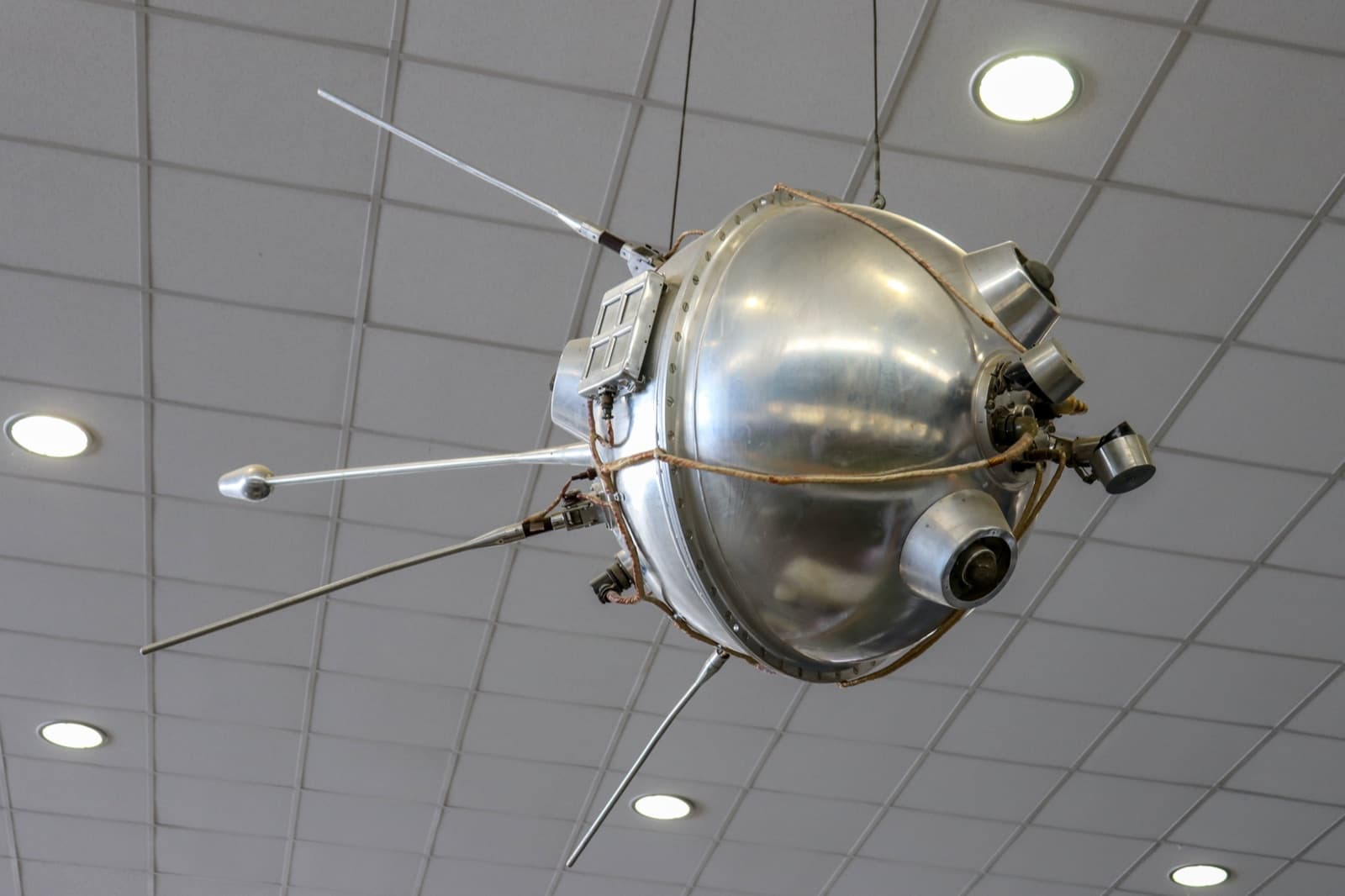
Commonly wrong. Luna 1 is often described in English as the first planned lunar flyby. It was an intended impactor: NASA's Siddiqi chronicle (SP-2018-4041), drawing on post-Soviet archival sources, states the objective outright as lunar impact, and NSSDCA independently concluded the same from its velocity and its cargo of Soviet emblems; a ground error in the guidance system caused the miss. It was also the fourth Ye-1 attempt, following three unannounced 1958 launch failures. The flyby distance is quoted inconsistently even across NASA sources: 5,995 km per NSSDCA versus 6,400 km in the live NASA-hosted Siddiqi chronicle, which notes some sources say up to 7,500 km.
01Mission facts
Launch
2 January 1959, 16:41:21 UT, Tyuratam (Baikonur), on an 8K72 (no. B1-6)↗
Spacecraft mass
361.3 kg (NSSDCA lists 361 kg)↗
Intended mission
Lunar impact, stated outright in NASA's Siddiqi chronicle (SP-2018-4041) from post-Soviet archives; fourth Ye-1 series attempt (three unannounced 1958 launch failures preceded it)↗
Lunar flyby
Within 5,995 km of the surface on 4 January 1959, about 34 hours after launch (NSSDCA; Siddiqi gives 6,400 km and notes some sources say up to 7,500 km)↗
Sodium cloud experiment
1 kg of sodium released 3 January at 00:57 UT, 113,000 km from Earth; visible at magnitude ~6 over the Indian Ocean↗
Key discoveries
First direct observations of the solar wind; Moon found to have no magnetic field; new radiation-belt data↗
Contact lost
About 62 hours after launch↗
Final orbit
Heliocentric, between the orbits of Earth and Mars; nicknamed Mechta and Artificial Planet 1↗
02Mission timeline
2 Jan 1959
Launch at 16:41:21 UT from Tyuratam (Baikonur) on an 8K72; first spacecraft to reach escape velocity
3 Jan 1959
00:57 UT: 1 kg sodium cloud released 113,000 km from Earth; photographed by astronomers as a magnitude-6 orange glow
4 Jan 1959
Flew past the Moon at 5,995 km after a guidance-system error spoiled the intended impact
Around 5 Jan 1959
Contact lost about 62 hours after launch; Luna 1 became the first artificial object in solar orbit
1963
Retroactively renamed Luna 1 (originally announced as Cosmic Rocket)
Teal dots: events that physically happened in flight or on the Moon. Grey: announcements, namings, contracts, and targets.
03The mission
Luna 1 did not fly alone in history: it was the fourth attempt in the Soviet Ye-1 impactor series, after three launch failures in 1958 that were never announced. The Soviet press at the time called the mission simply Cosmic Rocket; the name Luna 1 was applied retroactively in 1963, once there was a successful series to number. The spacecraft itself was a polished 361 kg sphere with whip antennas and protruding instrument ports, carrying a magnetometer, gas-discharge and scintillation counters, ion traps and a micrometeorite detector, plus metallic Soviet emblems. It had no propulsion of its own: everything depended on the launch vehicle's aim.
Launch came on 2 January 1959 at 16:41:21 UT from Tyuratam (Baikonur) on an 8K72, a modified R-7 with a new upper stage. Luna 1 became the first human-made object to reach escape velocity. On 3 January at 00:57 UT, at about 113,000 km from Earth, the flight released a 1 kg cloud of sodium gas that glowed orange with the brightness of a sixth-magnitude star over the Indian Ocean, serving both as an artificial comet for tracking and as an experiment on gas behavior in space.
The aim, however, was off. A problem in the ground-based guidance system meant the upper stage burned on the wrong trajectory, and Luna 1 passed within 5,995 km of the lunar surface on 4 January, about 34 hours after launch, instead of striking it (NSSDCA's figure; Siddiqi gives 6,400 km and notes some sources say as high as 7,500 km). The impact intent does not rest on inference alone: NASA's Siddiqi chronicle (Beyond Earth, SP-2018-4041), drawing on post-Soviet archives, lists the objective outright as lunar impact and attributes the miss to a ground error in a guidance antenna that let the upper stage burn 731.2 seconds, adding 175 m/s of excess velocity; NSSDCA's catalog still frames the intent as a conclusion from the high velocity and the cargo of Soviet emblems. NASA's mission catalog scored the flight a partial success. Ground controllers lost contact roughly 62 hours after launch.
The science salvaged from the miss was substantial. Luna 1's instruments found that the Moon has no detectable magnetic field, returned new data on Earth's radiation belt, and made the first direct observations of the solar wind, the flow of ionized plasma streaming from the Sun through interplanetary space. The probe then entered orbit around the Sun between Earth and Mars, earning the Soviet nicknames Mechta (Dream) and Artificial Planet 1: the first human-made object in heliocentric orbit, where it presumably still is.
04In pictures
Tap a photo to enlarge.
05Sources
- NSSDCA Master Catalog: Luna 1 (Wayback snapshot, 14 Aug 2025; canonical page temporarily offline)
- NASA Solar System Exploration, In Depth: Luna 01 (retired page, Wayback snapshot 22 Nov 2022)
- Siddiqi, Beyond Earth: A Chronicle of Deep Space Exploration 1958-2016 (NASA SP-2018-4041), Luna 1 entry p. 11
azmth is independent and is not affiliated with or endorsed by NASA, CNSA, Roscosmos, ISRO, JAXA, or any other space agency or company named on this page.