Mars Science Helicopter and Chopper
NASA JPL, NASA Ames and AeroVironment · United States · Helicopter · 2020 · AnnouncedIn development
Concept work with nothing approved to fly: as of 24 August 2026 neither the Mars Science Helicopter of March 2020 nor the SUV-sized Chopper of December 2024 has a mission, though the rotors have been tested past Mach 1.
TL;DR· 16 min read
NASA has six years of design work on a thirty kilogram successor to Ingenuity and has never funded one to fly. The Mars Science Helicopter, published in March 2020, settled on a 31.2 kg hexacopter that folds into a 2.5 m aeroshell, and the SUV-sized Chopper of December 2024 remains in early conceptual and design stages. The rotors are real: blades in JPL's 25-Foot Space Simulator reached Mach 1.08 at the tips over 137 runs. The Mars aircraft NASA did adopt, SkyFall, weighs 5 kg.
Ingenuity weighed 1.8 kilograms and carried no science instruments at all. Before it had even flown, JPL and NASA Ames were designing its successor: a second-generation Mars rotorcraft big enough to carry a real payload and to operate with no rover and no lander of its own. Two versions of that vehicle exist on paper, the Mars Science Helicopter and the later Chopper, and both are around thirty kilograms. Neither has ever been funded to fly. What has been funded is the hard part underneath them, the rotors, which were spun past the speed of sound, to Mach 1.08, in a vacuum chamber in Pasadena and held together.
- 31 kgthe most capable Mars Science Helicopter design that still fits a 2.5 m aeroshell
- 36.1 kgChopper's maximum system mass with margin, twenty times Ingenuity's 1.8 kg
- 0vehicles of this class approved for flight as of August 2026
Ingenuity was a technology demonstration with nothing aboard but what it needed to fly. It weighed 1.8 kilograms, its rotor spanned 1.21 metres, it was funded for five ninety-second flights over flat, rock-free ground, and it had to talk to Earth through the rover that carried it. Long before it left the ground, JPL and NASA Ames were designing the machine that would follow it. NASA/TM-2020-220485, dated March 2020, is that design. The Mars Science Helicopter was to carry two to three kilograms of instruments, fly 2 to 4 kilometres at a time, hover for 2 to 4 minutes, and relay through an orbiter so that it could work at unrestricted distance from any rover or lander. The target mass was about 20 kilograms, ten times Ingenuity. Two configurations were carried forward: a coaxial helicopter, which inherits Ingenuity's architecture directly, and a hexacopter with six smaller rotors, which has lower disc loading and better flight dynamics. What decided between them was not aerodynamics but packing. A Mars aircraft has to fold into an aeroshell, and the study worked to the legacy Mars Pathfinder shell, which caps the folded diameter at 2.5 metres. After every folding scheme had been drawn, the hexacopter won because it got 57 per cent more disc area into the same shell. The report says plainly that a bigger aeroshell would buy a better aircraft, which is a way of saying that the limiting factor on Mars aviation is the ride rather than the flying.
The numbers the study finished with are worth stating precisely, because they are the ones everything since has been measured against. Designing for maximum capability at a fixed size, at Jezero Crater in spring with an air density of 0.015 kilograms per cubic metre and a temperature of minus 50 Celsius, with a 25 per cent contingency weight allowance and rotor solidity capped at 0.25, the team arrived at a hexacopter of 31.2 kilograms gross weight drawing 6.2 kilowatts, with a rotor radius of 0.64 metres. Carrying 5 kilograms of payload it would give 10 minutes of hover or 5 kilometres of range. Carrying the baseline 2 kilograms it would give 15 minutes or 8 kilometres. Those figures come with a long list of things the study had not done: airframe structural design, a complete rotor root and hub model, three-dimensional computational fluid dynamics, flight dynamics and control, thermal management, and solar cell sizing against a real operating scenario. The report ends by recommending that a second real aircraft be designed, built and tested, because Ingenuity was the first and one data point is not enough. In November 2024 NASA went further and published the full rotor geometry, planform, twist and airfoils, as a technical memorandum so that other groups could work on it. Concept vehicles do not usually get that treatment.
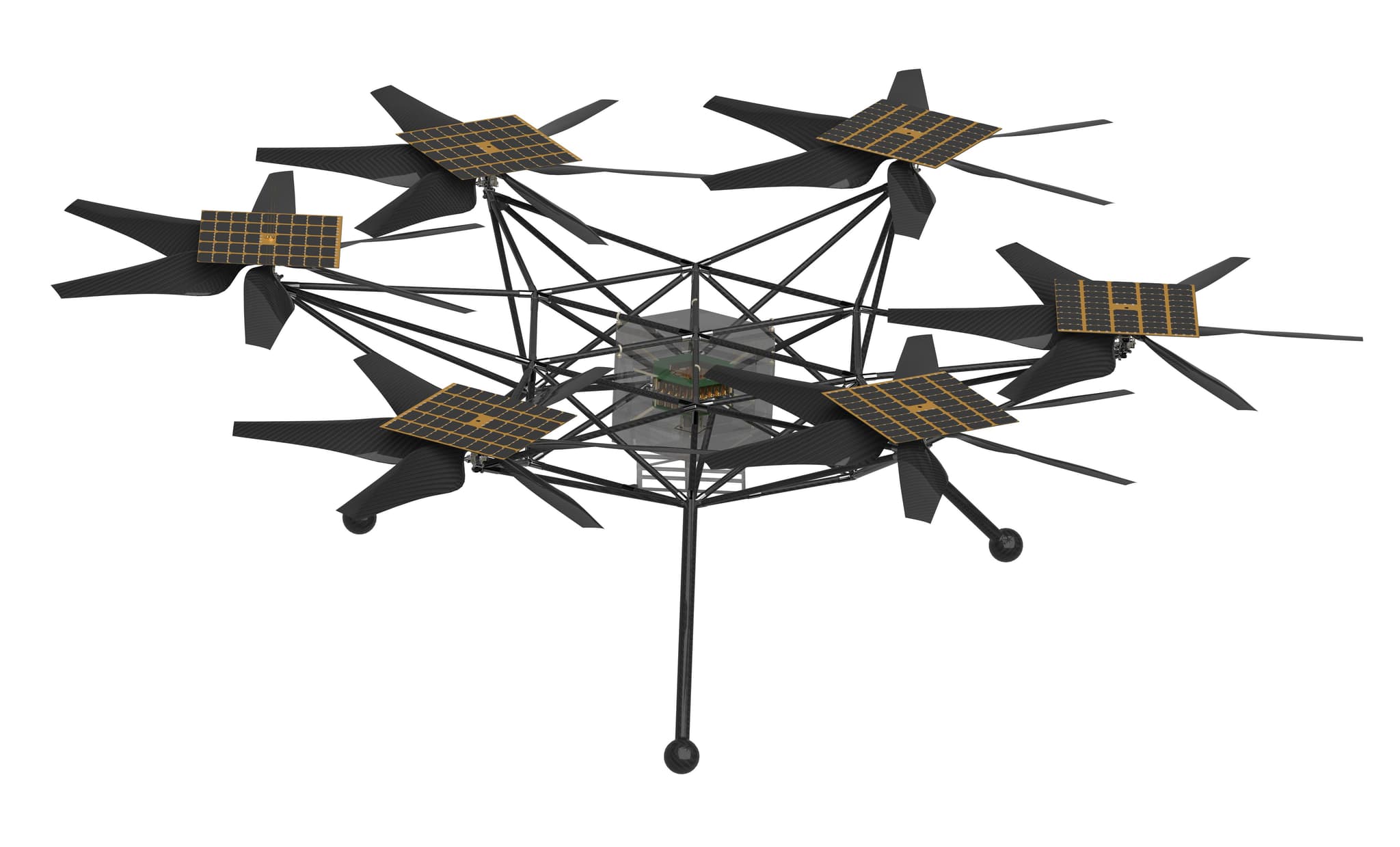
Chopper is the same idea, larger and closer to a product, and its numbers are quoted inconsistently enough to be worth untangling. JPL's public rendering, released on 11 December 2024, describes a vehicle about the size of an SUV, six rotors each with six blades, carrying science payloads as large as 5 kilograms up to 3 kilometres per sol, and states that it remains in early conceptual and design stages. The engineering paper presented at the Vertical Flight Society forum in May 2025 gives a probable best estimate mass of about 30 kilograms, a 24 per cent unallocated system margin, and a maximum system mass of 36.1 kilograms, with a configuration table listing 3 kilograms of payload, six blades per rotor and a 0.675 metre rotor radius, and payload growth to 10 kilograms if the margin is spent that way. Its own abstract calls Chopper about fifteen times Ingenuity's mass while the companion JPL paper is titled Scaling Ingenuity by a Factor of 20. All of that reconciles once you see which mass is being divided by Ingenuity's 1.8 kilograms. Chopper also changes how the aircraft arrives. Instead of unfolding from a lander, the concept uses Entry, Descent and Flyaway: the aircraft would be let go during descent and fly down on their own gear, deleting the lander, the most expensive and most dangerous element of a Mars surface mission. None of that has been flown. A single jet and a single rotor were tested together at Mars density in March 2025, and that is where the idea stands.
The rotors are the part that has actually been built and broken. In September 2023 a dual rotor system was spun up over three weeks in JPL's 25-Foot Space Simulator, a vacuum chamber that reproduces Martian air, and the carbon-fibre blades reached Mach 0.95 at the tips without failing. In November 2025 the Mars Exploration Program funded a joint JPL, Ames and AeroVironment campaign to go further. A three-bladed next-generation rotor was mounted horizontally and a second two-bladed rotor was aligned vertically to blow a headwind across it, so that the tips could be pushed past the speed of sound. NASA published the result on 7 May 2026: the tips reached Mach 1.08 over 137 runs, worth about 30 per cent more lift, and the data indicate the rotor could surpass the sound barrier without breaking apart. NASA's captions date those runs to November 2025 while its article calls them March tests, and it does not reconcile the two. All dates on this page are UTC. Work on the airframe has continued too, with a finite-element structural analysis of a Mars Science Helicopter blade presented at the Vertical Flight Society's Electric VTOL Symposium in San Jose in late January 2026. None of this is a mission. The 2025 Chopper paper stamps itself pre-decisional information for planning and discussion purposes only, and credits the Ames New Business Council and Convergent Aeronautics Solutions for the money, which is to say aeronautics research funds rather than a flight project. In August 2026 there is no obvious door into which such a vehicle could be proposed: the next Discovery call is not expected before 2028, New Frontiers not before 2027, and NASA's planetary science division is running 200 million dollars below its 2025 level.
The Mars aircraft NASA did adopt is smaller than both. On 24 March 2026 the agency announced SkyFall, three helicopters evolved from the Ingenuity design, each 5 kilograms and 52 centimetres tall with two counter-rotating 1.35 metre blades, released in mid-air during descent and flying themselves down. That is Chopper's landing concept and Chopper's industrial partner carried forward on a vehicle roughly a seventh of Chopper's mass. It is a reasonable outcome and it is also a clear answer about the 30 kilogram class: not yet. The same is true of the closest thing to a precedent. Two Sample Recovery Helicopters joined Mars Sample Return in July 2022 as a backup route for fetching sample tubes, and they too were Ingenuity-class, about 2.3 kilograms with four small wheels and a gripper, rather than anything from the Mars Science Helicopter line. They were absent from the revised architecture NASA published on 7 January 2025 and no release cancelled them. Meanwhile the Mars Exploration Program was told in 2026 to absorb SkyFall inside its own budget, which MEPAG's leadership wrote would effectively eliminate any new developments or missions until SkyFall launches. The Mars Science Helicopter is now six years of accumulated design, published rotor geometry and tested blades, waiting for a payload community and a budget line to exist at the same time.
Mission facts
What the Mars Science Helicopter is
A joint JPL and NASA Ames concept for a second-generation Mars rotorcraft able to conduct science investigations independently of a lander or rover, documented in NASA/TM-2020-220485, Mars Science Helicopter Conceptual Design, by Wayne Johnson and fifteen co-authors, dated March 2020. JPL led the study; Ames was responsible for aircraft sizing and packaging, rotor design and mission performance analysis; the University of Maryland contributed the rotor structural design and analysis. The starting requirements were a two to three kilogram science payload, 2 to 4 km of range, 2 to 4 minutes of hover, relay through an orbiter rather than a rover so it could work at unrestricted distance from other landed assets, and a design target mass of around 20 kg, against Ingenuity at 1.8 kg with a 1.21 m rotor and up to 90 seconds of flight.↗
Two configurations
A coaxial helicopter, which directly inherits Ingenuity's experience, with a rotor diameter of 2.5 to 2.7 m, and a hexacopter with six rotors of 1.0 to 1.4 m diameter. The hexacopter has better performance because of lower disc loading and better flight dynamics; the study carried both forward and settled on the hexacopter, which had 57 per cent more disc area than the coaxial design once both were folded to fit.↗
The constraint that shapes everything
The aeroshell. A Mars rotorcraft has to fold into the shell that carries it through entry, and the study used the legacy Mars Pathfinder aeroshell, which imposes a maximum folded diameter of 2.5 m. Numerous folding methods were examined for both configurations. The report is blunt that a larger aeroshell would allow a larger and more capable aircraft, and that the aeroshell is the limit rather than the aerodynamics.↗
The headline design
A hexacopter with 0.64 m rotor radius, sized for Jezero Crater in spring at an air density of 0.015 kg per cubic metre and minus 50 Celsius, with a 25 per cent contingency weight allowance and rotor solidity capped at 0.25. Gross weight 31.2 kg, power 6.2 kW. With a 5 kg payload it gives 10 minutes of hover or a 5 km range; with the baseline 2 kg payload, 15 minutes of hover or 8 km of range. Every design carried 1.2 kg of equipment and avionics and held a 20 per cent energy reserve.↗
The rotor geometry is published
NASA released the full planform, twist and airfoil definition of the Mars Science Helicopter hexacopter rotor as NASA/TM-20240013701, Mars Science Helicopter Rotor Geometry, by Witold Koning, Michelle Dominguez and Wayne Johnson, dated November 2024, explicitly so that other researchers could use it for rotor performance work in the Mars atmosphere. That is unusual for a concept vehicle and is one reason this design keeps reappearing in the literature.↗
Chopper, as NASA described it publicly
On 11 December 2024 JPL released a design rendering, PIA26375, of the Mars Chopper concept: about the size of an SUV, six rotors each carrying six blades, able to carry science payloads as large as 5 kg over distances of up to 3 km each Martian sol. NASA's caption states that "Chopper remains in early conceptual and design stages" and that the design is a collaboration between JPL, NASA Ames and AeroVironment Inc.↗
Chopper's numbers in the technical literature
The engineering papers give different figures from the press caption, and they do not agree with each other either. The 2025 Vertical Flight Society paper describes Chopper as a hexacopter of about 30 kg probable best estimate mass, with a 24 per cent unallocated system-level margin taking maximum system mass to 36.1 kg; its configuration table lists aircraft mass 36.1 kg, payload mass 3 kg, six blades per rotor and 0.675 m rotor radius, with payload growth to 10 kg if the margin is spent that way. The same paper's abstract calls Chopper about 15 times Ingenuity's mass, while the companion JPL paper is titled Scaling Ingenuity by a Factor of 20. We worked the two ratios out ourselves, and they only roughly close: dividing by Ingenuity's 1.8 kg, the 30 kg probable best estimate gives 16.7, which the abstract appears to round down to about 15, and 36.1 kg gives 20.1, which is the companion paper's factor. We have not read that companion paper (Grip et al., IEEE AeroConf 2025), only its title in the reference list.↗
How Chopper would land
Not from a lander. The concept uses Entry, Descent and Flyaway, previously called MAHD, in which the aircraft are released during descent and fly to the surface on their own landing gear. The paper's stated rationale is that this removes the cost and mass of a dedicated lander and opens up landing altitudes too high for a conventional lander. A single jet and rotor were tested together at Mars density in the Planetary Aeolian Laboratory at Ames in March 2025 as a proof of concept.↗
Rotor testing, 2023
On 15 September 2023 a dual rotor system for next-generation Mars helicopters was tested in the 25-Foot Space Simulator at JPL, whose vacuum chamber reproduces Mars-like conditions. Over three weeks the carbon-fibre blades, longer and stronger than Ingenuity's, were spun at ever higher speeds and pitch angles to see whether they held together as the tips approached supersonic speed. They reached Mach 0.95.↗
Rotor testing, 2025
NASA's Mars Exploration Program funded a joint JPL, Ames and AeroVironment proposal for a high solidity, high Mach number rotor test. It ran in the same 25-Foot Space Simulator in November 2025. A three-bladed next-generation rotor was hung horizontally and a second, vertically aligned two-bladed rotor was used to generate a headwind so that the three-bladed rotor's tips could go beyond Mach 1. NASA's caption, released 7 May 2026, states that the data indicate the next-generation rotor could surpass the sound barrier without breaking apart. NASA's article of the same day gives the numbers: tips at Mach 0.98 at 3,750 rpm before the headwind was applied, then pushed to Mach 1.08 across 137 runs, worth about 30 per cent more lift capability. That article dates the supersonic runs to "March tests", while its own photographs and the photojournal caption are both dated November 2025, and NASA does not reconcile the two. We follow the date the captions carry.↗
Still being worked in 2026
Dorcas Kaweesa, Gianmarco Sahragard-Monfared and Joshua Bowman of NASA Ames presented Structural Analysis of a Mars Science Helicopter Blade: Lessons Learned at the Vertical Flight Society's 13th Annual Electric VTOL Symposium in San Jose, California, held 27 to 29 January 2026, applying finite element methods to launch and operational flight load cases and to the blade's modal natural frequencies. The paper's framing is that next-generation Martian rotorcraft have evolved towards high payload vehicles for planetary science missions, and that the structural design has to be matured to bridge spacecraft and aircraft practice.↗
The one time a bigger helicopter got on a manifest
Two Sample Recovery Helicopters were added to the Mars Sample Return campaign in July 2022 as a backup route for getting sample tubes to the Sample Retrieval Lander. They were not Mars Science Helicopters. NASA's specification is Ingenuity-sized: about 2.3 kg, a rotor span of about 1.2 m, four wheels 2 cm wide and about 10 cm across, a gripper, roughly 700 m of flight range and 20 m of flight altitude. They vanished from the architecture NASA published on 7 January 2025.↗
How the pre-decisional status is stated
The 2025 Chopper paper carries the line "Pre-decisional information, for planning and discussion purposes only" at the foot of its acknowledgements, and thanks the NASA Ames New Business Council and NASA's Convergent Aeronautics Solutions for funding the Ames work. That is what this programme is: aeronautics research money and internal business development money, spent on a vehicle nobody has committed to buy.↗
Why there is no route to flight right now
NASA's planetary science division received 2.54 billion dollars for fiscal 2026, about 200 million below fiscal 2025, and division director Louise Prockter told the Lunar and Planetary Science Conference on 16 March 2026 that "we can't continue everything from the past." The next Discovery call for proposals is not expected before 2028 and the next New Frontiers call in 2027, so there is no near-term competed opportunity into which a vehicle of this class could be proposed.↗
And the Mars budget specifically
On 17 June 2026 MEPAG chair Briony Horgan and past chair Vicky Hamilton wrote to the Mars community that the Mars Exploration Program had been directed to absorb and manage the SkyFall payload on the Space Reactor-1 demonstration within its own budget, largely under the Mars Future Missions line, "effectively eliminating any new developments/missions until after SR-1/Skyfall launches," and that SkyFall's costs were anticipated to exceed the 110 million dollars available in that line.↗
What NASA adopted instead
SkyFall, announced at NASA's Ignition event on 24 March 2026 and covered separately in this catalogue. It is three helicopters evolved from the Ingenuity design, released in mid-air during descent, each 5 kg, 52 cm tall, with two counter-rotating blades of 1.35 m diameter, carrying cameras, ground-penetrating radar, temperature sensors and a radiation monitor. It takes Chopper's landing idea and Chopper's industrial partner, and leaves the 30 kg airframe behind.↗
Mission timeline
- Mar 2020NASA/TM-2020-220485, Mars Science Helicopter Conceptual Design, is completed: coaxial and hexacopter configurations, an initial 20 kg target, and a best case of a 31 kg hexacopter inside a 2.5 m aeroshell carrying 5 kg for 10 minutes of hover or 5 km of range.
- 19 Apr 2021Ingenuity makes the first powered flight on another planet, at 1.8 kg. It goes on to fly 72 times and to fly for the last time on 18 January 2024, which is what makes a bigger successor arguable in the first place.
- 27 Jul 2022Two Sample Recovery Helicopters are added to Mars Sample Return, replacing Europe's Sample Fetch Rover. They are Ingenuity-class at about 2.3 kg with wheels and a gripper, nothing from the Mars Science Helicopter line, and they are the closest a second-generation Mars rotorcraft has come to a real manifest.
- 12 Dec 2022NASA publishes a photograph of a physical model of the proposed six-rotor Mars Science Helicopter, describing a payload of 2 to 5 kg and stating that it remains in early conceptual and design stages, a collaboration between JPL, Ames and AeroVironment.
- 15 Sep 2023A dual rotor system for next-generation Mars helicopters is spun up over three weeks in JPL's 25-Foot Space Simulator, reaching Mach 0.95 at the blade tips without failing.
- Nov 2024NASA publishes the full rotor geometry of the Mars Science Helicopter hexacopter as a technical memorandum, so that other groups can use it for Mars rotor research.
- 11 Dec 2024JPL releases the Mars Chopper rendering, PIA26375: SUV-sized, six rotors of six blades, 5 kg of payload up to 3 km per sol, and a caption stating that Chopper remains in early conceptual and design stages.
- 7 Jan 2025NASA announces a revised Mars Sample Return architecture. The Sample Recovery Helicopters are absent from it. We found no release cancelling them.
- Mar 2025A single jet and a single rotor are tested together at Mars atmospheric density in the Planetary Aeolian Laboratory at Ames, a proof of concept for the Entry, Descent and Flyaway landing method Chopper depends on.
- 20 May 2025Withrow-Maser and fourteen co-authors present the Chopper maturation work at the Vertical Flight Society's 81st Annual Forum in Virginia Beach, held 20 to 22 May, with the 36.1 kg maximum system mass, the 0.675 m rotor radius and the note that the whole thing is pre-decisional information for planning and discussion purposes only.
- Nov 2025Mars Exploration Program funded rotor tests in JPL's 25-Foot Space Simulator drive a three-bladed next-generation rotor to Mach 1.08 at the tips, using a second rotor to create a headwind, over 137 runs. NASA releases the images and the result on 7 May 2026, in an article that calls them March tests while its captions date them to November 2025.
- 24 Mar 2026NASA announces SkyFall at its Ignition event: three 5 kg Ingenuity-derived helicopters, released in mid-air, launching late 2028 aboard SR-1 Freedom. Chopper's landing concept and Chopper's industrial partner go forward. Chopper's airframe does not.
A filled dot marks something that physically happened. A hollow one marks an announcement, a naming or a target.
In pictures
Tap a photo to enlarge.
Sources
- Wayne Johnson et al., Mars Science Helicopter Conceptual Design, NASA/TM-2020-220485 (ARC-E-DAA-TN78199), March 2020
- Witold Koning, Michelle Dominguez and Wayne Johnson, Mars Science Helicopter Rotor Geometry, NASA/TM-20240013701, November 2024
- Shannah Withrow-Maser et al., Critical Aerodynamic and Performance Upgrades to Enable Larger Mars Rotorcraft Such as the Chopper Platform, Vertical Flight Society forum, Virginia Beach, 20 May 2025
- Dorcas V. Kaweesa, Gianmarco Sahragard-Monfared and Joshua Bowman, Structural Analysis of a Mars Science Helicopter Blade: Lessons Learned, presented 27 January 2026 (NASA NTRS record)
- NASA Photojournal PIA26375: NASA's Mars Chopper Concept (Rendering), 11 December 2024
- NASA: Model of Proposed Mars Science Helicopter, 12 December 2022
- NASA: Testing Next-Generation Mars Helicopter Rotors, 22 November 2023
- NASA Photojournal PIA26648: NASA's Next-Gen Mars Helicopter Rotors Are Moving Fast, 7 May 2026
- NASA: Sample Recovery Helicopters
- NASA: SkyFall mission page
- MEPAG memo on the NASA Mars Exploration Program budget, 17 June 2026, from chair Briony Horgan and past chair Vicky Hamilton, republished by Astrobiology Web
- SpaceNews (Jeff Foust), 18 March 2026: NASA grappling with planetary science funding shortfall
Facts on this page were verified on 24 August 2026. Where sources disagree, the disagreement is stated rather than resolved silently.