Apollo 10
NASA (US) · Crewed orbiter · 1969Success
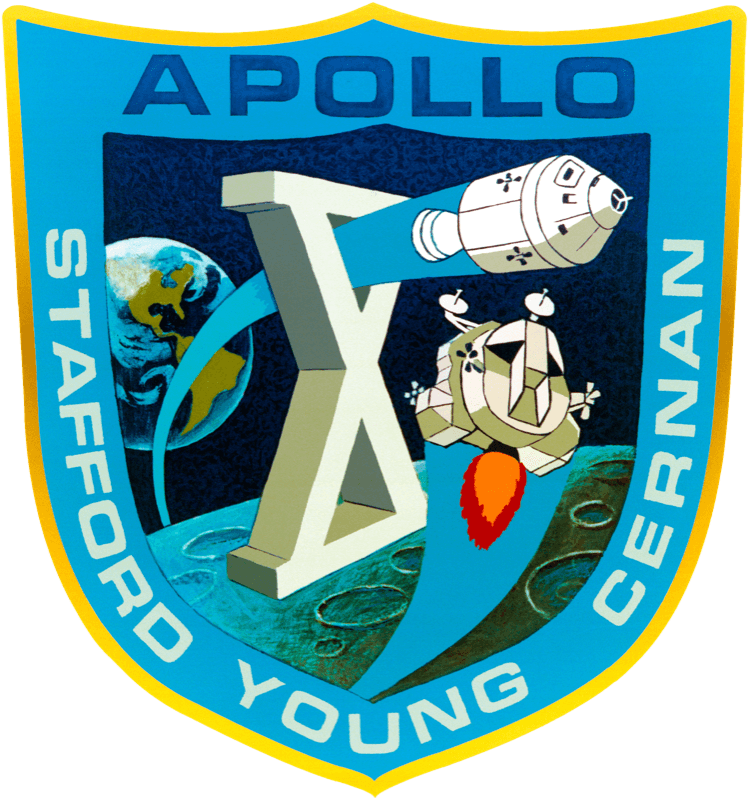
Completed May 26, 1969: full dress rehearsal for the Moon landing; LM Snoopy flew to roughly 47,400 ft above the surface, clearing the way for Apollo 11.
TL;DR· 5 min read
Apollo 10 was the full dress rehearsal for the landing: in May 1969 lunar module Snoopy separated from command module Charlie Brown and flew to roughly 47,400 feet above the surface along Apollo 11's planned approach, doing everything a landing mission would do except touch down. Snoopy's ascent stage was then cast off into an orbit around the Sun, where the catalogue object 2018 AV2 is a likely but unconfirmed match. The crew came home at 24,791 mph, the fastest crewed reentry of the Apollo era.
Apollo 10 flew every step of a Moon landing except the landing itself: lunar module Snoopy separated from command module Charlie Brown in lunar orbit and swooped to roughly 47,400 feet above the surface along Apollo 11's planned approach. Two corrections up front: the widely quoted "15.6 km" low point is the descent-orbit figure, while NASA's histories put the closest pass near 47,400 ft (about 14.4 km); and the crew's famous 24,791 mph return, the fastest crewed reentry of the Apollo era, now needs an asterisk after Artemis II's April 2026 return at about 25,000 mph.
Facts as of July 20, 2026, from the sources listed below.
47,400ft
closest approach to the lunar surface (about 14.4 km)
24,791mph
reentry speed, the crewed record for 57 years
31
lunar orbits over 61 hours 37 minutes
1 billion+
estimated viewers of the first color TV from space
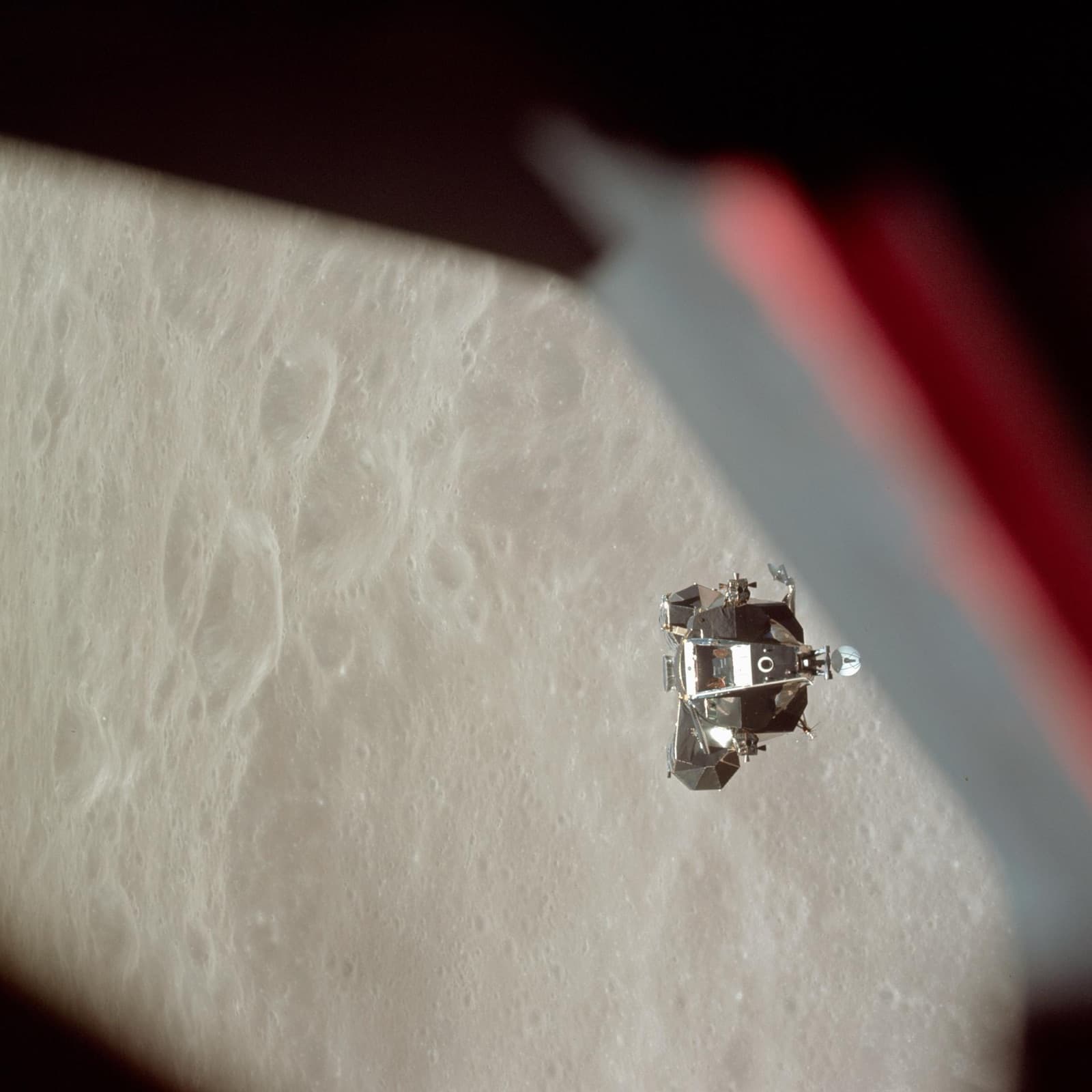
Commonly wrong. Three fixes. Altitude: English sources repeat "15.6 km / 8.4 nautical miles" as Snoopy's closest approach, but that is the descent-orbit low-point figure; NASA's own histories say the closest pass was later calculated at about 47,000-47,400 ft (roughly 14.4 km). Speed record: NASA's 2019 line that the 24,791 mph record "may not be exceeded until an astronaut crew returns from Mars" is stale; Artemis II returned from the Moon on April 10, 2026 with NASA describing entry at about 25,000 mph, though NASA has officially claimed only the distance record (252,756 miles) for that crew, so treat "fastest humans ever" as contested rather than settled. Snoopy: headlines saying the LM "was found" overstate it; the 2019 Royal Astronomical Society announcement made small asteroid 2018 AV2 a roughly 98 percent likely match, but the identification remains unconfirmed, and the object's next close Earth approach is not until July 2037.
01Mission facts
Launch
May 18, 1969, 12:49 p.m. EDT, Launch Pad 39B, Kennedy Space Center, on Saturn V AS-505↗
Crew
Thomas P. Stafford (commander), John W. Young (command module pilot), Eugene A. Cernan (lunar module pilot)↗
Callsigns
Command module "Charlie Brown", lunar module "Snoopy", after the Peanuts characters↗
Lunar orbit insertion
About 76 hours into the mission (May 21, 1969); a second burn 4.5 hours later circularized the orbit at about 69 miles↗
Low passes
May 22, 1969: Snoopy undocked on the 12th revolution (about 98 hours GET), descent orbit of 9.7 by 70.5 miles, closest approach later calculated at about 47,000-47,400 ft above the surface↗
Staging scare
During LM staging Snoopy gyrated unexpectedly in all three axes; Stafford and Cernan recovered quickly, and the motions were traced to a switch set in the wrong position↗
Snoopy's fate
After redocking on May 23 (about 106 hours GET, 16th revolution), the ascent stage fired its engine to fuel depletion, leaving lunar orbit for an orbit around the Sun; asteroid-catalog object 2018 AV2 is a likely but unconfirmed match (RAS announcement, June 2019)↗
Lunar orbits
31 revolutions over 61 hours 37 minutes in lunar orbit↗
TV first
First live color TV transmissions from space; by some estimates more than a billion people watched at least part of the broadcasts↗
Reentry
May 26, 1969: 24,791 mph at entry interface (400,000 ft), "the fastest reentry for any crewed space mission" per NASA history↗
Splashdown
May 26, 1969, 12:52:23 p.m. EDT, Pacific Ocean east of American Samoa (about 165 W, 5 08 S); crew recovered by USS Princeton, about 1.5 miles from target↗
Mission duration
192 hours, 3 minutes, 23 seconds (8 days)↗
02Crew
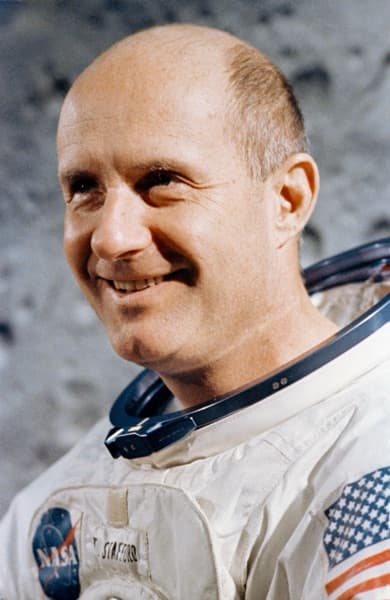

Tom Stafford
Commander
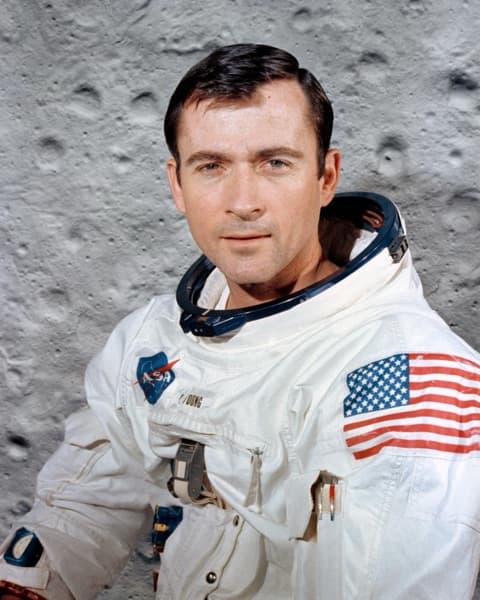
John Young
Command Module Pilot
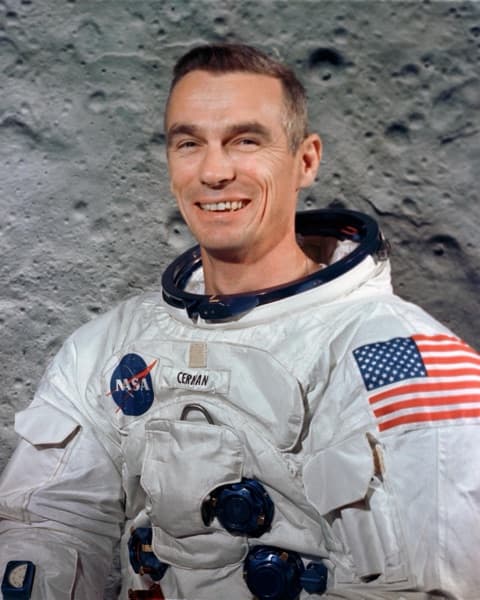
Gene Cernan
Lunar Module Pilot
Portraits: NASA.
03Mission timeline
18 May 1969
Launch at 12:49 p.m. EDT from Pad 39B; translunar injection after 1.5 Earth orbits
18 May 1969
First live color TV pictures from space, showing the S-IVB and Snoopy during transposition and docking
21 May 1969
Lunar orbit insertion about 76 hours into the mission; orbit circularized at about 69 miles
22 May 1969
Stafford and Cernan fly Snoopy down to roughly 47,400 ft above the Moon along Apollo 11's planned approach; brief staging gyrations traced to a mispositioned switch
23 May 1969
Redocking with Charlie Brown; Snoopy's ascent stage burns to depletion and enters orbit around the Sun
24 May 1969
Trans-Earth injection after 31 lunar orbits, followed by a 53-minute color telecast of the receding Moon
26 May 1969
Reentry at 24,791 mph, the fastest crewed reentry of the Apollo era; splashdown east of American Samoa, recovered by USS Princeton
Teal dots: events that physically happened in flight or on the Moon. Grey: announcements, namings, contracts, and targets.
04The mission
Apollo 10 was the full dress rehearsal: the first flight of the complete Apollo stack in lunar orbit, tasked with everything a landing mission would do except touch down. Thomas Stafford, John Young and Eugene Cernan launched from Pad 39B on May 18, 1969, and after a translunar coast entered lunar orbit on May 21, circularized at about 69 miles.
On May 22 Stafford and Cernan undocked lunar module Snoopy from Young in command module Charlie Brown and fired the descent engine, dropping into a 9.7 by 70.5 mile orbit that carried them across the approach path to the Sea of Tranquility site where Apollo 11 would land eight weeks later. Their closest pass was later calculated at roughly 47,400 feet, near enough for Cernan to report that they were "down among" the boulders. The one bad moment came at staging, when Snoopy briefly bucked through all three axes before the crew recovered; the culprit was a guidance switch left in the wrong position.
After redocking on May 23, Snoopy's ascent stage was cast off and burned its engine to fuel depletion, escaping lunar orbit into an orbit around the Sun. That makes it the only flown Apollo lunar module ascent stage that still exists intact somewhere. Amateur astronomers announced in 2019 that the small asteroid-catalog object 2018 AV2 is very likely Snoopy, but the identification is still unconfirmed, and the object will not pass close to Earth again until July 2037.
Apollo 10 also carried the first color television camera into space, and its live color broadcasts, from the docking maneuvers to a 53-minute tour of the receding Moon after trans-Earth injection, reached an audience NASA histories estimate at more than a billion people.
Coming home on May 26, 1969, the capsule hit entry interface at 24,791 mph, which NASA describes as the fastest reentry of any crewed mission, and splashed down within 1.5 miles of its aim point east of American Samoa, where USS Princeton was waiting, 192 hours, 3 minutes and 23 seconds after launch. That speed stood as the human record for 57 years; Artemis II's return from the Moon on April 10, 2026, at what NASA described as about 25,000 mph, likely matched or edged past it, though NASA has formally claimed only the farthest-distance record for the Artemis II crew. Either way, Apollo 10 did its real job perfectly: two months later, Apollo 11 flew the same route the rest of the way down.
05In pictures
Tap a photo to enlarge.
06Sources
- NASA: Apollo 10 mission page
- NASA: Apollo 10 Mission Details
- NASA history: 50 Years Ago, Apollo 10 Clears the Way for the First Moon Landing
- NASA history: 50 Years Ago, Apollo 10 to Sort Out the Unknowns
- NASA history: Charlie Brown and Snoopy in Lunar Orbit
- NASA history: Apollo 10 Clears the Way for the First Moon Landing (60th-anniversary edit)
- Sky & Telescope: Astronomers might have found Apollo 10's Snoopy module (2019)
- NASA news release: NASA Welcomes Record-Setting Artemis II Moonfarers Back to Earth (April 2026)
azmth is independent and is not affiliated with or endorsed by NASA, CNSA, Roscosmos, ISRO, JAXA, or any other space agency or company named on this page.
Flag icons: circle-flags by HatScripts, MIT license.