Zond 5
USSR · Flyby · 1968Success
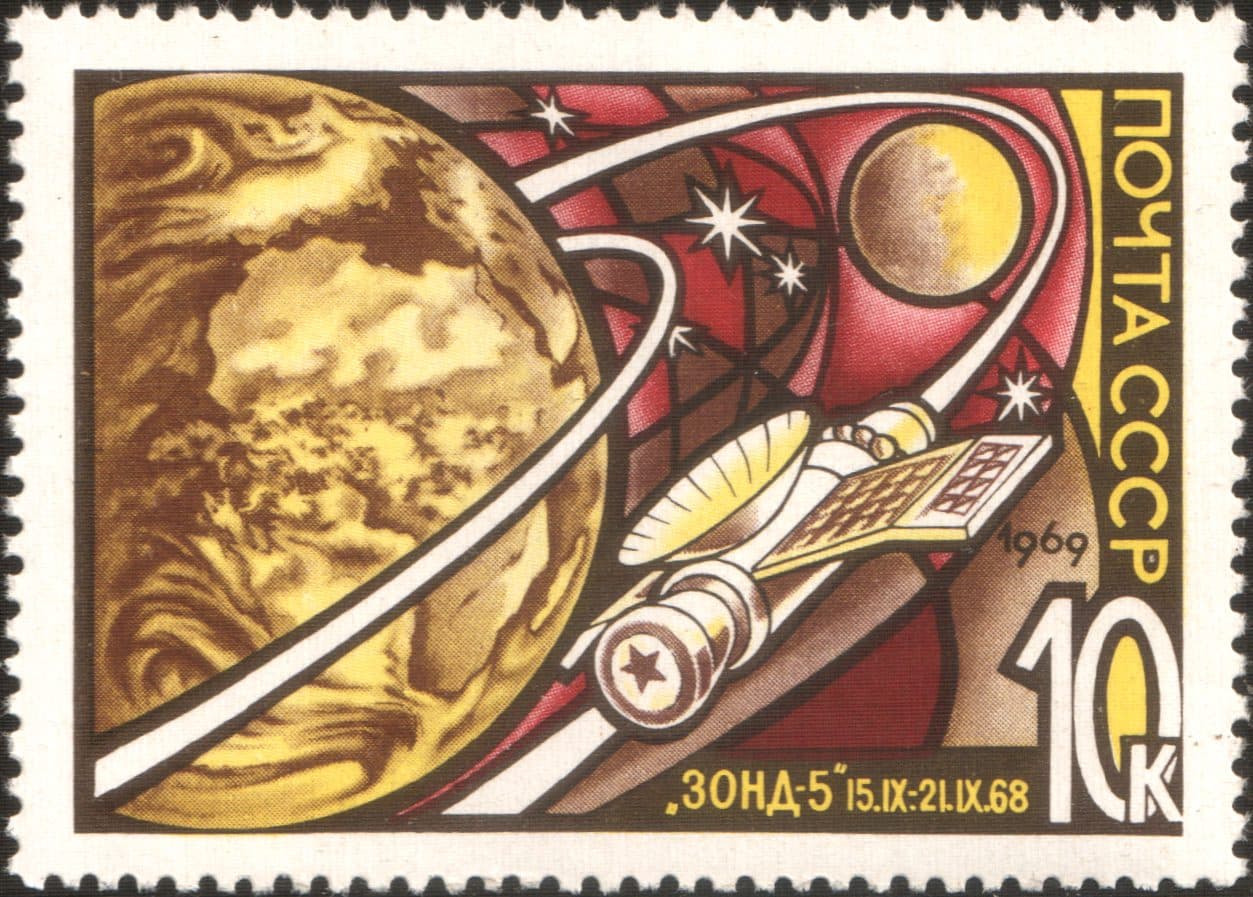
Uncrewed circumlunar flight, Sep 14-21, 1968: first spacecraft (and first Earth life, two steppe tortoises) to loop around the Moon and return safely to Earth.
TL;DR· 6 min read
Zond 5 sent a stripped-down Soyuz around the far side of the Moon in September 1968 and brought it back, the first spacecraft and the first Earth life to return from the Moon's vicinity. It flew a single free-return loop 1,950 km above the far side with no lunar orbit, then made a ballistic reentry and splashed down in the Indian Ocean on September 21. Its two steppe tortoises survived, and the flight helped push NASA toward sending Apollo 8 to lunar orbit that December.
In September 1968 the Soviet Union sent Zond 5, a stripped-down Soyuz built for the crewed circumlunar program, around the far side of the Moon and brought it home: the first spacecraft, and the first Earth life, ever to return from the Moon's vicinity. Contrary to a favorite English retelling, nothing orbited; Zond 5 made a single free-return loop 1,950 km above the far side, no lunar orbit involved. Its safe splashdown, plus the recorded cosmonaut voice Western antennas heard coming from it, helped push NASA toward committing Apollo 8 to the Moon three months later.
Facts as of July 20, 2026, from the sources listed below.
1,950km
closest pass over the lunar far side, Sep 18, 1968
2tortoises
first Earth life to travel around the Moon and return
6d 18h 24m
launch to Indian Ocean splashdown, Sep 14-21, 1968
90,000km
distance of its high-quality Earth photographs
Commonly wrong. English coverage routinely says the Zond 5 tortoises "orbited the Moon" (even Astronomy.com's retrospective uses "orbited another world"). They did not: Zond 5 flew a single free-return circumlunar loop, passing 1,950 km over the far side with no orbit insertion; the first living creatures to actually orbit the Moon were Apollo 8's crew. Related fixes: many US headlines call them "turtles", when they were steppe (Horsfield's) tortoises; the Indian Ocean splashdown was the ballistic backup and never the plan (the guided skip reentry toward Soviet territory was aborted by sensor failures); the launch was Sep 14, 1968, 21:42 UTC (some NASA history text says Sep 15, which is local/Moscow time); and the "cosmonaut voices" heard from Zond 5 by Jodrell Bank and the CIA came from a recorded or ground-relayed communications test, with nobody aboard.
01Mission facts
Launch
September 14, 1968, 21:42:11 UTC (00:42 September 15 Moscow time), Proton-K + Blok D, Baikonur (NIIP-5) Site 81/23↗
Spacecraft
Soyuz 7K-L1 no. 9L, c. 5,375 kg, built by TsKBEM for the crewed circumlunar program↗
Trans-lunar injection
Blok D restart about 67 minutes after launch, from a 191 x 219 km parking orbit↗
Lunar far-side pass
1,950 km closest approach (NASA's figure; NSSDCA and RussianSpaceWeb give 1,960 km), September 18, 1968; free-return trajectory, no lunar orbit↗
Biological payload
2 steppe (Horsfield's) tortoises at 0.34-0.40 kg each, Drosophila eggs, dried wheat/barley/pea/carrot/tomato cells, Tradescantia plant, 3 chlorella strains, lysogenic bacteria↗
Earth photography
High-quality photographs of Earth from about 90,000 km, plus far-side lunar imagery↗
Voice incident
Night of September 19-20, 1968: Jodrell Bank heard a Russian voice (a comms test, presumed tape-recorded or relayed) calling out instrument values from the spacecraft↗
Reentry
Guided-skip reentry system switched off after a second attitude-sensor failure; direct ballistic reentry into the backup recovery zone↗
Splashdown
September 21, 1968, 16:08 UTC, Indian Ocean at 32 deg 38 min S, 65 deg 33 min E, 105 km from the nearest Soviet tracking ship; mission duration 6 days 18 hours 24 minutes↗
Recovery
Recovered by Soviet ships Borovichy and Vasiliy Golovnin; capsule delivered to Mumbai (Bombay) October 3, 1968 for return to the USSR↗
Tortoise outcome
Survived; back in Moscow October 7; dissection October 11 after a 39-day fast attributed the main changes to starvation rather than to spaceflight (about 10% body-weight loss)↗
Legacy
First successful circumlunar mission by any nation; with N-1 reconnaissance imagery, it fed NASA's decision to fly Apollo 8 to lunar orbit in December 1968↗
02Mission timeline
2 Sep 1968
Two flight tortoises sealed aboard; feeding stops so spaceflight effects can be isolated
14 Sep 1968
21:42 UTC (15 Sep Moscow time): launch from Baikonur Site 81/23 on Proton-K; Blok D restart sends it moonward about 67 minutes later
17 Sep 1968
03:11 UTC: midcourse correction at 325,000 km using backup Sun/Earth sensors after the 100K star tracker fails from contamination
18 Sep 1968
Loops 1,950 km above the lunar far side on a free-return trajectory; photographs the Moon and Earth
19 to 20 Sep 1968
Jodrell Bank hears a Russian voice calling out instrument values from the returning craft, a comms rehearsal that briefly reads as a crewed flight
21 Sep 1968
16:08 UTC: ballistic reentry into the backup zone; splashdown in the Indian Ocean at 32 deg 38 min S, 65 deg 33 min E; first successful circumlunar return
3 Oct 1968
Recovery ship Vasiliy Golovnin delivers the capsule to Mumbai (Bombay) for return to the USSR
7 to 11 Oct 1968
Tortoises reach Moscow Oct 7; dissection Oct 11 traces the changes to their 39-day fast instead of to spaceflight
21 to 27 Dec 1968
Apollo 8, greenlit partly on fear of a crewed Zond, orbits the Moon with humans aboard
Teal dots: events that physically happened in flight or on the Moon. Grey: announcements, namings, contracts, and targets.
03The mission
Zond 5 was not a science probe wearing a disguise; it was a dress rehearsal for putting cosmonauts around the Moon. The spacecraft was a Soyuz 7K-L1 (vehicle no. 9L, about 5,375 kg), a Soyuz descent module and service module with the orbital module deleted so a Proton-K with a Blok D upper stage could throw it to the Moon. Three previous L1 circumlunar attempts had failed on ascent, so this fourth try only received the public name "Zond 5" after the Blok D restarted about 67 minutes into the flight and sent it out of its 191 x 219 km parking orbit toward the Moon on September 14, 1968 (21:42:11 UTC liftoff from Baikonur's Site 81/23).
Riding inside the descent module was a small ark: two steppe tortoises (Horsfield's tortoises, 0.34 to 0.40 kg each, ages 6 to 7, sealed aboard on September 2 and fasted from that day so spaceflight effects could be isolated), hundreds of Drosophila fruit-fly eggs, air-dried cells of wheat, barley, peas, carrots and tomatoes, a flowering Tradescantia, three strains of chlorella algae, and a bacterial culture. Six control tortoises stayed on the ground. The flight was not smooth: the 100K star tracker failed almost immediately from surface contamination, and controllers had to fly the September 17 midcourse correction (at 325,000 km out) on cruder Sun and Earth sensors. On September 18 Zond 5 swung 1,950 km above the lunar far side and headed home on its free-return trajectory, photographing the Moon and shooting high-quality pictures of Earth from about 90,000 km away.
On the night of September 19-20, Jodrell Bank Observatory heard something startling from the returning spacecraft: a Russian voice calling out instrument readings. West German listeners at Bochum picked it up too. It was a communications test, a recorded or ground-relayed cosmonaut voice played through the spacecraft's radio link to rehearse a future crewed flight, but at the height of the Moon race it read as evidence that Soviet crews were about to fly, and Western observers initially took the mission as proof a crewed circumlunar flight was imminent.
The ending was survivable but not the one Moscow wanted. On the return leg the 101K Earth sensor also failed, the guidance platform shut off the guided-skip reentry system, and controllers had to hand-steer the reentry attitude with the one remaining Sun sensor. Instead of the planned guided reentry to a recovery on Soviet territory, Zond 5 flew a direct ballistic reentry into the backup zone and splashed down in the Indian Ocean at 32 deg 38 min S, 65 deg 33 min E at 16:08 UTC on September 21, 1968, about 105 km from the nearest Soviet tracking ship, after a mission of 6 days, 18 hours and 24 minutes. Soviet vessels Borovichy and Vasiliy Golovnin recovered the capsule, which reached Mumbai (then Bombay) on October 3 for the trip home.
The tortoises survived, arriving in Moscow on October 7. Dissection on October 11, after what was by then a 39-day fast, found the main changes were caused by starvation rather than the trip around the Moon: as animal test results go, a green light. Zond 5 was the first successful circumlunar mission by any nation, and together with reconnaissance photos of the giant N-1 rocket at Baikonur it sharpened NASA's fear of being beaten, feeding the decision to send Apollo 8 into lunar orbit that December. The race verdict is part of the story too: no cosmonaut ever flew a Zond around the Moon, and the L1 program wound down after Apollo 8 and Apollo 11 made it moot.
04In pictures
Tap a photo to enlarge.
05Sources
- Siddiqi, Beyond Earth: A Chronicle of Deep Space Exploration 1958-2016 (NASA SP-2018-4041), Zond 5 entry pp. 79-80
- NASA History, 50 Years Ago: On the Way to the Moon (Zond 5 retrospective)
- NASA Science, Zond 5 resource page (its hosted spacecraft photo is credited 'S.P. Korolev RSC Energia': third-party copyright merely hosted by NASA, not public domain, do-not-self-host tier per the licensing policy)
- Jodrell Bank Centre for Astrophysics, history of early space tracking, part 2 (Zond 5 voice intercept and reentry timing)
- Wikipedia, Zond 5 (recovery ships, tortoise weight loss, launch time cross-check)
azmth is independent and is not affiliated with or endorsed by NASA, CNSA, Roscosmos, ISRO, JAXA, or any other space agency or company named on this page.