Apollo 11
NASA (US) · Crewed landing · 1969Success
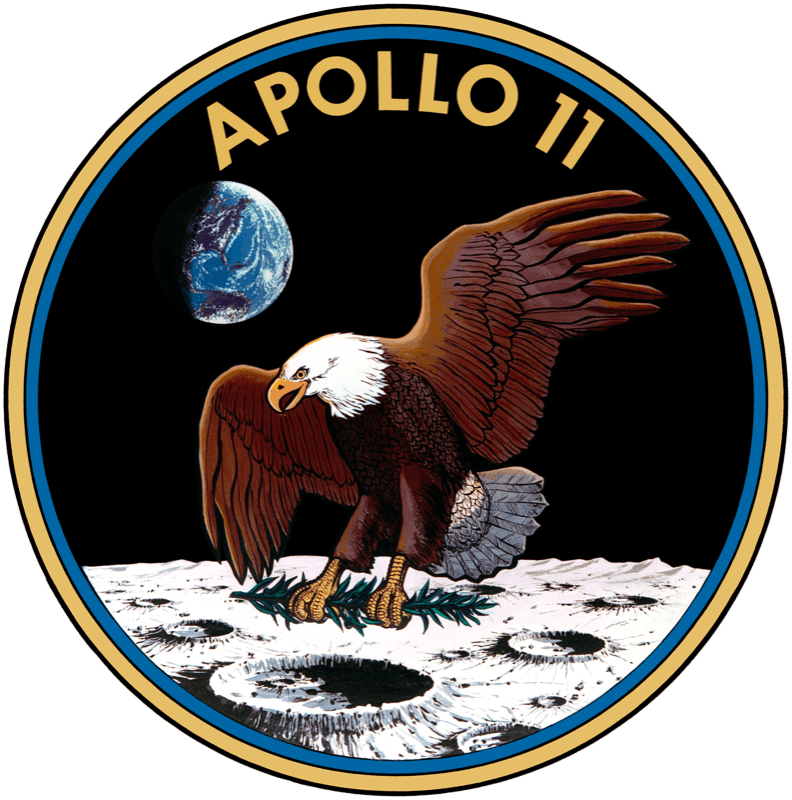
Success: first crewed lunar landing, July 20, 1969, 20:17:40 UTC at Tranquility Base; crew returned to Earth July 24, 1969.
TL;DR· 5 min read
Apollo 11 landed the first humans on the Moon on July 20, 1969, touching down at Tranquility Base at 20:17:40 UTC with, in the LROC science team's words, only tens of seconds of fuel remaining. Armstrong and Aldrin stayed 21 hours 36 minutes, made one moonwalk of about two and a half hours, and brought back 21.5 kg of samples. The retroreflector they left is still ranged by laser stations more than 50 years on, and its successor NGLR-1 reached the Moon in March 2025.
Apollo 11 landed the first humans on the Moon on July 20, 1969, meeting the goal President Kennedy set on May 25, 1961, and it left hardware that is still doing science: laser stations were still ranging to its retroreflector when its successor instrument reached the Moon in March 2025. One correction up front: the iconic surface portrait everyone knows shows Buzz Aldrin. Neil Armstrong carried the camera, and he appears in that photo only as a reflection in Aldrin's visor.
Facts as of July 20, 2026, from the sources listed below.
650M
estimated live TV audience for the first step
21.5kg
of lunar samples returned
21h 36m
spent on the lunar surface
1969
retroreflector deployed, still in scientific use today
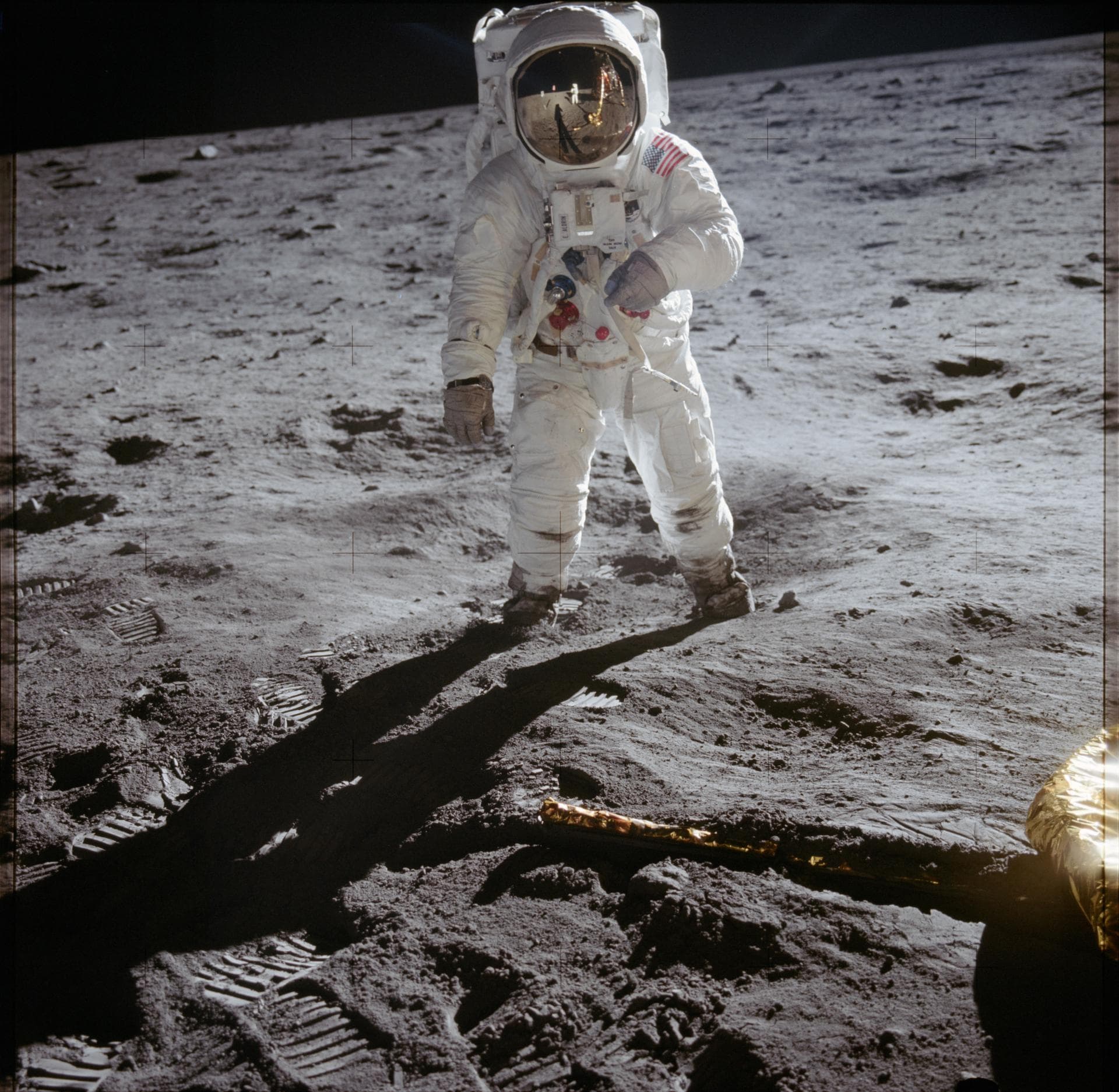
Commonly wrong. Three recurring errors in English coverage. (1) The famous visor portrait (AS11-40-5903) shows Aldrin rather than Armstrong: NASA's own caption notes Armstrong took it, and nearly every clear surface still from Apollo 11 shows Aldrin because Armstrong carried the Hasselblad. (2) The claim 'landed with 17 seconds of fuel' overstates it: what the 60- and 30-second calls counted down to was a mandatory land-or-abort decision, and the LROC site page puts the real margin at 'tens of seconds of fuel remaining'. (3) NASA renders the first words as 'one small step for [a] man'; Armstrong maintained he said, or at least intended, 'a man'. Bonus staleness trap: the Apollo 11 flag is NOT standing today (LROC imaging plus Aldrin's own account of it blowing over during ascent), even though flags still stand at the other Apollo sites.
01Mission facts
Launch
July 16, 1969, 9:32 a.m. EDT (13:32 UTC), Kennedy Space Center Launch Pad 39A, Saturn V↗
Crew
Neil Armstrong (Commander), Michael Collins (Command Module Pilot), Buzz Aldrin (Lunar Module Pilot)↗
Landing
July 20, 1969, 20:17:40 UTC, Mare Tranquillitatis, 0.67416 N, 23.47314 E↗
First step
July 20, 1969, 10:56 p.m. EDT (02:56 UTC July 21)↗
Moonwalk
One EVA of about 2.5 hours, ending 111 h 39 m mission elapsed time; crew stayed within about 300 feet of Eagle↗
Time on surface
21 hours 36 minutes↗
Samples returned
21.5 kg↗
Splashdown
July 24, 1969, 12:50 p.m. EDT, Pacific Ocean, 13 miles from USS Hornet↗
Mission duration
195 h 18 m 35 s, about 36 minutes longer than planned↗
TV audience
An estimated 650 million people watched Armstrong's first step↗
Retroreflector legacy
Apollo-era retroreflector data still used more than 50 years later (NASA, Jan 2, 2025); successor NGLR-1 delivered to the Moon in 2025↗
Flag status
LROC imaging shows flags standing at all Apollo sites except Apollo 11; Aldrin reported it was blown over by ascent engine exhaust↗
Crew status
Armstrong died Aug 25, 2012; Collins died Apr 28, 2021; Aldrin is the last living crew member (as of July 2026)↗
Site: 0.6742°N, 23.4731°E · Tranquility Base, Mare Tranquillitatis (source)
02Crew
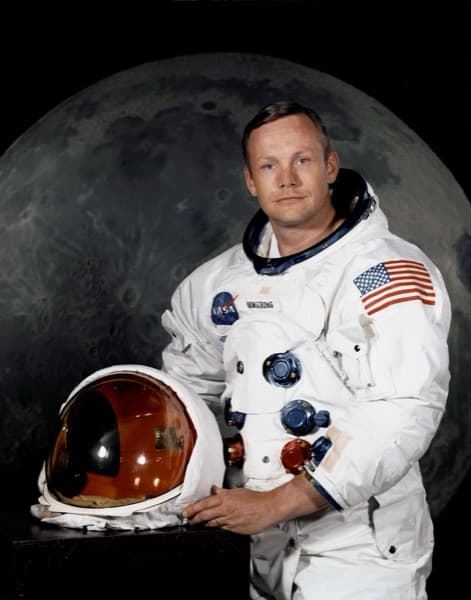

Neil Armstrong
Commander
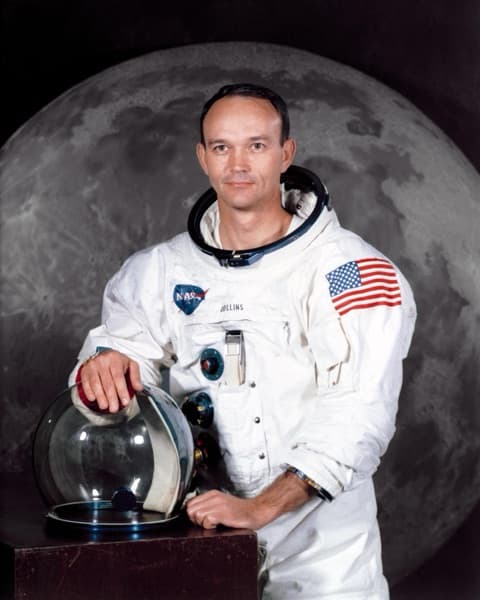
Michael Collins
Command Module Pilot
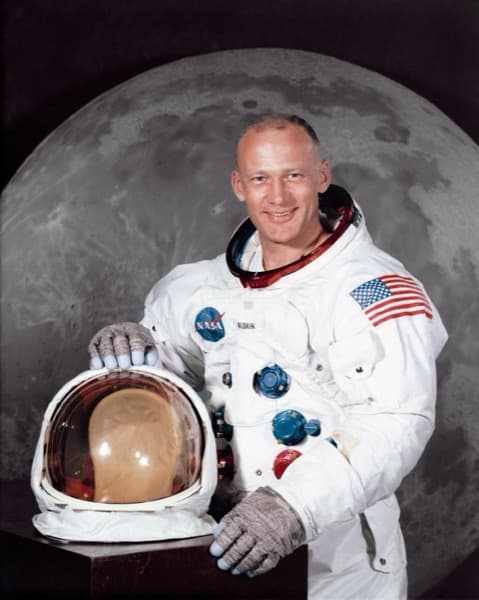
Buzz Aldrin
Lunar Module Pilot
Portraits: NASA.
03Mission timeline
25 May 1961
President Kennedy sets the national goal of a crewed lunar landing and safe return
16 Jul 1969
Launch from Kennedy Space Center Pad 39A at 9:32 a.m. EDT (13:32 UTC)
19 Jul 1969
Lunar orbit insertion, about 75 h 50 m after launch
20 Jul 1969
Eagle lands at Tranquility Base, 20:17:40 UTC
20 to 21 Jul 1969
Armstrong's first step at 10:56 p.m. EDT (02:56 UTC 21 Jul); one EVA of about 2.5 hours
21 Jul 1969
Ascent from the Moon at 124 h 22 m mission elapsed time after 21 h 36 m on the surface; docking with Columbia at 128 h 3 m
24 Jul 1969
Pacific splashdown at 12:50 p.m. EDT, 13 miles from USS Hornet; mission duration 195:18:35
Jul 2012
LROC imaging confirms the Apollo 11 flag is no longer standing, as Aldrin reported
Mar 2025
NGLR-1, the retroreflector program's successor instrument, lands via Blue Ghost; Grasse, Wettzell, and Apache Point record laser returns
Teal dots: events that physically happened in flight or on the Moon. Grey: announcements, namings, contracts, and targets.
04The mission
Apollo 11 launched from Kennedy Space Center Launch Pad 39A on July 16, 1969, at 9:32 a.m. EDT (13:32 UTC) atop a Saturn V, with Neil Armstrong commanding, Michael Collins piloting the command module Columbia, and Buzz Aldrin piloting the lunar module Eagle. Lunar orbit insertion came on July 19, about 75 hours 50 minutes into the flight. On July 20, Armstrong and Aldrin undocked Eagle and began the descent. Armstrong took manual control to fly past the bouldery ejecta of West crater, setting down almost a kilometer beyond the planned spot with, in the LROC science team's words, only tens of seconds of fuel remaining. Touchdown came at 20:17:40 UTC (4:17 p.m. EDT), 102 hours 45 minutes into the mission, followed by the call: Houston, Tranquility Base here. The Eagle has landed.
At 10:56 p.m. EDT on July 20 (02:56 UTC, July 21), Armstrong stepped off Eagle's footpad with the words NASA renders as 'that's one small step for [a] man, one giant leap for mankind,' watched by an estimated 650 million television viewers. Aldrin followed about 20 minutes later. The single moonwalk lasted about two and a half hours, ending at 111 hours 39 minutes mission elapsed time, and the pair never ranged farther than about 300 feet from the lander. They collected 21.5 kg of samples, planted the flag, took a call from President Nixon, and deployed the Early Apollo Scientific Experiments Package: a seismometer and the Laser Ranging Retroreflector. They also left a plaque reading 'Here men from the planet Earth first set foot upon the Moon. July 1969 A.D. We came in peace for all mankind.'
After 21 hours 36 minutes on the surface, Eagle's ascent stage lifted off at 124 hours 22 minutes mission elapsed time and docked with Columbia at 128 hours 3 minutes. Splashdown came on July 24, 1969, at 12:50 p.m. EDT in the Pacific, 13 miles from the recovery ship USS Hornet, closing a mission of 195 hours 18 minutes 35 seconds, about 36 minutes longer than planned.
The site is still an active laboratory. NASA wrote in January 2025 that lunar research 'still leverages data from those Apollo-era retroreflectors' more than 50 years on, and the program's direct successor, the University of Maryland's Next Generation Lunar Retroreflector NGLR-1, landed aboard Firefly's Blue Ghost on March 2, 2025; observatories at Grasse, Wettzell, and Apache Point recorded laser returns from it that same month, extending a ranging record that began with Apollo 11's array in 1969. Since 2009 the Lunar Reconnaissance Orbiter Camera has repeatedly imaged Tranquility Base, resolving the descent stage, the science instruments, and the dark line of Armstrong's trail to Little West crater. Those images also settled a question: the flags still cast shadows at every Apollo site except Apollo 11. Aldrin reported watching the flag blow over in the ascent engine's exhaust, and LROC concluded he was correct.
Armstrong died on August 25, 2012, and Collins on April 28, 2021. As of July 2026, Buzz Aldrin is the mission's last living crew member. The 57th anniversary of the landing falls on July 20, 2026.
05In pictures
Tap a photo to enlarge.
06Sources
- NASA: Apollo 11 mission page
- NASA History: Apollo 11 Mission Overview
- NASA History: July 20, 1969: One Giant Leap For Mankind
- LROC Featured Site: Apollo 11 (coordinates, surface stats)
- LROC Featured Image: 'Houston, Tranquility base here.' (M175124932R)
- LROC Featured Image: 'Question Answered!' (flag status at Apollo sites)
- NASA (Jan 2, 2025): NASA Anticipates Lunar Findings From Next-Generation Retroreflector
- UMD Physics: NGLR-1 status, March 12, 2025 (laser returns from Grasse, Wettzell, Apache Point)
- NASA: Statements on Passing of Michael Collins (Apr 28, 2021)
- NASA: Former Astronaut Neil A. Armstrong (died Aug 25, 2012)
- LROC image use terms (credit tag and permitted uses)
azmth is independent and is not affiliated with or endorsed by NASA, CNSA, Roscosmos, ISRO, JAXA, or any other space agency or company named on this page.
Flag icons: circle-flags by HatScripts, MIT license.