Apollo 12
NASA (US) · Crewed landing · 1969Success
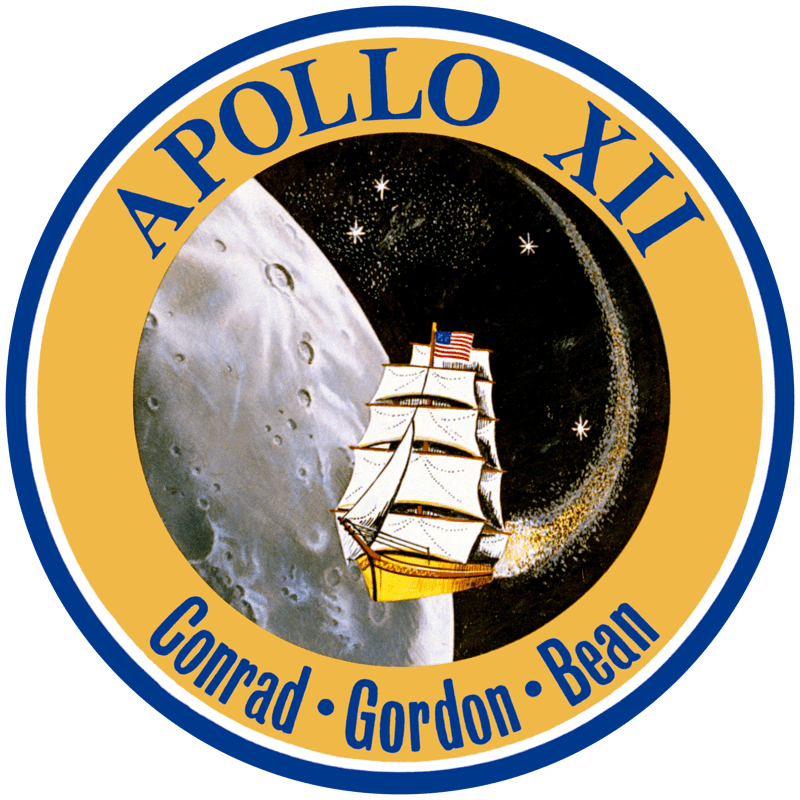
Second crewed Moon landing. Intrepid touched down 19 Nov 1969 in Oceanus Procellarum, about 160 m (535 ft) from the Surveyor 3 probe. Crew returned 24 Nov 1969. Success.
TL;DR· 5 min read
Apollo 12 proved a crew could land exactly where it aimed, setting Intrepid down in the Ocean of Storms on 19 November 1969 about 160 m from the Surveyor 3 probe that had sat there since 1967. Two lightning-like discharges just after liftoff knocked telemetry offline until John Aaron's "SCE to Auxiliary" call, executed by Alan Bean, restored it. Bean then accidentally destroyed the color TV camera when it was pointed at the Sun, so almost no live video came back from the surface.
Apollo 12 proved a crew could land on the Moon exactly where it aimed, setting Intrepid down about 160 m (535 ft) from the Surveyor 3 spacecraft that had been sitting in the Ocean of Storms since 1967. It is often remembered for the two lightning-like discharges that briefly knocked out its Saturn V's telemetry 36 seconds after liftoff, and for the fact that Alan Bean accidentally destroyed the color TV camera early in the first moonwalk, so almost no live surface video reached Earth.
Facts as of July 20, 2026, from the sources listed below.
~160m
from Surveyor 3 (mission-era 535 ft; LROC positions imply ~155 m)
34.4kg
lunar samples returned
2
lightning-like discharges at liftoff
7h 45m
total time spacewalking on the surface
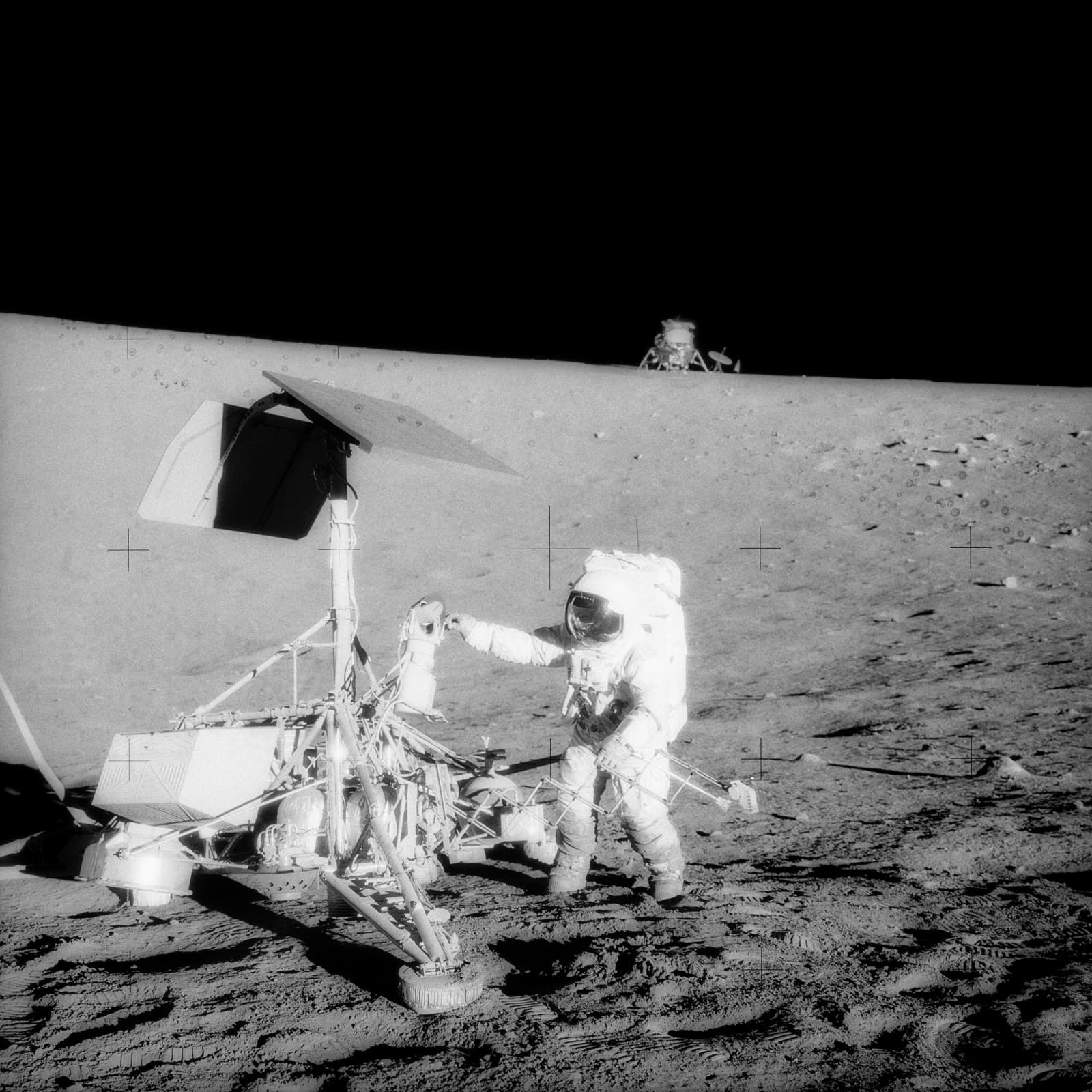
Commonly wrong. English write-ups often say lightning "struck" Apollo 12 from a storm; the two discharges at T+36.5 s and T+52 s were triggered by the vehicle and its ionized exhaust plume forming a conductive path, and the save came from flight controller John Aaron's "SCE to Auxiliary" call executed by Bean. The landing distance from Surveyor 3 is quoted anywhere from 535 to 600 ft; LROC-measured positions put it near 155 m (about 515 ft). Summaries also conflate the 19 Nov 1969 touchdown with the 24 Nov 1969 splashdown. And it is widely forgotten that Bean accidentally burned out the color TV vidicon early in EVA-1, so there was essentially no live television from the Apollo 12 surface.
01Mission facts
Crew
Charles "Pete" Conrad Jr. (commander), Richard F. Gordon Jr. (command module pilot, stayed in orbit), Alan L. Bean (lunar module pilot)↗
Command/Service Module
Yankee Clipper (CSM-108)↗
Lunar Module
Intrepid (LM-6)↗
Launch
14 Nov 1969, 11:22:00 a.m. EST (16:22:00 UTC), Kennedy Space Center LC-39A↗
Lightning discharges
Vehicle-triggered electrical discharges at T+36.5 s and T+52 s; John Aaron's "SCE to Auxiliary" call, executed by Bean, restored telemetry↗
Lunar touchdown
19 Nov 1969, 06:54:35 UTC (GET 110:32:36), Ocean of Storms (Oceanus Procellarum)↗
Distance from Surveyor 3
About 160 m (535 ft) by the mission-era NASA figure; NASA sources quote 535 to 600 ft, and modern LROC positions put the separation at roughly 155 m (LROC's site pages say about 170 yards, and the LROC coordinate table implies 156.8 m)↗
Surface EVAs
Two moonwalks: EVA-1 about 3 h 56 min, EVA-2 about 3 h 49 min, total roughly 7 h 45 min↗
Surface stay
About 31.5 hours on the Moon (touchdown 19 Nov 06:54 UTC to liftoff 20 Nov 14:25 UTC)↗
Samples returned
About 34.4 kg (75.7 lb) of rock and soil↗
Surveyor 3 parts retrieved
TV camera, sample scoop, and cabling cut off and brought back to study micrometeorite and radiation effects after 31 months on the Moon↗
Splashdown
24 Nov 1969, 20:58:24 UTC (3:58:24 p.m. EST), South Pacific; recovered by USS Hornet↗
Mission duration
10 days, 4 hours, 36 minutes↗
Site: 3.0128°S, 23.4219°W · LM Intrepid, Ocean of Storms (Oceanus Procellarum), near Surveyor crater; later designated Statio Cognitum (source)
02Crew
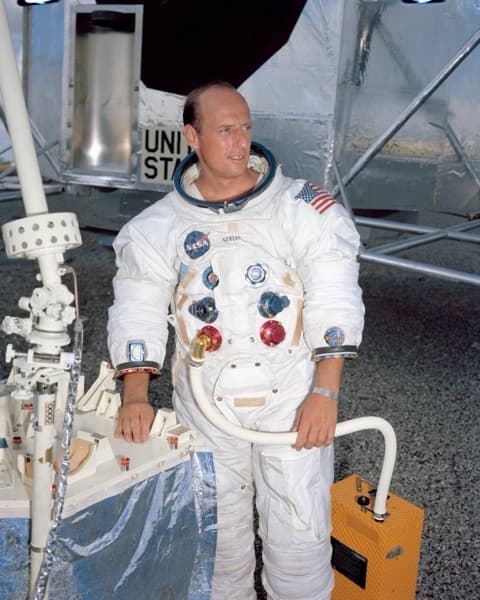

Pete Conrad
Commander
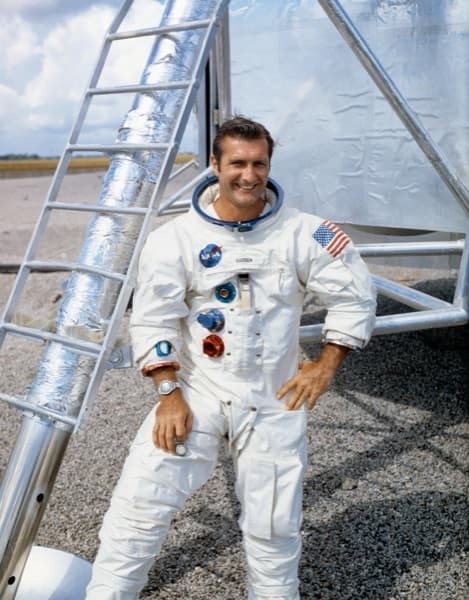
Richard Gordon
Command Module Pilot
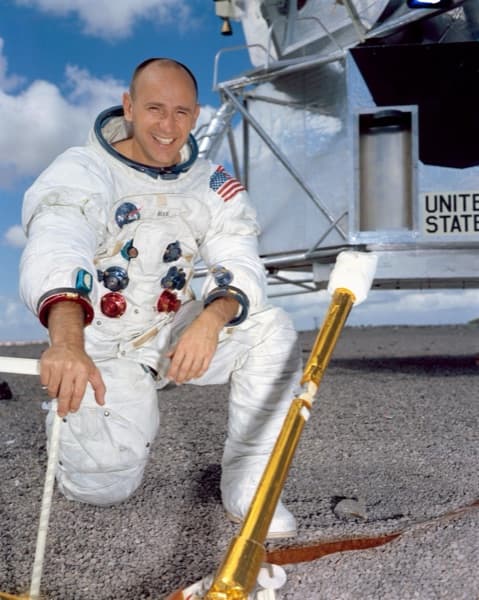
Alan Bean
Lunar Module Pilot
Portraits: NASA.
03Mission timeline
14 Nov 1969
Launch from Kennedy Space Center, 16:22 UTC
14 Nov 1969
Two electrical discharges strike the Saturn V (T+36.5 s, T+52 s)
19 Nov 1969
Intrepid lands in the Ocean of Storms, about 160 m from Surveyor 3, 06:54:35 UTC
19 Nov 1969
First EVA, color TV camera destroyed when aimed at the Sun
20 Nov 1969
Second EVA, crew walks to Surveyor 3 and cuts off its camera
20 Nov 1969
Intrepid lifts off from the Moon, 14:25:47 UTC
24 Nov 1969
Splashdown in the South Pacific, recovered by USS Hornet, 20:58 UTC
Teal dots: events that physically happened in flight or on the Moon. Grey: announcements, namings, contracts, and targets.
04The mission
Apollo 12 launched from Kennedy Space Center at 11:22 a.m. EST (16:22 UTC) on 14 Nov 1969, into a cloudy, rain-flecked sky. About 36.5 seconds after liftoff, and again near 52 seconds, the ascending Saturn V and its ionized exhaust trail formed a conductive path that produced two lightning-like discharges. Telemetry and the spacecraft's fuel cells dropped offline, and the instrument panel lit up with warnings. Flight controller John Aaron recognized the garbled data pattern and called "SCE to Auxiliary," a switch obscure enough that only lunar module pilot Alan Bean knew where it was. Bean flipped it, telemetry returned, and the mission continued to orbit.
The crew was commander Charles "Pete" Conrad Jr., command module pilot Richard F. Gordon Jr., and lunar module pilot Alan L. Bean. While Gordon orbited in the command module Yankee Clipper, Conrad and Bean flew the lunar module Intrepid to a landing in the Ocean of Storms at 06:54:35 UTC on 19 Nov 1969. The point of the mission was precision: NASA aimed Intrepid at the Surveyor 3 robotic probe, which had soft-landed in April 1967, and Conrad set down about 160 m (535 ft) from it by the mission-era NASA figure; modern LROC positions put the separation at roughly 155 m. That accuracy validated the navigation techniques needed for the more ambitious landing sites of later missions.
On the first moonwalk, Bean was mounting the color television camera when it was inadvertently pointed toward the Sun, destroying its light-sensitive tube. As a result there was almost no live TV coverage of the Apollo 12 surface operations, an unlucky footnote for a mission that otherwise went nearly flawlessly. Conrad and Bean deployed the first full Apollo Lunar Surface Experiments Package (ALSEP), a nuclear-powered suite of instruments, and collected geology samples.
During the second EVA the astronauts walked over to Surveyor 3 and cut off pieces of it, including its TV camera and sample scoop, to bring home. Studying those parts told engineers how materials and any hitchhiking microbes fared after 31 months of lunar exposure. Across the two moonwalks the crew logged roughly 7 hours 45 minutes outside and gathered about 34.4 kg (75.7 lb) of samples over a surface stay of about 31.5 hours.
Intrepid lifted off from the Moon on 20 Nov 1969 at 14:25:47 UTC, redocked with Yankee Clipper, and the crew splashed down in the South Pacific on 24 Nov 1969 at 20:58 UTC, recovered by the USS Hornet, the same carrier that had picked up Apollo 11. The total mission ran 10 days, 4 hours, 36 minutes. Apollo 12 remains the benchmark for pinpoint lunar landing in the Apollo program, and the LROC orbiter has since photographed the descent stage, the ALSEP, and Surveyor 3 sitting together in the Ocean of Storms.
05In pictures
Tap a photo to enlarge.
06Sources
- NASA - Apollo 12 mission page
- NASA - Apollo 12: The Pinpoint Mission
- NASA - 55 Years Ago: Apollo 12 Makes a Pinpoint Landing
- NASA Science - Apollo 12 and Surveyor 3
- LROC - Apollo 12 Fifty-first Anniversary (featured image)
- LROC - Spacecraft Related Coordinates, 2016 Update (Wagner et al.)
- Wikipedia - Apollo 12 (cross-check for times and durations)
azmth is independent and is not affiliated with or endorsed by NASA, CNSA, Roscosmos, ISRO, JAXA, or any other space agency or company named on this page.
Flag icons: circle-flags by HatScripts, MIT license.