Apollo 13
NASA (US) · Crewed flyby · 1970Partial
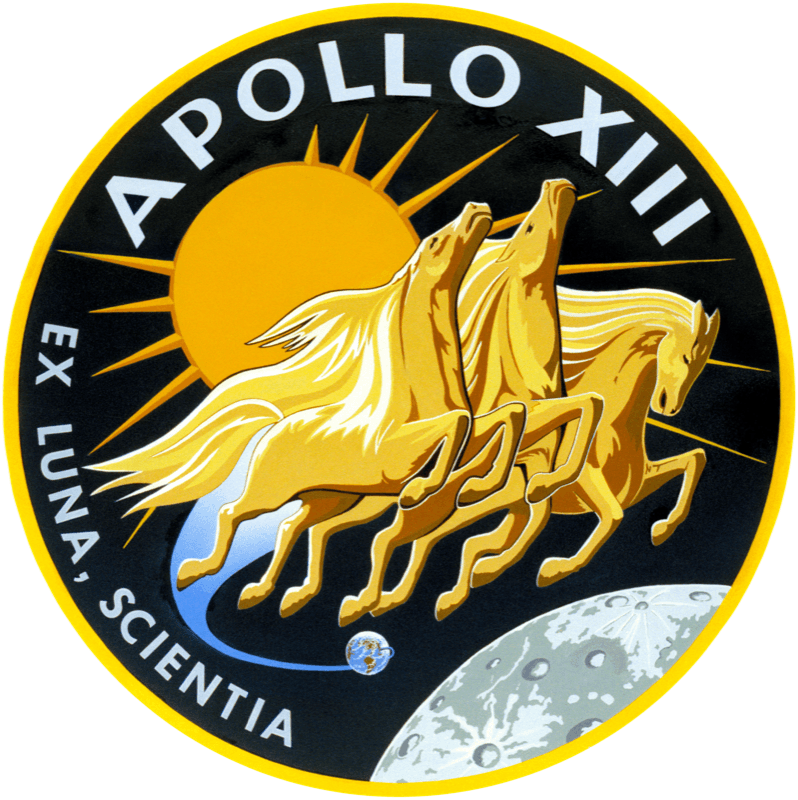
Aborted Moon landing, April 11-17, 1970: oxygen tank rupture about 200,000 miles out; all three crew returned safely. NASA's "successful failure".
TL;DR· 8 min read
Apollo 13's oxygen tank 2 ruptured about 200,000 miles from Earth on April 13, 1970, ending the landing and turning the flight into a four-day rescue that used the lunar module Aquarius as a lifeboat. All three men came home safely on April 17, and NASA calls it the "successful failure". Rounding the far side they reached 248,655 miles from Earth, the human distance record until Artemis II passed it on April 6, 2026.
Apollo 13 never landed on the Moon, and nobody aboard ever said "Houston, we have a problem" in those words: Jack Swigert's actual call was "Okay, Houston, we've had a problem here." What followed the oxygen tank rupture 200,000 miles from Earth, a four-day improvised rescue using the lunar module Aquarius as a lifeboat, turned a failed landing into the defining demonstration of Mission Control under pressure. Along the way the crew set a record nobody intended: 248,655 miles from Earth, the farthest humans have ever traveled, a mark that stood for 56 years until Artemis II passed it on April 6, 2026.
Facts as of July 20, 2026, from the sources listed below.
248,655mi
farthest humans have ever been from Earth, a record held for 56 years (1970-2026)
142:54:41
mission duration, launch to splashdown (hours:minutes:seconds)
38°F
cabin temperature at its coldest on the ride home
4days
three men kept alive in a lunar module rated for two men, two days
Commonly wrong. Three durable errors in English sources. (1) The quote: the movie's present-tense "Houston, we have a problem" (given to Lovell) is not what was said; Swigert called first with "Okay, Houston, we've had a problem here", and Lovell followed with the Main B Bus Undervolt report (NASA history). (2) "Failure is not an option" was never said in 1970 Mission Control; screenwriters coined it for the 1995 film after an interview with flight controller Jerry Bostick, and Gene Kranz only later adopted it as his memoir title (PBS NewsHour). (3) Many pages still call Apollo 13's 248,655 miles the standing record for farthest humans from Earth; that has been stale since April 6, 2026, when Artemis II passed it and peaked near 252,756 miles. A subtler one: tank 2 did not detonate like a bomb; the review board found an internal insulation fire drove an overpressure that blew out the tank and the service module panel.
01Mission facts
Crew
Jim Lovell (commander), Jack Swigert (command module pilot), Fred Haise (lunar module pilot); CM Odyssey, LM Aquarius↗
Late crew swap
Swigert replaced Ken Mattingly, announced April 10, 1970, the day before launch, after L-5 blood tests showed Mattingly had no immunity to German measles following exposure via backup crewman Charlie Duke↗
Launch
April 11, 1970, 2:13 p.m. EST, Kennedy Space Center Pad 39A, Saturn V SA-508↗
Launch anomaly
The S-II center engine shut down about two minutes early; the remaining engines and the S-IVB burned longer to compensate↗
The accident
Oxygen tank 2 (serial 10024X-TA0009) ruptured after a routine tank stir at about 55 hours 55 minutes into flight, 9:08 p.m. CST on April 13, 1970, roughly 200,000 miles from Earth; tank 1 failed as a consequence, taking down the CM's power and oxygen↗
First words
Swigert: "Okay, Houston, we've had a problem here." Lovell followed with the detail: "We've had a Main B Bus Undervolt."↗
Lifeboat
LM Aquarius, designed to support two men for two days, kept three men alive for four; a 34-second burn at 61:30 GET restored the free-return trajectory, raising the closest lunar approach from 69 to 156 miles↗
Farthest point
248,655 miles (400,171 km) from Earth while rounding the lunar far side, April 14-15, 1970; the human distance record until Artemis II reached about 252,756 miles on April 6, 2026↗
S-IVB impact
The spent Saturn third stage struck the Moon at GET 77:56:39.7, about 01:09:40 UT on April 15, 1970 (still April 14 in US time zones, the date LROC pages use), at 2.55 S, 27.88 W, north of Mare Cognitum, leaving a roughly 30-meter crater; the Apollo 12 seismometer 135 km away recorded the planned impact↗
PC+2 burn
About two hours past the far side, a five-minute burn of Aquarius's descent engine cut the trip home to about 142 hours total mission time↗
CO2 fix
Mission Control devised the "mailbox", an adapter of plastic bags, cardboard and tape that fit Odyssey's square lithium hydroxide canisters to Aquarius's round scrubber openings↗
Hardship
Cabin temperature fell to 38 degrees Fahrenheit; water was rationed to six ounces per man per day; the crew lost 31.5 pounds combined (Lovell 14); Haise developed a urinary tract infection↗
Splashdown
April 17, 1970, Pacific Ocean near Samoa, about one mile from target and four miles from the recovery ship USS Iwo Jima, at mission elapsed time 142:54:41↗
Investigation
The Cortright Review Board report (released June 15, 1970) traced a chain: tank dropped about two inches in 1968, thermostat switches welded shut by 65-volt ground power during a March 25, 1970 test that let the heater reach about 1,000 F and damage Teflon wire insulation, then an in-flight stir short-circuit sparked combustion↗
Site: 2.5500°S, 27.8800°W · Apollo 13 S-IVB impact crater, north of Mare Cognitum (source)
02Crew
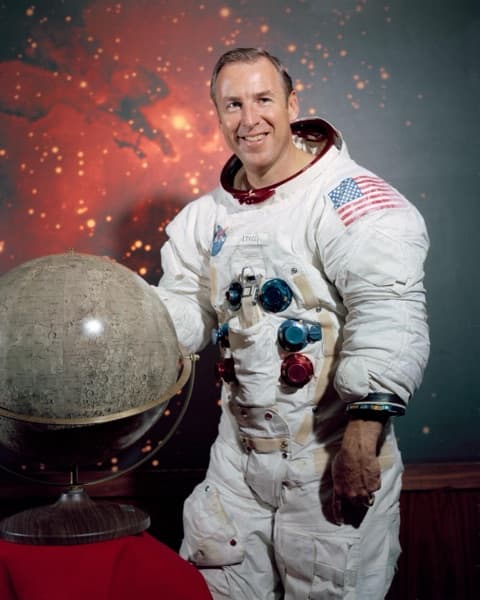

Jim Lovell
Commander
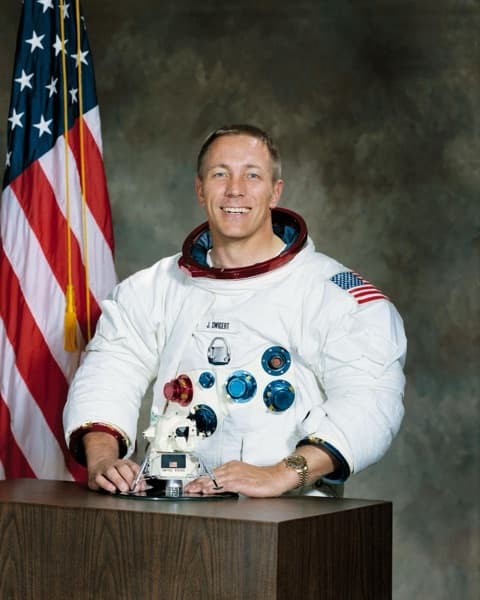
Jack Swigert
Command Module Pilot
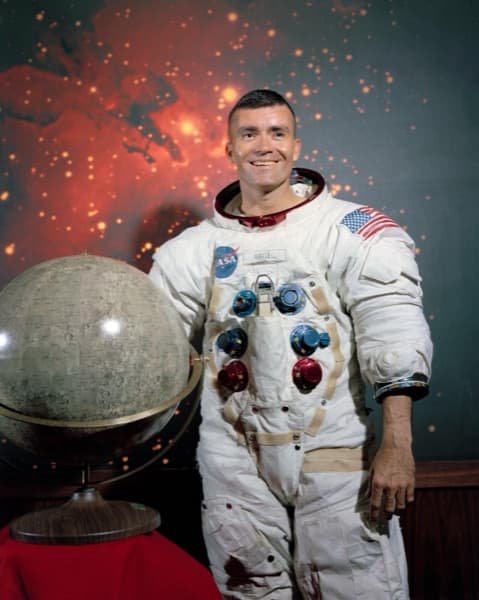
Fred Haise
Lunar Module Pilot
Portraits: NASA.
03Mission timeline
10 Apr 1970
Swigert formally replaces Mattingly at a press conference the day before liftoff, after the German measles scare
11 Apr 1970
Liftoff from KSC Pad 39A at 2:13 p.m. EST; the S-II center engine shuts down about two minutes early
13 Apr 1970
9:08 p.m. CST, about 56 hours into flight: oxygen tank 2 ruptures roughly 200,000 miles from Earth. "Okay, Houston, we've had a problem here."
14 Apr 1970
The crew powers up Aquarius as a lifeboat; a 34-second burn at 61:30 GET puts the ship back on a free-return trajectory around the Moon
15 Apr 1970
The discarded S-IVB third stage impacts the Moon at 2.55 S, 27.88 W as planned, about 01:09 UT (April 14 in US time zones); Apollo 12's seismometer 135 km away records it
14 to 15 Apr 1970
Rounding the far side, the crew reaches 248,655 miles (400,171 km) from Earth, the farthest humans had ever been
14 Apr 1970
Two hours past the Moon, the five-minute PC+2 burn on Aquarius's descent engine speeds the return home
17 Apr 1970
Service module jettison reveals a whole panel blown away; Aquarius is released ("Farewell, Aquarius, and we thank you"); splashdown near Samoa at 142:54:41, crew safe aboard USS Iwo Jima
15 Jun 1970
Cortright Review Board report released: "an unusual combination of mistakes coupled with a somewhat deficient and unforgiving design"
6 Apr 2026
Artemis II's crew passes Apollo 13's distance record at 12:56 p.m. CDT, peaking near 252,756 miles from Earth
Teal dots: events that physically happened in flight or on the Moon. Grey: announcements, namings, contracts, and targets.
04The mission
Apollo 13 was supposed to be NASA's third lunar landing, targeting the Fra Mauro highlands. It launched from Pad 39A on April 11, 1970 at 2:13 p.m. EST, shrugging off an early shutdown of the second stage's center engine. Two days in, nine minutes after the crew wrapped a TV broadcast nobody aired live, a routine stir of the cryogenic oxygen tanks ended the Moon mission. Oxygen tank 2 ruptured at 9:08 p.m. CST on April 13, about 200,000 miles from Earth, and the cascade took tank 1, and with it the command module's normal supply of electricity, light and water. Swigert radioed "Okay, Houston, we've had a problem here"; Lovell, looking out the window, reported the ship "venting something out into space."
The rescue plan was decided within hours: abandon the landing, swing around the Moon on a free-return trajectory, and use the lunar module Aquarius as a lifeboat. A craft built to keep two men alive for two days would have to keep three alive for four. A 34-second burn at 61 hours 30 minutes raised the closest lunar approach from 69 to 156 miles, and two hours past the far side the crew fired Aquarius's descent engine for five minutes (the PC+2 burn) to speed the trip home. Rounding the far side on April 14-15, the crew reached 248,655 miles from Earth, farther than any humans before or, for the next 56 years, since. In the middle of the crisis, one piece of the original mission worked exactly as planned: the discarded Saturn third stage slammed into the Moon north of Mare Cognitum, and the seismometer left by Apollo 12, 135 km away, recorded the impact for lunar science. LRO's camera later found the 30-meter crater at 2.55 S, 27.88 W.
The ride home was miserable by design: nearly everything was powered down to save Aquarius's batteries. Cabin temperature fell to 38 degrees Fahrenheit, water was rationed to six ounces per man per day, and the three astronauts lost 31.5 pounds between them; Haise developed a urinary tract infection likely brought on by dehydration. When carbon dioxide built up beyond the LM scrubbers' capacity, Mission Control talked the crew through building the "mailbox", an adapter of plastic bags, cardboard and tape that let the command module's square lithium hydroxide canisters work in the lunar module's round-socket system. It worked immediately.
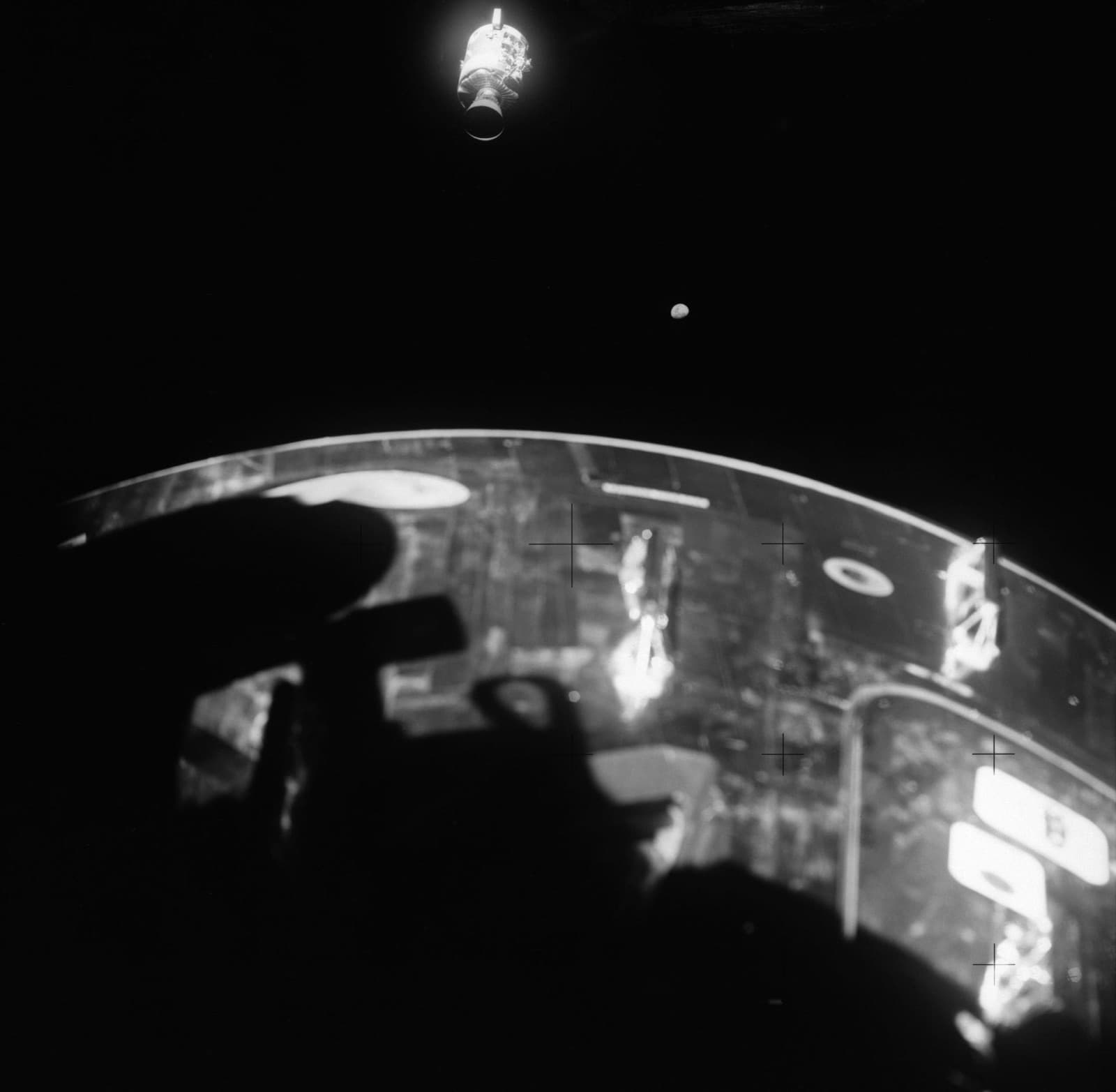
On April 17 the crew jettisoned the service module and finally saw what had happened to them: an entire exterior panel was gone. "There's one whole side of that spacecraft missing," Lovell reported, photographing the damage for the investigators. Aquarius was cut loose an hour before entry ("Farewell, Aquarius, and we thank you"), and Odyssey splashed down in the Pacific near Samoa at mission elapsed time 142 hours 54 minutes 41 seconds, about a mile from the aim point and four miles from the recovery ship USS Iwo Jima. After four days of open questions about a heat shield nobody could inspect, the landing was one of the most accurate of the program.
The Cortright Review Board, reporting on June 15, 1970, found no bad luck anywhere in the chain. The tank had been dropped about two inches during handling in 1968; during a pre-launch test on March 25, 1970, ground equipment fed 65 volts to thermostat switches rated for 28, welding them shut and letting the tank heater reach roughly 1,000 degrees Fahrenheit, cooking the Teflon insulation off the internal fan wiring. The stir command on April 13 short-circuited the bare wires and ignited a fire inside the tank. Cortright's verdict: the accident "was not the result of a chance malfunction in a statistical sense" but of "an unusual combination of mistakes coupled with a somewhat deficient and unforgiving design."
NASA itself calls Apollo 13 the "successful failure", and its afterlife has been long. Mattingly, bumped from the crew the day before launch over measles he never caught, flew to the Moon as Apollo 16's command module pilot two years later. The 1995 film made the mission a byword for calm engineering under pressure, at the cost of two misquotes that have outlived the transcripts. And the accidental distance record outlasted the entire Space Race era: only on April 6, 2026 did the Artemis II crew, looping the Moon on a free-return path of their own, finally fly farther from Earth, radioing down that they did so "honoring the extraordinary efforts and feats of our predecessors."
05In pictures
Tap a photo to enlarge.
06Sources
- NASA, Apollo 13 mission page
- NASA, Apollo 13: Mission Details
- NASA History, 50 Years Ago: "Houston, We've Had a Problem"
- NASA History, 50 Years Ago: Apollo 13 Crew Returns Safely to Earth
- NASA History, 50 Years Ago: Apollo 13 Review Board Report
- NASA History, 50 Years Ago: Apollo 13 and German Measles
- NASA History, NASA's Apollo 13 Mission Challenged Crew, Launch Team (launch time)
- NASA, Apollo 13: The Successful Failure
- LROC Featured Image, Rocket impacts recorded by the Apollo seismic network (S-IVB site, coordinates)
- NASA SVS, Apollo 13 S-IVB Impact Site (impact GET 77:56:39.7)
- NASA news release, Artemis II Crew Eclipses Record for Farthest Human Spaceflight (Apr 6, 2026)
- Al Jazeera, Artemis II breaks Apollo 13 record (400,171 km figure), Apr 6, 2026
- PBS NewsHour, Apollo 13's most famous quotes originated in Hollywood
- NASA, Apollo 16 mission page (Mattingly's later flight)
azmth is independent and is not affiliated with or endorsed by NASA, CNSA, Roscosmos, ISRO, JAXA, or any other space agency or company named on this page.
Flag icons: circle-flags by HatScripts, MIT license.