Luna 16
USSR · Sample return · 1970Success
Success: returned 101 g of Mare Fecunditatis soil, 12 to 24 September 1970, the first robotic sample return from another world.
TL;DR· 4 min read
Luna 16 was the first robotic sample return: it soft-landed in Mare Fecunditatis on 20 September 1970, drilled 35 cm before hitting rock, and dropped 101 grams of soil near Dzhezkazgan on 24 September. Apollo 11 and Apollo 12 had already brought samples home, so it was third overall, but it was the first done without a crew, and the first landing made in lunar darkness, about 60 hours after local sunset. In 1973 NASA traded Apollo 16 and Apollo 17 material for a share of it.
Luna 16 was the first robotic spacecraft to land on the Moon and bring a piece of it home, but it was not the first lunar sample return: Apollo 11 and Apollo 12 got there first, making Luna 16 the third overall. What it proved in September 1970 was that a 5.7-tonne automatic station could do, for 101 grams, what the USSR could no longer do with cosmonauts, and it did it at night: Luna 16 made the first landing in lunar darkness, touching down about 60 hours after local sunset.
Facts as of July 20, 2026, from the sources listed below.
101g
of lunar soil returned to Earth
26h 25m
spent on the lunar surface
35cm
drill-core depth before hitting rock
3rd
sample return in history, and the first by a robot
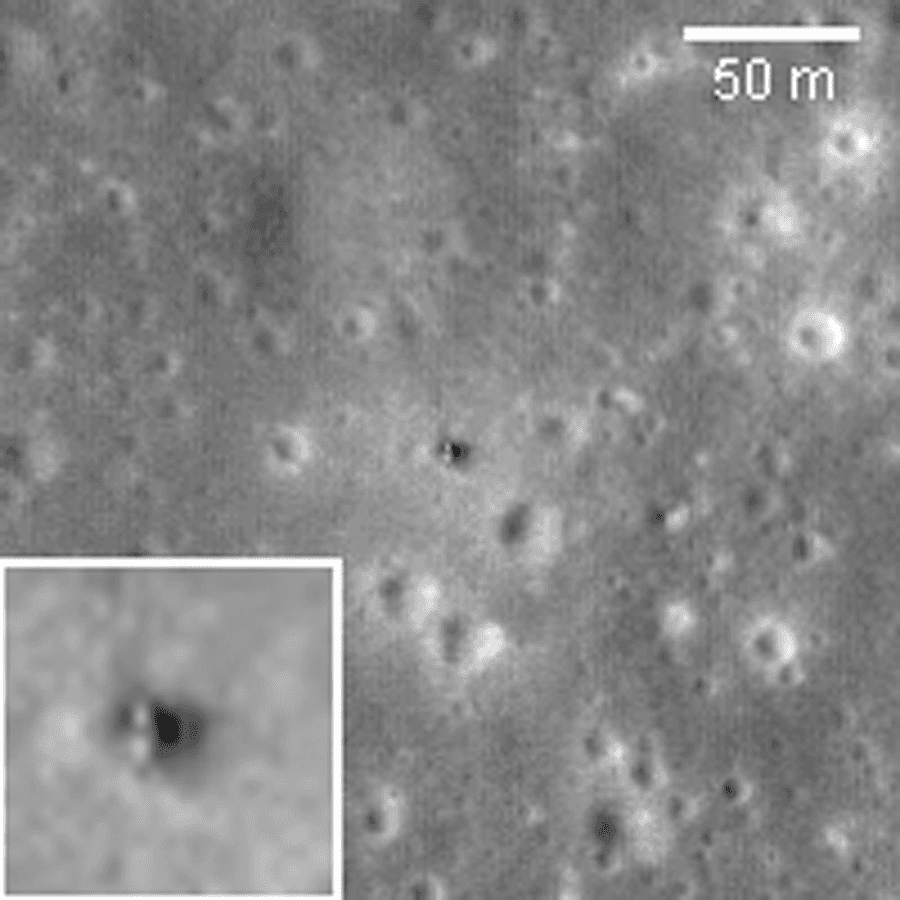
Commonly wrong. Two persistent errors in English coverage. (1) Luna 16 is often called "the first lunar sample return": it was the first ROBOTIC sample return and the third overall, after Apollo 11 and Apollo 12 (NSSDCA states this explicitly). (2) Most English sources still print the pre-LRO landing coordinates (0.68 S, 56.30 E); the LROC team located the actual descent stage at 0.5137 S, 56.3638 E, about 20 km from the old figure.
01Mission facts
Launch
12 September 1970, Proton from Tyuratam (Baikonur Cosmodrome)↗
Lunar orbit insertion
17 September 1970, into a 111 km circular orbit; perilune later lowered to 15.1 km↗
Landing
20 September 1970, 05:18 UT, Mare Fecunditatis; first landing made in the lunar night (Sun had set about 60 hours earlier)↗
Landing coordinates (LROC-derived, +/- ~15 m)
0.5137 S, 56.3638 E↗
Sample
101 grams from a single 35 cm drill core; the drill stopped after hitting hard rock at that depth↗
Surface stay / ascent
26 hours 25 minutes on the surface; ascent stage lifted off 21 September 1970 at 07:43 UT↗
Earth return
24 September 1970; ballistic reentry with no mid-course corrections, capsule landed about 80 km SE of Dzhezkazgan, Kazakhstan (NSSDCA gives 03:26 UT)↗
Spacecraft
Ye-8-5 bus, 3.96 m tall; 1,880 kg dry landed mass, 5,600 to 5,750 kg fueled at launch; return capsule 50 cm diameter, 39 kg↗
Sample exchange with NASA
March 1973: NASA traded 3 g each of Apollo 16 and Apollo 17 material for Luna 16 and Luna 20 samples↗
Only legal private sale of Moon rocks
Three Luna 16 fragments (~0.2 g), originally gifted to Sergei Korolev's widow, sold at Sotheby's for $855,000 on 29 November 2018↗
Site: 0.5137°S, 56.3638°E · Mare Fecunditatis (Sea of Fertility), ~100 km west of Webb crater (source)
02Mission timeline
12 Sep 1970
Launch on Proton from Tyuratam (Baikonur)
17 Sep 1970
Enters 111 km circular lunar orbit
20 Sep 1970
05:18 UT: Soft-lands in Mare Fecunditatis, the first landing in lunar darkness
20 Sep 1970
Drill penetrates 35 cm, collects 101 g, seals it in the return capsule
21 Sep 1970
07:43 UT: Ascent stage lifts off the Moon after 26 h 25 min on the surface
24 Sep 1970
Capsule lands ~80 km SE of Dzhezkazgan, Kazakhstan, completing the first robotic sample return
Mar 1973
NASA and the USSR exchange samples: 6 g of Apollo material for Luna 16 and Luna 20 soil
29 Nov 2018
Three Luna 16 fragments sell at Sotheby's for $855,000, still the only legal private sale of Moon rocks
Teal dots: events that physically happened in flight or on the Moon. Grey: announcements, namings, contracts, and targets.
03The mission
Luna 16 arrived at the end of a losing race. The USSR's Ye-8-5 robotic sample-return program had been built to bring back lunar soil before, or at least alongside, Apollo; its most famous attempt, Luna 15, crashed into Mare Crisium while Apollo 11's crew was still on the Moon in July 1969. By September 1970 the goal had shifted from beating Apollo to proving a different philosophy: that automatic stations could do meaningful lunar exploration at a fraction of the cost and risk of crewed flight. Luna 16 was the proof.
Launched on a Proton on 12 September 1970, the 5.7-tonne station entered a 111 km circular lunar orbit on 17 September, lowered its perilune to 15.1 km, and on 20 September at 05:18 UT soft-landed in Mare Fecunditatis, about 100 km west of Webb crater. Notably, it was the first spacecraft to land on the Moon in darkness: the Sun had set at the site roughly 60 hours earlier, and the whole surface operation ran on batteries and floodlights of telemetry rather than solar power. The LROC team has since pinpointed the descent stage at 0.5137 S, 56.3638 E, and photographed it repeatedly from orbit.
The sampling itself was minimal by Apollo standards and revolutionary by robotic ones. A 90 cm arm swung a rotary drill to the surface, penetrated 35 cm before stopping on hard rock, and transferred the core into a hermetically sealed 50 cm return capsule. After 26 hours 25 minutes on the surface, the 520 kg ascent stage fired its single-burn KRD-61 engine at 07:43 UT on 21 September, flew a direct ballistic trajectory home with no course corrections, and dropped the 39 kg capsule near Dzhezkazgan, Kazakhstan, on 24 September. Inside were 101 grams of dark mare basalt regolith.
Those 101 grams did real science and real diplomacy. Soviet analyses led by Aleksandr Vinogradov characterized the first mare soil from a region Apollo had not touched, and in March 1973 NASA traded three grams each of Apollo 16 and Apollo 17 material for portions of the Luna 16 and Luna 20 samples, a rare cooperative act mid-Cold War. Luna 16 also has a strange afterlife in the auction world: three tiny fragments, presented to Nina Koroleva, widow of chief designer Sergei Korolev, sold at Sotheby's in November 2018 for $855,000, the only Moon rocks ever legally sold to a private buyer.
The mission's descent stage still stands in Mare Fecunditatis, and LROC's repeated imaging of the site (its "flip book" shows the same lander under changing lighting) has turned Luna 16 into a calibration point for locating every other Soviet artifact on the Moon.
04In pictures
Tap a photo to enlarge.
05Sources
- NSSDCA Master Catalog: Luna 16 (1970-072A)
- LROC Featured Image: Luna 16 (25 Mar 2010)
- LROC Featured Site: Luna 16 flip book
- LROC Coordinates of Robotic Spacecraft, 2013 update
- NASA History: Apollo 17 post-mission activities (1973 sample exchange)
- NASA History: Luna 15 context (attempt to upstage Apollo 11)
- collectSPACE: Luna 16 fragments sell for $855,000 at Sotheby's (29 Nov 2018)
azmth is independent and is not affiliated with or endorsed by NASA, CNSA, Roscosmos, ISRO, JAXA, or any other space agency or company named on this page.