Luna 17 / Lunokhod 1
USSR · Rover · 1970Success
Success: landed 17 November 1970; Lunokhod 1 became the first rover on another world, drove ~10 km over 11 lunar days, and its laser reflector has been answering Earth again since 2010.
TL;DR· 5 min read
Lunokhod 1, delivered to Mare Imbrium by the Luna 17 lander on 17 November 1970, was the first rover to drive on another world, steered from Earth on eight independently powered wheels. Built for three lunar days, it worked for eleven and covered 10,540 m by Soviet odometry, remeasured at 9.93 km from LRO images in 2013. Its French-built laser reflector was found again in March 2010 and returned about 2,000 photons to Apache Point on the first attempt.
Lunokhod 1, delivered to Mare Imbrium by the Luna 17 lander on 17 November 1970, was the first rover ever to drive on another world, eight independently powered wheels steered in near-real time by operators on Earth. Designed to survive three lunar days, it worked for eleven, and its story did not end in 1971: lost for four decades, the rover was found in NASA LRO images in March 2010, and its French-built laser retroreflector immediately returned about 2,000 photons to Apache Point Observatory, a signal four times stronger than its twin on Lunokhod 2.
Facts as of July 20, 2026, from the sources listed below.
1st
rover ever to drive on another world
10.5km
official odometry (9.93 km per the 2013 LRO remap)
11lunar days
operated, against a three-day design life
2,000photons
returned by its laser reflector on the first 2010 shot, after 39 years of silence
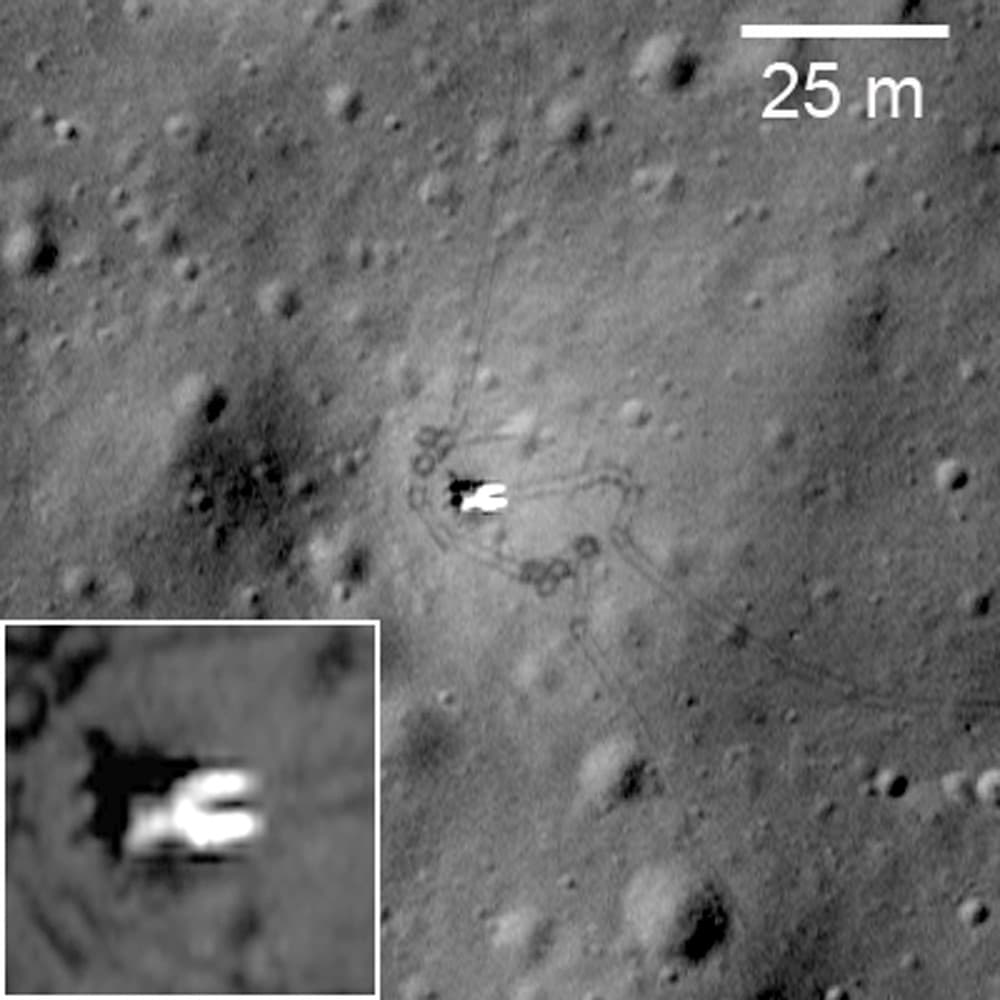
Commonly wrong. The canonical "10,540 m driven" figure that appears in nearly every English source is the Soviet operational odometry; the 2013 cartographic reconstruction from LRO NAC images and DEMs (Karachevtseva et al., Planetary and Space Science), which mapped 99% of the track, measured 9.93 km, about half a kilometer less. Also stale: articles still describe Lunokhod 1's reflector as "lost" or unusable. It was found in March 2010 and has been a working laser-ranging target since 22 April 2010, with a return signal about four times stronger than Lunokhod 2's.
01Mission facts
Launch
10 November 1970, Proton from Tyuratam (Baikonur Cosmodrome)↗
Lunar orbit insertion
15 November 1970↗
Landing
17 November 1970, 03:46:50 UT, Sea of Rains (Mare Imbrium) at 38.23764 N, 35.00163 W; rover rolled down dual ramps to the surface↗
LROC-derived coordinates (+/- ~15 m)
Luna 17 lander: 38.2376 N, 324.9984 E; Lunokhod 1 final position: 38.3151 N, 324.9919 E↗
Rover
756 kg, about 1.35 m high and 2.15 m across, eight independently powered wheels (Siddiqi, NASA SP-2018-4041)↗
Power and survival
Solar array under the hinged lid by day; polonium-210 radioisotope heater through the two-week lunar night↗
Design life vs actual
Intended to operate three lunar days; operated eleven; operations officially ceased 4 October 1971, the anniversary of Sputnik 1↗
Traverse
10,540 m per the official Soviet odometry; 9.93 km per the 2013 LRO-image cartographic reconstruction↗
Science return
More than 20,000 TV pictures, more than 200 TV panoramas, more than 500 lunar soil tests (plus X-ray spectrometer, X-ray telescope, cosmic-ray detectors)↗
Rediscovery
Luna 17 and rover tracks identified in LROC images published 17 March 2010; rover itself imaged at its final parking spot↗
Laser ranging revival
22 April 2010: APOLLO team (Tom Murphy, UCSD) hits the reflector with the Apache Point 3.5 m telescope, ~2,000 photons returned on the first try after almost 40 years of silence↗
Reflector performance
French-built retroreflector returns a signal roughly four times stronger than Lunokhod 2's; position now known to few-centimeter accuracy↗
Site: 38.2376°N, 35.0016°W · Mare Imbrium (Sea of Rains), Luna 17 lander; Lunokhod 1 parked 8.5 km north at 38.3151 N, 35.0081 W (source)
02Mission timeline
10 Nov 1970
Launch on Proton from Tyuratam (Baikonur)
15 Nov 1970
Enters lunar orbit
17 Nov 1970
03:46:50 UT: Luna 17 soft-lands in Mare Imbrium; Lunokhod 1 rolls down the ramps, the first wheels on another world
Sep to Oct 1971
Rover falls silent after eleven lunar days; operations officially cease 4 October 1971, the Sputnik 1 anniversary
17 Mar 2010
LROC publishes images identifying Luna 17 and the rover's tracks on Mare Imbrium
22 Apr 2010
Apache Point laser ranging gets ~2,000 photons back from the reflector on the first attempt
14 Mar 2012
LROC low-altitude pass (33 km) images Lunokhod 1 parked at 38.315 N, 324.992 E
2013
LRO-based cartographic reconstruction remeasures the traverse at 9.93 km, about 0.5 km less than the official 10.54 km
Teal dots: events that physically happened in flight or on the Moon. Grey: announcements, namings, contracts, and targets.
03The mission
Eight months before Apollo 15's astronauts drove the first crewed rover, a Soviet robot was already leaving tracks on the Moon. Luna 17 landed in the Sea of Rains at 03:46:50 UT on 17 November 1970 and lowered twin ramps; Lunokhod 1, a 756 kg tub-shaped vehicle under a hinged solar lid, rolled down onto Mare Imbrium and became the first rover to drive on another world. Operators on Earth steered it by television, working around a multi-second light-lag that made every drive a slow-motion exercise in patience.
The machine was built for three lunar days and lasted eleven. Each two-week night it hunkered down, lid closed, kept warm by a polonium-210 radioisotope heater; each dawn it woke and drove on. By the official Soviet count it covered 10,540 meters, returned more than 20,000 TV pictures and over 200 panoramas, and ran more than 500 soil-mechanics tests plus X-ray fluorescence analyses of the regolith along the way. Operations were officially declared over on 4 October 1971, a date chosen for the anniversary of Sputnik 1.
Then it vanished from science. The rover's exact parking spot was known too poorly for laser work: unlike the Apollo arrays and Lunokhod 2, the French-built retroreflector riding on Lunokhod 1 could not be reliably hit, and for almost four decades it returned nothing. In March 2010 LROC images finally revealed the Luna 17 lander with dark rover tracks looping away from it, and the trail led to the rover itself, parked at 38.3151 N, 324.9919 E with its reflector conveniently angled back toward Earth.
On 22 April 2010 Tom Murphy's APOLLO team at Apache Point Observatory fired its 3.5 m telescope's laser at the new coordinates and was stunned to get roughly 2,000 photons back on the first try, a return about four times stronger than Lunokhod 2's, strong enough that Murphy initially suspected an equipment error. Why the older, dustier rover outshines its twin remains unexplained. The reflector's position is now known to a few centimeters, and it rejoined the small family of lunar laser-ranging targets used to test general relativity and probe the lunar interior.
LRO kept refining the story. A 33 km low-altitude pass in March 2012 produced the sharpest view yet of the rover and lander, and in 2013 a Russian-German-US team reconstructed the entire traverse from LROC images and stereo terrain models, mapping 99% of the track and measuring it at 9.93 km, about half a kilometer short of the official odometry. Either number leaves the same verdict: the first rover on another world overdelivered by roughly a factor of four on its design life, and its reflector has been ranged regularly from Earth since the 2010 rediscovery, with published laser-ranging data through 2020.
04In pictures
Tap a photo to enlarge.
05Sources
- NSSDCA Master Catalog: Luna 17 / Lunokhod 1 (1970-095A)
- NSSDCA Master Catalog: Lunokhod 1 rover entry (1970-095D)
- LROC Featured Image: Soviet Union Lunar Rovers (17 Mar 2010)
- LROC Featured Image: Lunokhod 1 Revisited (14 Mar 2012)
- LROC Coordinates of Robotic Spacecraft, 2013 update
- NASA Science News via phys.org: Old Moon Rover Beams Surprising Laser Flashes to Earth (3 Jun 2010)
- Murphy et al., Laser ranging to the lost Lunokhod 1 reflector (Icarus 2011, arXiv preprint)
- Karachevtseva et al., Cartography of the Lunokhod-1 landing site and traverse (Planetary and Space Science, 2013)
- Guinness World Records: First lunar/planetary rover
- LROC Featured Site: Luna 17 flip book
- Siddiqi, Beyond Earth: A Chronicle of Deep Space Exploration 1958-2016 (NASA SP-2018-4041), p. 97 (rover mass and dimensions)
- Battat et al. 2023, Fifteen Years of Millimeter Accuracy Lunar Laser Ranging with APOLLO (PASP 135; Lunokhod 1 data through 2020)
azmth is independent and is not affiliated with or endorsed by NASA, CNSA, Roscosmos, ISRO, JAXA, or any other space agency or company named on this page.