Apollo 16
NASA (US) · Crewed landing · 1972Success
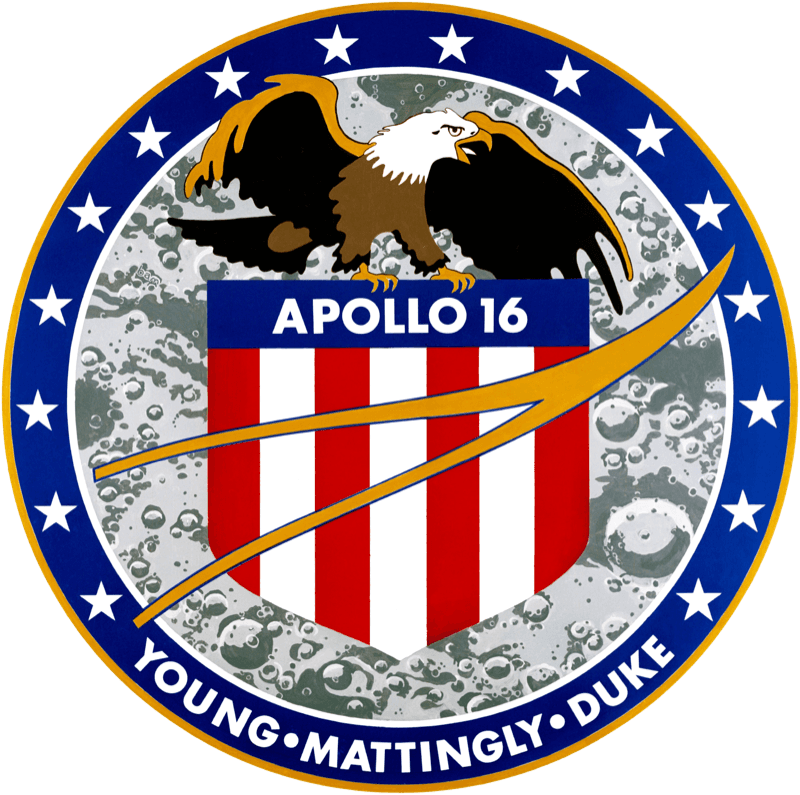
Landed in the Descartes Highlands April 20, 1972; splashed down April 27, 1972 after a mission cut one day short.
TL;DR· 6 min read
Apollo 16 was the only crewed landing in the Moon's central highlands, sent to Descartes in April 1972 to confirm that the highlands were volcanic. The 95.71 kg of samples John Young and Charlie Duke brought home were overwhelmingly impact breccias, overturning the hypothesis and forcing a rethink of how photogeology was used to pick sites. The landing itself nearly did not happen: an engine-control fault on the command module delayed touchdown by 5 hours 43 minutes and brought the crew home a day early.
Apollo 16 was the only crewed landing in the Moon's central highlands, and it flew there to confirm that the highlands were volcanic. The 95.71 kg (211 pounds) of samples John Young and Charlie Duke brought home said the opposite: the Descartes and Cayley rocks are impact breccias, a result that forced NASA to rethink photogeologic site selection. The landing itself nearly did not happen, touching down 5 hours 43 minutes late after an engine-control fault on the command module put the whole descent in doubt.
Facts as of July 20, 2026, from the sources listed below.
71h 02m
on the lunar surface
20h 14m
total moonwalk time across 3 EVAs
26.7 km
driven in the lunar rover (16.6 mi)
95.71 kg
of samples returned (211 lb), incl. 11.7 kg Big Muley
Commonly wrong. English write-ups still describe Descartes as a 'volcanic highlands site,' and some even say Apollo 16 confirmed highland volcanism. It is the reverse: the site was chosen (June 17, 1971) expecting volcanic rocks, and the samples came back almost entirely impact breccias, overturning the hypothesis. Also commonly glossed over: the April 20, 1972 landing was nearly waved off because of the CSM's SPS yaw-oscillation fault, touched down 5 h 43 m late, and the mission returned to Earth a day early; and the sample mass appears variously as 209 lb, 211 lb, or 95.7 kg across sources: 95.71 kg (211.00 lb) is the official Lunar Receiving Laboratory total per NASA SP-4029, while NASA feature pages carry a stale 209 lb (~94.8 kg) rounding.
01Mission facts
Launch
April 16, 1972, 12:54 p.m. EST, Saturn V from Pad 39A, Kennedy Space Center↗
Crew
John W. Young (Commander), Thomas K. Mattingly II (Command Module Pilot, CSM Casper), Charles M. Duke Jr. (Lunar Module Pilot, LM Orion)↗
Lunar landing
April 20, 1972, about 9:24 p.m. EST, Descartes Highlands, 5 h 43 m behind schedule after an SPS backup-circuit yaw oscillation on the CSM↗
Near-abort
The SPS oscillation appeared during circularization prep on the 12th lunar revolution; Mission Control had roughly 10 hours to clear the landing before the orbital track drifted too far west↗
LM coordinates (LROC-derived)
8.9734 S, 15.5011 E, uncertainty ±3.0 m, statistical mean of repeated LROC NAC imaging 2009-2015↗
Surface stay
71 hours 2 minutes; three EVAs totaling 20 h 14 m (7:11 on Apr 21, 7:23 on Apr 22, 5:40 on Apr 23)↗
Rover distance
16.6 miles (26.7 km) on the second Lunar Roving Vehicle, including the filmed 'Grand Prix' driving demonstration↗
Samples
95.71 kg (211.00 lb), the official Lunar Receiving Laboratory total per NASA SP-4029 (NASA feature pages round to 209 lb); includes Big Muley at ~26 lb (11.7 kg), the largest single sample returned by any Apollo mission↗
Science first
George Carruthers' Far Ultraviolet Camera/Spectrograph, set up in Orion's shadow on EVA-1, was the first astronomical observatory operated on the Moon; it captured Earth's geocorona and still sits at the site↗
Headline geology result
Pre-mission consensus (site selected June 17, 1971) held that the Cayley plains and Descartes formations were volcanic; the returned rocks were impact breccias↗
Breccia finding (primary literature)
Apollo 16 geologic summary: the site is dominated by impact breccias derived from an anorthosite-gabbro complex; basalts are not their source↗
Youngest moonwalker
Charlie Duke, the tenth and youngest person to walk on the Moon (age 36), logging over 21 hours of EVA↗
Early return
Because of the SPS concern, Mission Control had the crew leave lunar orbit one day early; Mattingly performed a 1 h 23 m deep-space EVA on the way home to retrieve SIM-bay film, 197,000 miles from Earth↗
Splashdown
April 27, 1972, just before 3 p.m. EST, Pacific Ocean; total mission 265 h 51 m 5 s (11 days 1 h 51 m)↗
2025-2026 legacy
NASA's Carruthers Geocorona Observatory, named for the Apollo 16 telescope's inventor, launched September 24, 2025 and began its 24-month primary science mission at Sun-Earth L1 on March 1, 2026↗
Site: 8.9734°S, 15.5011°E · Descartes Highlands (Cayley plains) (source)
02Crew
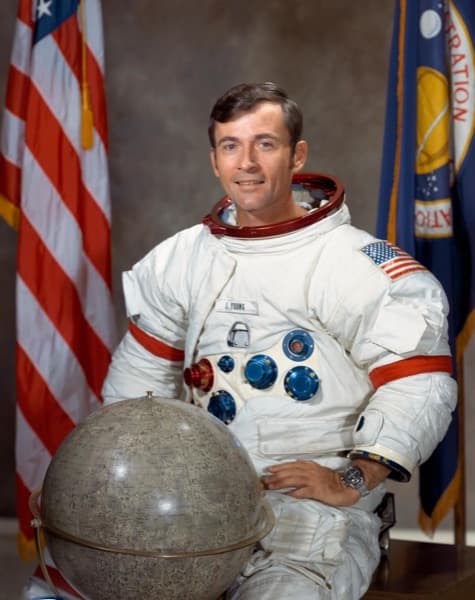

John Young
Commander
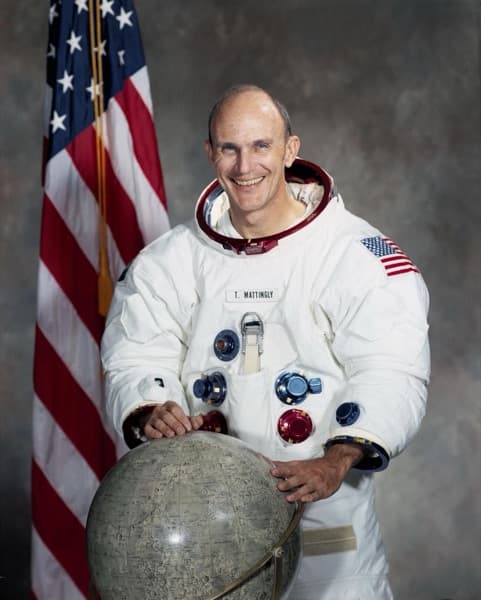
Ken Mattingly
Command Module Pilot
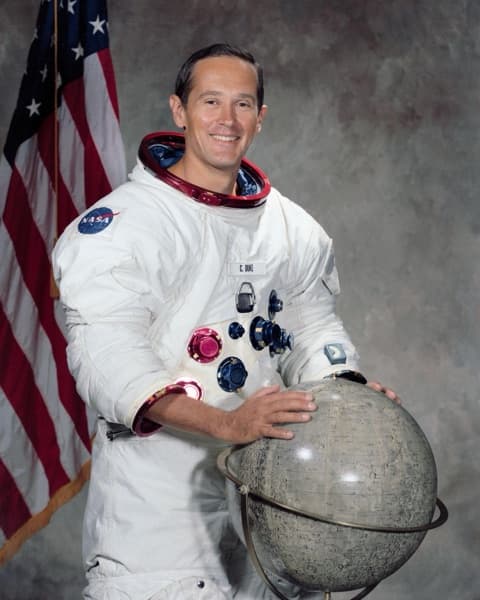
Charlie Duke
Lunar Module Pilot
Portraits: NASA.
03Mission timeline
17 Jun 1971
Descartes selected as the landing site, chosen largely to test the volcanic-highlands hypothesis
16 Apr 1972
Launch at 12:54 p.m. EST from Pad 39A
19 Apr 1972
Apollo 16 enters lunar orbit
20 Apr 1972
SPS backup-loop yaw oscillation puts the landing in doubt; Orion touches down at Descartes about 9:24 p.m. EST, 5 h 43 m late
21 Apr 1972
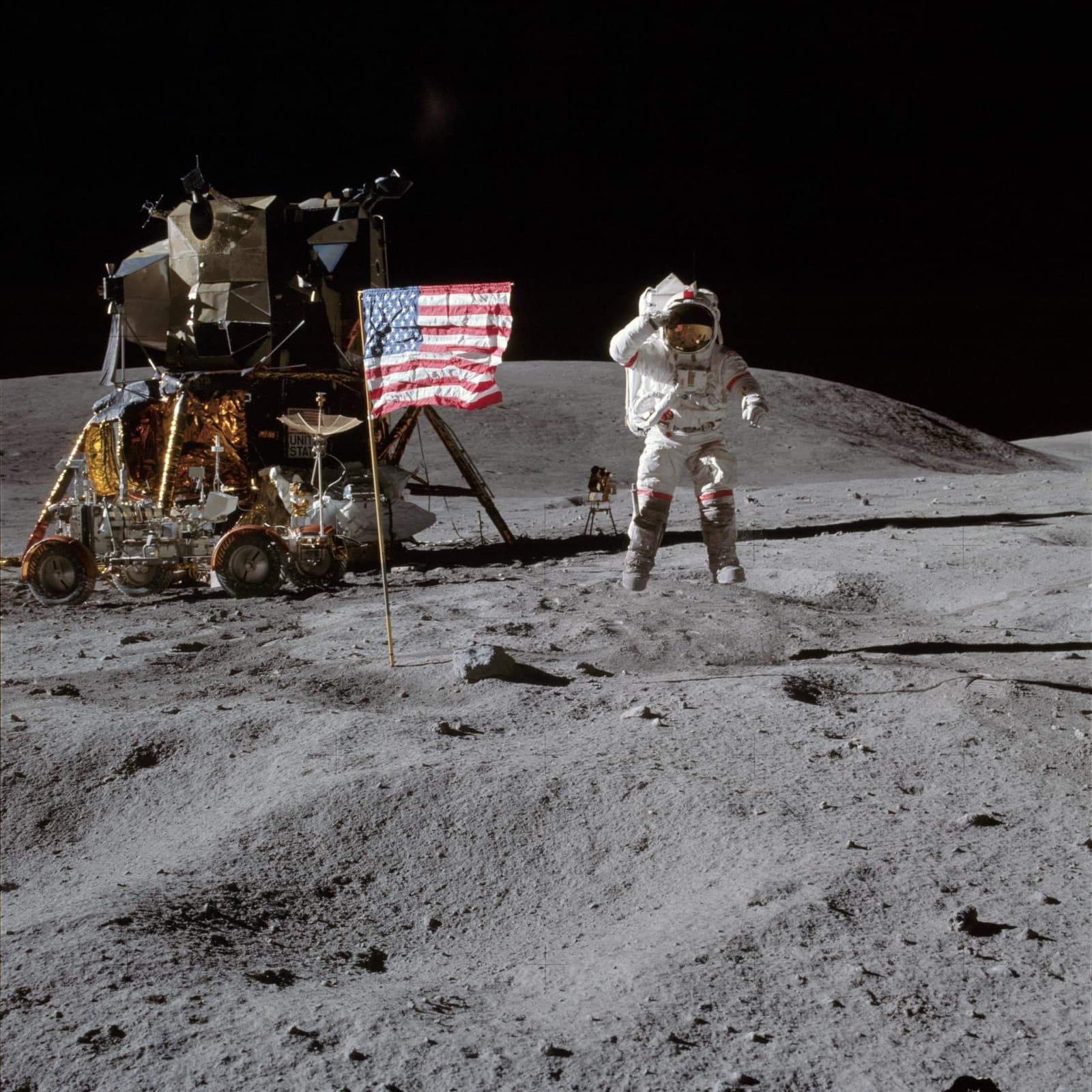
EVA-1 (7 h 11 m): ALSEP deployed, far-UV camera set up, Young's jump salute photographed by Duke
22 Apr 1972
EVA-2 (7 h 23 m, then an Apollo record): 6.9-mile rover traverse; Big Muley collected
23 Apr 1972
EVA-3 (5 h 40 m); Orion lifts off the Moon at 8:26 p.m. EST
25 Apr 1972
Mattingly's 1 h 23 m trans-Earth EVA to retrieve SIM-bay film cassettes, on the crew's 10th day in space
27 Apr 1972
Splashdown in the Pacific just before 3 p.m. EST; mission shortened by one day
24 Sep 2025
Carruthers Geocorona Observatory, named for the Apollo 16 far-UV camera's inventor, launches with IMAP
1 Mar 2026
Carruthers begins its 24-month primary science mission at L1, continuing the geocorona work Apollo 16 started
Teal dots: events that physically happened in flight or on the Moon. Grey: announcements, namings, contracts, and targets.
04The mission
Apollo 16 was the fifth crewed lunar landing and the only one in the Moon's central highlands. The Descartes site was picked on June 17, 1971 precisely because most geologists believed the highlands were volcanic, with lava domes like those on Earth, and expected samples older than the mare basalts of Apollo 11 and 12. The mission's three stated objectives were to survey and sample the Descartes material, emplace surface experiments, and run orbital and in-flight tasks.
It almost did not land. On April 20, 1972, as Ken Mattingly prepared the circularization burn on the 12th lunar revolution, the Service Propulsion System's backup control circuit produced yaw oscillations, and flight rules put the descent on hold. Mission Control had roughly 10 hours to clear the problem before the orbital track drifted too far west; the waiver came, and John Young and Charlie Duke set Orion down about 9:24 p.m. EST, 5 hours 43 minutes late. The same concern later prompted NASA to bring the crew home from lunar orbit a day early.
Across a 71-hour 2-minute stay, Young and Duke logged 20 hours 14 minutes outside in three EVAs and drove the Lunar Roving Vehicle 16.6 miles, including the famous filmed 'Grand Prix' demonstration. On EVA-1 they deployed the ALSEP station and George Carruthers' gold-plated Far Ultraviolet Camera/Spectrograph, the first astronomical observatory operated from the lunar surface, and Duke photographed Young's leaping flag salute. EVA-2 ran 7 hours 23 minutes, then the longest moonwalk yet, and brought back Big Muley, at roughly 26 pounds the largest single sample of the Apollo program. Duke, then 36, became the tenth and youngest person to walk on the Moon.
The science verdict was the opposite of the forecast: the 211 pounds (95.71 kg) of returned rocks were overwhelmingly impact breccias from an ancient anorthosite-gabbro crust; the expected volcanic flows were absent. Disproving the volcanic hypothesis for the Cayley plains forced a rethink of how photogeology was used for site selection, and it stands as a textbook case of a mission succeeding by proving its own premise wrong.
On the way home, Mattingly spent 1 hour 23 minutes outside the CSM Casper, 197,000 miles from Earth, retrieving film from the SIM bay. Splashdown came in the Pacific just before 3 p.m. EST on April 27, 1972, at 265 hours 51 minutes elapsed.
The mission's scientific afterlife is current news: on September 24, 2025 NASA launched the Carruthers Geocorona Observatory, named for the Apollo 16 telescope's inventor, and on March 1, 2026 it began a 24-month primary mission at Sun-Earth L1, imaging the same geocorona that Carruthers' Moon-based camera first photographed in 1972.
05In pictures
Tap a photo to enlarge.
06Sources
- NASA: Apollo 16 Mission Details
- NASA mission page: Apollo 16
- NASA History: 50 Years Ago, Apollo 16 on the Moon at Descartes
- NASA History: 50 Years Ago, Apollo 16 Heads Home to Earth
- NASA History: 50 Years Ago, NASA Selects Landing Site for Apollo 16
- LROC: Spacecraft Related Coordinates, 2016 Update (LM Orion position)
- LROC Featured Image: Apollo 16 50th Anniversary, A New Landscape
- NASA: Former Astronaut Charles M. Duke Jr.
- NTRS: Apollo 16 Exploration of Descartes, a Geologic Summary
- NASA Science: Carruthers Geocorona Observatory
- NASA Science blog: Carruthers begins primary science (Mar 2, 2026)
- NASA SP-4029, Apollo by the Numbers (Apollo 16 samples 211.00 lb / 95.71 kg)
azmth is independent and is not affiliated with or endorsed by NASA, CNSA, Roscosmos, ISRO, JAXA, or any other space agency or company named on this page.
Flag icons: circle-flags by HatScripts, MIT license.