Luna 18 and Luna 23
USSR · Sample return · 1971Failure
Failure: two Soviet sample-return attempts that brought back nothing. Luna 18 crashed near Mare Fecunditatis on 11 Sep 1971; Luna 23 tipped onto its side landing in Mare Crisium on 6 Nov 1974 and wrecked its brand-new deep drill, though it kept transmitting for 3 days.
TL;DR· 6 min read
The two failures of the Soviet Ye-8-5 sample-return line brought back nothing between them. Luna 18 lost attitude control during braking and crashed near Mare Fecunditatis on 11 September 1971, and as of 2026 no crater has been confirmed as its grave. Luna 23 soft-landed in Mare Crisium on 6 November 1974 at 11 m/s against a 5 m/s limit, toppled onto the 2.5 m deep drill it was built around, and still transmitted for three days before controllers ended the mission.
Between the triumphs of Luna 16, Luna 20 and Luna 24, the Soviet robotic sample-return line failed twice, and both failures are usually dismissed in a sentence apiece. Both deserve better. Luna 23 did not simply "crash": it soft-landed in Mare Crisium and talked to Earth for three days. What died was the new 2.5-meter deep drill it was built around, ruined when the lander came down at 11 m/s, more than twice its safe touchdown speed, and toppled onto its own sampling arm. And Luna 18's oft-quoted precise crash coordinates are essentially a guess: as of 2026 no crater on the Moon has been confirmed as its grave.
Facts as of July 20, 2026, from the sources listed below.
0g
of lunar soil returned by the two attempts combined
2.5m
deep-drill reach Luna 23 was built for, and never used
11m/s
Luna 23 touchdown speed, against a 5 m/s safe limit
54
lunar orbits Luna 18 flew before its fatal descent
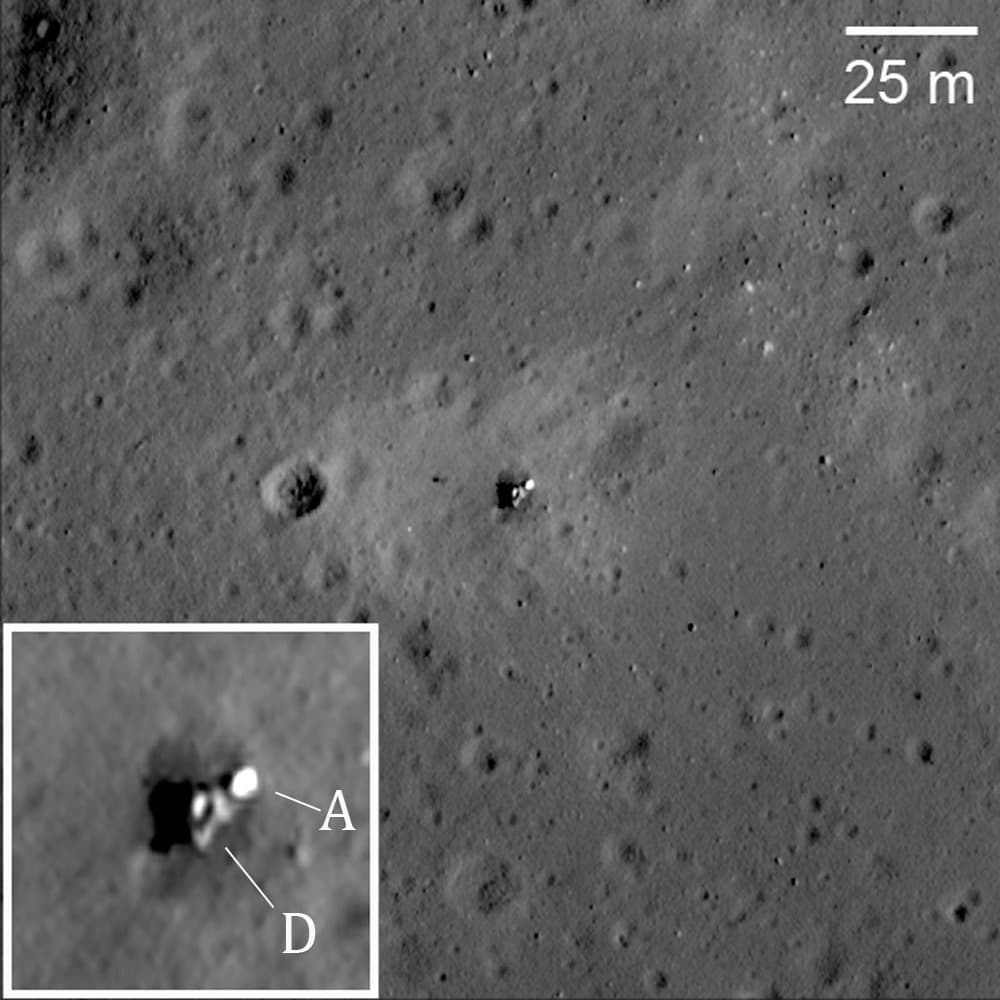
Commonly wrong. Three errors recur. (1) Luna 23 is repeatedly described as having "crashed": it did not. It made a hard but survivable soft landing in Mare Crisium and transmitted for three days; what failed was the sampling, when the lander tipped 10 to 15 degrees onto its own drill (Russian sources give a touchdown speed of 11 m/s against a 5 m/s limit). (2) NSSDCA's own text still says Luna 24 landed "several hundred meters" from Luna 23, but LROC imaging in 2012 put the two landers about 2.3 km apart. (3) English pages print Luna 18's crash coordinates (commonly 3.57 N, 56.50 E) as if they were surveyed; they are a tracking estimate, and the LRO candidate crater at 3.76 N, 56.66 E remained unconfirmed as of 2020, so unlike Luna 23, Luna 18 has no verified site on the Moon.
01Mission facts
Luna 18 launch
2 September 1971, 13:40:40 UT, Proton booster and Blok D upper stage from Tyuratam (Baikonur Cosmodrome)↗
Luna 18 orbit trouble
Lunar orbit insertion on 7 September 1971 cut off 15 seconds early, leaving a wrong 100 km circular orbit; an attitude-control engine fault then blocked the nominal 16.9 x 123.9 km orbit, settling it into 93.4 x 180.3 km↗
Luna 18 operations
85 communications sessions and 54 lunar orbits before it was commanded down toward the surface↗
Luna 18 crash
11 September 1971: the attitude-control engine failed again during braking, the craft could not hold orientation, and signals ceased at 07:47:16.5 UT (impact, possibly ~100 m above the surface) in rugged mountainous terrain near the edge of Mare Fecunditatis↗
Luna 18 impact site (estimated, unconfirmed)
Tracked to roughly 3.57 N, 56.50 E; an LRO image shows a candidate crater at 3.76 N, 56.66 E, but the identification was still unconfirmed as of February 2020↗
Shared design
Both were Ye-8-5 family landers: 3.96 m tall, ~1,880 kg landed dry, 5,600 to 5,750 kg fueled at launch, with a 90 cm arm carrying a drill to core the regolith and a 39 kg return capsule↗
Luna 23's new deep drill
Luna 23 introduced the upgraded Ye-8-5M sampler designed to drill 2.5 m into the surface, far past the ~0.3 m reached by Luna 16 and Luna 20↗
Luna 23 launch
28 October 1974, 14:30:32 UT, Proton from Tyuratam (Baikonur Cosmodrome)↗
Luna 23 landing
6 November 1974, Mare Crisium, at 12.6667 N, 62.1511 E; came in with a vertical speed of 11 m/s against a 5 m/s limit and tilted 10 to 15 degrees, tipping onto its side and its sampling apparatus↗
Luna 23 damage
The hard landing depressurized the instrument compartment and knocked out the decimeter transmitter; the soil-collection device could not operate and no sample was taken↗
Luna 23 survival
The lander kept transmitting for 3 days; work with the station was ended on 9 November 1974↗
Redemption 2.3 km away
In August 1976 Luna 24 soft-landed about 2.3 km from Luna 23 (LROC-derived) and returned 170.1 g, finally proving the deep-drill design that Luna 23 was built to fly↗
Site: 12.6667°N, 62.1511°E · Mare Crisium (Sea of Crises), southeastern edge; Luna 23 lies on its side ~2.3 km from where Luna 24 later succeeded (source)
02Mission timeline
2 Sep 1971
Luna 18 launches on a Proton from Baikonur, a sample-return follow-up to Luna 16
7 Sep 1971
Enters lunar orbit, but the insertion burn cuts off 15 seconds early and an engine fault leaves it in the wrong orbit
11 Sep 1971
07:47:16 UT: attitude control fails during braking and Luna 18 crashes in rough terrain near Mare Fecunditatis
28 Oct 1974
Luna 23, rebuilt around a 2.5 m deep drill (the Ye-8-5M), launches on a Proton from Baikonur
6 Nov 1974
Comes down in Mare Crisium at 11 m/s, tilts 10 to 15 degrees and topples onto its sampler; the drill is wrecked, but the lander survives
9 Nov 1974
After 3 days of transmissions from its side, work with Luna 23 is ended
18 Aug 1976
Luna 24 soft-lands about 2.3 km from Luna 23 and returns 170.1 g, redeeming the deep-drill design
16 Mar 2012
LROC images find Luna 23 lying on its side and fix the true 2.3 km gap between it and Luna 24
Teal dots: events that physically happened in flight or on the Moon. Grey: announcements, namings, contracts, and targets.
03The mission
The Soviet Ye-8-5 sample-return program is remembered for three successes, Luna 16, Luna 20 and Luna 24, but it flew five landing attempts. The other two, Luna 18 and Luna 23, are the missions that failed, and they failed in very different ways. Luna 18 never reached the surface intact; Luna 23 reached it, survived, and still could not do the one thing it was sent to do.
Luna 18 launched on 2 September 1971 as the first sample-return try after Luna 16's breakthrough the year before. It was aimed at rough, mountainous ground near the edge of Mare Fecunditatis, terrain the Soviets wanted to prove they could sample. The mission unraveled by degrees. Lunar orbit insertion on 7 September cut off 15 seconds early, dropping the craft into the wrong orbit; an attitude-control engine fault then blocked the corrective burn. After 85 communication sessions and 54 orbits, controllers commanded the descent anyway on 11 September, the balky engine failed once more, the lander could not hold its orientation, and its signal stopped at 07:47:16 UT as it hit the highlands. No verified crater has ever been tied to it: the LRO candidate site was still unconfirmed as of 2020.
Luna 23 was a more ambitious machine and, in some ways, a more painful loss. It carried the upgraded Ye-8-5M sampler, a deep drill designed to reach 2.5 meters, eight times deeper than the shallow cores of Luna 16 and Luna 20, into the unexplored floor of Mare Crisium. It got there. On 6 November 1974 it came down inside the Sea of Crises, but too hard: Russian accounts put the vertical speed at 11 m/s against a 5 m/s design limit. The lander tilted 10 to 15 degrees and settled onto its own sampling apparatus, depressurizing the instrument compartment and killing the main decimeter transmitter.
That should have been the end, but Luna 23 kept working. Crippled and lying on its side, it transmitted for three more days before controllers ended the mission on 9 November 1974. The sampling device could not operate and nothing was collected, so by the only measure that mattered, sample mass, Luna 23 returned zero. It is the reason the mission is honestly filed as a failure, even though it is more accurate to say it soft-landed and then could not sample than to say it crashed.
The two missions have a strange coda. In August 1976 the Soviets sent Luna 24 to almost exactly the same spot, and it soft-landed about 2.3 kilometers from Luna 23, drilled its deep core, and brought home 170.1 grams, the last lunar samples anyone returned for 44 years. LROC's cameras have since found both landers: Luna 24 standing upright, and a couple of kilometers away Luna 23 still on its side, a monument to how close the program came to losing the very capability it would end on. NSSDCA's own page still repeats the pre-LRO error that the two landed "several hundred meters" apart; the orbital imagery says 2.3 km.
04In pictures
Tap a photo to enlarge.
05Sources
- NSSDCA Master Catalog: Luna 18 (1971-073A)
- NSSDCA Master Catalog: Luna 23 (1974-084A)
- Russian Wikipedia: Луна-23 (touchdown speed 11 m/s, 10-15 degree tilt, depressurization, mission ended 9 Nov 1974)
- LROC Featured Image: Mare Crisium, Failure then Success (16 Mar 2012)
- LROC Spacecraft Related Coordinates, 2016 Update (Luna 23 at 12.6667 N, 62.1511 E, -3668 m)
- Gunter's Space Page: Luna Ye-8-5M (Luna 23, 24), 2.5 m deep drill
- English Wikipedia: Luna 18 (85 sessions, 54 orbits, radio-altimeter density result)
- LROC Featured Site: Luna 23 Flip Book (landed Mare Crisium 6 Nov 1974)
azmth is independent and is not affiliated with or endorsed by NASA, CNSA, Roscosmos, ISRO, JAXA, or any other space agency or company named on this page.