Firefly Blue Ghost Mission 1
Firefly Aerospace (US, commercial) · Lander · 2025Success
Success: landed upright in Mare Crisium Mar 2, 2025; 14 days of surface ops with 10 NASA payloads; mission concluded Mar 16, 2025.
TL;DR· 4 min read
Firefly's Blue Ghost was the first commercial lander to reach the Moon upright, intact and fully operational, touching down in Mare Crisium on 2 March 2025 within its 100-meter target zone. All 10 NASA payloads operated through a complete lunar day: LISTER drilled up to 3 feet, LuGRE tracked GNSS navigation signals on the Moon for the first time, and the lander imaged a total solar eclipse and the lunar sunset. It logged 346 hours of daylight operations and 119 GB of data before concluding on 16 March 2025.
When Blue Ghost touched down at 3:34 a.m. EST on March 2, 2025, it became the first commercial spacecraft to land on the Moon upright, intact, and fully operational. It was not the first commercial landing (Intuitive Machines' Odysseus reached the surface in February 2024 but tipped over); it was the first fully successful one, and it went on to run every one of its 10 NASA payloads through a complete lunar day.
Facts as of July 20, 2026, from the sources listed below.
14days
surface operations, plus 5 hours into the lunar night
119GB
data downlinked (51 GB of it science)
10
NASA payloads delivered and operated
100m
landing accuracy beside Mons Latreille
Commonly wrong. English coverage routinely calls Blue Ghost 'the first commercial Moon landing'. It was not: Intuitive Machines' IM-1 Odysseus landed on February 22, 2024, but tipped onto its side. Blue Ghost's actual first is the first fully successful commercial landing (upright, stable, full mission completed). Two smaller recurring errors: the lander touched down next to Mons Latreille rather than on it; and it did not die at sunset on a neat 14-day clock, it kept operating just over 5 hours into the lunar night before its final transmission late on March 16, 2025 UTC.
01Mission facts
Launch
January 15, 2025, 1:11 a.m. EST, Falcon 9 from KSC LC-39A↗
CLPS task order
About $93.3 million, awarded February 4, 2021↗
Transit
45 days, more than 2.8 million miles traveled↗
Landing
March 2, 2025, 3:34 a.m. EST (08:34 UTC), Mare Crisium↗
Landing accuracy
Upright, within its 100-meter target next to Mons Latreille↗
Site coordinates
18.5623 N, 61.8103 E, elevation -3650 m↗
Payloads
10 NASA science and technology payloads, all operated↗
Surface operations
346 hours of daylight plus just over 5 hours into lunar night; longest commercial lunar surface operations to date↗
Data returned
119 GB downlinked, including 51 GB of science and technology data↗
LuGRE first
First GNSS signal acquisition and tracking en route to and on the Moon; record distance 246,000 miles↗
LISTER first
Drilled up to 3 feet; deepest robotic planetary subsurface thermal probe↗
Eclipse and sunset imagery
Total solar eclipse imaged from the surface March 14, 2025; lunar sunset March 16, 2025↗
Mission end
Concluded March 16, 2025↗
Blue Ghost Mission 2
Targeted no earlier than 2027 (as of September 2026): far-side landing near Nassau crater with LuSEE-Night, Rashid 2 and SPIDER; Elytra Dark orbital relay with ESA Lunar Pathfinder↗
Site: 18.5623°N, 61.8103°E · Eastern Mare Crisium, beside Mons Latreille (source)
02Mission timeline
4 Feb 2021
NASA awards Firefly a $93.3M CLPS task order for the Mare Crisium delivery
15 Jan 2025
Launch at 1:11 a.m. EST on Falcon 9 from KSC LC-39A, sharing the ride with ispace RESILIENCE
2 Mar 2025
Touchdown at 3:34 a.m. EST in Mare Crisium: first fully successful commercial Moon landing
7 Mar 2025
LROC publishes orbital images pinpointing the lander at 18.5623 N, 61.8103 E
14 Mar 2025
Images a total solar eclipse from the lunar surface as Earth blocks the Sun
16 Mar 2025
Captures the lunar sunset, operates just over 5 hours into lunar night, and concludes the mission
NET 2027
Blue Ghost Mission 2 targeted to the lunar far side (as of Sep 2026)
Teal dots: events that physically happened in flight or on the Moon. Grey: announcements, namings, contracts, and targets.
03The mission
Blue Ghost Mission 1 flew under NASA's Commercial Lunar Payload Services (CLPS) initiative, on a task order worth approximately $93.3 million awarded to Firefly on February 4, 2021 for a 10-payload delivery to Mare Crisium. It launched on a SpaceX Falcon 9 from Kennedy Space Center's LC-39A at 1:11 a.m. EST on January 15, 2025, sharing the rocket with ispace's RESILIENCE lander, which took a slower route and was later destroyed in its own June 2025 landing attempt.
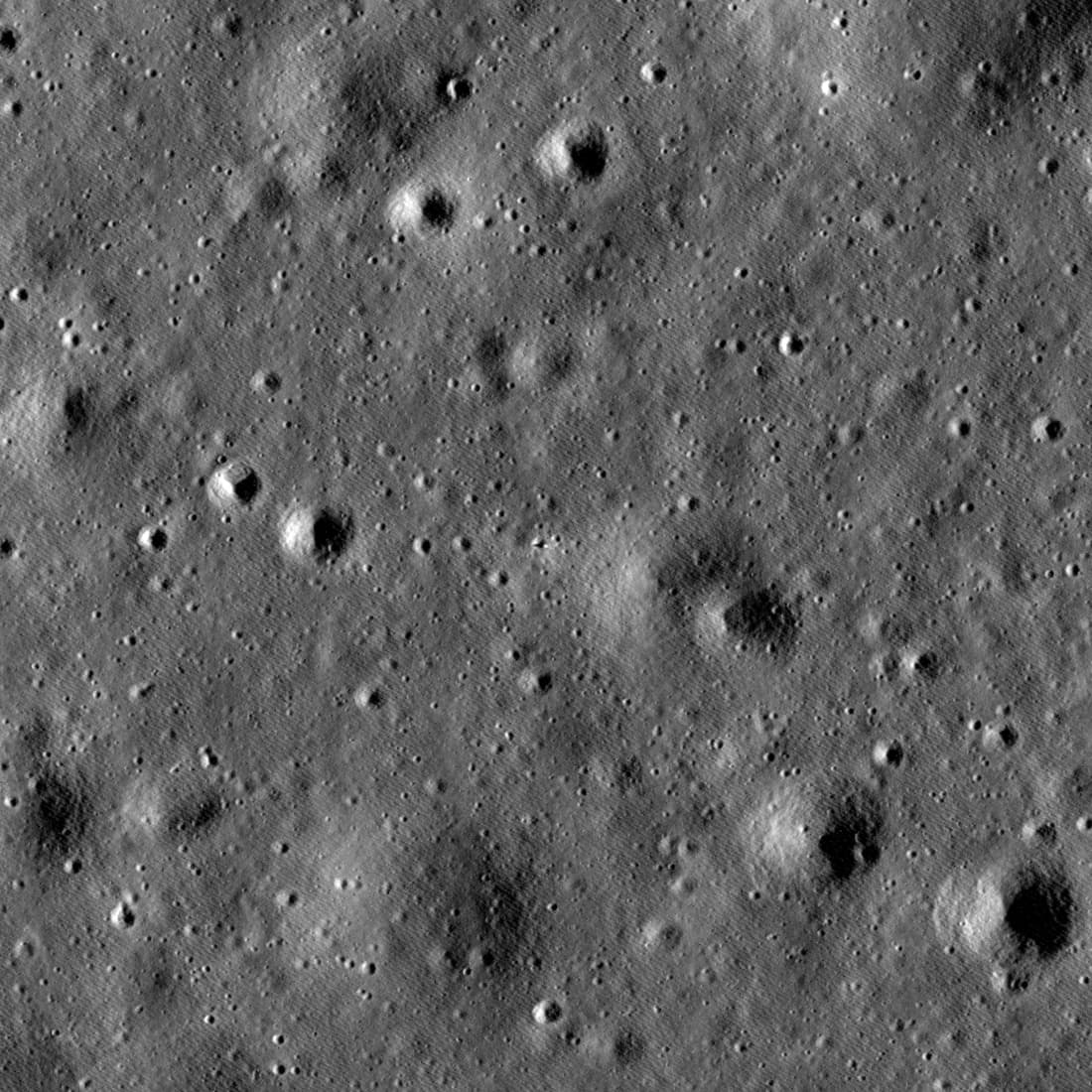
After a 45-day transit covering more than 2.8 million miles, Blue Ghost landed at 3:34 a.m. EST (08:34 UTC) on March 2, 2025, touching down within its 100-meter target zone next to Mons Latreille, an ancient volcanic cone in the more than 300-mile-wide Mare Crisium basin. LRO's cameras later pinpointed the lander at 18.5623 N, 61.8103 E, its shadow draped across the rim of a 12-meter crater, and captured before-and-after frames showing the engine plume's disturbance of the regolith.
The surface campaign delivered on essentially every payload objective. LISTER drilled up to 3 feet down, which NASA describes as the deepest robotic planetary subsurface thermal probe to date. LuGRE acquired and tracked GNSS satellite navigation signals en route to and on the Moon for the first time, with signal acquisition out to a record 246,000 miles. The Electrodynamic Dust Shield lifted regolith off surfaces electrostatically, the Lunar Magnetotelluric Sounder deployed sensors to probe the interior to depths of 700 miles, NGLR returned laser echoes to three observatories on Earth, at Grasse, Wettzell and Apache Point, between 3 and 20 March 2025, and SCALPSS captured roughly 9,000 images during descent and later at sunset.
Blue Ghost also became a witness to two celestial events. On March 14, 2025 it imaged a total solar eclipse from the lunar surface as Earth slid in front of the Sun, and on March 16 it documented the lunar sunset before operating just over 5 hours into the lunar night. In all, the mission logged 346 hours of daylight operations and downlinked 119 GB of data, including 51 GB of science and technology data, before it concluded on March 16, 2025.
Firefly's follow-up, Blue Ghost Mission 2, is set to launch no earlier than 2027 (as of September 2026, per Firefly's mission page). It will attempt the first commercial far-side landing, near Nassau crater, delivering the NASA/DOE LuSEE-Night radio telescope, the UAE's Rashid 2 rover, and Fleet Space's SPIDER seismometer, while Firefly's Elytra Dark transfer vehicle, carrying ESA's Lunar Pathfinder comsat, stays in orbit as a relay. The flight hardware went through environmental testing at NASA JPL starting in October 2025.
Image note per the licensing policy: Firefly's own surface photos (the sunset shots and the eclipse 'diamond ring') are company copyright, Tier 3, so link out to fireflyspace.com for those. The LROC orbital views and NASA launch photography below are the self-hostable set.
04In pictures
Tap a photo to enlarge.
05Sources
- NASA news release: Touchdown! (Mar 2, 2025)
- NASA news release: mission concludes (Mar 2025)
- NASA CLPS blog: liftoff (Jan 15, 2025)
- NASA news release: Firefly CLPS award (Feb 4, 2021)
- LROC Featured Image 1407: Blue Ghost seen from above (coordinates)
- LROC Featured Image 1410: looking back towards the Sun
- Firefly landing press release
- Firefly Blue Ghost Mission 1 page
- Firefly Blue Ghost Mission 2 page (BG2 target date, as of September 2026)
- University of Maryland: Next Generation Lunar Retroreflector (NGLR-1 returns at Grasse, Wettzell and Apache Point, March 3, 4 and 20, 2025)
- Wikipedia: Blue Ghost Mission 1 (launch time, last-contact time)
- LROC terms of use (image tier basis)
azmth is independent and is not affiliated with or endorsed by NASA, CNSA, Roscosmos, ISRO, JAXA, or any other space agency or company named on this page.