SLIM (Smart Lander for Investigating Moon)
JAXA (Japan) · Lander · 2024Success

Landed Jan 20, 2024 (JST): world's first pinpoint lunar landing (~10 m vs 100 m goal); survived three lunar nights; operations ended Aug 23, 2024.
TL;DR· 8 min read
SLIM ended up nose-down on the Moon and still succeeded. JAXA's 200 kg 'Moon Sniper' made the world's first pinpoint lunar landing on 20 January 2024, with a position error of about 10 m against a 100 m requirement, despite losing a main engine nozzle at 50 m altitude. It made Japan the fifth country to soft-land, woke on 28 January to run more spectroscopy than planned, survived three lunar nights it was never designed for, and was graded as meeting even its extra success criteria.
SLIM is best remembered in English media for ending up nose-down on the Moon, which makes it sound like a failure. It was the opposite: JAXA's 200 kg 'Moon Sniper' pulled off the world's first pinpoint lunar landing (position error of roughly 10 m, possibly 3-4 m, against a 100 m requirement) despite losing one of its two main engine nozzles at 50 m altitude, made Japan the fifth country to soft-land on the Moon, and went on to meet every success criterion including the stretch goals.
Facts as of July 20, 2026, from the sources listed below.
10m
pinpoint landing accuracy, possibly 3-4 m, against a 100 m goal
200kg
dry mass: the lightest successful lunar lander per JAXA
3lunar nights
survived, with zero night-survival design requirement
5th
country to soft-land on the Moon
Commonly wrong. Four recurring errors in English coverage. (1) 'SLIM missed by 55 m, so the pinpoint claim is inflated': the 55 m (about 60 m per the Dec 2024 review) is the final resting point after the deliberate obstacle-avoidance phase and the one-engine eastward drift; JAXA's pinpoint metric is position error at the 50 m altitude checkpoint, which was about 10 m or less and possibly 3-4 m, versus a formal 100 m goal. (2) The landing date appears as both Jan 19 and Jan 20, 2024; both are correct (Jan 19 15:20 UTC, Jan 20 00:20 JST). JAXA's official date is Jan 20. (3) 'It landed upside down and the mission failed': SLIM resumed operations on Jan 28, completed more spectroscopy than planned, survived three lunar nights it was never designed for, and JAXA graded even the extra-success criteria as achieved. (4) The famous nose-down photo is often credited to SLIM itself; it was taken by the LEV-2 SORA-Q robot and relayed to Earth via LEV-1. Also stale in some sources: recovery attempts are over (operations ended Aug 23, 2024) and the engine anomaly cause is no longer unknown (root cause published Dec 26, 2024).
01Mission facts
Launch
Sept 7, 2023 (JST), H-IIA Launch Vehicle No. 47 from Tanegashima, ridesharing with the XRISM X-ray telescope↗
Lunar orbit insertion
Dec 25, 2023↗
Landing
Jan 20, 2024 at 00:20 JST (Jan 19, 15:20 UTC / 10:20 a.m. EST); Japan became the fifth country to soft-land on the Moon↗
Landing site
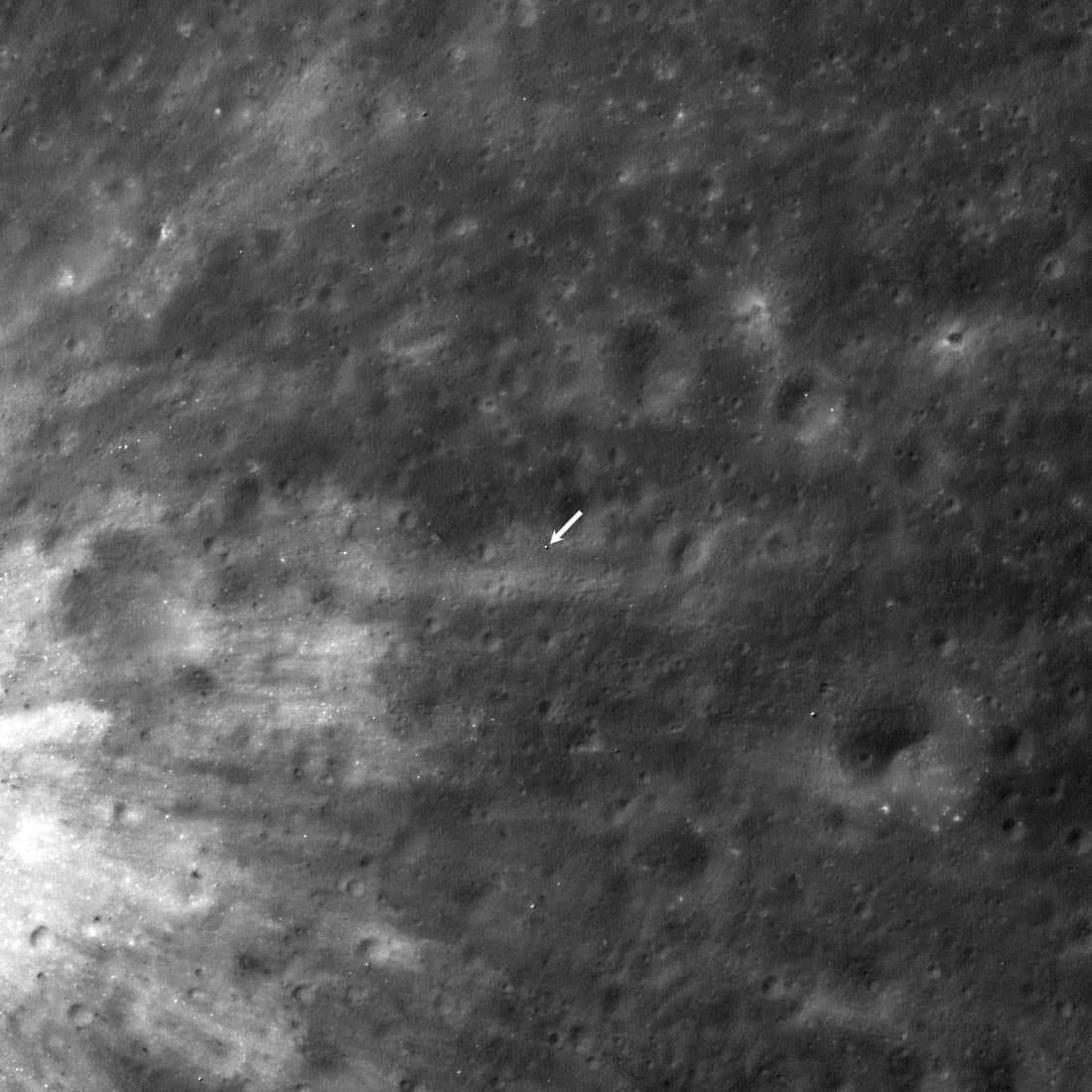
13.3160 S, 25.2510 E (ME coordinates, NASA LRO team), elevation -912 m, on ejecta near the 270 m Shioli crater in Mare Nectaris↗
Pinpoint accuracy
Position error at the 50 m altitude checkpoint (before obstacle avoidance took precedence) evaluated at approximately 10 m or less, possibly about 3-4 m; final touchdown about 55 m east of the original target (refined to about 60 m in the Dec 2024 project review)↗
Main engine anomaly
At about 50 m altitude the -X main engine's ceramic nozzle separated and thrust dropped; autonomous software continued descent on one engine, drifting east; touchdown vertical speed was 1.4 m/s or less but lateral velocity and attitude exceeded design limits, leaving SLIM nose-down with solar cells facing west↗
Root cause (published Dec 26, 2024)
Blowdown propellant feed pressure was low late in flight; simultaneous firing of the 12 auxiliary thrusters at main-engine ignition transiently dropped supply pressure, the -X engine failed to ignite for about 1 second, then unburned accumulated propellant lit with an excessive ignition shock that detached the nozzle; anomaly occurred at ~98% of total propulsion from separation to landing↗
Rovers
LEV-1 (2.1 kg, hopping locomotion, own direct-to-Earth comms) and LEV-2 'SORA-Q' (238 g, ~8 cm, developed with Takara Tomy, Sony Group and Doshisha University; world's smallest and lightest lunar exploration robot per JAXA) separated successfully just before touchdown; JAXA calls it the world's first lunar exploration by coordinated multiple robots↗
The famous photo
The nose-down image of SLIM was taken by LEV-2 (SORA-Q) and sent to LEV-1 by short-range (Bluetooth) link, then relayed to Earth by LEV-1↗
Power recovery and science
Shut down at 02:57 JST on landing night; resumed operations Jan 28, 2024 when the sun angle changed; Multi-Band Camera then made 10-band near-infrared spectral observations of 10 rocks (dog-breed nicknames such as Toy Poodle and AKITAINU) plus 2 regolith sites, exceeding expectations, targeting olivine chemistry relevant to lunar mantle composition↗
Lunar nights survived
Three, despite no night-survival design requirement; post-night comm windows were Feb 25-Mar 1, Mar 27-30, and Apr 23-29, 2024; last contact Apr 28, 2024↗
Laser ranging
On May 24, 2024, NASA's LRO bounced laser pulses off SLIM's 2-inch NASA Laser Retroreflector Array (~21 g) on two successive orbits from ~70 km altitude, despite the array lying sideways; SLIM remains a passive laser target on the surface for decades↗
End of operations
Aug 23, 2024 at 22:40 JST, after re-contact attempts from May through July failed (announced Aug 26, 2024)↗
Spacecraft
Approx. 200 kg dry / 715 kg at launch; ~2.4 m x 1.7 m x 2.7 m; JAXA assesses SLIM as the lightest successful lunar lander; total project development cost 14.9 billion yen↗
Success grading
Dec 26, 2024 project review: minimum success, full success, and extra success criteria all achieved↗
Legacy
Image-matching navigation feeds JAXA's MMX Mars-moons mission; Multi-Band Camera technology transfers to the ALIS spectrometer on the LUPEX rover with ISRO; flight results paper (Sakai et al.) published in Acta Astronautica vol. 235, Oct 2025↗
Site: 13.3160°S, 25.2510°E · Near Shioli crater, Mare Nectaris (source)
02Mission timeline
2016
SLIM becomes a JAXA project (concept lineage back to SELENE-B studies from 2002)
7 Sep 2023
Launch on H-IIA No. 47 from Tanegashima, with XRISM
25 Dec 2023
Arrival in lunar orbit
20 Jan 2024
Touchdown at 00:20 JST near Shioli crater after releasing LEV-1 and LEV-2 seconds earlier; world's first pinpoint lunar landing despite nozzle loss at 50 m; powered down 02:57 JST to preserve battery
24 Jan 2024
NASA's LRO images SLIM on the surface from ~80 km (published Jan 26)
28 Jan 2024
Operations resume as the sun reaches the west-facing solar cells; Multi-Band Camera science runs until lunar sunset (~Jan 31)
Feb to Apr 2024
Survives three lunar nights (comm windows Feb 25-Mar 1, Mar 27-30, Apr 23-29)
28 Apr 2024
Last contact with SLIM
24 May 2024
LRO successfully laser-ranges SLIM's NASA retroreflector on two successive orbits
23 Aug 2024
JAXA terminates SLIM operations at 22:40 JST after months of failed re-contact attempts (announced Aug 26)
26 Dec 2024
Project review: minimum, full, and extra success all achieved; nozzle-separation root cause published
Oct 2025
Definitive flight-results paper (Sakai et al.) appears in Acta Astronautica vol. 235
Teal dots: events that physically happened in flight or on the Moon. Grey: announcements, namings, contracts, and targets.
03The mission
SLIM (Smart Lander for Investigating Moon) was a JAXA technology demonstrator with two stated objectives: prove 100 m class 'pinpoint' landing on the Moon, where conventional landers were accurate to several kilometers at best, and prove that a radically lightweight spacecraft could do it. The lander massed about 200 kg dry and 715 kg fueled, stood about 2.4 m tall, and cost 14.9 billion yen to develop. Its nickname in Japan, Moon Sniper, referred to the vision-based image-matching navigation that compared live camera frames against orbital maps during descent. It launched on September 7, 2023 (JST) on H-IIA flight 47 from Tanegashima, sharing the rocket with the XRISM X-ray observatory, and entered lunar orbit on December 25, 2023.
Touchdown came at 00:20 JST on January 20, 2024 (15:20 UTC on January 19), on the ejecta apron of the 270 m crater Shioli in Mare Nectaris. The descent nearly ended in disaster: at about 50 m altitude, the ceramic nozzle of one of the two main engines separated, taking most of that engine's thrust with it. The autonomous guidance recognized the problem and pressed on with one engine, drifting slowly east and touching down about 55 m east of the target, tipped forward onto its nose with the solar cells aimed west, away from the morning sun. The number that matters for the pinpoint claim was measured before the anomaly, at the 50 m checkpoint where obstacle-avoidance logic takes over from precision navigation: position error of approximately 10 m or less, and possibly 3-4 m, against a 100 m requirement. That made SLIM the world's first pinpoint lunar landing and Japan the fifth country to soft-land on the Moon, after the USSR, the US, China, and India.
The mission then staged one of spaceflight's better comebacks. SLIM shut itself down at 02:57 JST with battery in reserve, and when the sun swung west on January 28 the lander woke up and ran its Multi-Band Camera through 10-band near-infrared scans of ten rocks, nicknamed after dog breeds (Toy Poodle, AKITAINU, St. Bernard and others), plus two regolith sites, exceeding the planned science and probing olivine chemistry relevant to the composition of the lunar mantle. The two rovers released seconds before touchdown had meanwhile made their own history: LEV-1 hopped and transmitted directly to Earth, while the 238 g, 8 cm LEV-2 'SORA-Q', a transforming ball robot co-developed with toymaker Takara Tomy, Sony Group, and Doshisha University, took the mission-defining photograph of the nose-down lander and relayed it to Earth through LEV-1. JAXA credits the pair as the world's first coordinated multi-robot lunar exploration, and LEV-2 as the world's smallest and lightest lunar exploration robot.
SLIM was never designed to survive the two-week lunar night, yet it answered ground calls after three of them, with communication windows in late February, late March, and late April 2024. The last contact was April 28, 2024. On May 24, 2024, NASA's Lunar Reconnaissance Orbiter bounced laser pulses off the small NASA retroreflector array bolted to SLIM, on two successive orbits, even though the array was lying sideways; the powerless lander will remain a usable laser target on the surface for decades. After months of unanswered attempts, JAXA formally ended operations at 22:40 JST on August 23, 2024.
The December 26, 2024 project review closed the books: minimum, full, and extra success criteria were all achieved, and the nozzle-loss mystery was solved. SLIM's weight-saving blowdown propellant feed meant supply pressure was already low late in the flight; when all twelve attitude thrusters fired at the same instant a main-engine burn started, the pressure transiently dropped, the -X engine failed to light for about one second, and the unburned propellant that had pooled in the chamber then ignited with a shock that broke the nozzle off. The trouble struck at roughly 98% of the way through the mission's total propulsion. The technology is already flowing onward: SLIM's image-matching navigation informs the MMX Mars-moons sample-return mission, and the Multi-Band Camera lineage continues as the ALIS spectrometer on the LUPEX polar rover being developed with ISRO. The full flight results were published by project manager Shin-ichiro Sakai and colleagues in Acta Astronautica in October 2025, and the mission's public afterlife continues, from life-size models at JAXA Sagamihara and Expo 2025 Osaka to a June 2026 NPR feature on the transforming rovers.
04In pictures
Tap a photo to enlarge.
05Sources
- JAXA press release, Jan 25, 2024: Outcome for SLIM's Moon Landing (accuracy, anomaly, rovers)
- JAXA press release, Aug 26, 2024: Conclusion of SLIM lunar activities (end of ops Aug 23, last contact Apr 28)
- ISAS SLIM Project review press briefing, Dec 26, 2024 (mass, cost, root cause, success grading, rover specs, night-survival dates)
- NASA, Jan 26, 2024: NASA's LRO Spots Japan's Moon Lander (coordinates, elevation, fifth-country statement, images)
- LROC Featured Image 1358: JAXA SLIM Landing (site coordinates 13.3160 S, 25.2510 E; observation details)
- NASA Science, Jul 29, 2024: NASA, JAXA bounce laser beam between Moon's surface and lunar orbit (May 24, 2024 laser ranging)
- JAXA SLIM project page
- Sakai et al., 'Moon landing results of SLIM', Acta Astronautica vol. 235 (Oct 2025)
- SpaceNews, Jan 2024: SLIM achieved pinpoint landing with one working engine (secondary corroboration)
- NPR Short Wave, Jun 19, 2026: feature on the SLIM transforming robots (ongoing cultural footprint)
azmth is independent and is not affiliated with or endorsed by NASA, CNSA, Roscosmos, ISRO, JAXA, or any other space agency or company named on this page.