Peregrine Mission One
Astrobotic (US, commercial, flying NASA CLPS payloads) · Lander · 2024Failure
Launched Jan 8, 2024 on Vulcan's first flight; a helium-valve failure hours later ruled out landing; controlled South Pacific reentry Jan 18, 2024.
TL;DR· 5 min read
Peregrine Mission One was the first Commercial Lunar Payload Services launch and the first US commercial lunar lander to leave Earth, and it never reached the Moon. Hours after a nominal maiden flight of Vulcan Centaur on 8 January 2024, a helium valve inside the lander failed to reseal, the oxidizer tank ruptured, and a landing was ruled out. Astrobotic flew the crippled spacecraft for ten more days, collected payload data in cislunar space, and steered it into a controlled reentry over the South Pacific on 18 January 2024.
Peregrine Mission One was the first launch of NASA's Commercial Lunar Payload Services era and the first US commercial lunar lander to leave Earth, and it died not on the Moon but in a propulsion tank a few hours after a flawless launch. The failure was entirely on the lander: the maiden Vulcan Centaur rocket performed nominally, a point English coverage still gets wrong. Astrobotic flew the crippled spacecraft for ten more days, collected payload data in cislunar space, and deliberately steered it into a destructive reentry over the South Pacific.
Facts as of July 20, 2026, from the sources listed below.
10 d 14 h
in space, launch to controlled reentry
535,000+miles
traveled through cislunar space
20
payloads aboard, from seven nations
$108M
NASA CLPS task order (5 science payloads)
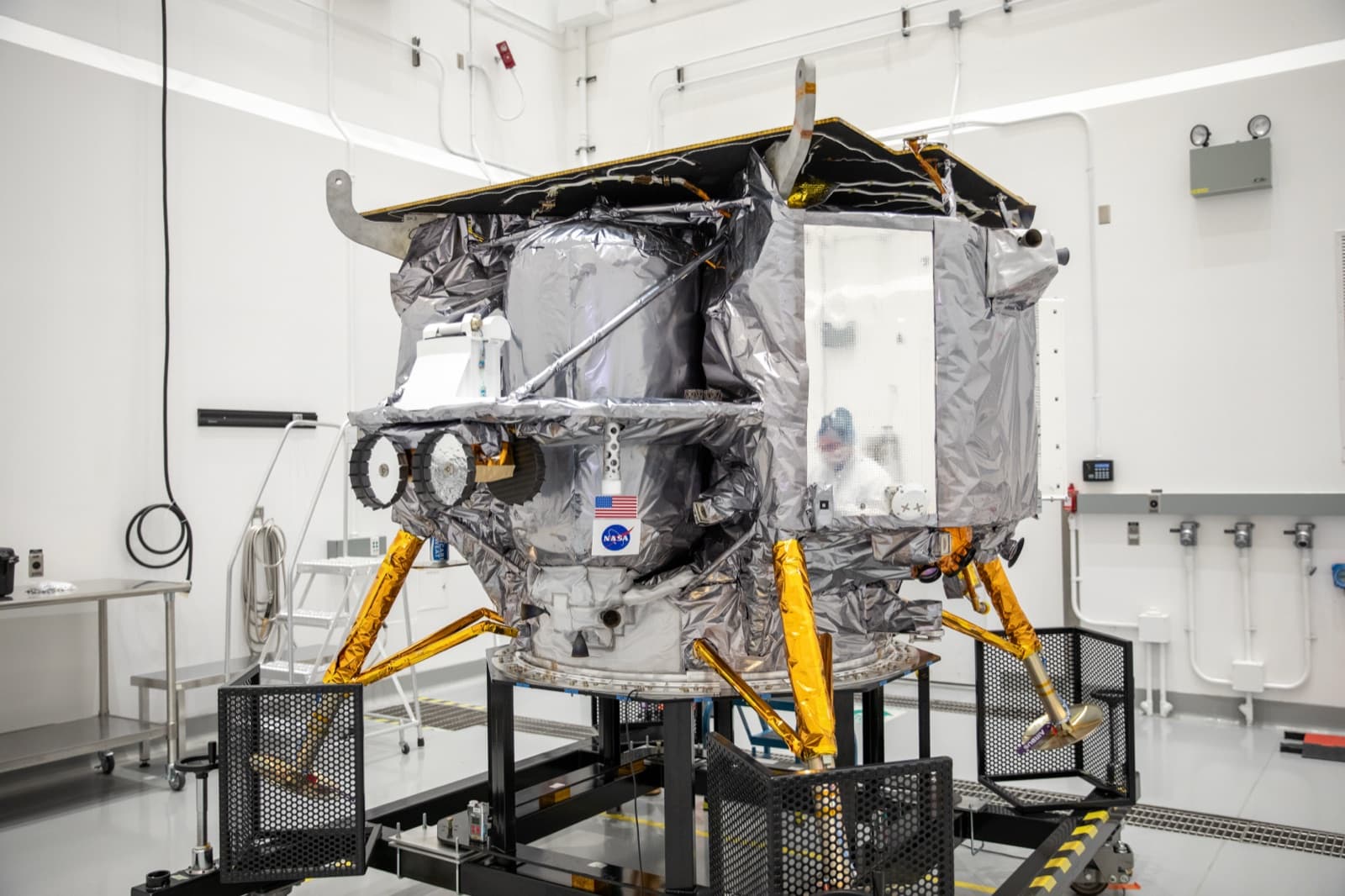
Commonly wrong. Two persistent errors: (1) 'the new Vulcan rocket failed' - it did not; Vulcan's maiden flight performed nominally and the failure was a stuck-open helium valve (PCV2) inside the lander's own propulsion system; (2) 'Peregrine crashed back to Earth' - the January 18 reentry was a deliberate disposal decision made January 13 in consultation with NASA. Also, Peregrine was not the first commercial lunar landing attempt (Beresheet 2019 and ispace's Hakuto-R M1 2023 crashed trying earlier); it was the first CLPS launch and the first US commercial lunar lander launched.
01Mission facts
Launch
January 8, 2024, 07:18 UTC (2:18 a.m. EST), Cape Canaveral SLC-41↗
Launch vehicle
ULA Vulcan Centaur VC2S, maiden flight (Cert-1)↗
Failure cause
Helium pressure control valve PCV2 failed to reseal during propulsion commissioning; oxidizer tank 'Tank 5' over-pressurized and ruptured↗
Root cause (review board)
Vibration-initiated relaxation of threaded components inside the valve, replicated in ground testing; 34-member board chaired by Dr. John Horack (Ohio State)↗
End of mission
Controlled reentry over the South Pacific, January 18, 2024, ~21:04 UTC (4:04 p.m. EST), after 10 days 14 hours and 535,000+ miles↗
NASA payloads
5 under task order TO2-AB (LRA, NSS, LETS, NIRVSS, PITMS); 4 of 5 collected data in flight (LRA is passive)↗
NASA task order value
About $108 million (up from the initial $79.5 million award, for 5 payloads instead of 14)↗
Total manifest
20 payloads from seven nations and 16 commercial customers↗
Intended landing
Sinus Viscositatis, adjacent to the Gruithuisen Domes; touchdown planned February 23, 2024, ~10 Earth days of surface ops↗
Lander dimensions
~1.9 m tall, ~2.5 m across, 90 kg payload capacity, five TALOS-150 thrusters (MMH/MON-25)↗
Human-remains controversy
Celestis and Elysium Space memorial capsules drew a formal objection from Navajo Nation President Buu Nygren and a White House-convened meeting days before launch↗
What came next
Griffin Mission One targeted NET November 2026 (as of July 13, 2026); Astrobotic acquired by Voyager Technologies in 2026, now Voyager Lunar Systems; Peregrine-2 planned for 2028 under a $298M CLPS task order↗
02Mission timeline
8 Jan 2024
Liftoff at 07:18 UTC on the maiden Vulcan Centaur: first CLPS launch, first US commercial lunar lander launch
8 Jan 2024
Avionics and power up at 08:16 UTC; communications established via NASA's Deep Space Network
8 Jan 2024
PCV2 fails to reseal during propulsion pressurization, hours into the mission; oxidizer Tank 5 ruptures and leaks; soft landing ruled out
8 to 17 Jan 2024
Team stabilizes spacecraft; 4 of 5 NASA instruments plus other payloads collect data in cislunar space; 8 potentially mission-ending anomalies handled
13 Jan 2024
Astrobotic, consulting NASA, decides on controlled Earth reentry to avoid debris risk in cislunar space
18 Jan 2024
Controlled reentry over open water in the South Pacific at ~21:04 UTC; mission ends
27 Aug 2024
Post-mission report published: root cause confirmed as vibration-loosened threaded joint in PCV2; corrective valve redesign for future landers
15 Jun 2026
Successor lander Griffin-1 unveiled ahead of environmental testing; launch targeted NET November 2026 (as of Jul 13, 2026)
13 Jul 2026
Voyager Technologies completes Astrobotic acquisition (now Voyager Lunar Systems); $298M CLPS award includes Peregrine-2, planned 2028, to the Gruithuisen Domes
Teal dots: events that physically happened in flight or on the Moon. Grey: announcements, namings, contracts, and targets.
03The mission
Peregrine launched from Space Launch Complex 41 at Cape Canaveral on January 8, 2024 at 07:18 UTC (2:18 a.m. EST), riding the first flight of United Launch Alliance's Vulcan Centaur (the VC2S configuration, certification flight Cert-1). It was a triple first: first CLPS launch, first US commercial lunar lander launch, and Vulcan's debut. By 08:16 UTC the spacecraft had activated its avionics and established communications through NASA's Deep Space Network, and propulsion commissioning began.
That commissioning killed the mission. When the second of two helium pressure control valves (PCV2) was actuated, it failed to reseal, and helium flowed uncontrollably into the oxidizer tank known as Tank 5. Within about 90 seconds the tank's pressure sensors pegged at maximum; the tank ruptured near the top and leaked oxidizer for the rest of the flight, torquing the spacecraft and starving it of the propellant needed to land. Astrobotic's 34-expert review board, chaired by independent investigator Dr. John Horack of Ohio State University, later replicated the failure on a spare valve: a threaded joint inside the valve had loosened through vibration-initiated relaxation, damaging the primary seating O-ring. The board also counted 24 in-flight anomalies in total, eight of them potentially mission-ending, all handled in real time by mission control.
What followed became a study in salvage. The team stabilized the tumbling spacecraft, kept its solar panel sun-pointed, and powered up payloads: four of the five NASA instruments aboard (NSS, LETS, PITMS, NIRVSS; the fifth, the Laser Retroreflector Array, is passive and only works on the surface) collected data on the radiation and chemical environment around the lander. On January 13, in consultation with NASA, Astrobotic chose to end the mission with a controlled Earth reentry rather than leave a derelict leaking spacecraft in cislunar space. After traveling more than 535,000 miles, Peregrine reentered over open water in the South Pacific on January 18, 2024 at about 21:04 UTC (4:04 p.m. EST), 10 days and 14 hours after launch.
The manifest it carried made headlines of its own: 20 payloads from seven nations and 16 commercial customers, including Carnegie Mellon's Iris rover, Mexico's five-robot Colmena swarm (that country's first Moon hardware), a DHL MoonBox of keepsakes, and memorial capsules with cremated human remains from Celestis and Elysium Space. Those remains prompted a formal objection from Navajo Nation President Buu Nygren, who called burying remains on a Moon sacred in Navajo cosmology 'deeply disturbing' and forced a last-minute White House-convened meeting in the week before launch. NASA's five payloads flew under CLPS task order TO2-AB, reported at about $108 million after modifications. The intended landing site was Sinus Viscositatis, beside the Gruithuisen Domes, with touchdown planned for February 23, 2024.
The program did not end there, though the company as founded did. Astrobotic redesigned the valves (future landers get multiple dissimilar PCVs) and pressed on with the much larger Griffin lander. Griffin Mission One, now carrying Astrolab's FLIP rover after NASA cancelled VIPER in July 2024, was unveiled on June 15, 2026 ahead of environmental testing and is targeted for launch no earlier than November 2026 (as of July 13, 2026). In mid-2026 Voyager Technologies completed its acquisition of Astrobotic, which now operates as Voyager Lunar Systems, and NASA awarded a $298 million CLPS task order that includes a Peregrine-2 lander planned for 2028, aimed at the same Gruithuisen Domes region Peregrine 1 never reached.
04In pictures
Tap a photo to enlarge.
05Sources
- NSSDCA Master Catalog: Peregrine Mission 1 (retrieved via Wayback; NSSDCA temporarily offline July 2026)
- Astrobotic, Peregrine Mission 1 Post-Mission Report (August 2024, PDF)
- NASA news release: NASA Science, Astrobotic Peregrine Mission One Concludes (Jan 19, 2024)
- NASA Science: TO2-AB payload page
- Astrobotic launch release: 20 payloads, seven nations
- TechCrunch on the $108M task order and valve failure (Aug 27, 2024)
- CNN: Navajo Nation objection and White House meeting (Jan 5, 2024)
- Astrobotic: Griffin-1 unveiled ahead of environmental testing (June 2026)
- Astrobotic/Voyager: $298M NASA award under completed acquisition (Jul 13, 2026)
- Spaceflight Now: Griffin-1 delay to NET July 2026 (Oct 28, 2025)
azmth is independent and is not affiliated with or endorsed by NASA, CNSA, Roscosmos, ISRO, JAXA, or any other space agency or company named on this page.