IM-1 Odysseus
Intuitive Machines (US, commercial, flying NASA CLPS payloads) · Lander · 2024Partial
Landed at 80.13°S near Malapert A on Feb 22, 2024; tipped ~30°, transmitted until Feb 29, 2024; did not survive lunar night (confirmed Mar 23, 2024).
TL;DR· 6 min read
Odysseus was the first commercial spacecraft to soft-land on the Moon and the first American soft landing since Apollo 17, touching down near Malapert A at 80.13 S on 22 February 2024. Its laser rangefinders were dead because a safety-enable switch was never disarmed, and the patched-in NASA Navigation Doppler Lidar data never processed, so it landed on optical navigation alone, broke a landing leg and came to rest tilted about 30 degrees. All six NASA payloads still returned data before it was powered down on 29 February 2024.
Odysseus was the first commercial spacecraft ever to soft-land on the Moon and the first American soft landing since Apollo 17 in December 1972, and it did it half-blind: its laser rangefinders were dead because a safety-enable switch was never thrown before launch. The heroic last-minute software patch to NASA's Navigation Doppler Lidar has become the mission's legend, but Intuitive Machines later admitted a missed data flag meant that data never actually processed, and Odysseus landed hard on optical navigation alone, snapping a leg and coming to rest tilted about 30 degrees. NASA and IM still called it a success; the honest grade is a landing that worked, wounded.
Facts as of July 20, 2026, from the sources listed below.
80.13°S
landing latitude, southernmost on the Moon at the time
51years
since the previous US soft landing (Apollo 17)
~30°
resting tilt after a landing leg broke
$118M
NASA CLPS task order for six payloads
Commonly wrong. The most repeated story, that NASA's Navigation Doppler Lidar 'saved the landing,' is wrong: IM's Tim Crain confirmed on Feb 28, 2024 that a missed data flag meant the patched-in NDL data never processed, and Odysseus landed on optical terrain navigation and inertial data alone. Odysseus also did not end up flat on its side (that was IM-2 Athena in 2025); it came to rest tilted about 30 degrees and kept operating. 'Southernmost landing ever' is now stale: IM-2 landed at 84.79°S in March 2025. And the Feb 29 shutdown was not a failure; Nova-C was never designed to survive lunar night.
01Mission facts
Launch
February 15, 2024, 06:05 UTC (1:05 a.m. EST), SpaceX Falcon 9, LC-39A, Kennedy Space Center↗
Landing
February 22, 2024, 23:23:53 UTC (6:23 p.m. EST)↗
Landing site
80.13°S, 1.44°E, elevation 2,579 m, inside a degraded 1-km crater sloped 12°, near Malapert A; ~1.5 km from the intended site↗
Firsts
First commercial soft landing on the Moon; first US soft landing since Apollo 17 (December 1972); southernmost landing at the time↗
Launch mass
1,908 kg (Nova-C, fueled)↗
NASA payloads
6 (NDL, LN-1, RFMG, ROLSES, SCALPSS, LRA) under a CLPS task order of about $118 million; all six returned data↗
Rangefinder failure
Laser rangefinders inoperable because a pre-launch safety-enable switch was never disarmed; discovered hours before descent; NDL patch uploaded during an extra lunar orbit↗
The data flag
Crain (Feb 28, 2024): a missed validity flag meant NDL data 'did not process after all'; Odysseus landed on optical navigation and IMU only, with excess descent and lateral velocity↗
Post-landing state
At least one landing leg broken; lander tilted ~30° from vertical; downlink severely degraded but operational↗
EagleCam
Could not deploy during descent; ejected ~4 m from the lander Feb 28, 2024 but returned no images of Odysseus↗
End of mission
Powered down February 29, 2024 with a farewell image; wake-up listening from March 20; confirmed dead March 23, 2024↗
What came next
IM-2 Athena landed at 84.79°S on March 6, 2025 but tipped onto its side and ended within a day; IM-3 (Trinity, Reiner Gamma) targeted for the first part of 2027 (as of September 2026)↗
Site: 80.1300°S, 1.4400°E · Degraded 1-km crater near Malapert A, south polar highlands (source)
02Mission timeline
15 Feb 2024
Falcon 9 launch at 06:05 UTC from LC-39A, Kennedy Space Center
21 Feb 2024
Lunar orbit insertion
22 Feb 2024
Laser rangefinders found dead hours before descent (safety switch never disarmed); extra orbit taken to patch in NASA's NDL payload
22 Feb 2024
Touchdown at 23:23:53 UTC near Malapert A: first commercial Moon landing, first US soft landing in 51 years; weak signal confirmed ~15 minutes later
23 Feb 2024
IM confirms the lander is tipped, resting at about 30 degrees; downlink limited
24 Feb 2024
NASA's LRO photographs Odysseus on the surface at 18:57 UTC; LROC fixes the site at 80.13 S, 1.44 E
28 Feb 2024
NASA and IM declare success (data from all six NASA payloads); Crain reveals the NDL data never processed; EagleCam ejected, no images
29 Feb 2024
Odysseus sends a farewell image and is powered down ahead of lunar night
23 Mar 2024
After listening since March 20, IM confirms Odie will not wake; mission permanently ends
6 Mar 2025
Successor IM-2 Athena lands farther south (84.79 S, Mons Mouton) but tips onto its side; mission ends within a day
Teal dots: events that physically happened in flight or on the Moon. Grey: announcements, namings, contracts, and targets.
03The mission
IM-1 launched on a SpaceX Falcon 9 from Launch Pad 39A at NASA's Kennedy Space Center on February 15, 2024 at 06:05 UTC (1:05 a.m. EST), with the 1,908 kg (fueled) Nova-C lander named Odysseus, 'Odie' to its Houston controllers. The mission flew six NASA payloads under a CLPS task order valued at about $118 million, alongside six commercial payloads including Embry-Riddle's student-built EagleCam, Jeff Koons' 'Moon Phases' sculptures, and an ILOA imaging system. Its target was a site at about 80.2°S, 1.0°E, east of the crater Malapert A, farther south than any spacecraft had ever attempted to land.
The drama came in lunar orbit. Hours before descent on February 22, controllers discovered the lander's laser rangefinders were inoperable: a hardware safety-enable switch (the lasers are not eye-safe) had not been disarmed before launch, and a skipped pre-flight test had masked it. Flight director and CTO Tim Crain's team took an extra orbit, about two more hours, to write and upload a patch feeding NASA's experimental Navigation Doppler Lidar (NDL) payload into the navigation system. Odysseus touched down at 23:23:53 UTC. Only after landing did the team learn the punchline, reported by SpaceNews from the February 28 briefing: engineers had missed a data flag marking the NDL data as valid, 'so those did not process after all.' NASA's own February 23 release had claimed only that NDL 'ultimately played a key role in aiding the successful landing' and that IM 'leaned on NASA's guidance system for an assist'; the stronger framing of NDL as the primary landing sensor came from landing-week briefings and press coverage; the release itself never went that far. Odysseus descended on optical terrain-relative navigation and inertial data only, came down about 1.5 km short of its target in higher terrain with more downward and lateral velocity than planned, broke at least one landing leg, and tipped to rest at roughly 30 degrees off vertical.
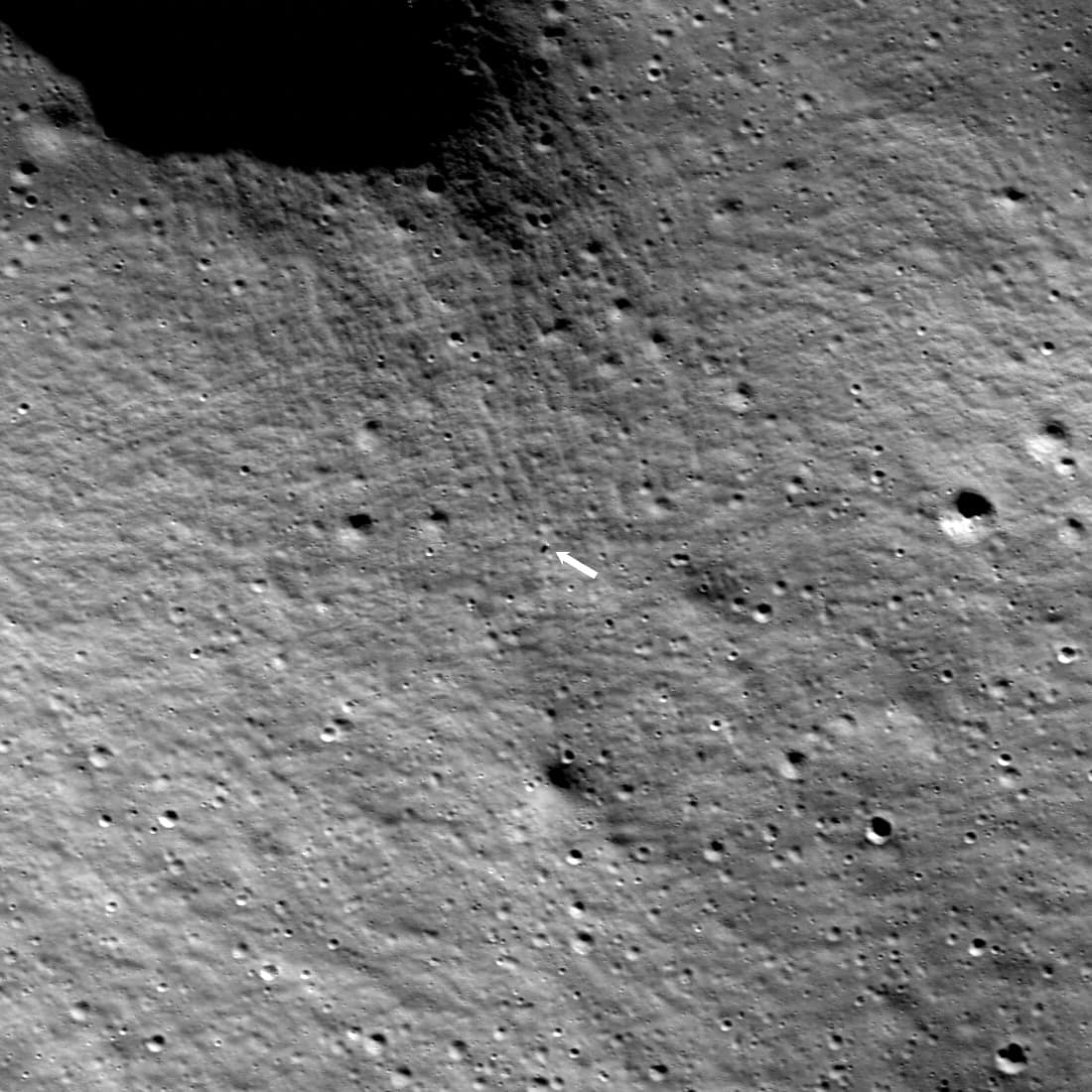
NASA's Lunar Reconnaissance Orbiter photographed the lander on February 24 and the LROC team fixed the site at 80.13°S, 1.44°E, at 2,579 m elevation inside a degraded one-kilometer crater with a 12-degree local slope. The tilt left antennas pointed badly and cut the downlink to a trickle, and the solar arrays caught less light than planned, but all six NASA payloads returned data and NASA and Intuitive Machines jointly declared the mission a success on February 28. EagleCam, which could not deploy during the compromised descent, was ejected about 4 meters from the lander on February 28 but never returned an image of it.
Odysseus transmitted for roughly a week on the surface, sending a farewell image as controllers powered it down on February 29, 2024 ahead of lunar night, which Nova-C was never designed to survive. Intuitive Machines listened for a wake-up signal from March 20 and confirmed on March 23, 2024 that Odie's power system 'would not complete another call home.' In just over seven days on the Moon, the mission had returned the United States to the lunar surface after 51 years and proven, tilt and all, that a fixed-price commercial lander could deliver working NASA science to the south polar highlands.
The record it set did not stand long, and its lessons carried forward. Follow-on IM-2 Athena landed even farther south at Mons Mouton (84.79°S) on March 6, 2025 but ended up on its side inside a small crater, its mission over within a day; NASA still received some payload data. IM-3, with the Nova-C lander Trinity bound for the Reiner Gamma lunar swirl carrying NASA's Lunar Vertex and CADRE rovers, is targeted for the first part of 2027 (as of September 2026, according to NASA's Moon Base program manager and Intuitive Machines' chief executive, reported by Aerospace America on 15 September 2026), with IM planning flight-tested rangefinders and twelve pre-landing lunar orbits instead of three.
04In pictures
Tap a photo to enlarge.
05Sources
- NASA/LRO: LRO Images Intuitive Machine's Odysseus Lander (coordinates, elevation)
- LROC Featured Image 1360: IM-1 On The Moon (landing time, site details)
- LROC Featured Image 1321: IM-1 Landing Region (intended site 80.2°S, 1.0°E)
- NSSDCA Master Catalog: IM-1 2024-030A (retrieved via Wayback; NSSDCA temporarily offline July 2026)
- SpaceNews: Intuitive Machines lands on the moon (Feb 2024)
- SpaceNews: IM and NASA call IM-1 a success as mission winds down (the NDL data-flag admission)
- NASA image article: Odysseus Lands on the Moon
- CBS News: lander tipped over during touchdown (Feb 23, 2024)
- Space.com: IM-1 mission ends, lander 'permanently faded' (Mar 2024)
- Embry-Riddle: EagleCam updates via IM CEO Steve Altemus
- NASA release: NASA Receives Some Data Before Intuitive Machines Ends Lunar Mission (IM-2, Mar 2025)
- Intuitive Machines IM-1 mission page (company gallery; surface photos are IM copyright, link out only)
- NASA release (Feb 23, 2024): NASA Tech Contributes to Soft Moon Landing (the actual 'key role' / 'assist' wording on NDL)
- Aerospace America: IM-3 slips to the first part of 2027, per NASA's Moon Base program manager and Intuitive Machines' CEO (Sep 15, 2026)
azmth is independent and is not affiliated with or endorsed by NASA, CNSA, Roscosmos, ISRO, JAXA, or any other space agency or company named on this page.