Chang'e 6 and Queqiao-2
CNSA (China) · Sample return · 2024Success

Success: first-ever far-side sample return. 1,935.3 g landed in Inner Mongolia on Jun 25, 2024; Queqiao-2 relay still operating, sample science running hot through 2026.
TL;DR· 8 min read
Chang'e 6 brought back the first samples ever collected from the Moon's far side: 1,935.3 g scooped and drilled from the southern Apollo basin and landed in Inner Mongolia on 25 June 2024, 53 days after launch. Chang'e 4 had already landed on the far side in 2019, so the new feat was the return, which needed the Queqiao-2 relay launched six weeks ahead. The samples have since dated far-side basalt to 2.83 billion years and the South Pole-Aitken basin to 4.25 billion years.
Chang'e 6 did the one thing no mission had managed in six decades of lunar exploration: it brought rock back from the Moon's far side, 1,935.3 grams scooped and drilled from the southern Apollo basin and landed in Inner Mongolia on June 25, 2024. It was not the first far-side landing (China's own Chang'e 4 did that in January 2019), but it was the first far-side sample return, and it required launching a dedicated comsat first, because the far side never faces Earth. That comsat, Queqiao-2, is still on duty and is the relay backbone for China's next lunar missions.
Facts as of July 20, 2026, from the sources listed below.
1,935.3g
far-side sample returned, the only far-side material on Earth
53days
launch to touchdown in Inner Mongolia
4.25billion yr
measured age of the South Pole-Aitken basin
4.2m
Queqiao-2 relay dish that made far-side comms possible
Commonly wrong. Four recurring errors in English coverage. (1) Chang'e 6 was not the first far-side landing; Chang'e 4 landed on the far side on 3 January 2019. Chang'e 6 was the first far-side SAMPLE RETURN. (2) It did not land on the "dark side" and not "near the lunar south pole": the far side gets as much sunlight as the near side, and the Apollo basin site sits at 41.6 S, roughly 1,500 km from the pole. The "South Pole-Aitken basin" name (a basin stretching from Aitken crater to the pole) misleads headline writers. (3) The sample is routinely rounded up to "about 2 kg" or reported as hitting a 2 kg target; the official figure is 1,935.3 g. (4) Queqiao-2 is often described as sitting at Earth-Moon L2 like the original Queqiao; it actually flies a 24-hour elliptical frozen orbit around the Moon itself (about 200 x 16,000 km). Also now stale: any pre-2026 claim that the samples support a Late Heavy Bombardment cataclysm; the February 2026 Science Advances chronology paper found a steadily declining impact flux with no LHB spike.
01Mission facts
Chang'e 6 launch
3 May 2024, 09:27 UTC (17:27 Beijing time), Long March 5 from Wenchang Space Launch Site, Hainan↗
Lunar orbit insertion / ICUBE-Q deploy
8 May 2024: braked into lunar orbit and released Pakistan's ICUBE-Q cubesat (approx 7 kg, Pakistan's first lunar spacecraft; returned its first Moon images 11 May 2024)↗
Landing
1 June 2024, 22:23 UTC (06:23 on 2 June, Beijing time), southern Apollo basin within the South Pole-Aitken basin↗
Landing site coordinates
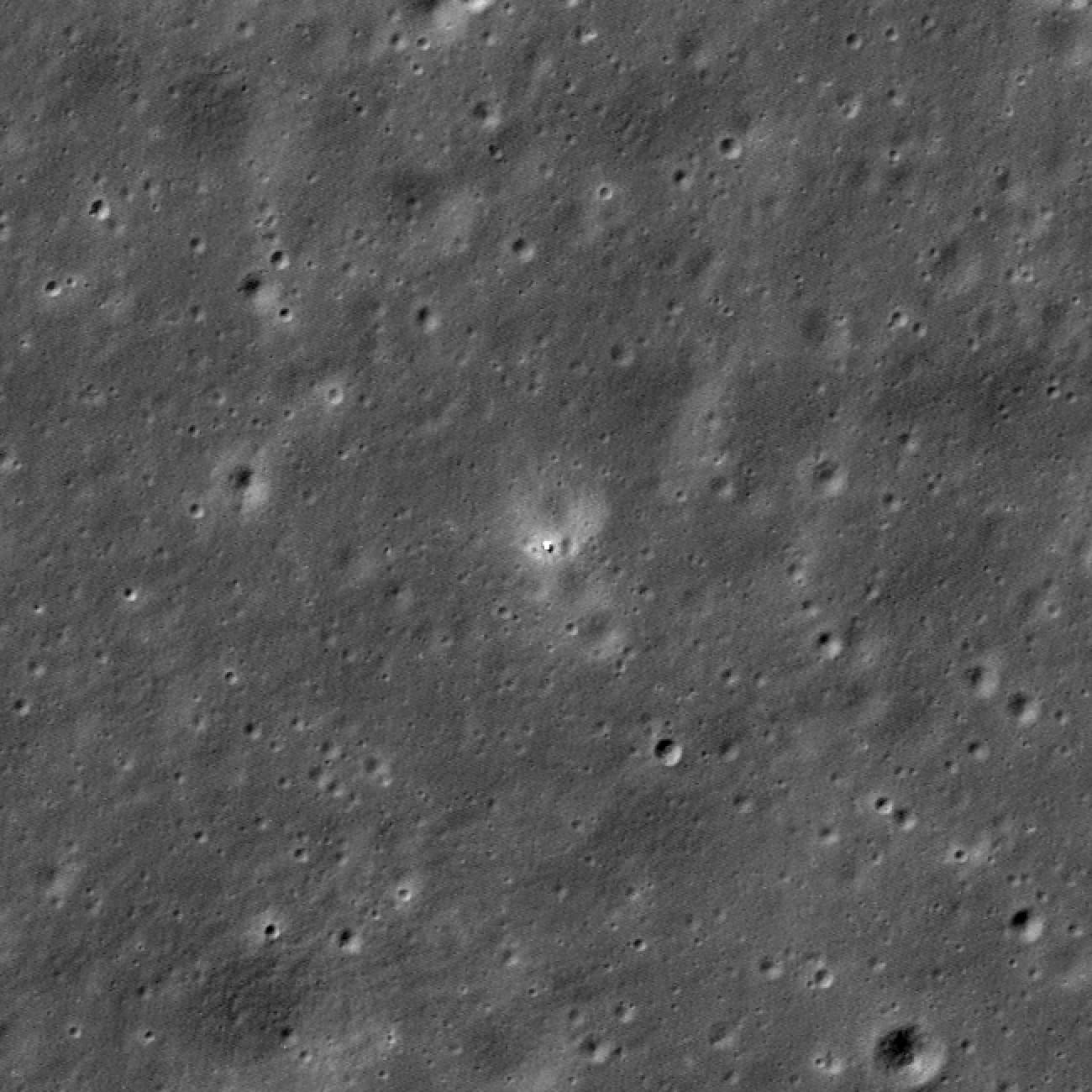
41.6385 S, 206.0148 E (equivalently 153.9852 W), elevation -5,256 m, horizontal accuracy plus or minus 30 m; lander sits on the rim of an eroded crater about 50 m across (LROC NAC M1472410644L, imaged 7 June 2024)↗
Sample mass
1,935.3 g of far-side soil and rock (surface scoop plus subsurface drill), announced by CNSA on 28 June 2024; mission team described the material as more viscous and clumpier than earlier lunar samples↗
First launch from the far side
Ascender lifted off 4 June 2024, 07:38 Beijing time (3 June, 23:38 UTC), the first rocket launch ever from the Moon's far side↗
Lunar-orbit docking and sample transfer
6 June 2024, 14:48 Beijing time: ascender docked with the orbiter-returner in a 210 km lunar orbit; sample container transferred to the returner by 15:24↗
Return to Earth
25 June 2024: reentry capsule landed in Siziwang Banner, Inner Mongolia, 53 days after launch↗
International payloads on the lander
DORN radon-outgassing detector (France/CNES), NILS negative-ion detector (ESA, built in Sweden), INRRI passive laser retroreflector (Italy); ICUBE-Q cubesat (Pakistan) rode on the orbiter↗
NILS result
First-ever detection of negative ions at the lunar surface, and ESA's first scientific data collected on the Moon; instrument logged over three hours of data, three times the mission-success requirement↗
Queqiao-2 launch
20 March 2024, 08:31 Beijing time (00:31 UTC), Long March 8 from Wenchang, with Tiandu-1 and Tiandu-2 comms/navigation tech-test smallsats as rideshares↗
Queqiao-2 orbit and hardware
Entered lunar orbit 24 March 2024; works from an elliptical frozen orbit of roughly 200 x 16,000 km at 62.4 deg inclination (24-hour period); 4.2 m parabolic dish for X-band/UHF links to surface craft, 0.6 m dish to Earth; design life 8 to 10 years; supports Chang'e 4, 6, 7 and 8↗
Youngest dated far-side basalt
2.83 billion years (2807 plus or minus 3 Myr), radiometrically dated from Chang'e 6 basalt fragments, published in Science in November 2024; a separate 4.2-billion-year-old basalt clast records much earlier volcanism↗
South Pole-Aitken basin age
4.25 billion years, dated from Chang'e 6 norite fragments (Chinese Academy of Sciences team, National Science Review, published March 2025), making SPA a sample-anchored calibration point for lunar chronology↗
Far-side mantle water
1 to 1.5 micrograms of water per gram in the basalts' mantle source (Nature, April 2025), drier than nearside estimates and hinting at a hemispheric water dichotomy↗
July 2025 Nature package
Four Nature papers (9-10 July 2025) from CAS-led teams laid out far-side volcanism at 4.2 and 2.8 Ga, a lunar-dynamo rebound around 2.8 Ga, low mantle water, and a depleted mantle source, the first evolutionary history of the far side↗
February 2026 chronology result
Science Advances study (published 4 Feb 2026) using Chang'e 6 samples found near-side and far-side cratering rates essentially consistent, enabling a unified lunar chronology and offering no support for a Late Heavy Bombardment spike↗
Site: 41.6385°S, 153.9852°W · Southern Apollo basin, inside the South Pole-Aitken basin (lunar far side); LROC-computed site 41.6385 S, 206.0148 E, elevation -5,256 m (source)
02Mission timeline
20 Mar 2024
Queqiao-2 relay satellite launches on a Long March 8 from Wenchang at 00:31 UTC, with Tiandu-1/2 rideshares
24 Mar 2024
Queqiao-2 enters lunar orbit, settling into an elliptical frozen orbit (about 200 x 16,000 km, 24-hour period)
3 May 2024
Chang'e 6 launches at 09:27 UTC on a Long March 5 from Wenchang
8 May 2024
Lunar orbit insertion; Pakistan's ICUBE-Q cubesat deployed into lunar orbit
1 Jun 2024
Lander touches down at 22:23 UTC in the southern Apollo basin, far side of the Moon
2 to 3 Jun 2024
Scoop and drill sampling; DORN and NILS run on the surface, with all comms via Queqiao-2
3 Jun 2024
Ascender lifts off at 23:38 UTC, the first launch from the lunar far side
6 Jun 2024
Ascender docks with the orbiter-returner in lunar orbit; sample container transferred
7 Jun 2024
NASA's LRO photographs the lander on the rim of a 50 m crater; LROC later publishes site coordinates 41.6385 S, 206.0148 E
25 Jun 2024
Reentry capsule lands in Siziwang Banner, Inner Mongolia; first far-side samples on Earth
28 Jun 2024
CNSA announces the official sample mass: 1,935.3 g
Nov 2024
First headline science: 2.83-billion-year-old far-side basalt reported in Science and Nature
Mar 2025
South Pole-Aitken basin dated to 4.25 billion years from Chang'e 6 norites (National Science Review)
9 to 10 Jul 2025
Four-paper Nature package delivers the first evolutionary history of the Moon's far side
4 Feb 2026
Science Advances chronology study: near/far-side impact rates match; no support for a Late Heavy Bombardment spike
Mid-2026
Queqiao-2 stands by as relay for Chang'e 7, whose launch was postponed on 23 Aug 2026 with no new date announced (as of 28 Sep 2026)
Teal dots: events that physically happened in flight or on the Moon. Grey: announcements, namings, contracts, and targets.
03The mission
Every lunar sample on Earth before June 2024, roughly 380 kg from Apollo, 301 g from the Soviet Luna drills, and 1,731 g from Chang'e 5, came from the Moon's near side. Chang'e 6 broke that asymmetry. Launched on 3 May 2024 at 09:27 UTC on a Long March 5 from Wenchang, the four-module stack (orbiter, lander, ascender, returner) repeated the Chang'e 5 architecture but pointed it at the hardest real estate available: the southern Apollo basin, a mare-flooded impact scar nested inside the South Pole-Aitken basin, the Moon's largest and oldest confirmed impact structure. Because the far side never faces Earth, none of it works without a relay. China launched Queqiao-2 six weeks ahead, on 20 March 2024, precisely so Chang'e 6 would have a dial tone.
The lander touched down at 22:23 UTC on 1 June 2024 (early morning 2 June in Beijing). NASA's Lunar Reconnaissance Orbiter photographed it six days later sitting on the rim of an eroded crater about 50 m across, and the LROC team computed the site at 41.6385 S, 206.0148 E, elevation minus 5,256 m, on a basaltic lava flow about 3.1 billion years old. Over roughly 49 hours the lander drilled subsurface material and scooped surface regolith, while its international guests worked: France's DORN sniffed for radon outgassing, Italy's INRRI retroreflector took up station as a passive laser target, and ESA's Swedish-built NILS made the first-ever detection of negative ions at the lunar surface, ESA's first science ever collected on the Moon. Pakistan's ICUBE-Q cubesat, released into lunar orbit on 8 May, had already made Pakistan the newest lunar-capable nation.
Then Chang'e 6 did something no one had done: it launched from the far side. The ascender lifted off at 23:38 UTC on 3 June, docked with the orbiter-returner on 6 June at 14:48 Beijing time, and handed over the sealed sample container within 36 minutes. On 25 June the returner skipped the capsule into the atmosphere and it landed in Siziwang Banner, Inner Mongolia, 53 days after launch. CNSA's official tally, announced 28 June 2024: 1,935.3 grams, which mission staff noted was more viscous and clumpier than earlier lunar soil. It remains the only far-side material humanity possesses.
Queqiao-2 deserves co-billing. The 1.2-tonne-class relay entered lunar orbit on 24 March 2024 and operates from an elliptical frozen orbit of roughly 200 x 16,000 km inclined 62.4 degrees, a 24-hour loop that keeps it hanging over the southern hemisphere for most of each day. Its 4.2 m parabolic dish, the largest antenna sent to lunar orbit, carried every command and every bit of far-side telemetry for Chang'e 6, took over relay duties for Chang'e 4, and is designed for 8 to 10 years of service. Mission designers said in 2023 that Queqiao-2 would adjust its orbit after Chang'e 6 to serve Chang'e 7 and Chang'e 8, making it the communications backbone of China's planned International Lunar Research Station buildout. As of 28 September 2026, Chang'e 7's launch has been postponed with no new date announced (China Manned Space Engineering Office, 23 August 2026). CNSA's published target for Chang'e 8 is around 2029, although SpaceNews reported on 10 September 2026 that China appears to be reconfiguring its robotic Moon program, Chang'e 8 included, and no Chinese official source has announced a change.
The science return has been the gift that keeps publishing. November 2024: Science and Nature papers dated far-side basalt to 2.83 billion years, with a 4.2-billion-year-old clast proving volcanism spanned at least 1.4 billion years. March 2025: a CAS team dated the South Pole-Aitken impact itself to 4.25 billion years, an anchor point for the entire lunar timescale. April 2025: the far-side mantle source turned out to hold just 1 to 1.5 micrograms of water per gram, drier than the near side. July 2025: a four-paper Nature package assembled the first evolutionary history of the far side, including a surprise rebound of the lunar magnetic dynamo around 2.8 billion years ago. And in February 2026 a Science Advances study used the samples to show near-side and far-side cratering rates agree, unifying lunar chronology and undercutting the Late Heavy Bombardment hypothesis. Domestic sample loans opened first; CNSA has committed to opening Chang'e 6 samples to international applications, and its standing rules allow foreign proposals two years after return, which points to a window from mid-2026.
04In pictures
Tap a photo to enlarge.
05Sources
- Xinhua: Chang'e-6 returns 1,935.3 g of far-side samples (28 Jun 2024)
- gov.cn: Chang'e-6 lands on moon's far side (2 Jun 2024)
- gov.cn: docking and sample transfer in lunar orbit (6 Jun 2024)
- NASA: LRO spots Chang'e 6 on the far side (14 Jun 2024)
- LROC Featured Image 1374: First Look, Chang'e 6 (site coordinates)
- CNSA: Queqiao-2 relay satellite launched (20 Mar 2024)
- SpaceNews: Chang'e 6 spacecraft dock in lunar orbit (Jun 2024)
- ESA: first detection of negative ions on the Moon (NILS)
- Planetary Society: Chang'e-6 mission page (payload roster)
- Science: 2.83-billion-year-old far-side basalt (Nov 2024)
- National Science Review: SPA impact 4.25 Ga (Mar 2025)
- Nature: water abundance in the lunar farside mantle (Apr 2025)
- Nature: reinforced lunar dynamo recorded by Chang'e-6 basalt
- CAS: Chang'e-6 sheds first light on far-side evolution, four Nature papers (10 Jul 2025)
- CAS: lunar chronology breakthrough with Chang'e-6 samples (Feb 2026)
- Phys.org: Chang'e-6 samples constrain lunar impact flux (Feb 2026)
- SpaceNews: Chang'e-7 to target Shackleton crater (Jan 30, 2024)
- Wikipedia: Chang'e 6 (launch time, orbit dates)
- Wikipedia: Queqiao-2 (orbit parameters, antenna, design life)
- Wikipedia: ICUBE-Q (Pakistan cubesat)
- Xinhua: Queqiao-2 to adjust its orbit after Chang'e 6 to serve Chang'e 7 and 8 (Chinese, October 2023)
- CMSE: Chang'e 7 cannot fly in this year's scheduled window (Chinese, 23 August 2026)
- CNSA: Chang'e 8 planned for around 2029 (Chinese, 24 April 2025)
- SpaceNews: China alters Chang'e-8 lunar south pole mission amid lunar program reorganization (10 September 2026)
azmth is independent and is not affiliated with or endorsed by NASA, CNSA, Roscosmos, ISRO, JAXA, or any other space agency or company named on this page.