Luna 25
Roscosmos (Russia) · Lander · 2023Failure
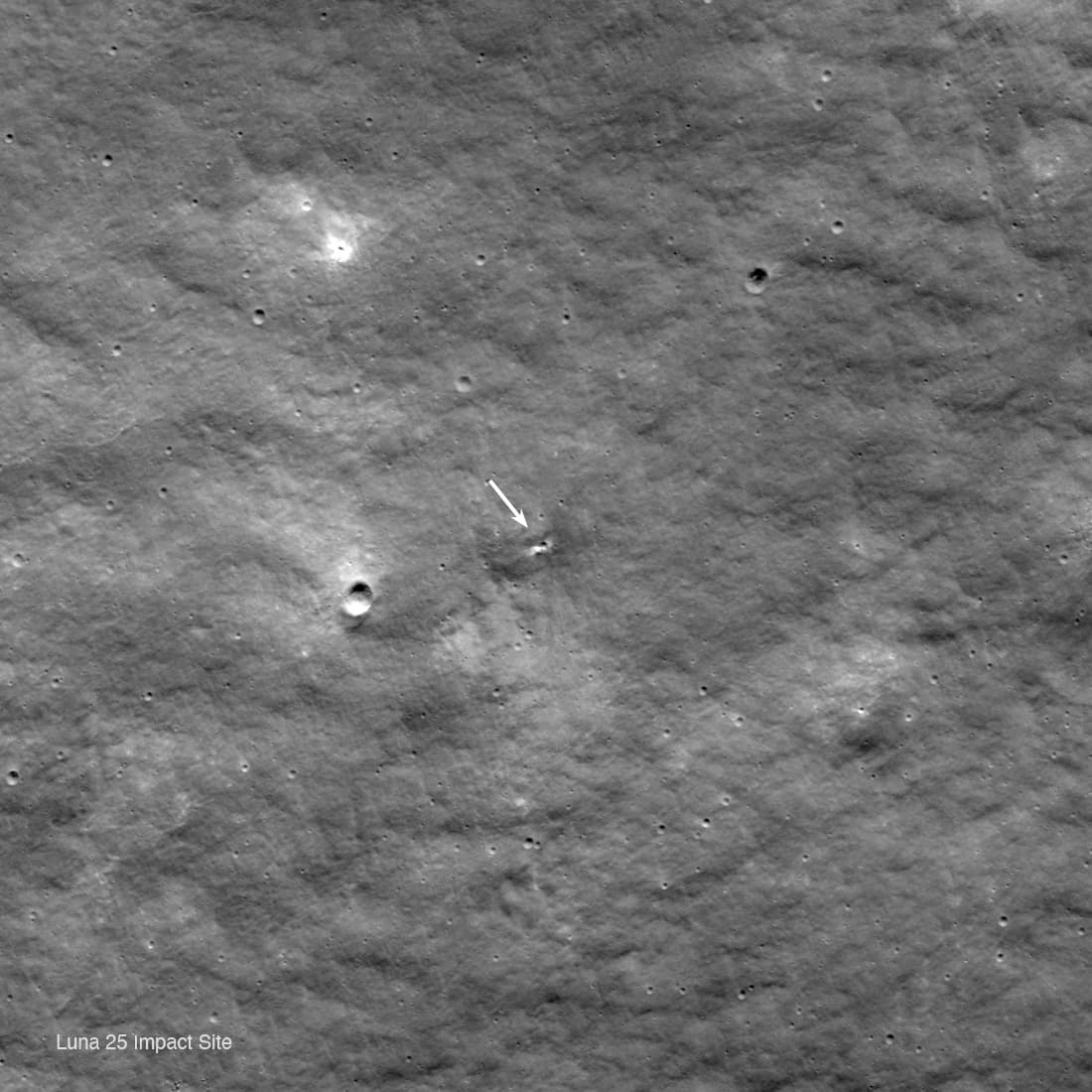
Crashed into the Moon 19 Aug 2023 after an orbit-lowering burn ran 43 seconds long; NASA's LRO photographed the ~10 m crater on 24 Aug 2023.
TL;DR· 6 min read
Luna 25 was Russia's first lunar mission since Luna 24 in 1976, a 47-year gap, and it crashed on 19 August 2023. The failure came during a routine orbit-lowering burn that ran 127 seconds instead of the planned 84, two days before the touchdown scheduled near Boguslawsky crater, so no landing was ever attempted. LRO found a fresh crater about 10 m across on 24 August, roughly 400 km short of the target. Roscosmos traced the cause to a BIUS-L accelerometer unit that never switched on.
Luna 25 was Russia's first lunar mission of any kind since the Soviet Luna 24 in 1976, a 47-year gap, and it ended six days after reaching lunar orbit. Contrary to the common shorthand that it "crashed while trying to land," it never began a landing attempt: an orbit-lowering engine burn on 19 August 2023 ran 127 seconds instead of the planned 84, putting it on a surface-intersecting trajectory two days before its scheduled 21 August touchdown near Boguslawsky crater.
Facts as of July 20, 2026, from the sources listed below.
47years
since Russia's previous lunar mission, Luna 24 in 1976
127s
actual engine burn on 19 Aug 2023, vs 84 s planned
~10m
diameter of the impact crater LRO found
400km
short of the intended Boguslawsky landing site
Commonly wrong. English coverage routinely says Luna 25 "crashed while attempting to land." It did not: the failure happened during a routine orbit-lowering maneuver on 19 August 2023, two days before the landing attempt scheduled for 21 August. Related shorthand calls it a "south pole lander"; its Boguslawsky target sits near 69.5 S, a high southern latitude comparable to Chandrayaan-3's site, hundreds of kilometers from the pole itself. Also widely stale: "Luna 26 in 2027, Luna 27 in 2028" still circulates from 2023-2024 statements, but as of Aug 2025 Luna 26 is targeted 2028, and as of Feb 2026 Luna 27 has been split into two landers targeted 2029 (27A, south polar) and 2030 (27B, north polar). Finally, the crater identification is formally "likely" per the LROC team (new crater, right place, right time), often misreported as an absolute confirmation.
01Mission facts
Launch
10 Aug 2023, 23:10 UTC, on a Soyuz-2.1b with Fregat upper stage from Vostochny Cosmodrome; first Russian lunar mission since Luna 24 in 1976↗
Spacecraft
1,750 kg launch mass, built by NPO Lavochkin, carrying about 30 kg of science payload (8 instruments including ADRON-LR neutron/gamma spectrometer, LASMA-LR laser mass spectrometer, STS-L cameras, plus a robotic sampling arm)↗
Lunar orbit insertion
16 Aug 2023↗
Planned landing
21 Aug 2023, north of Boguslawsky crater at about 69.545 S, 43.544 E; a high-southern-latitude site well short of the south pole itself↗
Failure
19 Aug 2023: pre-landing orbit-lowering burn ran 127 seconds instead of the planned 84 (per Roscosmos chief Yuri Borisov); contact lost the same day, impact at 11:58 UTC; Roscosmos declared the spacecraft lost on 20 Aug 2023↗
Investigation finding
3 Oct 2023: Roscosmos attributed the crash to abnormal operation of the onboard control system after the accelerometer unit in the BIUS-L angular-velocity device failed to switch on, likely because commands with different priorities entered one data array; with zero accelerometer signals the engine could not be cut off at the target velocity and shut down only on a backup timer↗
Crash site found
LRO imaged a new crater about 10 m across on 24 Aug 2023 at 57.865 S, 61.360 E (elevation about minus 360 m) on the southwest rim of Pontecoulant G, roughly 400 km short of the intended landing site; NASA announced it 31 Aug 2023 as "likely" from Luna 25 because the crater was absent in June 2022 imagery and matched Russia's published impact estimate↗
Luna 26 status
Orbiter delayed to targeted 2028 launch (as of Aug 2025 RAS statements, reaffirmed by RAS vice president Sergei Chernyshev on 7 Apr 2026 and by NPO Lavochkin's Feb 2026 presentation); it slipped after the Luna 25 failure, with contractor NPO Lavochkin receiving added funding↗
Luna 27 status
Doubled into two landers (as of 4 Feb 2026, per NPO Lavochkin director general Vasily Marfin): Luna-27A targeted 2029 to the south polar region and Luna-27B targeted 2030 to the north polar region↗
Later Luna missions
Still slipping: on 7 Apr 2026 RAS vice president Sergei Chernyshev gave Luna-29 in 2032, Luna-30 in 2034 and sample-return Luna-28 in 2036, contradicting NPO Lavochkin's February 2026 figure of 2034 for Luna-28↗
Site: 57.8650°S, 61.3600°E · Luna 25 impact crater, southwest rim of Pontecoulant G crater (source)
02Mission timeline
10 Aug 2023
Launch at 23:10 UTC on Soyuz-2.1b/Fregat from Vostochny Cosmodrome
16 Aug 2023
Enters lunar orbit
19 Aug 2023
Orbit-lowering burn runs 127 s instead of 84 s; contact lost; impact at 11:58 UTC on the rim of Pontecoulant G
20 Aug 2023
Roscosmos declares the spacecraft lost
21 Aug 2023
Planned landing date near Boguslawsky crater (never attempted)
24 Aug 2023
LRO images a fresh ~10 m crater at the predicted impact point; NASA announces the find 31 Aug
3 Oct 2023
Roscosmos names the probable cause: failure of the BIUS-L accelerometer unit left the control system with zero velocity signals during the burn
22 Aug 2025
RAS confirms follow-on Luna 26 orbiter delayed to targeted 2028
4 Feb 2026
NPO Lavochkin outlines two Luna 27 landers: 27A targeted 2029 (south polar), 27B targeted 2030 (north polar)
Teal dots: events that physically happened in flight or on the Moon. Grey: announcements, namings, contracts, and targets.
03The mission
Luna 25 carried an unusual weight of history for a 1,750 kg robot. It was the first lunar mission launched by the Russian Federation, ever: every previous Luna flight belonged to the Soviet Union, and the last of those, Luna 24, had returned its samples in August 1976. Development stretched across roughly two decades under the name Luna-Glob before the spacecraft finally left Vostochny Cosmodrome on a Soyuz-2.1b/Fregat at 23:10 UTC on 10 August 2023.
The flight went well for nine days. Luna 25 entered lunar orbit on 16 August 2023 and was scheduled to touch down on 21 August north of Boguslawsky crater, at about 69.5 degrees south. That put it in an informal race with India's Chandrayaan-3, which was circling the Moon at the same time and aiming for a similar high-southern-latitude band; Luna 25 would have landed two days earlier.
On 19 August 2023, a burn intended to drop the spacecraft into its pre-landing elliptical orbit ran long: 127 seconds instead of the planned 84, according to Roscosmos chief Yuri Borisov. The overburn bent the orbit into the Moon. Contact was lost that day, impact came at 11:58 UTC, and Roscosmos announced on 20 August that the spacecraft had ceased to exist. The agency's investigation, published 3 October 2023, traced the failure to the accelerometer unit inside the BIUS-L angular-velocity device, which apparently never switched on because commands with different execution priorities landed in a single data array. Reading zero acceleration, the control system never registered that the target velocity had been reached, and the engine kept firing until a backup timer stopped it.
The epilogue was written by an American orbiter. NASA's Lunar Reconnaissance Orbiter photographed the predicted impact zone on 24 August 2023 and found a fresh crater about 10 meters across at 57.865 S, 61.360 E, on the steep southwest rim of Pontecoulant G, roughly 400 km short of the intended landing site. Because the crater was absent from June 2022 imagery and sat close to Russia's own impact estimate, the LROC team concluded it was likely Luna 25's grave.
The crash reset Russia's whole lunar line. The Luna 26 orbiter, once advertised for 2027, is targeted for 2028 (per RAS statements of Aug 2025, reaffirmed by RAS in April 2026 and NPO Lavochkin in Feb 2026), partly because systems lost with Luna 25 had to be redesigned around sanctioned components. The Luna 27 lander has been doubled for redundancy: as of Feb 2026, NPO Lavochkin targets Luna-27A at the south polar region in 2029 and Luna-27B at the north polar region in 2030. Missions beyond that keep sliding; in April 2026 the Academy quoted 2032 for Luna-29, 2034 for Luna-30 and 2036 for the Luna-28 sample return, later than the dates NPO Lavochkin had given just two months earlier.
04In pictures
Tap a photo to enlarge.
05Sources
- NASA: LRO observes crater likely from Luna 25 impact (31 Aug 2023)
- LROC Featured Image 1311: Luna 25 Impact Crater (29 Nov 2023, with site coordinates)
- TASS: Roscosmos names probable crash cause, BIUS-L (3 Oct 2023)
- Space.com: Russia pinpoints cause of Luna-25 failure (4 Oct 2023)
- NASASpaceflight: Luna 25 launch coverage (Aug 2023)
- Wikipedia: Luna 25 (cross-check for mass, orbit insertion, planned site)
- Moscow Times: Russia delays Moon and Venus missions again (22 Aug 2025)
- Nuclear Engineering International: Russia resets lunar programme (4 Feb 2026)
- Meduza: Russia revises Luna-28/29/30 timeline (7 Apr 2026)
- Wikimedia Commons: Luna-Glob lander mockup photo, CC BY-SA 4.0

azmth is independent and is not affiliated with or endorsed by NASA, CNSA, Roscosmos, ISRO, JAXA, or any other space agency or company named on this page.