CAPSTONE
Advanced Space for NASA (US, commercial) · Orbiter · 2022Success
All primary and extended mission objectives achieved; NASA activities concluded June 2026 after nearly four years; Advanced Space continues flying it as a commercial testbed in the NRHO (as of July 2026).
TL;DR· 7 min read
CAPSTONE proved the halo orbit Gateway was designed to fly. The 25 kg CubeSat launched June 28, 2022, survived a radio blackout and a month-long tumble, and on November 13, 2022 became the first spacecraft ever in a near-rectilinear halo orbit and the first CubeSat to operate at the Moon. NASA bought the mission as a service from Advanced Space for $13.7 million, making it the first US commercial mission at the Moon. NASA activities concluded in June 2026.
CAPSTONE is the 25 kg CubeSat that got to the Moon first in the Artemis era and proved the halo orbit Gateway was designed to fly. NASA never owned it: the agency paid Advanced Space, a small Colorado company, $13.7 million to build and fly the mission and bought the results, making CAPSTONE the first US commercial mission at the Moon and the working prototype for how NASA now buys lunar services. It survived a radio blackout and a month-long tumble on the way out, then outlived its own six-month primary mission by three years.
Facts as of July 20, 2026, from the sources listed below.
1st
spacecraft ever to fly a near-rectilinear halo orbit, the orbit planned for Gateway
25kg
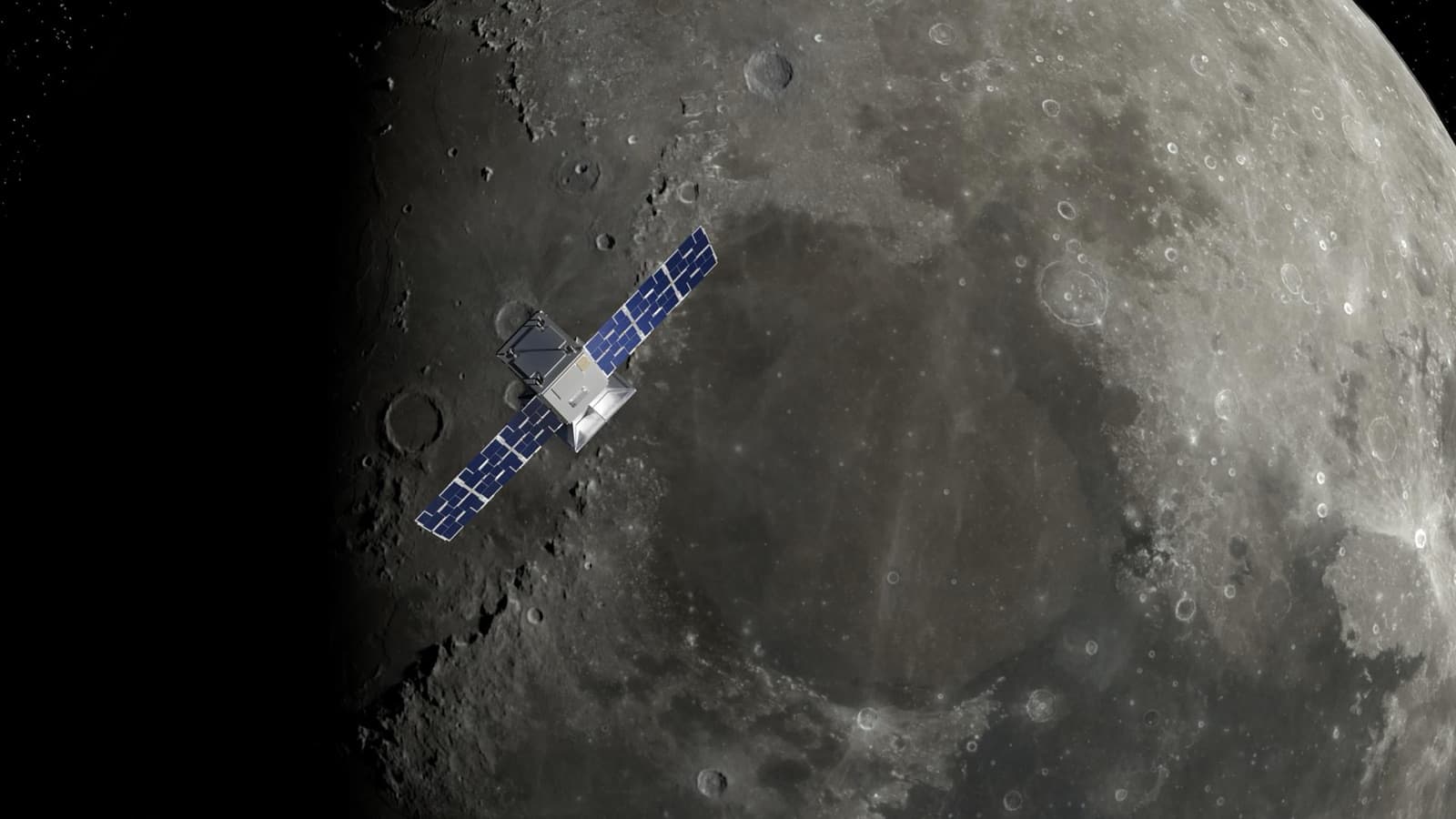
12U CubeSat, about the size of a microwave oven
6.5days
per lap of the 9:2 resonant NRHO, from about 1,600 km over the north pole to 70,000 km beyond the south
$13.7M
NASA contract to Advanced Space for the spacecraft and operations, plus $9.95M to Rocket Lab for launch
Commonly wrong. Three recurring errors in English coverage. (1) "NASA's CAPSTONE spacecraft." NASA's own releases use the shorthand, but NASA never owned it: Advanced Space owns and operates the spacecraft, Terran Orbital built it, and NASA bought the mission as a service, which is exactly what made it the first US commercial mission at the Moon. That distinction became load-bearing in June 2026, when NASA's mission ended but the spacecraft simply kept flying for its commercial owner. (2) Inflated "first CubeSat" claims. CAPSTONE was the first CubeSat to operate at the Moon. It was not the first CubeSat in deep space: NASA's twin MarCO CubeSats flew to Mars in 2018. (3) The 2022 anomalies remembered as fatal. The July radio blackout and the September-to-October tumble both ended in full recoveries, and the mission went on to run almost four years; pages describing CAPSTONE as "lost" or "crippled" are wrong. A date quirk also trips people: the insertion burn was 7:39 p.m. EST on November 13, 2022, which is November 14 in UTC, so both dates appear in reputable sources.
01Mission facts
Launch
June 28, 2022, on a Rocket Lab Electron from Launch Complex 1, Mahia, New Zealand↗
Ownership
Designed and built by Terran Orbital (Tyvak); owned and operated by Advanced Space of Westminster, Colorado, for NASA↗
Contract
$13.7 million SBIR Phase III award to Advanced Space (September 2019) to develop and operate the mission↗
Launch contract
$9.95 million to Rocket Lab (February 2020), originally slated for Wallops, Virginia, later moved to New Zealand↗
Spacecraft
12U CubeSat, 25 kg, 34 x 34 x 64 cm, with eight 0.25-newton hydrazine thrusters giving over 200 m/s of delta-V↗
Transfer
Four-month ballistic lunar transfer: Rocket Lab's Lunar Photon fired seven times over six days, raising its orbit's high point to around 810,000 miles from Earth, before releasing CAPSTONE on July 4, 2022↗
Orbit
Near-rectilinear halo orbit passing about 1,000 miles over the lunar north pole and out to 43,500 miles past the south pole, one lap every six and a half days↗
NRHO insertion
Insertion burn at 7:39 p.m. EST on November 13, 2022, followed by two clean-up maneuvers; first spacecraft to fly an NRHO and first CubeSat to operate at the Moon↗
Primary mission
Completed May 18, 2023, after six months in the NRHO: 28 orbits, 7 maneuvers, 6 lunar eclipses endured↗
CAPS demonstration
Five successful crosslink ranging demonstrations with Lunar Reconnaissance Orbiter, the first on May 9, 2023, plus one-way ranging using an onboard chip-scale atomic clock↗
Extended mission
15-month NASA extension managed by the SCaN Division: first lunar test of autoNGC autonomous navigation and first flight of the latest delay/disruption tolerant networking protocols beyond Earth orbit↗
Mission end
NASA activities concluded in June 2026 with all primary and extended objectives achieved; Advanced Space continues to use the spacecraft as a technology development testbed (as of July 2026)↗
02Mission timeline
13 Sep 2019
NASA awards Advanced Space a $13.7 million SBIR Phase III contract to fly a CubeSat pathfinder to Gateway's planned orbit
14 Feb 2020
Rocket Lab wins the $9.95 million launch contract, then planned from Wallops Island, Virginia
28 Jun 2022
Launch on an Electron from Mahia, New Zealand; the Lunar Photon upper stage begins six days of orbit-raising burns
4 Jul 2022
Lunar Photon's seventh and final burn releases CAPSTONE onto its four-month ballistic lunar transfer, a low-energy route that lets the Sun's gravity carry the CubeSat to the Moon on minimal fuel
4 to 6 Jul 2022
The radio falls silent hours after separation, knocked out by an improperly formatted command; onboard fault protection eventually clears the fault and contact is re-established on July 6
8 Sep 2022
A partially open thruster valve during a trajectory correction spins the spacecraft up beyond what its reaction wheels can counter; CAPSTONE tumbles in deep space for a month
7 Oct 2022
Recovery commands stop the spin and restore full three-axis control, keeping the arrival date intact
13 Nov 2022
Insertion burn at 7:39 p.m. EST makes CAPSTONE the first spacecraft ever in a near-rectilinear halo orbit and the first CubeSat to operate at the Moon
9 May 2023
First successful CAPS crosslink: CAPSTONE ranges against Lunar Reconnaissance Orbiter, spacecraft-to-spacecraft, without ground tracking
18 May 2023
Six-month primary mission complete after 28 NRHO orbits and 7 maneuvers; the enhanced mission begins
May 2024
Contracted 18-month mission wraps with 83 NRHO orbits, 25 orbit-maintenance maneuvers, and five LRO crosslink demonstrations; the spacecraft flies on as a technology testbed
2025 to 2026
Extended-mission experiments fly: autoNGC navigates the spacecraft with star-tracker images of the Moon and Earth while the Deep Space Network is busy with Artemis II, and DTN store-and-forward networking delivers every byte across broken contacts
Jun 2026
NASA activities conclude with all primary and extended mission objectives achieved, nearly four years after launch
Jul 2026
Advanced Space keeps flying CAPSTONE as a commercial testbed, station-keeping in the NRHO roughly weekly (as of July 2026)
Teal dots: events that physically happened in flight or on the Moon. Grey: announcements, namings, contracts, and targets.
03The mission
CAPSTONE (Cislunar Autonomous Positioning System Technology Operations and Navigation Experiment) was NASA's cheapest possible answer to an awkward question: Gateway was designed to live in a near-rectilinear halo orbit, and no spacecraft had ever flown one. Rather than build a pathfinder in-house, NASA wrote a $13.7 million SBIR Phase III contract in September 2019 to Advanced Space, a small flight-dynamics company in Westminster, Colorado, which owned and operated the spacecraft outright and sold NASA the results. Terran Orbital's Tyvak built the bus, a 12U CubeSat of 25 kg, about the size of a microwave oven, and Rocket Lab won the $9.95 million launch. When it flew, NASA called it the first US commercial mission at the Moon, proving out in flight the buy-a-service model the agency was also betting on with the CLPS lander contracts, none of which had launched yet.
The ride out was cheap and eventful. An Electron launched from Mahia, New Zealand on June 28, 2022, and Rocket Lab's Lunar Photon stage spent six days raising its orbit before flinging CAPSTONE onto a ballistic lunar transfer on July 4. The four-month, low-energy route swung about 1.5 million kilometers from Earth, more than three times the Moon's distance, letting the Sun's gravity do work the tiny thrusters could not. Hours after separation an improperly formatted command silenced the radio, and a flight-software fault kept the watchdog from rebooting it; onboard fault protection finally cleared the problem and contact resumed on July 6. Worse came on September 8, when a valve in one of the eight 0.25-newton thrusters stuck partially open during a course correction and spun the spacecraft faster than its reaction wheels could fight. CAPSTONE tumbled through deep space in safe mode for a month before recovery commands stopped the spin on October 7, with the arrival date still intact.
On November 13, 2022, at 7:39 p.m. EST, an insertion burn made CAPSTONE the first spacecraft ever to fly a near-rectilinear halo orbit and the first CubeSat to operate at the Moon. The NRHO is a 9:2 resonant three-body orbit, balanced between Earth's and the Moon's gravity: one lap every 6.5 days, sweeping from roughly 1,600 km above the lunar north pole to about 70,000 km beyond the south pole, with near-constant line of sight to Earth and very low station-keeping cost. Those properties are why Gateway was designed for it, and CAPSTONE's job was to replace models with flight data. Its six-month primary mission ended on May 18, 2023 after 28 laps and 7 maneuvers, confirming the orbit could be held for pennies of propellant.
The navigation experiments were the point of the name. CAPS, Advanced Space's Cislunar Autonomous Positioning System, had CAPSTONE exchange ranging signals directly with NASA's Lunar Reconnaissance Orbiter, spacecraft fixing each other's positions without waiting for antennas on Earth; the first successful crosslink came on May 9, 2023, and five were completed in all, alongside one-way ranging against an onboard chip-scale atomic clock. A 15-month NASA extension managed by the SCaN Division then turned the CubeSat into a software-defined testbed. Goddard's autoNGC flew at the Moon for the first time and navigated with star-tracker images of the Moon and Earth, at times beating ground-based methods for real-time onboard navigation, a capability tested for real when Deep Space Network time collapsed to a few passes a week during Artemis II. Delay/disruption tolerant networking protocols ran beyond Earth orbit for the first time in NASA's core Flight System, storing data through dropped contacts and delivering all of it.
NASA's activities on CAPSTONE concluded in June 2026, nearly four years after launch, with every primary and extended objective achieved. The spacecraft itself is not done: Advanced Space continues to operate it as a company-owned technology testbed in the NRHO, performing station-keeping maneuvers roughly weekly (as of July 2026), and has said it will eventually dispose of the spacecraft on the lunar surface when propellant runs out. Whatever becomes of Gateway, the halo orbit is no longer theoretical, and the flight experience, the anomaly recoveries, and the autonomous-navigation results are already baked into how NRHO missions will be flown.
04In pictures
Tap a photo to enlarge.
05Sources
- NASA, July 6, 2026: CAPSTONE Completes Extended Mission Testing Lunar Technologies (mission end, autoNGC, DTN, ownership)
- NASA: What is CAPSTONE? (mission overview, orbit geometry, launch, contractors)
- NASA news release, September 2019: $13.7 million SBIR Phase III award to Advanced Space
- NASA news release, February 2020: $9.95 million launch contract to Rocket Lab
- NASA blog, July 4, 2022: CAPSTONE Leaves Earth Orbit, Headed to the Moon (Photon burns, 810,000-mile orbit raise, release onto the ballistic lunar transfer)
- NASA blog, July 6, 2022: Communications Re-Established (radio anomaly recovery)
- NASA blog, July 7, 2022: Mission Team Determines Cause of Communications Issues (improperly formatted command, flight-software fault)
- NASA blog, October 7, 2022: CAPSTONE Team Stops Spacecraft Spin (thruster valve anomaly and recovery)
- NASA blog, November 13, 2022: CAPSTONE Arrives to Orbit at the Moon (insertion burn, NRHO and CubeSat firsts)
- Advanced Space, May 18, 2023: primary mission complete (28 orbits, first LRO crosslink May 9, 2023, chip-scale atomic clock)
- Advanced Space, May 29, 2024: all operational objectives completed (83 orbits, 25 maneuvers, five crosslinks, 9:2 synodic orbit and 6.5-day period, disposal plan)
- Advanced Space: CAPSTONE mission page (live days-in-orbit counter, weekly station-keeping, 1.5-million-km transfer distance, mission patch story)
- eoPortal: CAPSTONE technical summary (12U bus, 25 kg, dimensions, propulsion, orbit parameters)
azmth is independent and is not affiliated with or endorsed by NASA, CNSA, Roscosmos, ISRO, JAXA, or any other space agency or company named on this page.