Danuri (Korea Pathfinder Lunar Orbiter)
KARI (South Korea) · Orbiter · 2022Operating
Operating: in a 60 x 200 km frozen orbit since September 24, 2025, twice extended through December 2027 as of July 2026; a controlled lunar impact is planned for March 2028.
TL;DR· 8 min read
Danuri is South Korea's first spacecraft to leave Earth orbit, launched August 4, 2022 and in lunar orbit since December 2022. It carries five Korean payloads plus NASA's ShadowCam, which images permanently shadowed craters by reflected light. Propellant saved on its cheap ballistic transfer bought two extensions, and as of July 2026 it flies a 60 x 200 km frozen orbit funded through December 2027, with a controlled lunar impact planned for March 2028.
Danuri is South Korea's first spacecraft to leave Earth orbit, and it has turned a cautious one-year pathfinder into a long-haul lunar workhorse. Launched in August 2022 and in lunar orbit since mid-December 2022, it carries five Korean payloads plus NASA's ShadowCam, the camera that sees into the Moon's permanently shadowed craters. The mission has been extended twice, now through December 2027, and as of July 2026 it is flying a propellant-free frozen orbit with a deliberate lunar impact booked for March 2028.
Facts as of September 28, 2026, from the sources listed below.
678kg
launch mass of South Korea's first spacecraft beyond Earth orbit
200x
ShadowCam's light sensitivity vs LRO's narrow angle cameras
2
mission extensions, now funded through December 2027
3.5+yr
years in lunar orbit as of July 2026
Commonly wrong. A few recurring slips in English coverage. (1) The launch date: Danuri lifted off on August 4, 2022, in US time (UTC and EDT) but on August 5 in Korea, and both dates circulate; neither is wrong, but mixing them in one article is. (2) Staleness: pages written between 2022 and 2024 still describe a one-year mission ending December 2023, or a first extension ending December 2025; the mission has been extended twice, runs through December 2027, and has a controlled impact planned for March 2028. Likewise, plan-era references (eoPortal included) still describe five lunar orbit insertion burns, when the flight needed only three. (3) Attribution slips in both directions: ShadowCam is a NASA-funded American instrument (built by Malin Space Science Systems, run first by an Arizona State University team and by Intuitive Machines since May 2026) riding on a Korean spacecraft, so it is not a Korean camera, and the Shackleton images are credited NASA/KARI/ASU, not KARI alone; meanwhile the spacecraft itself is KARI-built but has been overseen by KASA, the Korea AeroSpace Administration, since that agency stood up in May 2024.
01Mission facts
Launch
August 4, 2022 (August 5 in Korea), on a SpaceX Falcon 9 Block 5 from Cape Canaveral; 678 kg at launch, developed by KARI from 2016↗
Lunar transfer
A fuel-cheap 4.5-month ballistic lunar transfer saved about 165 m/s of delta-v over a direct route; the first lunar orbit insertion burn came on December 16, 2022 (UTC; December 17 KST)↗
Lunar arrival
Insertion took only three burns instead of the planned five; KARI confirmed on December 28, 2022 (KST) that Danuri was in its 100 km, 90-degree circular polar orbit, circling the Moon about every two hours↗
Payloads
Six: the LUTI high-resolution terrain imager (about 2.5 m per pixel), PolCam wide-angle polarimetric camera, KMAG magnetometer, KGRS gamma-ray spectrometer, a delay-tolerant networking (space internet) experiment, and NASA's ShadowCam↗
ShadowCam
NASA-funded, built by Malin Space Science Systems as a build-to-print copy of LRO's narrow angle camera telescope (founding PI Mark Robinson, Arizona State University); more than 200 times the NACs' sensitivity, 1.7 m per pixel from 100 km, imaging permanently shadowed regions by reflected light↗
Program cost
About $180 million↗
First extension
Announced June 27, 2023: the cruise burned 172.92 kg of propellant against a 202.64 kg budget, and the roughly 30 kg margin stretched the mission from end-2023 to end-2025↗
Second extension
Approved by the Korea AeroSpace Administration (KASA) on February 10, 2025: mission runs through December 2027, with a 60 km low-orbit campaign, a frozen-orbit phase, landing-technology descent tests, and a controlled lunar impact in March 2028↗
Frozen orbit
Entered September 24, 2025: a 60 x 200 km elliptical orbit shaped by the Moon's lumpy gravity field that holds itself without propellant, planned to be flown through December 2027↗
ShadowCam operations (new, May 2026)
Intuitive Machines became prime contractor for ShadowCam operations on May 18, 2026 ($4.5 million cost-plus-fixed-fee over three years), in the same handover that moved LROC operations from Arizona State University to the company↗
Still operating in 2026
After a SpaceX Falcon 9 upper stage struck the Moon on August 5, 2026, NASA's Center for Near Earth Object Studies at JPL passed the predicted impact point to the Danuri team, whose LUTI camera imaged the new crater a few hours later and showed the prediction was accurate to about 1 km (0.6 miles); Danuri then sent coordinates that helped NASA's LRO team refine its own follow-up imaging (NASA, August 18, 2026)↗
Site documentation role
Danuri photographed India's Chandrayaan-3 lander at Shiv Shakti point with its high-resolution camera at 07:55 KST on August 27, 2023, from the 100 km orbit, four days after the landing↗
PolCam
The first instrument to conduct global polarimetric observations from lunar orbit; its calibration papers were still being published in July 2026↗
02Mission timeline
2016
Lunar orbiter development begins at KARI, six years before launch
May 2022
Named Danuri, a blend of the Korean words dal (Moon) and nuri (enjoy), after a national contest that drew more than 60,000 participants
4 Aug 2022
Launched (August 5 in Korea) on a SpaceX Falcon 9 from Cape Canaveral into a ballistic lunar transfer
Aug to Oct 2022
The space-internet payload streams the BTS music video Dynamite to Earth from about 1.21 million km in delay-tolerant networking tests during the cruise
16 to 28 Dec 2022
Lunar orbit insertion: the first burn on December 16 UTC (December 17 KST) starts capture, and Danuri needs only three of the five planned burns before KARI confirms the 100 km, 90-degree circular polar orbit on December 28 KST
24 to 28 Dec 2022
LUTI returns black-and-white views of Earth over the lunar horizon, feeding site selection for a future Korean lander
4 Feb 2023
Full science operations begin
9 Feb 2023
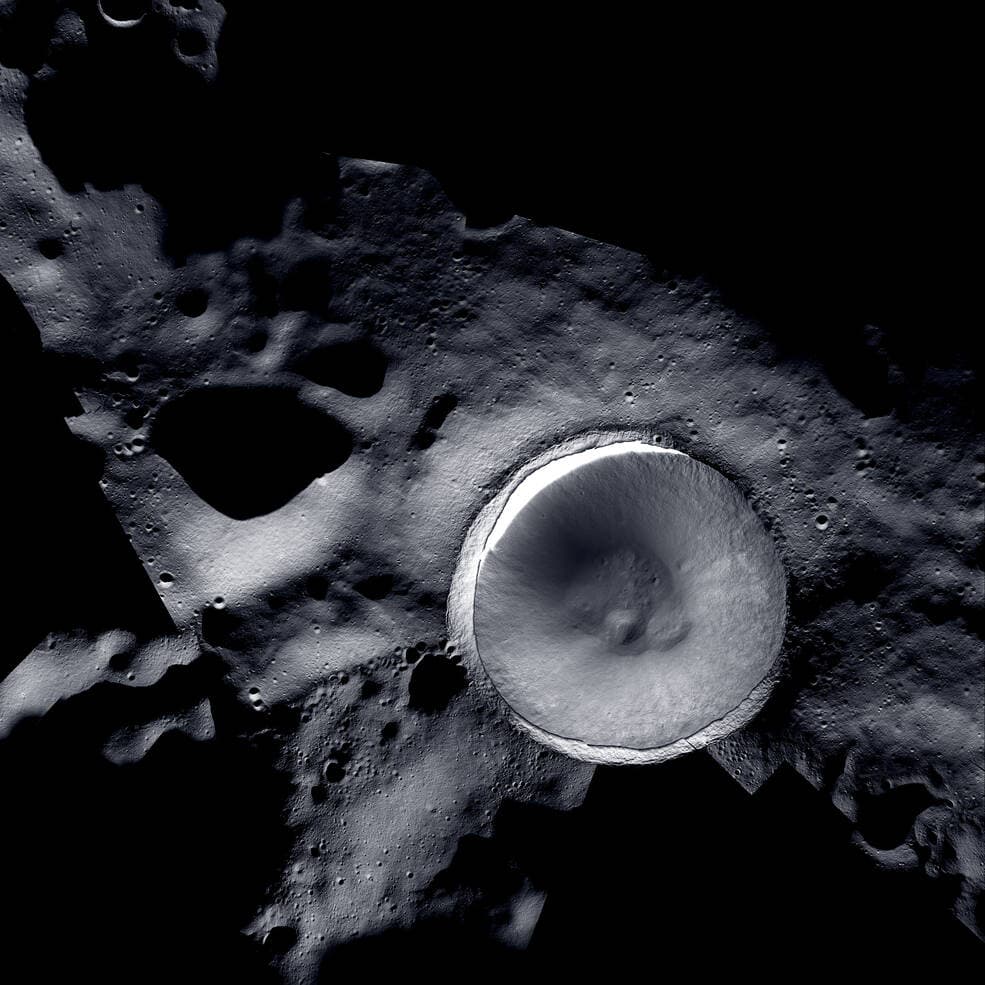
NASA publishes ShadowCam's view of the permanently shadowed wall and floor of Shackleton crater beside LROC's near-black image of the same scene, a demonstration of its 200x sensitivity edge
7 Apr 2023
ShadowCam photographs LRO as Danuri passes 18 km above it, the two orbiters closing at about 11,000 km/h
27 Jun 2023
First extension announced: propellant saved on the cruise stretches the mission from end-2023 to end-2025
27 Aug 2023
Danuri's high-resolution camera images India's Chandrayaan-3 lander at Shiv Shakti point, four days after its landing
5 to 6 Mar 2024
LRO returns the favor, catching Danuri as a smeared streak on three successive orbits at 11,500 km/h relative speed
10 Feb 2025
KASA approves a second extension through December 2027: a 60 km low-orbit campaign, then a frozen orbit, then descent tests toward a controlled impact
Feb to Sep 2025
Seven months of low-altitude observations from 60 km, the closest sustained look of the mission
24 Sep 2025
Enters a 60 x 200 km frozen orbit that needs almost no propellant to maintain, good through December 2027
18 May 2026
NASA appoints Intuitive Machines prime contractor for ShadowCam operations ($4.5 million, three years) alongside its new LROC contract
Targeted Mar 2028
After descent tests that simulate a landing approach, Danuri is slated for a controlled impact on the lunar surface
Teal dots: events that physically happened in flight or on the Moon. Grey: announcements, namings, contracts, and targets.
03The mission
South Korea's first Moon mission almost apologizes in its full name: Korea Pathfinder Lunar Orbiter, a test run to prove the country could operate beyond Earth orbit at all. Development began at KARI in 2016, and the public named the spacecraft Danuri, a blend of the Korean words dal (Moon) and nuri (enjoy), through a contest that drew more than 60,000 participants. It launched on a SpaceX Falcon 9 from Cape Canaveral on August 4, 2022 (August 5 in Korea) and took the slow, fuel-cheap route: a ballistic lunar transfer that swung it more than 1.2 million kilometers from Earth before falling back toward the Moon, saving roughly 165 m/s of delta-v. Orbit insertion began on December 16, 2022, and went smoothly enough that Danuri needed only three of the five planned burns to settle into a 100 km circular polar orbit, confirmed on December 28 (KST); full science operations began on February 4, 2023.
The 678 kg orbiter carries six payloads. LUTI, the high-resolution terrain imager, shoots the surface at roughly 2.5 meters per pixel to scout landing sites for Korea's national lunar lander, targeted for 2032. A space industry strategy approved by Korea's National Space Committee on July 3, 2026 adds a smaller lander developed with private companies, bringing the target for Korea's first lunar landing forward to 2030 (both targets as of July 2026). PolCam is the first instrument to conduct global polarimetric observations from lunar orbit, reading grain size and texture in the regolith. KMAG measures magnetic fields, KGRS maps elemental composition by gamma rays, and a delay-tolerant networking payload tested interplanetary internet by streaming the BTS music video Dynamite to Earth from 1.21 million kilometers out. The sixth instrument is NASA's ShadowCam, built by Malin Space Science Systems as a copy of LRO's narrow angle camera but more than 200 times as light-sensitive, designed to image the permanently shadowed craters where water ice may hide, using nothing but light bounced off crater walls and Earthshine.
Danuri paid its way quickly. Within weeks of arrival LUTI sent home stark black-and-white postcards of Earth hanging over the lunar horizon, and ShadowCam returned a detailed view from inside a permanently shadowed region, the wall and floor of Shackleton crater, which NASA published in February 2023 beside LROC's near-black image of the same terrain. A September 2023 mosaic combining ShadowCam and LROC imagery showed Shackleton with no shadows at all. The orbiter also joined the Moon's mutual-documentation club: on August 27, 2023, Danuri photographed India's Chandrayaan-3 lander at Shiv Shakti point with its high-resolution camera, four days after touchdown; in April 2023 ShadowCam caught NASA's LRO passing 18 kilometers below; and in March 2024 LRO returned the favor, imaging Danuri as a streak smeared ten times its length by their 11,500 km/h closing speed.
The mission keeps getting longer because the cruise was cheap. The trans-lunar journey used 172.92 kg of propellant against a 202.64 kg budget, and that 30 kg margin bought a first extension, announced in June 2023, from end-2023 to end-2025. In February 2025 the Korea AeroSpace Administration (KASA), the national space agency that took over the program from the science ministry in 2024, approved a second extension through December 2027 and said cooperation with NASA on ShadowCam, tracking, and communications had been extended to December 2028. The plan: drop from 100 km to 60 km for seven months of close-up observation, then transition to a frozen orbit. Danuri executed both. On September 24, 2025, it entered a 60 x 200 km elliptical frozen orbit, a geometry that the Moon's lumpy gravity field holds stable with almost no propellant, where it can work through December 2027.
As of September 2026 Danuri is operating in that frozen orbit, and its data pipeline is busy on two continents. Intuitive Machines became prime contractor for ShadowCam operations on May 18, 2026 ($4.5 million over three years, in the same handover that moved LROC from Arizona State University), and the September 2026 ShadowCam data release, published August 21, 2026, added 5,247 observations (taken July to September 2025) totaling 5.61 TiB. Korean teams were still publishing PolCam calibration papers in July 2026. The endgame is already scheduled: after descent tests in early 2028 that simulate a lunar landing approach, the pathfinder that was supposed to last a year will be steered into the Moon in March 2028, gathering landing data for its successors all the way down.
04In pictures
Tap a photo to enlarge.
05Sources
- eoPortal: KPLO / Danuri (launch, mass, BLT delta-v savings of about 165 m/s, 100 km polar orbit, six payloads)
- KED Global, Dec 28, 2022: Korea's 1st moon probe Danuri enters lunar orbit (three LOI burns instead of the planned five, roughly two-hour orbit)
- Korea Herald, Feb 10, 2025: Danuri lunar orbiter extends mission through 2027 (KASA approval, 60 km phase, frozen orbit, March 2028 impact)
- Kyunghyang Shinmun, Sep 24, 2025: Danuri enters frozen orbit (60 x 200 km, no fuel needed, through end of 2027)
- NewsSpace, Sep 25, 2025: frozen orbit entry detail (11:16 KST, fuel state favorable, KASA quote)
- Korea Times, Jun 27, 2023: first mission extension to 2025 (fuel figures 172.92 vs 202.64 kg, science ops began Feb 4, 2023)
- Korea Times, Sep 12, 2023: Danuri photographs the Chandrayaan-3 landing site (Aug 27, 2023, 07:55, high-resolution camera)
- Korea Herald, Nov 8, 2022: Danuri plays BTS Dynamite from space (DTN tests, video streamed from 1.21 million km)
- Korea Herald, Jun 6, 2022: Danuri all set for Korea's first moon exploration (development from 2016, naming contest with 60,000+ participants)
- NASA blog, Feb 9, 2023: NASA's ShadowCam Images Permanently Shadowed Regions from Lunar Orbit (Shackleton wall-and-floor image beside LROC's view, 200x sensitivity)
- NASA, Sep 2023: NASA Moon Camera Mosaic Sheds Light on Lunar South Pole (Shackleton ShadowCam/LROC mosaic and credit line)
- NASA, Apr 2024: NASA's LRO Finds Photo Op as It Zips Past SKorea's Danuri Moon Orbiter (mutual imaging, March 2024 and April 7, 2023)
- NASA Science blog, May 18, 2026: NASA Transfers Management of Lunar Science Instruments (ShadowCam and LROC management to Intuitive Machines; PIs Prasun Mahanti and Mark Robinson)
- Intuitive Machines press release, May 18, 2026: Two Prime Lunar Reconnaissance Contracts ($4.5M cost-plus-fixed-fee over three years for ShadowCam operations; $15.5M for LROC)
- ShadowCam news, August 21, 2026: September 2026 PDS release (5,247 observations Jul-Sep 2025, 5.61 TiB)
- NASA Science, Aug 18, 2026: LRO images the Falcon 9 crater (Danuri's LUTI imaged the Aug 5, 2026 impact crater first and passed coordinates to LRO)
- KASA press release (Korean), Jul 3, 2026: space industry strategy approved by the National Space Committee, a small lander built with private companies for a first Korean lunar landing in 2030, national lander in 2032
- ShadowCam: About (instrument specs, 1.7 m/px, 5.2 km swath, current Intuitive Machines-led team)
- Robinson et al., J. Astron. Space Sci. 40(4), Dec 2023: ShadowCam Instrument and Investigation Overview (Malin-built NAC copy, PI, sensitivity)
- Baek et al., arXiv:2607.08008, Jul 2026: On-Orbit Calibration of Danuri/PolCam II (PolCam first global polarimetric observations from lunar orbit)
- The Planetary Society: Danuri, South Korea's first Moon mission (instrument overview, LUTI 2.5 m per pixel)
- Space.com, Jan 4, 2023: South Korea's moon mission snaps stunning Earth pics ($180 million cost, LUTI Earth images Dec 24-28, 2022, 2032 lander target)
azmth is independent and is not affiliated with or endorsed by NASA, CNSA, Roscosmos, ISRO, JAXA, or any other space agency or company named on this page.