WE0913A (2022 rocket body)
Unattributed (evidence points to China) · Rocket debris · 2022Debris impact
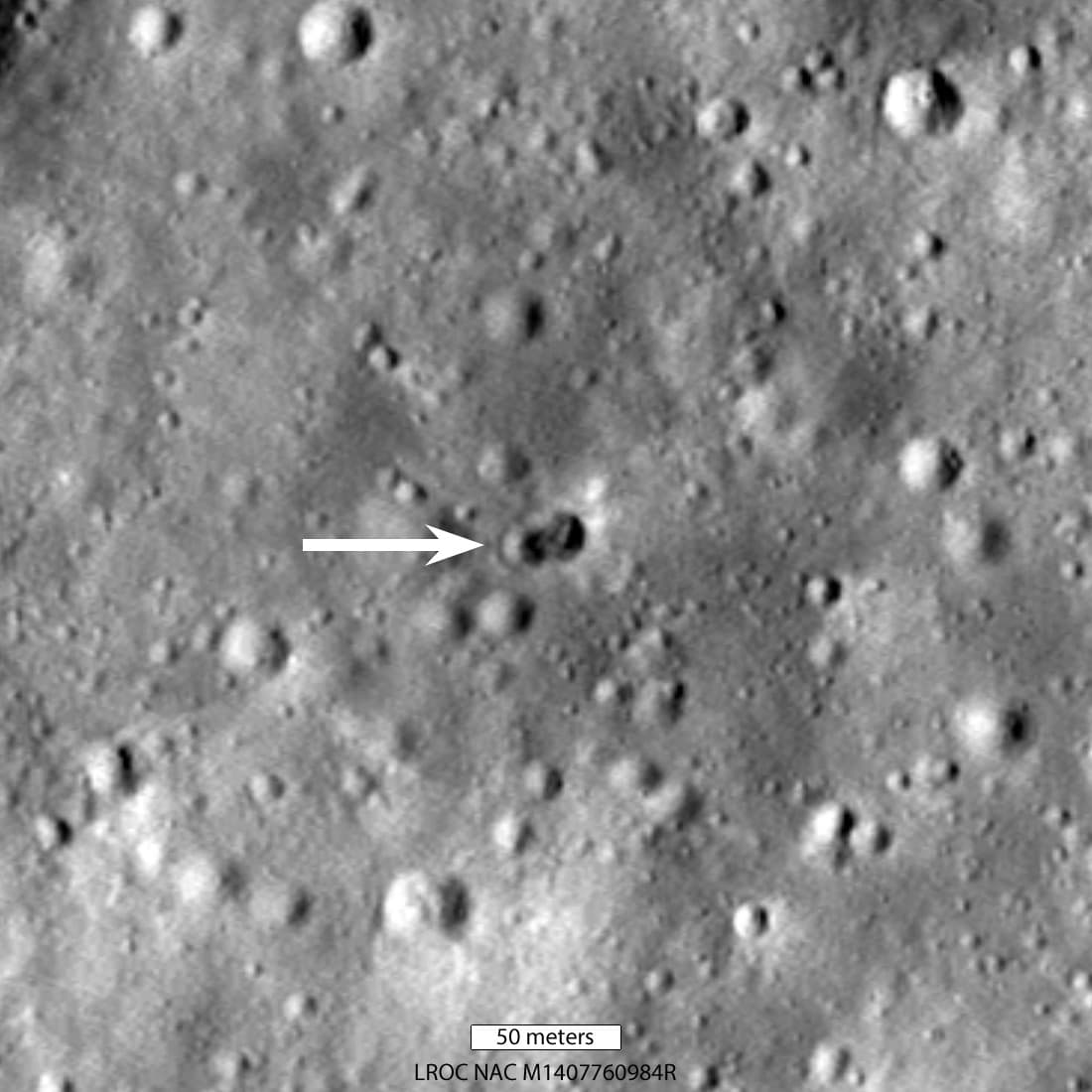
Hit the far side on Mar 4, 2022 and left a double crater, 18 m and 16 m wide, imaged by LRO at 5.226 N, 234.486 E. First identified as a SpaceX stage, later reattributed to a Chinese booster; officially it remains unattributed.
TL;DR· 4 min read
An object catalogued WE0913A struck the lunar far side on 4 March 2022, the first known accidental impact of human hardware on the Moon, and left the only double crater a rocket body has ever made: holes 18 m and 16 m wide at 5.226 N, 234.486 E, imaged by LRO. It was reported worldwide as a SpaceX Falcon 9 stage until the tracker who made that identification corrected himself. A 2023 study points to a Chinese Long March 3C booster, but NASA has never attributed it and China denies it.
The first known accidental impact of human hardware on the Moon is also a lesson in how easily debris gets pinned on the wrong rocket. An object catalogued as WE0913A struck the far side in March 2022, and for weeks it was reported worldwide as a SpaceX Falcon 9 stage. It was not. The tracker who made the identification retracted it himself after a NASA analyst pointed out the trajectory never went near the Moon, and the evidence since points to a Chinese Long March 3C booster. NASA has never attributed it to anyone, and China denies it. What is beyond dispute is the crater: two overlapping holes that no other rocket body impact has produced.
Facts as of August 9, 2026, from the sources listed below.
2
overlapping craters, 18 m and 16 m across
28m
longest extent of the double crater
7years
the object drifted before anyone identified it
Commonly wrong. That SpaceX put it there. That was the original identification and it travelled around the world before it was corrected by the person who made it. The evidence now points to a Chinese Long March 3C booster, though NASA has never made an official attribution and China rejects it.
01Mission facts
Impact
Mar 4, 2022, on the lunar far side in the Hertzsprung region. Nothing was in position to observe it.↗
The crater
A double crater at 5.226 N, 234.486 E: an eastern crater 18 m across superimposed on a western crater 16 m across, about 28 m at its longest. Imaged by LRO's narrow-angle camera on May 21, 2022 and published Jun 23, 2022. LROC notes no other rocket body impact has left a double crater; the four Apollo S-IVB craters were all single and over 35 m.↗
Why two craters
The double shape surprised researchers. A spent stage normally has its mass concentrated at the engine end, which would make one crater; two suggest large masses at both ends of the body.↗
The misidentification
Bill Gray identified the object in 2015 as the Falcon 9 stage from the DSCOVR launch. In February 2022 Jon Giorgini of NASA's Jet Propulsion Laboratory pointed out that DSCOVR's trajectory never took it near the Moon. Gray publicly corrected himself and reidentified it as a Chang'e 5-T1 booster.↗
The reattribution
A peer-reviewed study in The Planetary Science Journal (Campbell et al., Nov 2023) analysed the object's brightness and spin and concluded it was the Long March 3C upper stage from Chang'e 5-T1.↗
Official position
NASA and the LRO camera team never attributed the impactor to any country or company: their image was titled "Mystery Rocket Body Found!" and they wrote that the identity remains unclear. Chinese officials denied the booster was theirs.↗
Why it matters now
The same researchers frame the 2026 Falcon 9 impact as the calibration case this one could not be: because 2025-010D's origin is independently known, it becomes a benchmark for identifying future cislunar objects of uncertain origin.↗
Site: 5.2260°N, 125.5140°W · Double crater in the Hertzsprung region, far side (LRO-imaged) (source)
02Mission timeline
Oct 23, 2014
Chang'e 5-T1 launches from Xichang on a Long March 3C. Its upper stage is left in a high orbit.
2015
Bill Gray identifies a drifting object as the Falcon 9 upper stage from the DSCOVR launch. The identification stands unchallenged for seven years.
Jan 2022
Gray calculates that the object, catalogued WE0913A, will hit the Moon. The story goes worldwide as a SpaceX rocket about to strike the Moon.
Feb 12, 2022
Jon Giorgini of NASA's Jet Propulsion Laboratory emails Gray to point out that DSCOVR's trajectory never took it near the Moon. Gray rechecks and publicly corrects himself.
Mar 4, 2022
Impact on the far side, in the Hertzsprung region. Nothing was in position to observe it.
May 21, 2022
LRO's narrow-angle camera photographs the site and finds not one crater but two, overlapping.
Jun 23, 2022
LROC publishes the image under the title "Mystery Rocket Body Found!", stating the identity of the impactor remains unclear.
Nov 2023
A peer-reviewed study in The Planetary Science Journal analyses the object's brightness and spin and concludes it was the Long March 3C stage.
Teal dots: events that physically happened in flight or on the Moon. Grey: announcements, namings, contracts, and targets.
03The mission
This is the impact that taught everyone to be careful. For seven years an object drifting between Earth and the Moon was catalogued as a SpaceX rocket stage, and when it turned out to be on a collision course, that label travelled with it into headlines around the world. The correction came from the person who made the original identification, after a NASA analyst pointed out the trajectory simply did not work.
The crater is the part nobody predicted. Rocket stages carry their mass at the engine end, so they punch a single hole; the four Apollo S-IVB stages fired into the Moon each left one crater over 35 metres across. This one left two, overlapping, which means there was substantial mass at both ends of the body. The declared secondary payload weighed 10 to 14 kilograms, nowhere near enough to explain it. Something else was attached to that rocket and nobody has ever said what.
China denied the booster was theirs. NASA has never made an official attribution, and the LROC team's own title for the photograph, four months after the impact, was still Mystery Rocket Body Found.
04In pictures
Tap a photo to enlarge.
05Sources
- LROC featured image: Mystery Rocket Body Found!
- NASA: LRO spots rocket impact site on the Moon
- Campbell et al., Physical Characterization of Moon Impactor WE0913A, PSJ (2023)
- Project Pluto: the correction
- azmth: the 2026 Falcon 9 upper stage impact
- azmth: did a SpaceX rocket crash into the Moon?
azmth is independent and is not affiliated with or endorsed by NASA, CNSA, Roscosmos, ISRO, JAXA, or any other space agency or company named on this page.