Chandrayaan-3
ISRO (India) · Rover · 2023Success

Landed 23 Aug 2023 at 69.37 S (Statio Shiv Shakti); Vikram and Pragyan completed one lunar day plus a hop bonus, the propulsion module returned to Earth orbit; full success.
TL;DR· 7 min read
Chandrayaan-3 made India the fourth country to soft-land on the Moon and the first to land in the south polar region, touching down at 69.37 S on 23 August 2023. Vikram and the 26 kg Pragyan rover worked through one lunar day, roving more than 100 metres and confirming sulfur in the first in-situ elemental measurements made at high southern latitudes. Vikram then hopped a short distance under its own engines, and the propulsion module flew back to high Earth orbit as a rehearsal for a future sample return.
Chandrayaan-3 made India the fourth country to soft-land on the Moon and the first to land in the lunar south polar region, at 69.37 S. Despite four years of headlines, it did not land "at the south pole": Statio Shiv Shakti sits roughly 600 km from the pole itself. On a budget of about Rs 615 crore (roughly $75 million), the Vikram lander and 26 kg Pragyan rover delivered the first in-situ measurements ever made at high southern lunar latitudes.
Facts as of July 20, 2026, from the sources listed below.
4th
nation to soft-land on the Moon
69.37deg S
landing latitude, first in the south polar region
100+m
roved by 26 kg Pragyan in one lunar day
₹615 cr~$75M
total mission cost
Commonly wrong. Four persistent errors in English coverage. (1) "Landed on the lunar south pole": it landed at 69.37 S, about 600 km from the pole; "first landing in the south polar region" is the defensible claim. (2) "Southernmost landing ever" is stale: Intuitive Machines' Odysseus landed much farther south (about 80.1 S near Malapert A) in February 2024. (3) The hop experiment's date and height are reported inconsistently even by ISRO: the original 4 Sep 2023 announcement said about 40 cm up and 30-40 cm over, while ISRO's 2026 science release tied to the ApJ paper dates it 2 September 2023 at about 50 cm; the original announcement date is why many outlets say 3 or 4 September. (4) "Chandrayaan-3 discovered water on the Moon": it did not detect water; the orbital hydration discovery belongs to Chandrayaan-1 (2008-09), while Chandrayaan-3's ChaSTE temperatures only constrain where subsurface ice could survive. Also stale: hopeful "Vikram may still wake up" framing; neither craft ever responded after the September 2023 lunar night.
01Mission facts
Launch
14 July 2023, LVM3 M4, Satish Dhawan Space Centre (Sriharikota)↗
Landing
23 August 2023, 18:04 IST; 4th nation to soft-land, 1st in south polar region↗
Landing site
69.3741 S, 32.32 E, elevation 532 m (LROC-derived)↗
Site name
Statio Shiv Shakti, IAU-approved 19 March 2024↗
Mass
3,900 kg total: 2,148 kg propulsion module + 1,752 kg lander module incl. 26 kg Pragyan rover↗
Mission cost
About Rs 615 crore (~$75 million)↗
Rover traverse
100+ metres in one lunar day; slept 2 September 2023, never woke↗
LIBS result
First in-situ elemental analysis near lunar south pole; sulfur confirmed plus Al, Ca, Fe, Cr, Ti, Mn, Si, O↗
Hop experiment
Vikram refired engines, rose ~40-50 cm and moved 30-40 cm; 2026 ApJ paper (Durga Prasad et al., ApJ 1001 135) shows plume stripped ~3 cm of dust, exposing layered regolith↗
Propulsion module return
TEI 13 Oct 2023, left lunar SOI 10 Nov after 4 flybys, high Earth orbit (announced 4 Dec 2023); explicit sample-return ops rehearsal↗
ChaSTE headline result (2025)
Surface hit ~82 C on a 6-degree sunward slope; model shows poleward slopes >14 degrees at high latitude could harbour near-surface water ice (Comms Earth & Environment, March 2025)↗
Context: Chandrayaan-2 orbiter
Still healthy in 100 km polar orbit, payloads operational; new polar data products released November 2025↗
Context: Chandrayaan-4 sample return
Cabinet-approved 18 Sep 2024 at Rs 2,104.06 crore; two LVM3 launches with Earth-orbit and lunar-orbit docking, ~3 kg samples; targeted around 2028 (as of December 2025, reaffirmed by ISRO Chairman V. Narayanan), with April 2026 parliamentary-committee reporting flagging launch-vehicle readiness and slow spending as schedule risks↗
Context: Chandrayaan-5 / LUPEX
ISRO-JAXA joint mission approved 10 March 2025; ~350 kg JAXA rover on ISRO lander, launch on Japan's H3-24L; JAXA's English project page gives no earlier than 2028 and its Japanese page gives Japanese fiscal year 2028, April 2028 to March 2029 (as of September 2026)↗
Context: Gaganyaan crewed program
Uncrewed G1 targeted H2 2026 (as of July 2026): the Feb 2026 window was abandoned, and G1 had not flown as of July 18, 2026, with reporting expecting it around late 2026 carrying the Vyommitra robot; first crewed flight targeted 2027 (as of July 2026), with officials suggesting a possible slip to 2028; crewed Moon landing goal 2040↗
Site: 69.3741°S, 32.3200°E · Statio Shiv Shakti (source)
02Mission timeline
14 Jul 2023
Launch (LVM3 M4, Sriharikota)
5 Aug 2023
Lunar orbit insertion
17 Aug 2023
Lander module separates from propulsion module
23 Aug 2023
Vikram lands at Statio Shiv Shakti, 18:04 IST; Pragyan deploys
Late Aug 2023
LIBS confirms sulfur near south pole (announced 28 Aug)
~27 Aug 2023
LRO images the landing site (frame M1447750764LR)
2 Sep 2023
Pragyan passes 100 m, enters sleep mode
2 to 3 Sep 2023
Vikram hop experiment (announced 4 Sep; ISRO's 2026 release dates it 2 Sep)
4 Sep 2023
Vikram sleeps; no response after lunar night despite attempts from 22 Sep
4 Dec 2023
Propulsion module returned to high Earth orbit, announced this date (TEI 13 Oct; left lunar SOI 10 Nov)
19 Mar 2024
IAU approves the name Statio Shiv Shakti
Mar 2025
ChaSTE paper: warmer surface, possible near-surface ice on steep poleward slopes
2026
Hop-site erosion and regolith layering paper (ApJ 1001 135)
Teal dots: events that physically happened in flight or on the Moon. Grey: announcements, namings, contracts, and targets.
03The mission
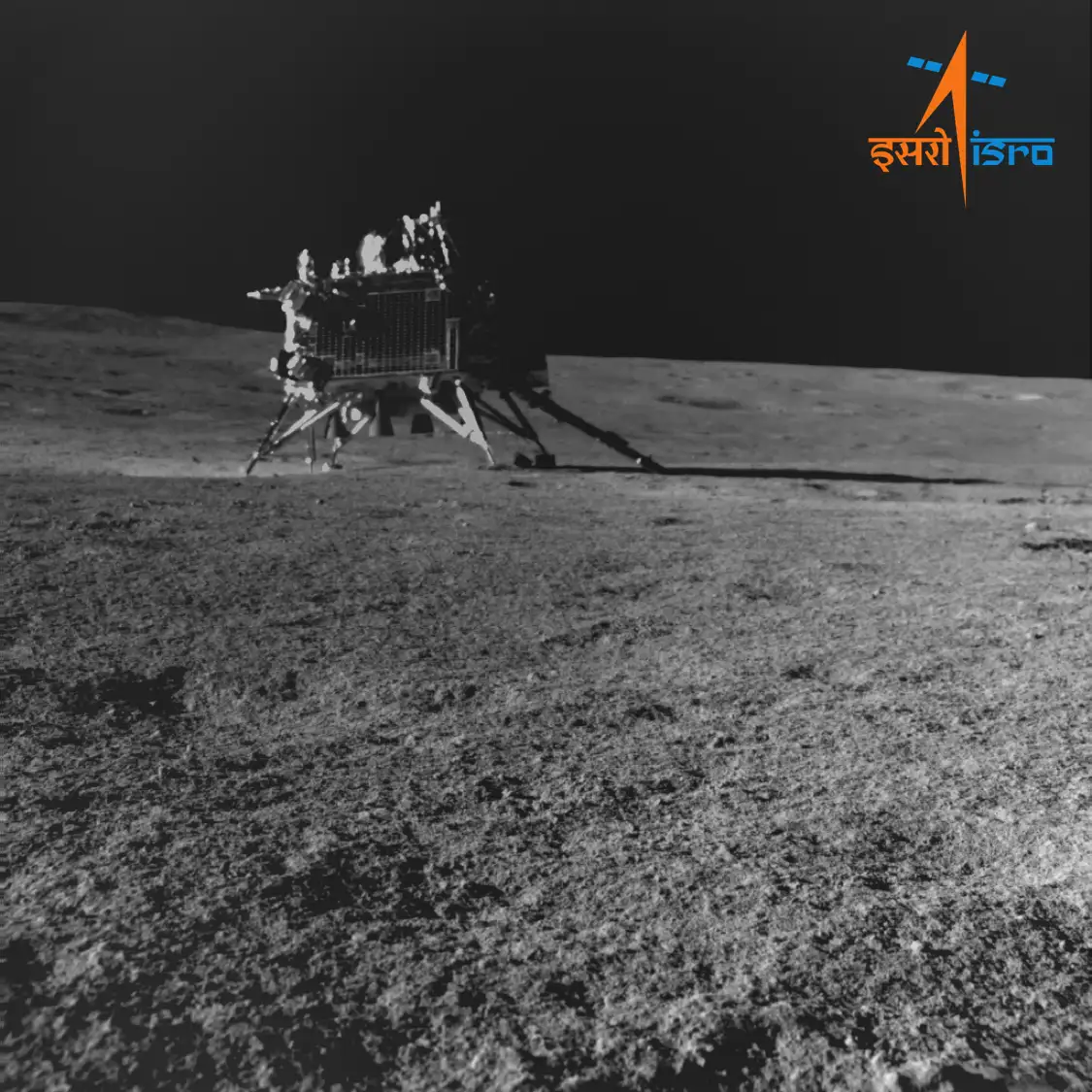
Chandrayaan-3 was a redemption flight. Chandrayaan-2's Vikram lander crashed during descent in September 2019, so ISRO re-flew a strengthened lander and rover without a new orbiter, leaning on the still-operating Chandrayaan-2 orbiter overhead. The stack (3,900 kg total: a 2,148 kg propulsion module carrying a 1,752 kg lander module that included the 26 kg rover) launched on LVM3 M4 from the Satish Dhawan Space Centre, Sriharikota, on 14 July 2023, entered lunar orbit on 5 August, and the lander separated on 17 August. Vikram touched down at 18:04 IST on 23 August 2023, making India the fourth nation to soft-land on the Moon after the USSR, the US and China, and the first anywhere in the south polar region.
The surface mission was designed for one lunar day, and it delivered. Pragyan rolled down its ramp and traversed more than 100 metres, while its LIBS instrument made the first in-situ elemental measurements near the lunar south pole, confirming sulfur along with aluminium, calcium, iron, chromium, titanium, manganese, silicon and oxygen. The lander's ChaSTE probe pushed a thermal sensor about 10 cm into the regolith and recorded the first in-situ temperature profile at these latitudes. Pragyan was parked and put to sleep on 2 September 2023 and Vikram on 4 September; neither responded after the lunar night, despite listening attempts from 22 September onward, and ISRO closed out the surface mission.
Before sleeping, Vikram performed an unplanned bonus: the hop experiment. On command it refired its engines, lifted itself off the surface and set down again a short distance away, a miniature rehearsal of the ascent capability a sample-return mission needs. ISRO's original 4 September 2023 announcement described a rise of about 40 cm and a displacement of 30 to 40 cm; ISRO's 2026 science release, tied to a peer-reviewed Astrophysical Journal paper (K. Durga Prasad et al. 2026, ApJ 1001 135), dates the hop to 2 September 2023 and puts the rise at about 50 cm. That same work turned the hop into science: the exhaust plume stripped roughly 3 cm of loose dust and exposed older, more compacted material, revealing a layered, two-tier structure in the top centimetres of south-polar regolith.
The propulsion module got a second life too. With over 100 kg of fuel remaining after lunar operations, ISRO raised its orbit from 9 October 2023, performed a trans-Earth injection on 13 October, flew four lunar flybys, departed the Moon's sphere of influence on 10 November and settled into a high Earth orbit (first perigee crossing 22 November), a result ISRO announced on 4 December 2023. ISRO explicitly framed the exercise as a dress rehearsal of return-from-the-Moon operations for a future sample return, while the module's SHAPE payload kept observing Earth as an exoplanet analogue.
The science afterlife has kept the mission in the journals. The IAU approved the landing site name Statio Shiv Shakti on 19 March 2024. In March 2025, a Communications Earth & Environment paper built on ChaSTE data reported surface temperatures peaking near 82 C on the lander's small sunward slope while modelling showed that poleward-facing slopes steeper than about 14 degrees at these high latitudes could harbour water ice much closer to the surface than assumed, a direct input to landing-site selection for future missions. NASA's Lunar Reconnaissance Orbiter imaged the landing site four days after touchdown, the source of the best freely usable overhead views.
Chandrayaan-3 also reset India's lunar roadmap. The Chandrayaan-2 orbiter remains healthy in its 100 km polar orbit with payloads operational, and ISRO was still releasing new polar data products from it in November 2025. The Union Cabinet approved the Chandrayaan-4 sample-return mission on 18 September 2024 at Rs 2,104.06 crore, a two-LVM3-launch, docking-based architecture intended to bring back roughly 3 kg of regolith, targeted around 2028 (as of December 2025, when ISRO chairman V. Narayanan reaffirmed it; an April 2026 parliamentary review flagged schedule risk after ISRO switched the launch-vehicle configuration mid-development). Chandrayaan-5/LUPEX, a joint mission with JAXA carrying a roughly 350 kg Japanese rover on an ISRO lander, was approved on 10 March 2025 and is targeted for no earlier than 2028 (JAXA, as of September 2026) on Japan's H3 rocket. On the crewed side, the first uncrewed Gaganyaan flight G1 (carrying the Vyommitra humanoid) has slipped repeatedly: the February 2026 window was abandoned, ISRO's January 21, 2026 schedule moved G1 to the second half of 2026, and as of July 2026 it had still not flown, with reporting still expecting it around late 2026. The first crewed flight is targeted 2027 (as of July 2026), with officials suggesting a possible slip to 2028. India's stated long-range goals remain a Bharatiya Antariksh Station by 2035 and an Indian crewed Moon landing by 2040.
04In pictures
Tap a photo to enlarge.
05Sources
- ISRO: Chandrayaan-3 mission details (masses, payloads, site box)
- ISRO: LVM3 M4 / Chandrayaan-3 launch brochure (PDF)
- LROC Featured Image 1314: Chandrayaan-3 Landing Site (coordinates 69.3741 S, 32.32 E)
- NASA: LRO Observes Chandrayaan-3 Landing Site
- IAU Gazetteer of Planetary Nomenclature: Statio Shiv Shakti (approved 19 Mar 2024)
- Space.com: Chandrayaan-3 landing (4th nation, 1st south polar region)
- Space.com: LIBS sulfur detection in south-polar soil
- The Week: ISRO map of Pragyan's 100-metre route (2 Sep 2023)
- ISRO: hop experiment reveals regolith heterogeneity (2026 release, ApJ 1001 135)
- ISRO: Propulsion Module moved from lunar orbit to Earth orbit (4 Dec 2023)
- Space.com: propulsion module returns to Earth orbit
- Nature Communications Earth & Environment: ChaSTE higher surface temperatures paper (Mar 2025)
- IOPscience ApJ: post-hop ChaSTE twilight observations (2026)
- eoPortal: Chandrayaan-3 mission chronology
- ISRO: Chandrayaan-2 science (orbiter healthy, payloads operational)
- ISRO on X: new Chandrayaan-2 orbiter polar data products (Nov 2025)
- The Statesman: Cabinet approves Chandrayaan-4 (18 Sep 2024, Rs 2,104.06 crore)
- ISRO: National Science Meet on Chandrayaan-4 lunar sample return
- Jatan.space Indian Space Progress: Chandrayaan-5/LUPEX approval and architecture
- ThePrint: Gaganyaan uncrewed flight faces delay (16 Jan 2026)
- DD News: India targets astronauts on the Moon by 2040, station by 2035
- DNA India: Chandrayaan-3 cost Rs 615 crore
- The Week: Gaganyaan tests completed, G1 launch expected around late 2026 (July 14, 2026)
- Indian Defense News: ISRO chairman reaffirms Chandrayaan-4 and 5 launch targets (Dec 13, 2025)
- News Karnataka via Dailyhunt: Chandrayaan-4 faces delays after ISRO switches rocket plan (April 2026 parliamentary review)
azmth is independent and is not affiliated with or endorsed by NASA, CNSA, Roscosmos, ISRO, JAXA, or any other space agency or company named on this page.