China's Crewed Lunar Program
CMSA (China) · Program · 2023In development

In development: first crewed landing targeted before 2030 (restated by CMSA May 23, 2026); CZ-10A/Mengzhou-1 orbital debut listed by CMSA among its 2026 flights (Nov 2025), though CMSA's Feb 27, 2026 annual plan does not name it and no date has been given; trackers report a slip to 2027 and CMSA has announced no change (as of Oct 9, 2026); CZ-10B variant flew and was recovered Jul 10, 2026.
TL;DR· 8 min read
China aims to land astronauts on the Moon before 2030, using two Long March 10 launches per mission, one for the Lanyue lander and one for the crewed Mengzhou, with two astronauts making what CMSA calls a short-term stay on the surface. Hardware started flying in 2025: a pad abort, a full-scale lander landing-and-ascent test, two heavy static fires, then a max-Q in-flight abort in February 2026. On 10 July 2026 a Long March 10B reached orbit and its booster was caught in a net at sea, but no CZ-10A had flown as of 9 October 2026.
China's crewed lunar program is no longer a paper ambition: since mid-2025 it has flown a pad abort, a full-scale lander landing-and-ascent test, two heavy static fires, a supersonic in-flight abort, and, on July 10, 2026, the first orbital flight of a Long March 10 family rocket, whose booster was caught in a net at sea. The official target has always been a landing "before 2030", which English coverage routinely paraphrases as "by 2030" or "around 2030". Neither the crew-rated CZ-10A nor Mengzhou-1 has reached orbit yet: CMSA listed their orbital debut among its 2026 flights in November 2025 but has given it no date, and trackers report a slip to 2027 that CMSA has not announced (as of October 9, 2026).
Facts as of October 9, 2026, from the sources listed below.
2030
first crewed landing targeted before (restated May 23, 2026)
2
Long March 10 launches per landing mission
27t
CZ-10 payload to trans-lunar injection
2
astronauts the Lanyue lander carries to the surface and back
Targets are the operator's current plan (as of October 9, 2026) and can change.
In development. Completed milestones on this page are historical record; future dates are targets from official announcements, tagged with when they were made, and can change.
Commonly wrong. Three recurring errors in English coverage. (1) The target is a landing "before 2030" (官方: 2030年前), which English sources routinely soften to "by 2030" or "around 2030"; officials have used the same phrasing consistently since May 2023. (2) Anything written before July 10, 2026 saying "only SpaceX and Blue Origin have recovered orbital-class boosters" or "China's Moon rocket has never flown" is now stale: the CZ-10B variant reached orbit and its stage was net-recovered at sea that day, though the crew-rated CZ-10A itself has still not flown as of October 9, 2026. (3) Mengzhou is often called an "upgraded Shenzhou"; it is a clean-sheet new-generation spacecraft (its uncrewed prototype flew in May 2020 on the first CZ-5B), and the Feb 11, 2026 flight was a suborbital abort test, sometimes misreported as the CZ-10's orbital debut. Bonus: official English releases translate Tansuo as "Exploration", so "Exploration rover" and "Tansuo rover" are the same vehicle.
01Mission facts
Lunar-landing phase formally announced
May 29, 2023, by CMSA deputy director Lin Xiqiang: first Chinese crewed lunar landing before 2030↗
Mission architecture
Dual launch: two Long March 10 rockets send the Lanyue lander and the crewed Mengzhou spacecraft separately to lunar orbit for rendezvous and docking↗
Surface plan
Two astronauts ride the Lanyue lander down for what CMSA calls a short-term stay on the surface (月面短期驻留), with the Tansuo rover. CMSA's program description gives no duration; the widely quoted six hours matches the minimum surface stay CMSA asked for in a 2018 ideas contest for a crewed lander↗
Long March 10 (tri-core lunar version)
92.5 m tall, about 2,189 t at liftoff, 27 t to trans-lunar injection, 70 t to LEO↗
Element names
Mengzhou spacecraft and Lanyue lander named Feb 24, 2024; Wangyu lunar suit and Tansuo rover named Feb 12, 2025 (public contests)↗
Mengzhou zero-altitude pad abort
Jun 17, 2025, Jiuquan; capsule landed on airbags about 2 minutes after ignition; China's first pad abort test since 1998; declared fully successful↗
Lanyue landing and takeoff test
Aug 6, 2025, Huailai, Hebei; full-scale lander flew in a purpose-built extraterrestrial-gravity simulator; first Chinese off-Earth landing-and-ascent trial for a crew vehicle↗
CZ-10 first static fire
Aug 15, 2025, LC-301 Wenchang; seven YF-100K engines, thrust near 1,000 t, largest such test ever in China↗
CZ-10 second static fire
Sep 12, 2025; seven engines, 320 seconds, including restarts simulating launch, re-entry, and landing for a reusable first stage↗
Prototype stage complete
Oct 30, 2025: CMSA spokesperson Zhang Jingbo said CZ-10, Mengzhou, Lanyue, Wangyu suit, and rover "have completed the main work of the prototype stage"↗
In-flight max-Q abort test
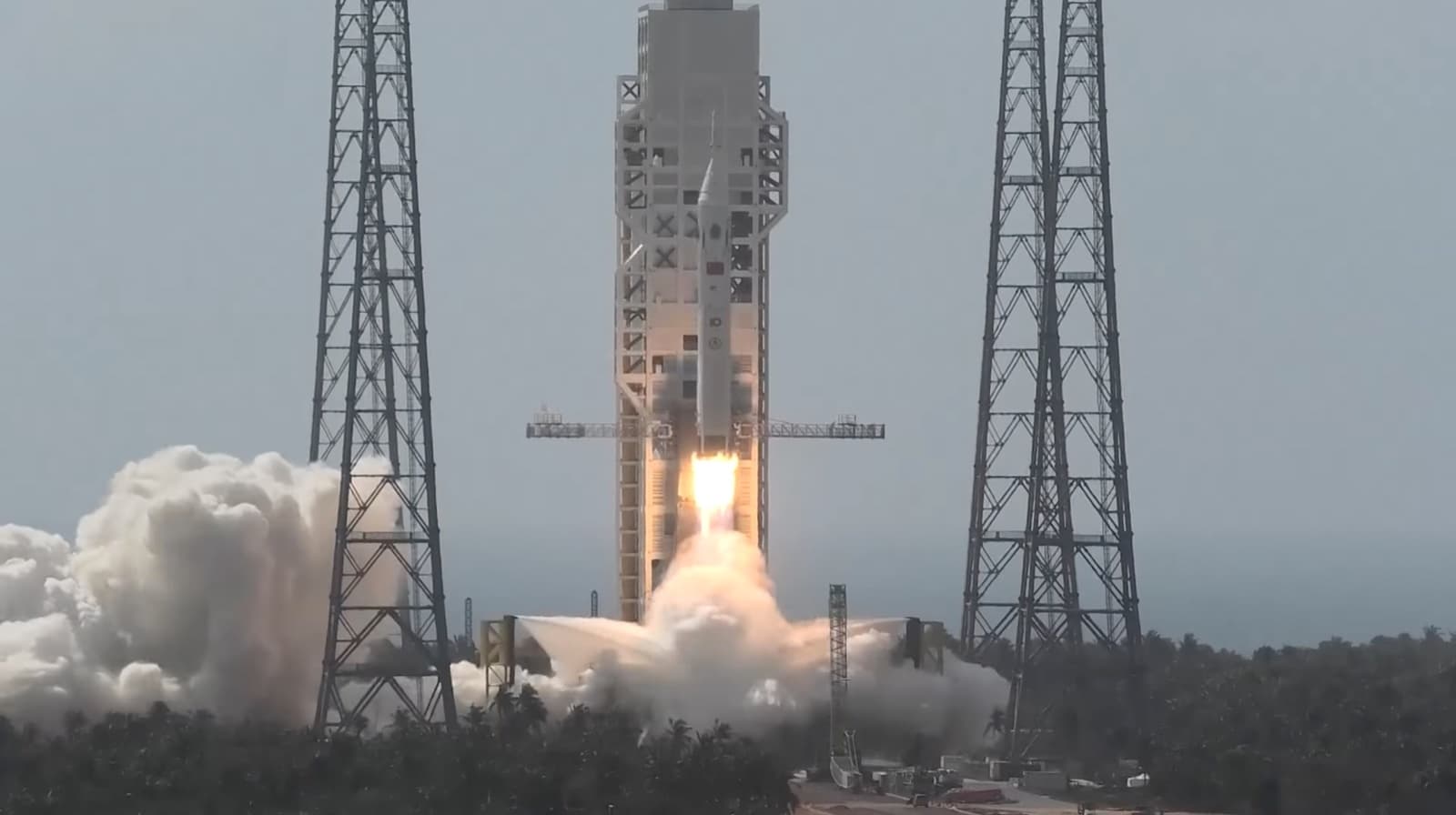
Feb 11, 2026, LC-301 Wenchang; Mengzhou pulled away about one minute into flight at roughly 10-11 km, at maximum dynamic pressure (Global Times, citing CASC experts, gives about one minute and around 10 km with parachutes near 8 km); capsule recovered from the sea, which CMSA called China's first sea-based search and recovery for a crewed spacecraft; the booster flew a recovery-simulation profile with reentry burn, powered descent and propulsive splashdown at a preset simulated landing point about 200 m from its recovery vessel, according to Zhu Pingping of CASC's China Academy of Launch Vehicle Technology (Science and Technology Daily, Feb 12, 2026)↗
CZ-10B maiden flight and booster recovery
Jul 10, 2026, 04:15 UTC, Hainan Commercial Space Launch Site; single-stick cargo variant (16 t to LEO reusable) reached orbit and its first stage was caught by the net system of the Linghang Zhe recovery ship: China's first orbital-booster recovery and the world's first net recovery↗
CZ-10A / Mengzhou-1 orbital debut
Listed for 2026 with no date (CMSA's 2026 mission list, Nov 2025, as adjusted on Nov 26, 2025: Tianzhou-10, Shenzhou-23, Shenzhou-24 and Mengzhou-1); CMSA's Feb 27, 2026 annual plan names two crewed flights and one cargo flight for the year without naming Mengzhou-1; uncrewed Mengzhou on the crew-rated CZ-10A single-stick variant; not listed in CMSA's second-half-2026 outlook and reported by trackers as likely slipping to 2027 (China in Space, Jul 18, 2026), with no official change announced; had NOT flown as of Oct 9, 2026↗
2026 program plan
Feb 27, 2026 CMSA plan: build out lunar-mission facilities at Wenchang plus tracking, communications, and landing-site ground systems; development "progressing smoothly" toward the before-2030 goal↗
02Mission timeline
29 May 2023
CMSA announces the lunar-landing phase: crewed landing before 2030
24 Feb 2024
Spacecraft named Mengzhou ("dream vessel"), lander named Lanyue ("embracing the Moon")
12 Feb 2025
Lunar suit named Wangyu, crew rover named Tansuo, from 9,000+ public entries
17 Jun 2025
Mengzhou zero-altitude pad abort at Jiuquan, first such Chinese test in 27 years; fully successful
6 Aug 2025
Lanyue full-scale landing-and-takeoff test at Huailai, Hebei, in an extraterrestrial-gravity simulator
15 Aug 2025
First CZ-10 static fire at Wenchang LC-301: seven YF-100K engines, ~1,000 t thrust
12 Sep 2025
Second CZ-10 static fire: 320 s with engine restarts for reusability
30 Oct 2025
CMSA: all five major flight products completed the main work of the prototype stage
11 Feb 2026
Max-Q in-flight abort at Wenchang: Mengzhou escapes about one minute into flight at roughly 10-11 km; China's first sea-based recovery of a crewed-spacecraft capsule; booster demonstrates recovery maneuvers
23 May 2026
CMSA merges the crewed lunar landing and robotic Chang'e programs across missions, resources and teams into a single 'Lunar Exploration Project' (月球探测工程), and restates the before-2030 landing target
10 Jul 2026
CZ-10B maiden orbital flight; first stage caught in the Linghang Zhe ship's net: China's first orbital-booster recovery
2026 (listed, no date; slip to 2027 reported)
CZ-10A maiden orbital flight carrying the uncrewed Mengzhou-1 to low Earth orbit (as of 9 Oct 2026)
Teal dots: events that physically happened in flight or on the Moon. Grey: announcements, namings, contracts, and targets.
03The mission
China formally started the landing phase of its crewed lunar effort on May 29, 2023, when CMSA deputy director Lin Xiqiang announced the goal of putting Chinese astronauts on the Moon before 2030. The architecture is a dual-launch lunar-orbit rendezvous: one Long March 10 sends the Lanyue lander to lunar orbit, a second sends the crewed Mengzhou spacecraft, the two dock, two astronauts descend for what CMSA calls a short-term stay on the surface, with the Tansuo rover, then the Lanyue ascent vehicle returns them to Mengzhou for the trip home. Every element carries a poetic public-contest name: Mengzhou ("dream vessel", Feb 24, 2024), Lanyue ("embracing the Moon", from a Mao Zedong poem, same date), the Wangyu ("gazing into the cosmos") suit and Tansuo ("to explore") rover (Feb 12, 2025).
2025 was the year the hardware started flying. On June 17, 2025 a Mengzhou test capsule performed a zero-altitude pad abort at Jiuquan, China's first such test since a Shenzhou trial in 1998, landing on airbags two minutes later. On August 6, 2025 a full-scale Lanyue flew a combined landing-and-takeoff test inside a purpose-built extraterrestrial-gravity rig at Huailai, Hebei, the first Chinese trial of an off-Earth landing and ascent for a crew vehicle. At Wenchang's new LC-301 pad, a shortened CZ-10 first stage fired its seven YF-100K engines on August 15, 2025 (nearly 1,000 tonnes of thrust, the largest static fire in Chinese history) and again on September 12, 2025 for 320 seconds with restarts that rehearsed a reusable booster's flight profile. On October 30, 2025 CMSA declared the prototype stage's main work complete for all five major flight products.
The campaign accelerated in 2026. On February 11, a Long March 10 test booster (CMSA calls the flight a low-altitude demonstration of the Long March 10 system) lifted off from Wenchang and, about one minute in at roughly 10 to 11 km altitude, the abort system pulled Mengzhou away at maximum dynamic pressure while the booster continued a recovery-simulation profile of relights and powered deceleration, splashing down at a preset simulated landing point about 200 meters from its recovery vessel, according to Zhu Pingping of the China Academy of Launch Vehicle Technology, quoted by Science and Technology Daily. The capsule's parachute descent into the sea produced another first: what Global Times, quoting CASC experts and the China Manned Space Agency, called China's first sea-based search and recovery operation for a crewed spacecraft.
Then, on July 10, 2026 at 04:15 UTC, the Long March 10B, a single-stick 16-tonne-to-LEO cargo and commercial variant of the same first stage, reached orbit from the Hainan Commercial Space Launch Site and its booster was caught by the tensioned-net system of the Linghang Zhe ("navigator") recovery ship six minutes after staging. That made China the second country ever to recover an orbital-class booster, via the world's first net recovery, and the Long March 10B development team said on July 10, 2026 that it expects to fly a reused first stage before the end of 2026. CASC has also outlined a methalox CZ-10C as a future commercial workhorse. For the lunar program, the flight validated the first-stage design shared with the crew-rated CZ-10A.
What has not happened yet, as of October 9, 2026: no CZ-10A has flown, and no crewed mission of the lunar program has launched. The next gate is Mengzhou-1, the uncrewed orbital debut of both Mengzhou and the CZ-10A, announced by CMSA on November 1, 2025 for a 2026 flight, with no date given since. CMSA has not formally moved that year, but its February 27, 2026 annual plan (two crewed flights and one cargo flight in 2026) does not name Mengzhou-1, nor did its outlook for the second half of 2026, and trackers reported in July 2026 that the flight will probably slip into 2027. The bigger change since is structural: on May 23, 2026 CMSA said the crewed lunar landing effort and the robotic Chang'e effort had been merged across missions, resources and teams into a single program, 月球探测工程, the Lunar Exploration Project, and that the near-Earth CZ-10A and Mengzhou system shares an integrated design with the CZ-10 and lunar Mengzhou, so that several space station flights over the next two years will raise the lunar system's maturity. CMSA's February 27, 2026 annual plan keeps the before-2030 landing target and focuses 2026 work on lunar-mission ground infrastructure at Wenchang plus tracking, communications, and landing-site systems. No landing site has been officially announced, so this program page gets no globe pin yet.
04In pictures
Tap a photo to enlarge.
05Sources
- China Manned Space Engineering Office: Shenzhou-23 press conference, crewed and robotic lunar programs merged into the 'Lunar Exploration Project', before-2030 landing target restated (Chinese, May 23, 2026)
- China in Space: first Mengzhou mission may be delayed to 2027, reported not announced (subscription newsletter, Jul 18, 2026)
- CGTN: China plans crewed lunar landing before 2030 (May 29, 2023)
- collectSPACE: Mengzhou and Lanyue names revealed (Feb 24, 2024)
- gov.cn: Wangyu suit and Tansuo rover named (Feb 12, 2025)
- CMSE: 2018 ideas contest for a crewed lunar lander, requiring at least six hours on the surface and two EVAs (Chinese, April 27, 2018)
- CMSE: program description, a short-term stay on the lunar surface (Chinese)
- SpaceNews: China on track for crewed Moon landing by 2030 (Apr 24, 2024; paywalled)
- gov.cn: Mengzhou zero-altitude escape test (Jun 17, 2025)
- SpaceNews: pad abort test report (Jun 2025)
- SpaceNews: Lanyue landing and takeoff test (Aug 2025)
- gov.cn: first CZ-10 static fire (Aug 15, 2025)
- SpaceNews: seven-engine static fire (Aug 2025)
- Global Times: second static fire, 320 s (Sep 2025)
- SpaceNews: second hot fire with engine restarts (Sep 2025)
- SpaceNews: prototype stage complete, 2026 targets (Oct 30, 2025)
- CGTN: 2026 lineup, Mengzhou-1 and CZ-10A to debut (Nov 1, 2025)
- Xinhua: first sea recovery of a return capsule (Feb 11, 2026)
- Global Times: low-altitude Long March 10 test, abort about one minute into flight at around 10 km, parachutes near 8 km, China's first sea-based search and recovery of a crewed spacecraft (Feb 11, 2026)
- Science and Technology Daily via Xinhua: CASC experts on the Feb 11 test, max-Q a little over 60 seconds into flight at about 11 km and the booster's simulated landing point about 200 m from the recovery ship (Chinese, Feb 12, 2026)
- CGTN: CZ-10 and Mengzhou escape/recovery test (Feb 12, 2026)
- SpaceNews: abort and rocket-recovery test milestone (Feb 2026)
- Global Times: CMSA 2026 crewed space plan (Feb 27, 2026)
- SpaceNews: CZ-10B launch and recovery scheduled (Jun 25, 2026)
- SpaceNews: China becomes second country to recover an orbital booster (Jul 10, 2026)
- SpaceNews: methalox CZ-10C lined up after booster recovery (Jul 2026)
- Wikipedia: Long March 10 (specs and flight log)
- Space Scout: China completes Mengzhou abort test, splashes down booster (Feb 2026)
azmth is independent and is not affiliated with or endorsed by NASA, CNSA, Roscosmos, ISRO, JAXA, or any other space agency or company named on this page.