Falcon 9 upper stage (2025-010D)
SpaceX (US) · Rocket debris · 2026Debris impact
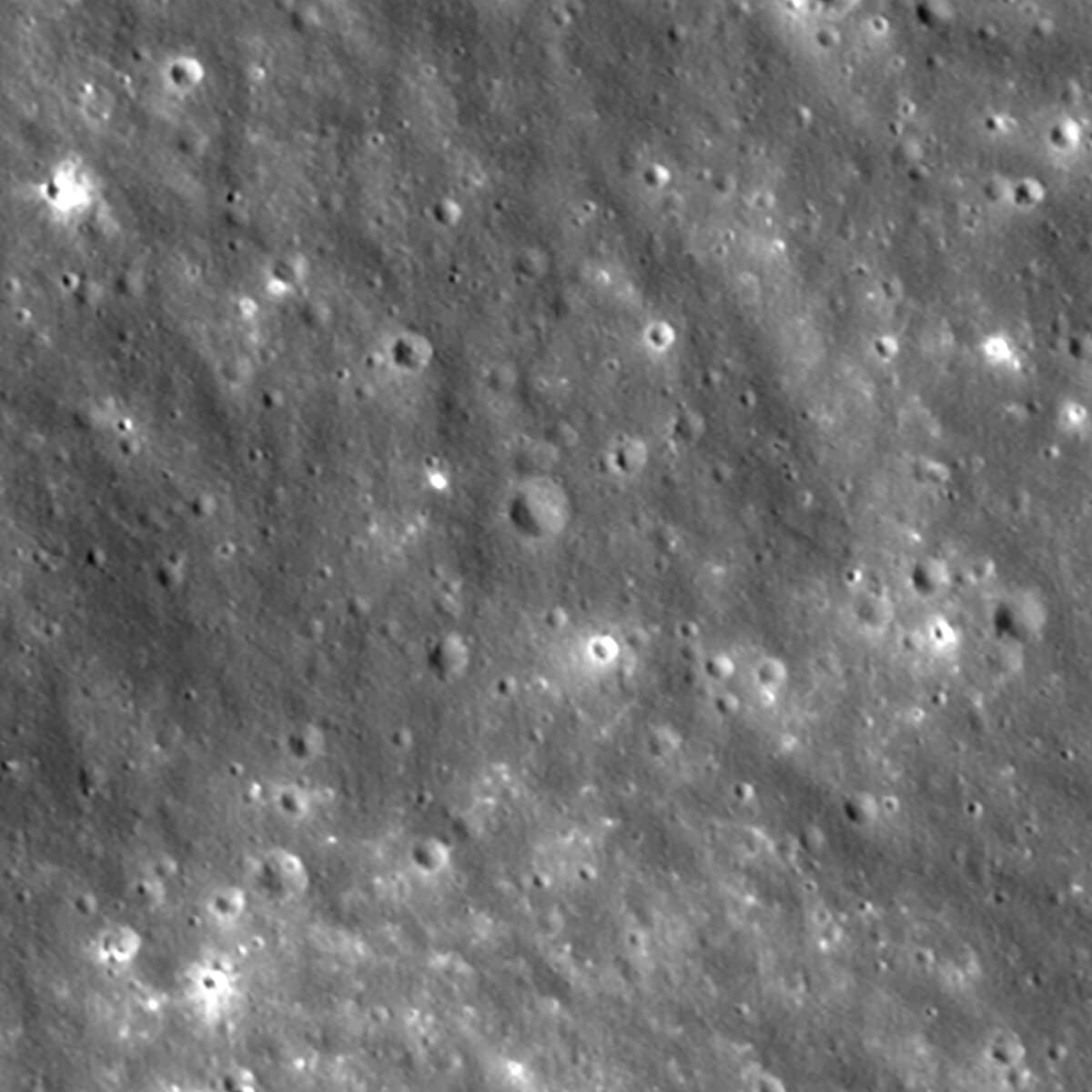
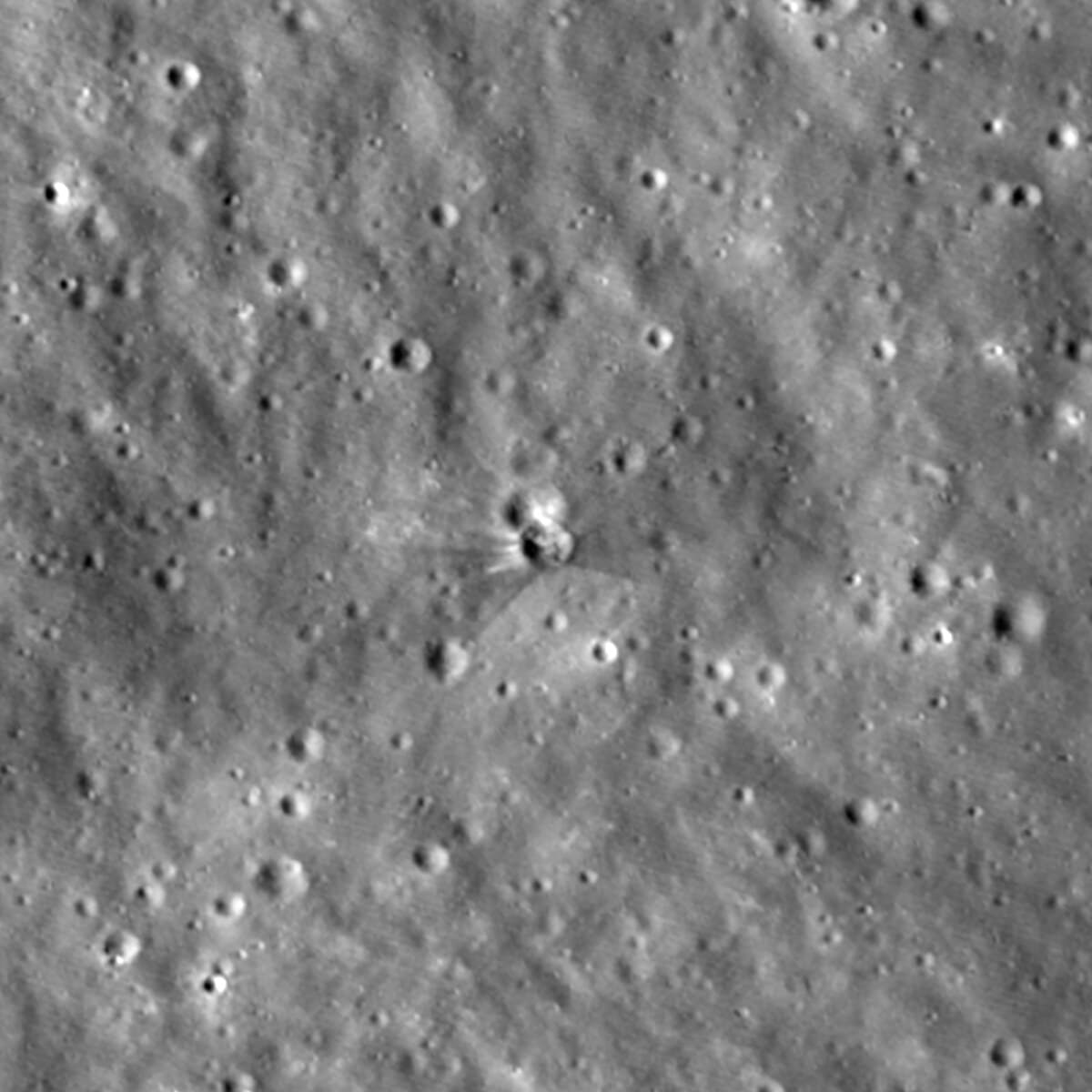
Hit the Moon on Aug 5, 2026 near Einstein crater: the spent second stage from the Falcon 9 that launched Blue Ghost 1 and Resilience in Jan 2025. Unintentional. LRO photographed the crater on Aug 11-12 and measured it at about 60 feet (18 m) across and under 10 feet (3 m) deep, centred at 19.4759 N, 266.7138 E.
TL;DR· 6 min read
A spent Falcon 9 second stage, left in a high Earth orbit after launching Blue Ghost 1 and Resilience in January 2025, hit the Moon near Einstein crater on 5 August 2026. Nobody aimed it and nothing watched it land. LRO photographed the site on 11 and 12 August and measured a crater about 60 feet (18 m) across and under 10 feet (3 m) deep, within about 0.6 miles of the prediction. NASA and SpaceX say they are studying how to stop it happening again.
On 5 August 2026 a discarded SpaceX upper stage hit the Moon, and for two weeks nobody could say exactly where. The object is 2025-010D, the second stage of the Falcon 9 that launched two commercial landers in January 2025. It finished its job that day; solar activity and gravity spent the next nineteen months bending its orbit until it intersected the Moon. Nobody aimed it and nothing watched it land. Then NASA's Lunar Reconnaissance Orbiter tilted to photograph the site on 11 and 12 August, found a fresh 60-foot crater, and the guesswork ended: the trajectory predictions had been right to about 0.6 miles.
Facts as of August 19, 2026, from the sources listed below.
60feet
measured crater width, about 18 m
2.43km/s
predicted impact speed, about 5,400 mph
19months
between finishing its mission and hitting the Moon
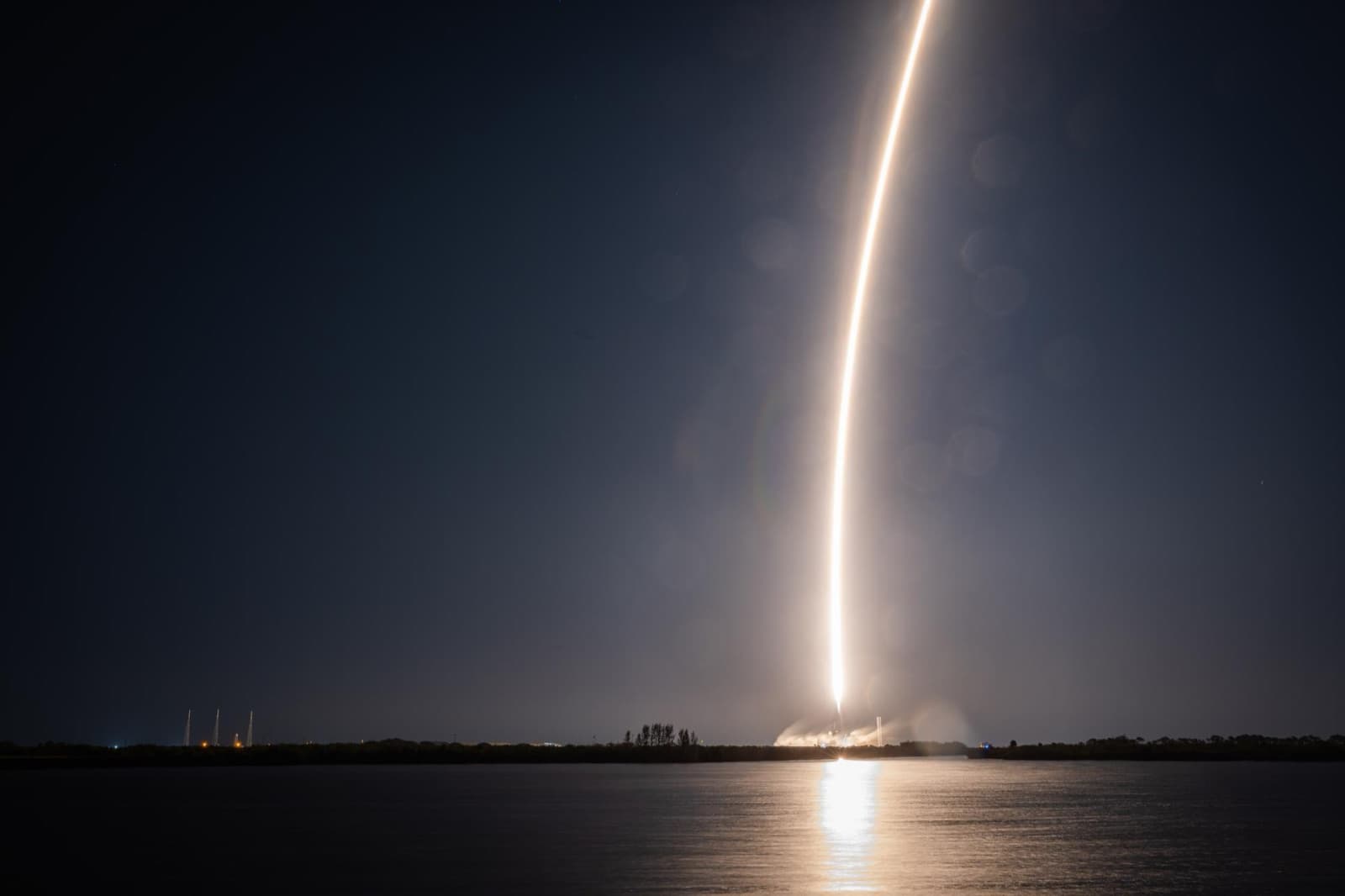
Commonly wrong. Two things. (1) That a Starlink satellite crashed into the Moon: none was involved. Starlink satellites orbit roughly 550 km up and have no way to reach the Moon, 384,400 km away. The object was a spent rocket stage, and the word Starlink appears nowhere in NASA's release, the tracking analysis, or the scientific papers. (2) That there is video of the impact: there is not. The clip that spread was traced to a post from April 2026, months before the impact happened, and fact-checkers found it inauthentic.
01Mission facts
What it was
The Falcon 9 second stage from the Jan 15, 2025 launch of Firefly's Blue Ghost Mission 1 and ispace's HAKUTO-R Mission 2 (Resilience), catalogued as COSPAR 2025-010D. Backward propagation of its orbit independently ties it to that launch.↗
The launch
Jan 15, 2025, 1:11 a.m. EST from Launch Complex 39A, Kennedy Space Center. Both landers were delivered successfully to their trans-lunar trajectories.↗
Impact date
Aug 5, 2026. The crater is now imaged and measured, but the impact TIME is still only predicted: Bill Gray gave 06:35:37.5 UTC and Campbell et al. 06:33:23 UTC plus or minus 55 seconds. Nothing observed the moment of impact, so no measured time exists.↗
Where it hit
19.4759 N, 266.7138 E, at 511 m elevation, near the 181 km crater Einstein on the western limb. This is a measured position: the LRO team refined it by comparing images taken on Aug 11-12, 2026 against pre-impact ones. Earlier figures in circulation were predictions, and NASA reports the prediction proved accurate to about 0.6 miles.↗
Near side or far side
Genuinely unsettled. At roughly 93 to 94 degrees west the point sits essentially on the western limb. Gray places it on the near side; Campbell et al. and Korean coverage call it the far side; NASA says only "near the Einstein and Bell craters".↗
Impact speed (predicted)
2.43 km/s, about 5,400 mph or 8,700 km/h. From the same orbital solution as the predicted position; no measured value has been published.↗
Mass
Not measured. Published estimates run from about 4,000 kg (Fernando et al.) to about 4,900 kg (Gray). NASA's release gives no mass, despite the figure often being attributed to it.↗
Why it hit the Moon
Unintentional. SpaceX passivated the stage "per the appropriate rules and regulations", but stages sent on high-energy trajectories cannot be deorbited the way low-Earth-orbit stages can. NASA attributes the return to "solar activity and gravitational forces", and calls disposal on the lunar surface a technically accepted method rather than a violation.↗
Was it a mission failure
No. The stage had finished boosting both landers out of Earth orbit 19 months earlier. Blue Ghost 1 went on to land successfully and operate about 14 days; ispace's Resilience failed separately during its own descent in June 2025.↗
Who tracked it
Bill Gray of Project Pluto identified the collision course from 1,053 astrometric observations contributed by asteroid surveys and amateur astronomers at five observatories in Mississippi, Utah, Beijing and England. NASA's Center for Near Earth Object Studies at JPL later confirmed the impact was certain.↗
Did anyone see it
No spacecraft watched the impact itself. South Korea's Danuri orbiter imaged the site eight times, once about 30 minutes before and seven times afterwards, giving the first before-and-after orbital record of a rocket body hitting the Moon, and its coordinates then helped LRO aim the imaging that measured the crater.↗
What the images show
A dark patch centred on the impact point with radial ejecta traces; the crater itself is not resolved. Danuri's terrain imager works at roughly 5 m per pixel, so a 20 to 30 m crater spans only a handful of pixels; KASA says the crater's size and shape are still being analysed.↗
Crater size
About 60 feet (18 m) across, measured where the rim stood out in the images, and less than 10 feet (3 m) deep, worked out from the length of its shadow. LRO's narrow-angle camera resolves features down to about 3 feet.↗
What happens next
Done: NASA's Lunar Reconnaissance Orbiter tilted to image the site on Aug 11-12, 2026 and published the results on Aug 18. Finding it took an unusual chain of hands: amateur astronomers spotted the trajectory, NASA's Center for Near Earth Object Studies refined it and passed the location to South Korea, Danuri photographed the site first and sent coordinates back, and LRO used those to aim its own follow-up.↗
What Korea's space agency published
KASA's own pre-impact plan gave a mass of about 4.9 tonnes, an impact speed of 2.43 km/s and a predicted crater 20 to 30 m across. Its post-impact release reports terrain change and ejecta traces near the site and states that the crater's size and shape are still being analysed. Neither release publishes coordinates.↗
The policy question
NASA and SpaceX say they are jointly studying how to prevent uncontrolled upper stage impacts on future high-energy missions in the Sun-Earth-Moon system.↗
Site: 19.4759°N, 93.2862°W · Crater centre measured by LRO, near Einstein crater on the western limb (511 m elevation) (source)
02Mission timeline
Jan 15, 2025
Falcon 9 lifts off from Kennedy Space Center and delivers Firefly's Blue Ghost Mission 1 and ispace's Resilience to trans-lunar trajectories. The second stage, its job done, is left in a high Earth orbit.
Mar 2, 2025
Blue Ghost 1 lands successfully and operates about 14 days on the surface.
Jun 5, 2025
Resilience is lost during its own descent, a separate failure unrelated to the stage.
Feb 26, 2026
1,053 tracking observations have accumulated from asteroid surveys and amateur astronomers at five observatories, enough to show the abandoned stage is on a Moon-crossing path.
Jun to Aug 2026
Bill Gray revises the predicted impact repeatedly as new tracking arrives, once moving it about 170 km. NASA's Center for Near Earth Object Studies confirms the impact is certain.
Aug 5, 2026
Impact, near Einstein crater on the western limb. Nothing was in position to watch it happen.
Aug 5 to 6, 2026
South Korea's Danuri images the site eight times, starting about 30 minutes before the impact: the first before-and-after orbital record of a rocket body hitting the Moon.
Aug 6, 2026
KASA publishes the images, showing terrain change and ejecta traces, and says the crater's size and shape are still being analysed.
Aug 11 to 12, 2026
NASA's Lunar Reconnaissance Orbiter tilts to photograph the site from several angles, catching the crater under different lighting.
Aug 18, 2026
NASA publishes the measured crater: about 60 feet across, under 10 feet deep, centred at 19.4759 N, 266.7138 E. The predictions were right to about 0.6 miles.
Teal dots: events that physically happened in flight or on the Moon. Grey: announcements, namings, contracts, and targets.
03The mission
For two weeks this was a story about the difference between a prediction and a measurement. An impact is a single instant at a single point, and for a fortnight the best anyone had was a number computed before it happened, from a body tumbling in sunlight that pushes on it unevenly. Bill Gray, who worked out the collision course, published his own coordinates to three decimals and then told you not to trust them past a few kilometres.
He was being properly careful, and he was also right. When LRO finally photographed the site on 11 and 12 August, the measured centre landed about 0.6 miles from the prediction. That is a good result for a calculation made from amateur telescope data about an object nobody was tracking on purpose.
What is not in doubt: a four to five tonne object that nobody was steering hit the Moon at 2.43 kilometres per second, because a stage sent on a high-energy trajectory has no way home and no way down. NASA and SpaceX say they are studying how to stop it happening again, which is still the most interesting sentence in the whole affair.
04Before and after
05Sources
- NASA: LRO images the Falcon 9 crater on the Moon, learns new details (18 August 2026)
- NASA: NASA Will Attempt to Observe Rocket Part's Lunar Impact
- KASA (Korea AeroSpace Administration): Danuri captures the impact site before and after (Korean)
- KASA: pre-impact observation plan (Korean)
- Project Pluto (Bill Gray): tracking and impact prediction for 2025-010D
- SpaceNews: NASA, SpaceX studying how to prevent future upper stage lunar collisions
- Campbell et al.: physical characterization of 2025-010D (arXiv)
- Fernando et al.: observational planning for the impact (arXiv)
- Korea Herald: Danuri captures before-and-after images
- azmth: did a SpaceX rocket crash into the Moon? (the Starlink misconception, answered)
- azmth: WE0913A, the 2022 rocket body impact that was also blamed on SpaceX
azmth is independent and is not affiliated with or endorsed by NASA, CNSA, Roscosmos, ISRO, JAXA, or any other space agency or company named on this page.