Griffin Mission One
Astrobotic (US, commercial; renamed Voyager Lunar Systems after Voyager Technologies' acquisition closed Jul 13, 2026) · Lander · 2026In development
Flight lander built, unveiled Jun 15, 2026, and in acceptance testing at NASA JPL, with four of five tests done by Sep 2, 2026 and thermal vacuum testing next; Falcon Heavy launch targeted no earlier than November 2026 (as of Sep 28, 2026).
TL;DR· 7 min read
Griffin Mission One began as the delivery truck for NASA's VIPER rover, lost that cargo in July 2024, and was rebuilt around a commercial manifest of 10 payloads from six countries headlined by Astrolab's 500 kg FLIP rover. The flight lander was unveiled in Pittsburgh on June 15, 2026 and shipped to JPL for environmental testing, with a Falcon Heavy launch targeted no earlier than November 2026 (as of September 2026). NASA now calls the flight Moon Base II, and Astrobotic became Voyager Lunar Systems on July 13, 2026.
Griffin Mission One was born as the delivery truck for NASA's VIPER ice-hunting rover and survived losing its entire original cargo: NASA pulled VIPER in July 2024, kept the roughly $323 million task order as a flight demonstration, and the mission was rebuilt around a commercial manifest headlined by Astrolab's 500 kg FLIP rover. The lander is real hardware now, unveiled in Pittsburgh on June 15, 2026 and shipped to JPL for environmental testing, with launch targeted no earlier than November 2026 (as of September 2026). Two identity changes landed in quick succession on the way to the pad: NASA designated the flight Moon Base II in May 2026, and Voyager Technologies closed its purchase of Astrobotic on July 13, 2026, renaming the company Voyager Lunar Systems.
Facts as of September 28, 2026, from the sources listed below.
625kg
payload capacity to the lunar surface
500kg
Astrolab's FLIP rover, the primary payload
10
payloads from six countries
$323M
NASA task order retained after VIPER's removal
Targets are the operator's current plan (as of September 28, 2026) and can change.
Not yet flown. Dates on this page are the operator's current targets, tagged with when they were announced, and can change.
Commonly wrong. Three stale storylines persist in English coverage. (1) On 'the VIPER delivery': VIPER has not been Griffin's cargo since July 17, 2024, and the rover is now assigned to Blue Origin's Blue Moon MK1 for late 2027; Griffin-1 flies a commercial manifest headlined by Astrolab's FLIP rover. (2) The mid-2024 'mass simulator' framing: the ballast plan was real but short-lived, replaced by FLIP in February 2025. (3) Naming: the builder has been Voyager Lunar Systems, a Voyager Technologies company, since July 13, 2026, and NASA now calls the flight Moon Base II, so the same mission appears as 'Astrobotic's Griffin-1', 'Moon Base II' or a Voyager mission depending on the article's month. Launch dates also age fast: October 2025 reporting said NET July 2026, while the current target is no earlier than November 2026 (as of September 2026).
01Mission facts
Status (as of Sep 28, 2026)
Flight lander in acceptance testing at NASA JPL after leaving Pittsburgh in late June 2026: four of five acceptance tests (mass properties, electromagnetic, acoustic and sine vibration) were complete by Sep 2, 2026, with a multi-week thermal vacuum campaign next; then final assembly in Pittsburgh and shipment to Cape Canaveral. Launch targeted no earlier than November 2026 (company, Jul 13, 2026; NASA's Moon Base program manager, Sep 15, 2026)↗
Launch
Targeted no earlier than November 2026 (as of September 2026), SpaceX Falcon Heavy from LC-39A, Kennedy Space Center↗
Landing target
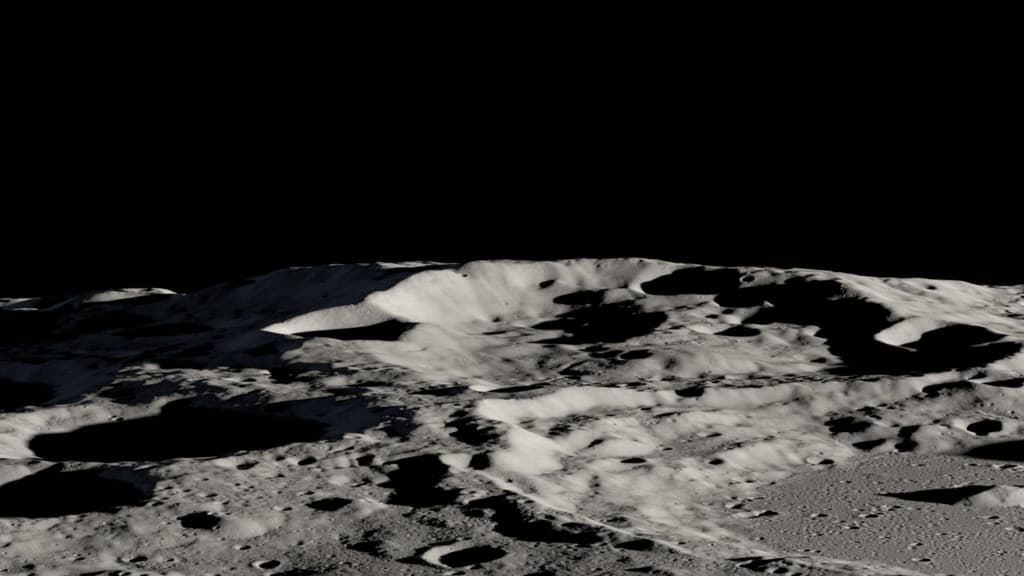
Mons Mouton, the flat-topped mountain near Nobile crater at the lunar south pole; the VIPER-era site region, with no specific point published (as of September 2026)↗
Lander
About 4.5 m wide and 2.0 m tall, 625 kg payload capacity to the surface, seven main engines, four attitude-thruster clusters, 100 m landing accuracy target↗
Primary payload
Astrolab's FLIP rover, 500 kg, announced February 5, 2025; matures tires, batteries, avionics and software for Astrolab's larger FLEX vehicle↗
NASA instruments on FLIP
Five NASA payloads by NASA's own August 2026 count, among them the METAL multicolor camera and radiometer, a laser retroreflector array, a lunar dust sensor, and a lidar demonstration for 3D surface mapping; the sources that give the count do not name the fifth↗
Full manifest
10 payloads from six countries, including BEACON (CubeRover autonomy demo with Canada's Mission Control), ESA's LandCam-X landing camera, and a Nanofiche nickel micro-archive↗
CLPS task order
$199.5 million awarded June 11, 2020 (TO 20A) to deliver NASA's VIPER rover to the lunar south pole↗
VIPER removed
July 17, 2024: NASA ended the VIPER project over cost growth; Griffin-1 continued under its contract as a flight demonstration of the lander and its engines, with NASA retaining the task order (about $323 million by then)↗
VIPER's second life
September 19, 2025: NASA awarded Blue Origin a task order with a total potential value of $190 million to deliver VIPER on a Blue Moon MK1 lander, targeted for late 2027 (as of that announcement)↗
Moon Base II designation
May 26, 2026: NASA renamed its first three upcoming CLPS-lineage landers Moon Base I (Blue Moon MK1 Endurance), II (Griffin-1) and III (IM-3 Trinity); Griffin-1 delivers more than 1,100 pounds of cargo↗
Ownership
Voyager Technologies' acquisition of Astrobotic, announced June 2, 2026, closed July 13, 2026 ($162 million in cash and stock, up to $129 million in earnouts, $9 million debt assumed); the company is now Voyager Lunar Systems, still led by John Thornton↗
Site: 84.6000°S, 31.0000°E · Targeted region: the Mons Mouton plateau near Nobile crater, lunar south pole (feature coordinates; a specific landing point had not been published as of Sep 2026) (source)
02Mission timeline
11 Jun 2020
CLPS task order awarded: $199.5 million to deliver NASA's VIPER rover to the lunar south pole
20 Sep 2021
VIPER landing zone announced: the mountainous area west of Nobile crater, officially named Mons Mouton in 2022
17 Jul 2024
VIPER pulled from Griffin: NASA ends the VIPER project; Griffin-1 continues as a flight demonstration of the lander and its engines
5 Feb 2025
FLIP named primary payload: Astrolab's 500 kg rover replaces the planned mass simulator
19 Sep 2025
VIPER reassigned to Blue Origin: task order with a total potential value of $190 million to deliver the rover on Blue Moon MK1, targeted late 2027
Oct 2025
Launch slips to mid-2026: target moves from late 2025 to NET July 2026
26 May 2026
Designated Moon Base II: NASA names its first three Moon Base lander missions
15 Jun 2026
Flight lander unveiled at the Moonshot Museum in Pittsburgh, then shipped to JPL for environmental testing
13 Jul 2026
Voyager acquisition closes: Astrobotic becomes Voyager Lunar Systems
Targeted NET Nov 2026
Launch, no earlier than November 2026, on Falcon Heavy from KSC LC-39A (as of Sep 2026)
NET late 2026
Landing attempt at the Mons Mouton area near Nobile crater, a few days after launch (as of Sep 2026)
Teal dots: events that physically happened in flight or on the Moon. Grey: announcements, namings, contracts, and targets.
03The mission
Griffin is the big sibling of Astrobotic's Peregrine, the lander lost to a propulsion failure hours after the first CLPS launch in January 2024. Where Peregrine was a roughly 100 kg-class delivery, Griffin is built to put 625 kg on the lunar surface from a deck about 4.5 m across and 2.0 m tall, descending on seven main engines with four clusters of attitude-control thrusters and a 100 m landing accuracy target. Coverage of the June 2026 unveiling described it as an infrastructure-class logistics vehicle, and NASA's own materials describe its primary cargo as the largest commercial payload ever sent to the lunar surface.
The mission's first life began on June 11, 2020, when NASA awarded Astrobotic a $199.5 million CLPS task order (TO 20A) to deliver the VIPER rover to the lunar south pole; the landing zone announced in September 2021 was the mountainous area west of Nobile crater, a flat-topped massif officially named Mons Mouton in 2022 (a naming NASA publicized in 2023). Added testing and slips grew the order to roughly $323 million, and then on July 17, 2024 NASA ended the VIPER project, judging that its cost growth threatened other CLPS missions. Rather than cancel the lander too, NASA kept the task order alive as a flight demonstration of Griffin and its engines, with a mass simulator initially penciled in where the rover would have ridden. VIPER itself was rescued later: on September 19, 2025 NASA awarded Blue Origin a task order with a total potential value of $190 million to deliver the rover on a Blue Moon MK1 lander, targeted for late 2027 (as of that announcement).
The manifest that replaced VIPER is commercial and international: 10 payloads from six countries. The headliner, announced February 5, 2025, is Astrolab's FLIP (FLEX Lunar Innovation Platform), a 500 kg rover that matures the tires, batteries, avionics and software of Astrolab's larger FLEX vehicle and carries five NASA payloads by NASA's own August 2026 count, among them the METAL multicolor camera and radiometer, a laser retroreflector array, a lunar dust sensor, and a lidar demonstration for high-resolution 3D surface mapping. NASA frames the delivery as maturing mobility systems that inform future Lunar Terrain Vehicle operations. Alongside FLIP ride BEACON, a CubeRover autonomy demonstration flown with Canada's Mission Control, ESA's LandCam-X landing camera, a Nanofiche nickel micro-archive, and smaller commercial and cultural payloads, including a plaque carrying messages from Japanese children, that round out the six nations represented.
The mission also picked up a new name. On May 26, 2026, NASA folded its next CLPS deliveries into a Moon Base program line and designated the first three flights Moon Base I (Blue Origin's Blue Moon MK1 Endurance), Moon Base II (Griffin-1) and Moon Base III (Intuitive Machines' IM-3 Trinity). Griffin-1 will take several days to reach the Moon after launch and then descend autonomously to the Mons Mouton area near Nobile crater, the same south-polar high ground picked for VIPER. No mission has yet soft-landed a payload of this class on the Moon commercially, and the descent itself remains the step every predecessor in this class has found hardest.
The company changed hands during final assembly. Voyager Technologies announced its acquisition of Astrobotic on June 2, 2026 and closed it on July 13, 2026, paying $162 million in cash and stock with up to $129 million in earnouts and $9 million of assumed debt; Astrobotic became Voyager Lunar Systems, still led by John Thornton and still headquartered in Pittsburgh. The order book grew in parallel: on June 30, 2026 NASA awarded the company approximately $298 million for two Peregrine-class deliveries to the Gruithuisen Domes, each targeted to launch in 2028 (as of June 30, 2026). Griffin-1 itself left Pittsburgh for environmental testing at JPL in late June 2026, returns for final integration, then heads to Kennedy Space Center, where FLIP will be installed and the stack mated to its SpaceX Falcon Heavy at LC-39A for a launch targeted no earlier than November 2026 (as of September 2026).
04In pictures
Tap a photo to enlarge.
05Sources
- Astrobotic/Voyager Lunar Systems: acquisition closed, $298M award, Griffin-1 NET November 2026 (Jul 13, 2026)
- SpaceNews: Voyager completes acquisition of Astrobotic (Jul 13, 2026)
- SpacePolicyOnline: Astrobotic unveils Griffin 'Moon Base II' lander (Jun 15, 2026)
- NASA: Moon Base rovers, landers, missions update and renaming (May 26, 2026)
- NASA: Astrobotic's Griffin-1 image gallery (mission description, Mons Mouton target)
- NASA: VIPER project ended, Griffin continues (Jul 17, 2024)
- SpacePolicyOnline: NASA details to Congress on VIPER decision (confirms $323M Task Order 20A retained)
- NASA: Blue Origin selected to deliver VIPER (Sep 19, 2025)
- NASA: Astrobotic selected to fly VIPER, $199.5M (Jun 11, 2020)
- Astrobotic: Astrolab's FLIP rover joins Griffin-1 (Feb 5, 2025)
- Spaceflight Now: Griffin-1 delayed to NET July 2026 (Oct 28, 2025; contract value history)
- SatNews: unveiling detail, 10 payloads from six nations (Jun 16, 2026)
- Astrobotic: Griffin lander specifications
- Astrobotic: two NASA Moon Base task orders, ~$298M (Jun 30, 2026)
- RocketLaunch.Live: Griffin Mission 1, targeted November 2026
- Voyager Technologies: Meet Voyager's Lunar Missions, Griffin-1 four of five JPL acceptance tests complete, thermal vacuum next (Sep 2, 2026)
- NASA: Moon Base cargo landers and tech demonstrations update, Griffin-1 at JPL and five NASA payloads on FLIP (Aug 4, 2026)
- Aerospace America: NASA's Moon Base program manager on Griffin-1, on track to launch no earlier than November 2026 (Sep 15, 2026)
azmth is independent and is not affiliated with or endorsed by NASA, CNSA, Roscosmos, ISRO, JAXA, or any other space agency or company named on this page.