Chang'e 5
CNSA (China) · Sample return · 2020Success

Returned 1,731 g from Oceanus Procellarum on Dec 16, 2020; orbiter flew on and was still operating in lunar distant retrograde orbit per April 2025 reporting.
TL;DR· 7 min read
Chang'e 5 returned 1,731 g from northern Oceanus Procellarum on 16 December 2020, the first lunar samples anyone had brought home since Luna 24 in 1976, and it did so with the first robotic rendezvous and docking ever performed in lunar orbit. The basalts dated to about 2.0 billion years, roughly a billion years younger than any Apollo or Luna sample. The orbiter flew on and was still in a lunar distant retrograde orbit as of April 2025 reporting.
Chang'e 5 made China the third nation to return Moon samples, and it did so with the first robotic rendezvous and docking ever performed in lunar orbit. Its 1,731 grams from northern Oceanus Procellarum were the first lunar samples since Luna 24 in 1976, and they rewrote the volcanic timeline: basalts radiometrically dated to 2.0 billion years, roughly a billion years younger than anything Apollo or Luna brought home. Contrary to the common assumption that the mission ended in December 2020, its orbiter is still flying: it visited Sun-Earth L1 and became the first spacecraft ever to enter a lunar distant retrograde orbit.
Facts as of July 20, 2026, from the sources listed below.
1,731g
of lunar samples returned, the first since 1976
2.0Ga
age of the returned basalts, about a billion years younger than any Apollo or Luna sample
44years
between Luna 24 (August 1976) and Chang'e 5's sample return
23days
from launch to capsule touchdown in Inner Mongolia
Commonly wrong. Three stale claims persist in English coverage. (1) The claim 'the mission ended in December 2020': only the sample phase did. The orbiter flew on to Sun-Earth L1 (March 2021), then in February 2022 became the first spacecraft in history to enter a lunar distant retrograde orbit, where April 2025 reporting still placed it. (2) The 4 March 2022 Moon impact was widely reported as a SpaceX Falcon 9 stage from the DSCOVR launch; trajectory analyses and LROC's double-crater imagery instead identified it as the Long March 3C upper stage from Chang'e 5-T1 (2014), and US Space Command stated that stage never reentered Earth's atmosphere, though China officially disputes the identification. (3) The figure 'about 2 kg of samples': 2 kg was the design target; the official returned mass is 1,731 g. Bonus nuance: the site is usually glossed as 'Mons Rümker', but the lander sat on the young mare basalts of northern Oceanus Procellarum near Rümker, at the IAU-named Statio Tianchuan (43.0576 N, 51.9161 W per LROC).
01Mission facts
Launch
23 November 2020, 20:30 UTC, Long March 5 (Y5) from Wenchang Space Launch Site, Hainan↗
Lunar orbit insertion
28 November 2020, 14:58 UTC↗
Lunar landing
1 December 2020, 15:11 UTC, northern Oceanus Procellarum↗
Landing coordinates (LROC-computed)
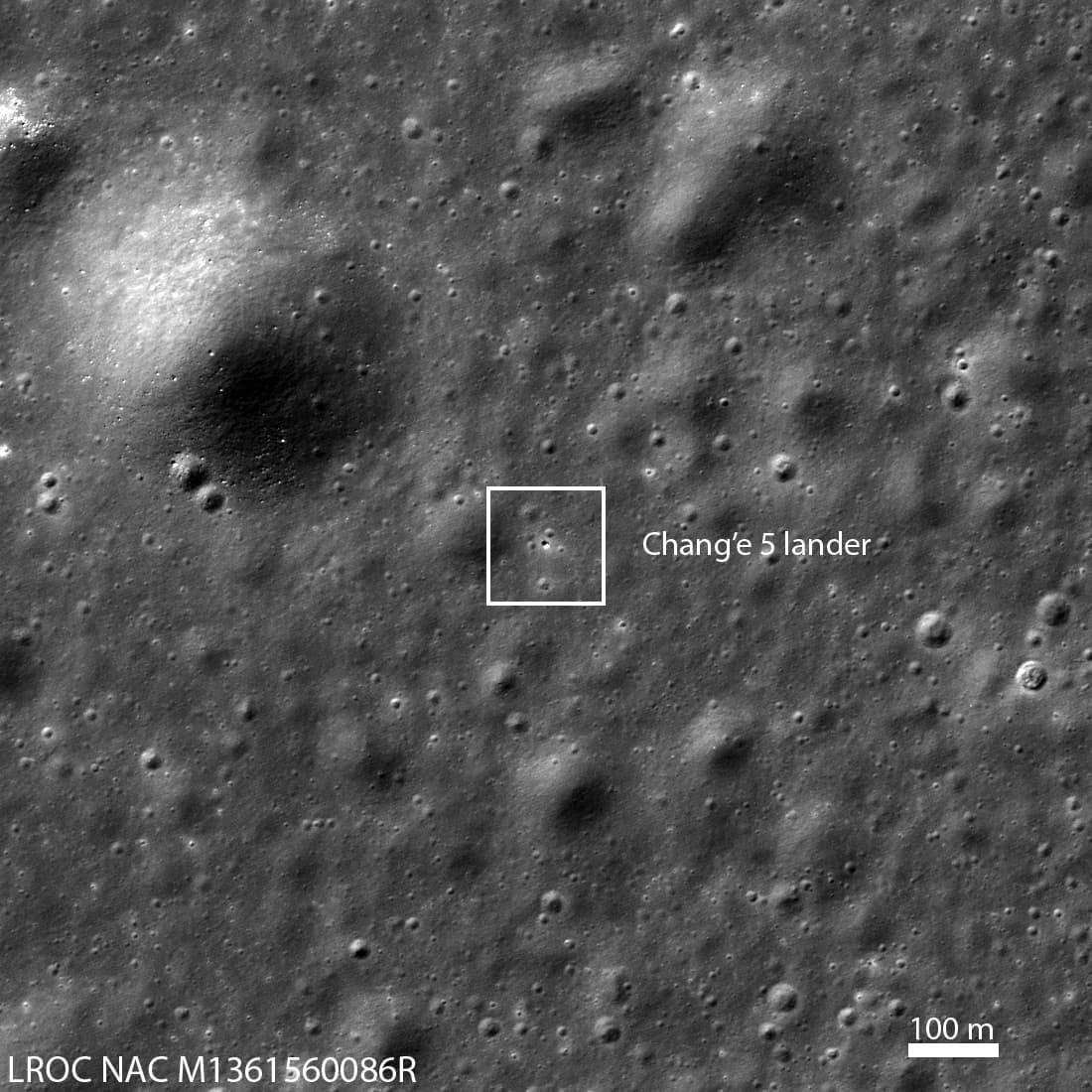
43.0576 N, 308.0839 E (51.9161 W), elevation -2,570 m, accuracy ±20 m; LRO imaged the lander on 2 December 2020, the day after touchdown (NAC M1361560086R)↗
Site name
Statio Tianchuan, one of eight Chinese names near the site approved by the IAU Working Group for Planetary System Nomenclature in May 2021 (Tianchuan is a Chinese constellation, a ship sailing the Milky Way)↗
Sample mass
1,731 g (scooped surface material plus a drill core), against a 2 kg target; first lunar samples returned to Earth since Luna 24 in August 1976↗
Flag deployment
First deployed (free-standing) Chinese national flag on the Moon: a 12 g composite-fabric flag rated for ±150 C swings↗
Ascent and docking
Ascender lifted off from the Moon 3 December 2020, 15:10 UTC (China's first launch from another world), then performed the first robotic rendezvous and docking in lunar orbit, 5 December 2020, 21:42 UTC↗
Ascender disposal
Deorbited 7 December 2020 UTC (8 December Beijing time), impacting the Moon near 30 S, 0 E↗
Capsule return
Ballistic skip reentry; landed 16 December 2020, 17:59 UTC (1:59 am 17 December Beijing time) in Siziwang Banner, Inner Mongolia↗
Youngest dated lunar basalts
2,030 ± 4 million years (Pb-Pb, Li et al., Nature 600, 2021; independent Science study found 1.96 to 2.01 Ga), extending known mare volcanism by roughly 800 to 900 million years beyond Apollo and Luna samples↗
First in-situ water detection on the lunar surface
Lander's mineralogical spectrometer measured up to 120 ppm water (OH + H2O) in regolith and ~180 ppm in a nearby rock, published in Science Advances 7 January 2022↗
New minerals from the samples
Changesite-(Y), announced 9 September 2022 (IMA 2022-023, sixth lunar mineral overall); Magnesiochangesite-(Y) and Changesite-(Ce), announced 24 April 2026 in Chengdu, the seventh and eighth lunar minerals found in returned samples, all merrillite-group phosphates↗
Orbiter extended mission
Arrived at Sun-Earth L1 on 15 March 2021 (a first for China), lunar flyby 9 September 2021, then entered a lunar distant retrograde orbit in February 2022, the first spacecraft in history to use that orbit; April 2025 reporting still placed it in DRO↗
International sample loans
On 24 April 2025 CNSA approved loans to seven institutions in six countries (US, Japan, Germany, France, UK, Pakistan), including NASA-funded Brown University and Stony Brook University under a Wolf Amendment carve-out↗
Precursor: Chang'e 5-T1 (2014)
Launched 23 October 2014, 18:00 UTC on a Long March 3C; its Xiaofei capsule validated the high-speed skip reentry, landing 31 October 2014 in Siziwang Banner; carried the 4M Manfred Memorial Moon Mission, the first commercial payload sent around the Moon; the service module entered lunar orbit 13 January 2015 and rehearsed Chang'e 5 rendezvous geometry↗
Chang'e 5-T1 booster impact
A rocket body struck the lunar far side on 4 March 2022, leaving an unusual double crater (18 m and 16 m, ~28 m across) at 5.226 N, 234.486 E near Hertzsprung basin; independent trajectory analyses identified it as the Chang'e 5-T1 Long March 3C upper stage, which China disputes↗
Site: 43.0576°N, 51.9161°W · Statio Tianchuan, northern Oceanus Procellarum (source)
02Mission timeline
23 Oct 2014
Chang'e 5-T1 precursor launches; its Xiaofei capsule proves the lunar-velocity skip reentry on 31 October
23 Nov 2020
Launch at 20:30 UTC on a Long March 5 from Wenchang
28 Nov 2020
Lunar orbit insertion, 14:58 UTC
1 Dec 2020
Touchdown in northern Oceanus Procellarum at 15:11 UTC
2 Dec 2020
NASA's LRO images the lander from orbit; LROC team fixes the site at 43.0576 N, 308.0839 E
3 Dec 2020
Ascender lifts off with the samples at 15:10 UTC, China's first launch from another world
5 Dec 2020
First-ever robotic rendezvous and docking in lunar orbit, 21:42 UTC; sample container transferred to the returner
7 Dec 2020
Ascender deorbited; impacts the Moon near 30 S, 0 E
16 Dec 2020
Capsule skip-reenters and lands in Siziwang Banner, Inner Mongolia at 17:59 UTC with 1,731 g of the Moon
15 Mar 2021
Orbiter arrives at Sun-Earth L1 for extended operations, a Chinese first
May 2021
IAU approves Statio Tianchuan and seven other Chinese feature names around the site
Oct 2021
Nature and Science papers date the basalts at ~2.0 billion years, the youngest lunar volcanism then known from samples
7 Jan 2022
First in-situ detection of water on the lunar surface published from lander spectrometer data (up to 120 ppm)
Feb 2022
Orbiter becomes the first spacecraft in history to enter a lunar distant retrograde orbit
4 Mar 2022
The Chang'e 5-T1 booster (per independent analyses; China disputes) impacts the far side, leaving a double crater near Hertzsprung
9 Sep 2022
Changesite-(Y) announced, the first new lunar mineral discovered by China and sixth overall
24 Apr 2025
CNSA approves sample loans to seven institutions in six countries, including NASA-funded Brown and Stony Brook
24 Apr 2026
Two more new minerals announced from the samples, Magnesiochangesite-(Y) and Changesite-(Ce), the seventh and eighth lunar minerals worldwide
Teal dots: events that physically happened in flight or on the Moon. Grey: announcements, namings, contracts, and targets.
03The mission
Chang'e 5 was the 'hui' (return) capstone of China's orbit-land-return lunar program, and it compressed an Apollo-like mission profile into 23 robotic days. A four-module stack (orbiter, returner, lander, ascender) totaling about 8.2 tonnes launched on a Long March 5 from Wenchang on 23 November 2020 at 20:30 UTC. The lander came down on 1 December at 15:11 UTC on the young mare basalts of northern Oceanus Procellarum. NASA's Lunar Reconnaissance Orbiter photographed it the very next day, and the LROC team fixed the site at 43.0576 N, 308.0839 E, within 20 meters. In May 2021 the IAU named the spot Statio Tianchuan, joining Apollo 11's Statio Tranquillitatis and Chang'e 4's Statio Tianhe in the short list of named landing 'stations'.
The surface phase lasted just under 48 hours: a robotic scoop and a drill core, a deployed 12 gram fabric flag (China's first free-standing flag on the Moon), and then the mission's boldest step. On 3 December the ascender lifted off from the lander's back, and on 5 December at 21:42 UTC it executed the first robotic rendezvous and docking ever performed in lunar orbit, transferring the sample container to the returner. The spent ascender was deliberately crashed near 30 S, 0 E. On 16 December at 17:59 UTC the capsule skip-reentered over Earth and landed in the Inner Mongolian grassland at Siziwang Banner with 1,731 grams of the Moon, the first samples returned by anyone in 44 years.
The science exceeded the mass. Pb-Pb dating published in Nature in 2021 put the basalts at 2,030 ± 4 million years, the youngest radiometrically dated lunar volcanic rocks, stretching the Moon's known volcanic life by 800 to 900 million years, and follow-up work showed the source mantle was surprisingly dry and not KREEP-fed. The lander's spectrometer also made the first in-situ detection of water on the lunar surface, up to 120 ppm in the regolith. The samples have yielded three new minerals: Changesite-(Y), announced 9 September 2022, then Magnesiochangesite-(Y) and Changesite-(Ce), announced 24 April 2026 in Chengdu, the seventh and eighth minerals ever discovered on the Moon in returned samples. In April 2025 CNSA opened the collection to the world, approving loans to seven institutions in six countries, including NASA-funded Brown University and Stony Brook University under a congressional Wolf Amendment carve-out.
The orbiter never stopped flying. After releasing the capsule it headed for Sun-Earth L1, arriving 15 March 2021 as China's first spacecraft there, swung past the Moon on 9 September 2021, and in February 2022 became the first spacecraft in history to enter a lunar distant retrograde orbit, the stable regime China has since built into its DRO-A/B/L communications constellation. Its trajectory was reconstructed largely by amateur radio trackers, since CNSA rarely comments; as of April 2025 reporting it remained in DRO with generous propellant reserves.
The whole architecture was rehearsed six years earlier by Chang'e 5-T1, launched 23 October 2014, whose Xiaofei capsule proved the 11 km/s skip reentry on 31 October 2014, and whose service module rehearsed the lunar-orbit rendezvous geometry in early 2015. That rehearsal produced a strange coda: the Long March 3C upper stage from the 2014 launch is the leading identification for the object that hit the lunar far side on 4 March 2022, leaving a curious double crater near Hertzsprung basin at 5.226 N, 234.486 E, first misattributed worldwide to a SpaceX Falcon 9 stage. China disputes the identification; the crater is there either way, and LRO has photographed it.
04In pictures
Tap a photo to enlarge.
05Sources
- LROC Featured Image: First Look, Chang'e 5 (landing site coordinates)
- LROC Featured Image: Chang'e 5, After Blast Off
- CNSA (English): Chang'e 5 reentry capsule lands with moon samples
- CNSA (English): Chinese scientists discover two new lunar minerals (24 April 2026)
- SpaceNews: China to lend Chang'e-5 moon samples to U.S. universities (24 April 2025)
- SpaceNews: Chang'e-5 orbiter embarks on extended mission to Sun-Earth Lagrange point
- China in Space: DRO communications network (CE-5 orbiter status, April 2025)
- Nature (Li et al. 2021): Two-billion-year-old volcanism on the Moon from Chang'e-5 basalts
- Science Advances (Lin et al. 2022): In situ detection of water on the Moon by the Chang'E-5 lander
- Nature (Tian et al. 2021): Non-KREEP origin for Chang'e-5 basalts
- NASA: LRO spots rocket impact site on Moon (double crater, coordinates)
- Space.com: Rocket that hit the Moon confirmed as Chinese Long March 3C stage
- CGTN: 8 Chinese names approved for Moon features (Statio Tianchuan)
- Wikipedia: Chang'e 5 (mission timeline, UTC times)
- Wikipedia: Chang'e 5-T1 (precursor mission)
azmth is independent and is not affiliated with or endorsed by NASA, CNSA, Roscosmos, ISRO, JAXA, or any other space agency or company named on this page.