Hiten (MUSES-A)
ISAS (Japan) · Orbiter · 1990Success
Deliberately impacted the Moon between Stevinus and Furnerius Apr 10, 1993 (Apr 11 JST); Uesugi 1996 records two impact solutions, 18:03:25.7 UT at 34.0 S, 55.3 E and 18:08:45 UT at 34.3 S, 55.6 E. Hagoromo's lunar orbit was never confirmed.
TL;DR· 8 min read
Hiten ended the longest gap the Moon has had between visitors: no nation had launched a lunar probe since Luna 24 in 1976 when Japan's 197 kg ISAS testbed left Earth on January 24, 1990. It flew the first aerobraking passes by a deep-space probe in March 1991, then reached the Moon on the first low-energy ballistic transfer, captured on October 2, 1991 with no delta-V. Its 12 kg Hagoromo orbiter had gone silent before release, and Hiten was deliberately impacted on April 10, 1993.
Hiten is the mission that broke the silence: when the 197 kg ISAS engineering testbed left Earth in January 1990, no nation had launched a lunar probe since Luna 24 in 1976, and Japan became the third country ever to reach the Moon. English memory files it, when it files it at all, as an obscure technology demo that lost its little Hagoromo orbiter. The record shows something bigger: the first spacecraft to reach the Moon on a low-energy ballistic transfer, the trajectory family that Belbruno and Miller invented to rescue this exact mission, plus the first aerobraking passes flown by a deep-space probe, two years before Magellan's celebrated campaign at Venus.
Facts as of July 20, 2026, from the sources listed below.
1976
the last time any nation had launched a lunar probe (Luna 24) when Hiten flew in 1990
0m/s
capture burn required at arrival on the first low-energy ballistic lunar transfer
125.5km
altitude of the first aerobrake pass through Earth's upper atmosphere, March 19, 1991
10
lunar gravity-assist swingbys before the eleventh encounter became orbit insertion
Commonly wrong. Four recurring problems in English coverage. (1) The impact numbers are usually a mix-and-match: Uesugi's 1996 results paper gives two distinct end-of-mission solutions, 18:03:25.7 UT at 34.0 S, 55.3 E and 18:08:45 UT at 34.3 S, 55.6 E (NSSDCA lists both; JAXA's DARTS archive uses the second; Siddiqi's Beyond Earth uses the first), while Wikipedia and most articles pair the first solution's clock time with the second solution's coordinates. (2) Hagoromo's fate is overstated in both directions. ISAS's English page still says it was 'put into orbit around the Moon' and Siddiqi credits it with making Japan the third nation to orbit the Moon, but the retrorocket burn was only observed from the ground and NSSDCA is explicit that the estimated orbit was never confirmed, so lunar orbit, lunar impact and heliocentric escape all remain possible; conversely, 'communication was lost shortly after release' understates the failure, since the transmitter died on February 21, 1990, weeks before release. (3) 'Hiten crashed into Furnerius.' Both published solutions put the impact in the terrain northwest of Furnerius, between Stevinus and Furnerius; even ISAS's English page compresses this to hitting 'the Furnerius Crater.' (4) Aerobraking is routinely dated to Magellan's 1993 campaign at Venus; Hiten flew aerobrake passes in March 1991, two years earlier, and NASA's Hiten page calls them the first aerobraking maneuver by a deep-space probe (Magellan's was the first at another planet).
01Mission facts
Launch
January 24, 1990, 11:46:00 UT (20:46 JST), on M-3SII no. 5 from Kagoshima Space Center (now Uchinoura)↗
Firsts
First Japanese lunar mission and the first robotic lunar probe by any nation since the Soviet Luna 24 in 1976↗
Third nation
The mission included Japan's first lunar flyby, lunar orbiter and lunar surface impact, making Japan only the third nation to achieve each↗
Spacecraft
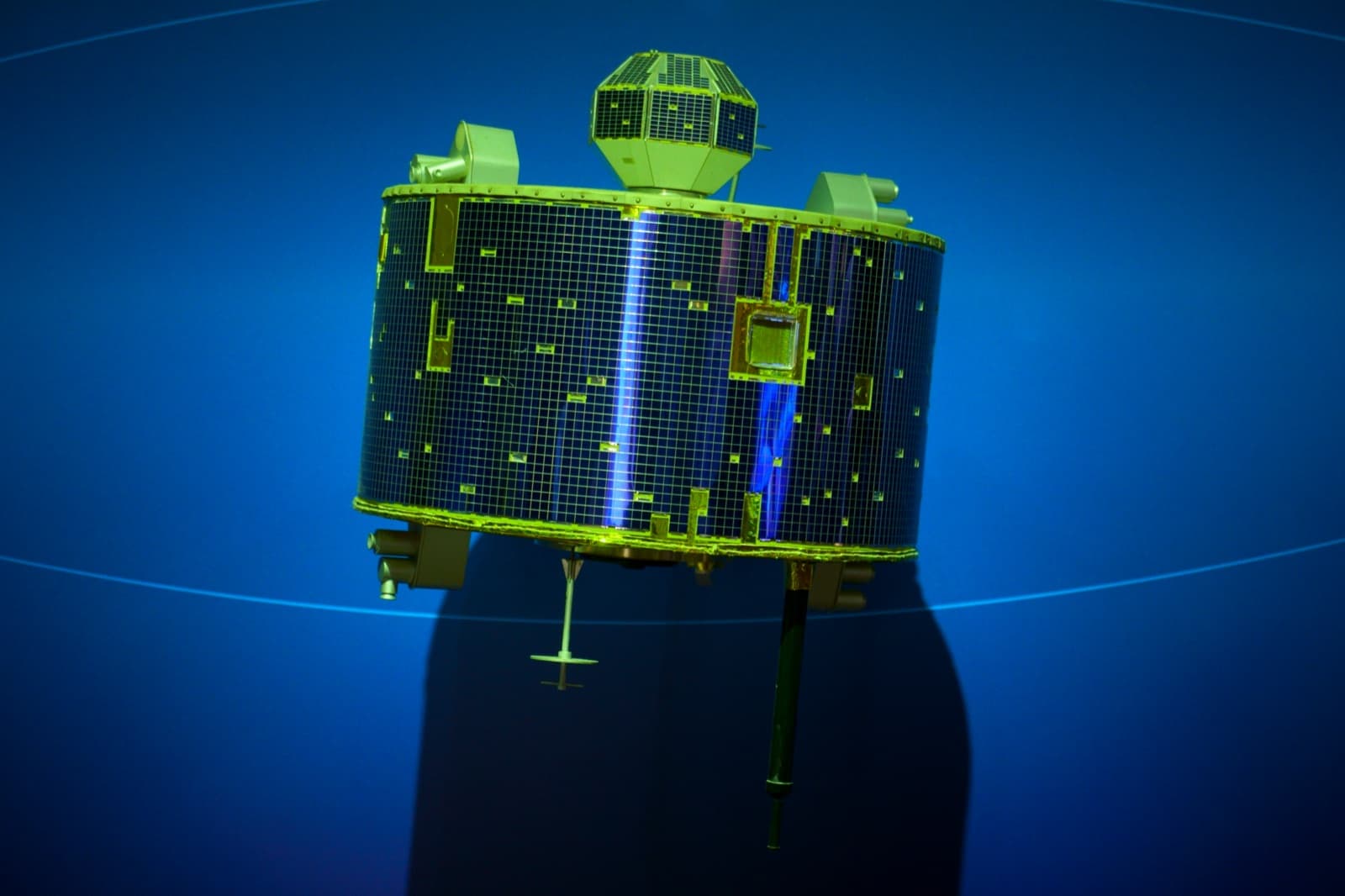
Spin-stabilized cylinder 1.4 m across and 0.8 m high; 197 kg fully fueled, including 42 kg of hydrazine and the 12 kg Hagoromo mounted on top↗
Launch shortfall
Injection came in 50 m/s slow, leaving apogee at 290,000 km against a planned 476,000 km; correction maneuvers restored the nominal orbit↗
Hagoromo
12 kg, 26-faced polyhedral orbiter released at 19:37 UT on March 18, 1990; its retrorocket ignition was confirmed by ground observation at 20:04:03 UT, but the estimated 7,400 x 20,000 km lunar orbit was never confirmed because the S-band transmitter had failed on February 21, 1990↗
Aerobraking
March 19, 1991: through Earth's upper atmosphere at 125.5 km over the Pacific at 11.0 km/s, shedding 1.712 m/s and 8,665 km of apogee; second pass March 30 at 120 km. NASA calls it the first aerobraking maneuver by a deep-space probe↗
Low-energy transfer
First spacecraft to transfer to the Moon on a low-energy (weak stability boundary) trajectory, constructed by Edward Belbruno and James Miller of JPL after Hagoromo's failure; per NSSDCA it was also the first lunar transfer requiring no delta-V for capture↗
Transfer apogee
A ninth lunar swingby raised apogee to 1,532,000 km for the ballistic transfer; temporary lunar capture followed on October 2, 1991↗
Science payload
One instrument: the Munich Dust Counter, built jointly with Germany; during looping passes through the Earth-Moon L4 and L5 points it found no obvious dust increase over background↗
Lunar orbit insertion
February 15, 1992, 13:33 UT: a roughly ten-minute burn at a 422 km approach put Hiten into an initial 422 x 49,400 km lunar orbit, spending most of its remaining fuel↗
Impact
April 10, 1993, between Stevinus and Furnerius on the southeastern near side; JAXA's DARTS archive records telemetry ceasing at 18:08:45 UT with impact estimated at 34.3 S, 55.6 E↗
Site: 34.3000°S, 55.6000°E · Between Stevinus and Furnerius, southeastern near side (source)
02Mission timeline
24 Jan 1990
Launch at 11:46 UT (20:46 JST) on M-3SII no. 5 from Kagoshima Space Center; injection runs 50 m/s slow, leaving apogee at 290,000 km instead of 476,000 km
21 Feb 1990
Hagoromo's S-band transmitter fails, three and a half weeks before its release at the Moon
18 Mar 1990
First lunar flyby, 16,472.4 km at 20:04:09 UT (Mar 19 JST): the first Japanese spacecraft at the Moon and the first from any nation since 1976; Hagoromo released at 19:37 UT, its retrorocket burn seen from the ground but its orbit never confirmed
4 Mar 1991
Eighth lunar swingby closes out the double-swingby program, which also simulated the planned trajectory of the future Geotail spacecraft
19 Mar 1991
First aerobrake: Hiten skims the atmosphere at 125.5 km over the Pacific at 11.0 km/s, losing 1.712 m/s of velocity and 8,665 km of apogee
30 Mar 1991
Second aerobrake at 120 km trims 2.8 m/s and 14,000 km of apogee, completing the primary mission
25 Apr 1991
Hiten departs on the Belbruno-Miller weak stability boundary trajectory, apogee raised toward 1.53 million km by a ninth lunar swingby
2 Oct 1991
Ballistic capture at the Moon: the first arrival on a low-energy transfer, needing no capture burn
Late 1991 to early 1992
A looping orbit carries Hiten through the Earth-Moon L4 and L5 points; the Munich Dust Counter searches for trapped dust and finds no obvious increase over background
15 Feb 1992
Eleventh lunar encounter becomes orbit insertion: a roughly ten-minute burn at 13:33 UT, 422 km out, leaves Hiten in a 422 x 49,400 km lunar orbit
10 Apr 1993
The last fuel deorbits Hiten into the southeastern near side between Stevinus and Furnerius (Apr 11 JST); Uesugi 1996 records two impact solutions, 18:03:25.7 UT at 34.0 S, 55.3 E and 18:08:45 UT at 34.3 S, 55.6 E
Teal dots: events that physically happened in flight or on the Moon. Grey: announcements, namings, contracts, and targets.
03The mission
Hiten ended the longest gap the Moon has ever had between visitors. Between Luna 24's departure in August 1976 and January 24, 1990, not one spacecraft from any nation launched for the Moon; the drought ended at 11:46 UT that day, when ISAS, Japan's space science institute, lofted MUSES-A on an M-3SII solid rocket from Kagoshima Space Center. Renamed Hiten, for a flying, music-playing Buddhist celestial being, the 197 kg spin-stabilized drum was an engineering testbed rather than a science mission: its job was to master gravity-assist double lunar swingbys, test a fault-tolerant computer and packet telemetry, try optical navigation on a spinner, and demonstrate aerobraking. The start was rough. The injection burn ran 50 m/s slow, leaving apogee at 290,000 km instead of the planned 476,000 km, and trajectory correction maneuvers had to claw back the nominal orbit before the Moon work could begin.
Riding on top was Hagoromo, a 12 kg polyhedral grandchild satellite named for the celestial being's feathered robe, meant to become Japan's first lunar orbiter. Its S-band transmitter died on February 21, 1990, weeks before arrival, and ISAS released it anyway: at 19:37 UT on March 18, 1990, as Hiten swept toward its first lunar flyby, Hagoromo separated, and ground-based observation confirmed its retrorocket fired at 20:04:03 UT. Six seconds later Hiten made its own closest approach at 16,472.4 km, the first Japanese pass of the Moon and the first by any spacecraft in nearly fourteen years. A lunar orbit of roughly 7,400 x 20,000 km was estimated for Hagoromo but never confirmed; whether it circled the Moon, hit it, or escaped into solar orbit is unknown to this day.
The main spacecraft then worked through its syllabus. By March 4, 1991 it had flown eight lunar swingbys, along the way simulating the trajectory planned for the Geotail magnetospheric mission. On March 19, 1991 it dipped into Earth's upper atmosphere at 125.5 km over the Pacific at 11.0 km/s, deliberately trading 1.712 m/s of velocity and 8,665 km of apogee against atmospheric drag, and repeated the trick on March 30 at 120 km. NASA's mission page calls this the first aerobraking maneuver by a deep-space probe, and NSSDCA notes it was the first use of aerobraking to modify an orbit at close to escape velocity; Magellan's famous aerobraking campaign at Venus came two years later.
What turned a tidy engineering demo into orbital-mechanics history was the rescue of the lost orbiter's mission. With Hagoromo silent, ISAS wanted Hiten itself at the Moon, but the mother ship lacked the fuel for a conventional transfer. Edward Belbruno and James Miller of JPL constructed a new kind of route: a weak stability boundary transfer that lets solar gravity do most of the braking. In April 1991 a ninth lunar swingby stretched Hiten's apogee toward 1,532,000 km, and on October 2, 1991 the spacecraft arrived at the Moon ballistically, the first spacecraft ever to reach it on a low-energy transfer and, per NSSDCA, the first whose capture needed no delta-V at all. The price was time, months instead of days, which is exactly the trade modern missions still make. Hiten then looped through the Earth-Moon L4 and L5 Lagrange points hunting for trapped dust with its single science instrument, the German-built Munich Dust Counter, and found no obvious increase over background. On February 15, 1992, a ten-minute burn during its eleventh lunar encounter finally made Hiten a lunar orbiter, in a 422 x 49,400 km orbit that consumed most of the remaining fuel.
The orbit was unstable, and ISAS chose to end the mission on its own terms: on April 10, 1993 (April 11 in Japan) the last propellant steered Hiten into the southeastern near side between the craters Stevinus and Furnerius. Its afterlife has been outsized. JPL's own trajectory-design literature treats Hiten as the founding flight of the low-energy lunar transfer, the technique NASA's ARTEMIS spacecraft and the GRAIL gravity twins later flew, and the ballistic lunar transfers of recent small missions like CAPSTONE descend from the same mathematics. For Japan, the navigation and swingby craft learned on Hiten fed the deep-space program that led to Nozomi, Hayabusa and, in 2007, the Kaguya flagship that reopened lunar science; JAXA's own retrospective framing is that Hiten flew to learn the road to the Moon, and the road it found is the one budget missions still drive.
04In pictures
Tap a photo to enlarge.
05Sources
- NSSDCA master catalog: Hiten 1990-007A, Aug 15, 2025 Wayback snapshot (launch time, injection shortfall, spacecraft and Hagoromo details, aerobrake numbers, WSB firsts, L4/L5 search, orbit insertion, both Uesugi impact solutions; live NSSDCA redirected to nasa.gov/nssdc as of Jul 20, 2026)
- JAXA ISAS: HITEN spacecraft page (JST launch time, dimensions, ten swingby experiments, world-first optical navigation claim for a spin-stabilized satellite)
- DARTS at ISAS/JAXA: hiten mission page (objectives, Hagoromo 12 kg and 40 cm, telemetry loss 18:08:45 UT Apr 10, 1993, impact estimate 55.6 E, 34.3 S, Munich Dust Counter description)
- NASA Science: Hiten/Hagoromo mission page (first Japanese lunar mission, first robotic lunar probe since Luna 24, first aerobraking maneuver by a deep-space probe, Hagoromo orbit estimate, 11th flyby orbit insertion)
- Parker and Anderson, Low-Energy Lunar Trajectory Design, JPL Descanso Deep Space Communications and Navigation Series (Hiten as the first spacecraft to transfer to the Moon on a low-energy lunar transfer; Belbruno and Miller WSB construction; Hiten-ARTEMIS-GRAIL lineage)
- Siddiqi, Beyond Earth: A Chronicle of Deep Space Exploration 1958-2016, NASA SP-2018-4041 (masses, Geotail simulation, ten-minute insertion burn, 422 x 49,400 km orbit, MDC jointly built with Germany, impact solution 18:03:25.7 UT at 55.3 E / 34.0 S)
- Uesugi 1996, Results of the MUSES-A HITEN mission, Advances in Space Research 18(11) 69-72 (the mission results paper carrying both impact solutions)
- Uesugi et al. 1991, Japanese first double lunar swingby mission HITEN, Acta Astronautica 25(7) 347-355 (mission design of the double swingby program)
- Belbruno and Miller 1993, Sun-Perturbed Earth-to-Moon Transfers with Ballistic Capture, Journal of Guidance, Control, and Dynamics 16(4) 770-775 (the WSB transfer theory paper, with Hiten's October 2, 1991 arrival as demonstration)
- Krish, Belbruno and Hollister 1992, An investigation into critical aspects of a new form of low energy lunar transfer, the Belbruno-Miller trajectories, AIAA paper via NASA NTRS (Hiten entered the B-M trajectory April 25, 1991; delta-V savings of 150 to 222 m/s over Hohmann; months-long flight time)
- The Planetary Society: Hiten descent mosaic image page (optical navigation camera frames from the terminal plunge, processed by Ted Stryk)
- JAXA special feature: The Quest for New Adventure (Mizutani interview: Hiten as Japan's first Moon explorer, flown to learn navigation and gravity-assist technique, feeding later missions up to Kaguya)
- NASA: CAPSTONE mission page (modern ballistic lunar transfer lineage referenced in the closing body paragraph)
azmth is independent and is not affiliated with or endorsed by NASA, CNSA, Roscosmos, ISRO, JAXA, or any other space agency or company named on this page.