Luna 24
USSR · Sample return · 1976Success
Success: returned 170.1 g from Mare Crisium, 9 to 22 August 1976; the last Soviet lunar mission, and the last lunar samples anyone returned for 44 years.
TL;DR· 5 min read
Luna 24 returned 170.1 grams of Mare Crisium drill core on 22 August 1976, the last Soviet lunar mission and the last lunar samples anyone brought back for 44 years, until Chang'e 5 in December 2020. Its samples clashed with remote sensing of Mare Crisium for 35 years, until LROC showed in 2012 that the lander sat on the rim of a 64 m crater and drilled its excavated ejecta. A February 1978 Soviet paper had also reported about 0.1% water by mass in the core.
Luna 24 closed the first age of lunar exploration: when its capsule parachuted into western Siberia on 22 August 1976 with 170.1 grams of Mare Crisium core, nobody knew that no spacecraft would soft-land on the Moon again until 2013, or return samples until 2020. Its cargo hid two surprises. In 1978 Soviet scientists reported about 0.1% water by mass in the core, three decades before the West's celebrated lunar-water discoveries, and its samples stubbornly refused to match remote sensing of Mare Crisium until LRO images showed in 2012 that the lander had, by chance, sampled fresh ejecta on the rim of a 64-meter crater.
Facts as of July 20, 2026, from the sources listed below.
170.1g
of Mare Crisium drill core returned
0.1%
water by mass reported in the core in 1978, decades early
44years
until the next lunar samples (Chang'e 5, December 2020)
64m
crater whose rim ejecta Luna 24 unknowingly sampled
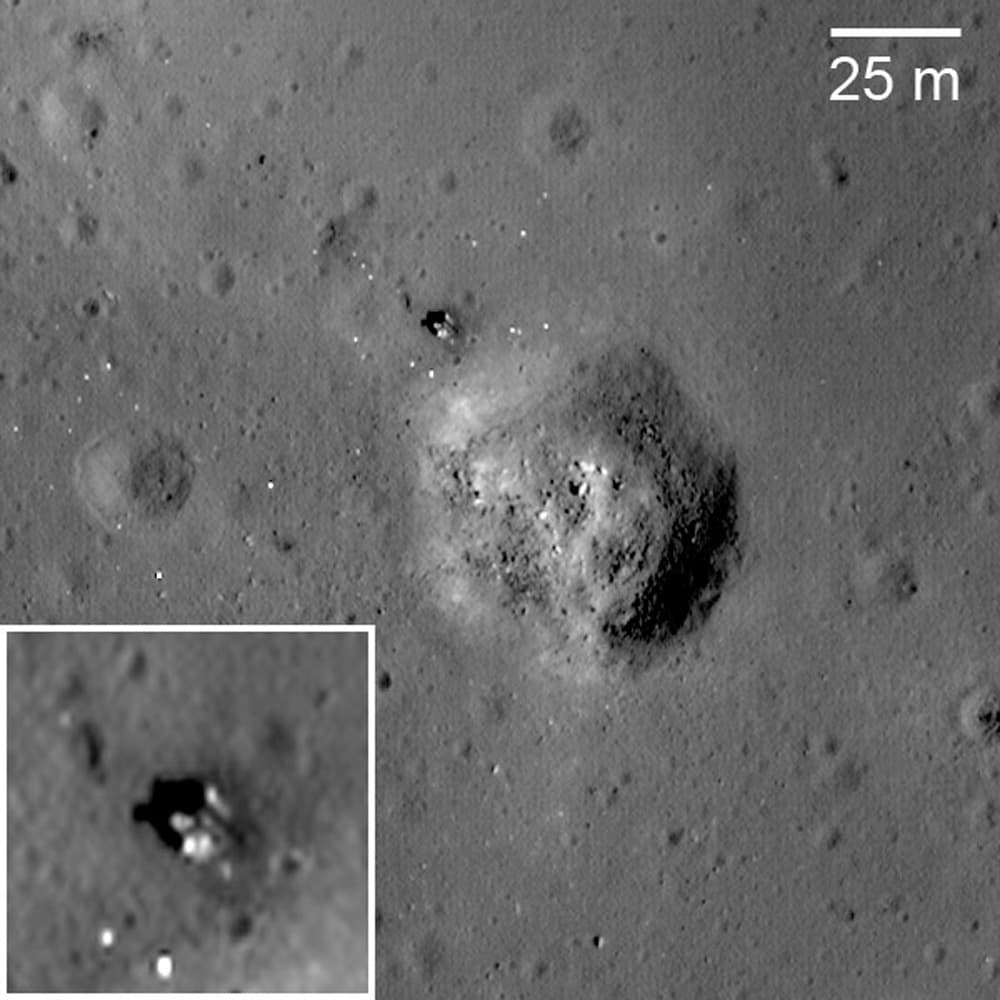
Commonly wrong. English accounts routinely date the discovery of lunar water to 2008-2009 (Chandrayaan-1's M3 and re-analysis of Apollo samples). A February 1978 Geokhimiya paper by Akhmanova, Dement'ev and Markov had already reported ~0.1% water by mass in the Luna 24 core via infrared spectroscopy, with water content apparently increasing with depth; it went essentially uncited in the West and was never independently confirmed (the authors themselves could not fully exclude terrestrial contamination), but it deserves a place in the story. Separately, the decades-old claim that Luna 24's samples "contradict" remote sensing of Mare Crisium has a mundane explanation: LROC showed in 2012 that the lander sampled 64 m crater-rim ejecta excavated from deeper, less space-weathered basalt flows, explaining the titanium and maturity mismatch.
01Mission facts
Launch
9 August 1976, Proton from Tyuratam (Baikonur Cosmodrome)↗
Lunar orbit
115 x 115 km at 120 degrees inclination↗
Landing
18 August 1976, Mare Crisium, at 12.7142 N, 62.2129 E (NSSDCA and the LROC 2016 coordinate update agree; LROC's superseded 2013 estimate of 12.7145 N still circulates)↗
The accidental sampling site
Landed on the northwest rim of a 64 m crater, ~2.3 km from Luna 23, and sampled its excavated ejecta rather than typical mare surface↗
Sample
170.1 grams collected by sample arm and drill and sealed in the return capsule↗
Analyzed depths
Laboratory studies used core material from depths of 118, 143 and 184 cm↗
Ascent and return
Capsule launched from the Moon 19 August 1976 at 05:25 UT; landed 22 August at 05:55 UT about 200 km southeast of Surgut, western Siberia↗
Water report
February 1978: Akhmanova, Dement'ev and Markov (Vernadsky Institute) report ~0.1% water by mass in the samples via 3-micron infrared absorption, in Geokhimiya↗
Luna 23 prequel
Luna 23 (November 1974) hit the surface too fast and fell on its side; LROC images published 16 March 2012 show the toppled lander 2.3 km from Luna 24↗
The long gap
Next lunar sample return: China's Chang'e 5, which landed its capsule 16 December 2020, 44 years later↗
The Russian sequel
Russia's next lunar landing attempt, Luna 25, crashed on 19 August 2023; NASA's LRO imaged its fresh crater↗
Site: 12.7142°N, 62.2129°E · Mare Crisium (Sea of Crises), on the rim of a 64 m crater, ~2.3 km from the failed Luna 23 (source)
02Mission timeline
9 Aug 1976
Launch on Proton from Tyuratam (Baikonur)
18 Aug 1976
Soft-lands in Mare Crisium, 2.3 km from the toppled Luna 23; drill collects 170.1 g of core
19 Aug 1976
05:25 UT: ascent stage launches the sample capsule off the Moon
22 Aug 1976
05:55 UT: capsule lands ~200 km SE of Surgut, western Siberia: the last Soviet lunar mission is complete
Feb 1978
Vernadsky Institute team reports ~0.1% water by mass in the Luna 24 core (Geokhimiya), largely unnoticed in the West
16 Mar 2012
LROC images solve the 35-year sample mismatch: Luna 24 sat on the rim of a 64 m crater and sampled its deep-dug ejecta
14 Dec 2013
Chang'e 3 makes the first lunar soft landing since Luna 24, 37 years later
16 Dec 2020
Chang'e 5 returns the first lunar samples since Luna 24, 44 years later
19 Aug 2023
Russia's Luna 25, the first Luna since 1976, crashes; LRO images the impact crater
Teal dots: events that physically happened in flight or on the Moon. Grey: announcements, namings, contracts, and targets.
03The mission
Nobody plans a finale, and the Soviet Union certainly did not intend Luna 24 to be one. Launched 9 August 1976, it was simply the third successful robotic sample return (after Luna 16 and Luna 20) and the second attempt to core Mare Crisium, where Luna 23 had come in too fast in November 1974 and toppled onto its side, unable to sample. Luna 24 landed on 18 August 1976 about 2.3 km from its dead twin, drilled a deep core, and sealed 170.1 grams into its return capsule.
The ascent stage left the Moon at 05:25 UT on 19 August, and on 22 August the capsule parachuted down about 200 km southeast of Surgut in western Siberia. With that, an era ended quietly: Luna 24 was the last spacecraft of the Luna program, the last Soviet lunar mission, and, as it turned out, the last soft landing on the Moon by anyone until China's Chang'e 3 in December 2013, and the last sample return until Chang'e 5 in December 2020.
The samples immediately caused a puzzle. Their titanium content and maturity did not match what remote sensing said Mare Crisium should look like, a discrepancy that hung over the mission for 35 years. LROC solved it in March 2012: precise images showed Luna 24 had landed on the northwest rim of a 64-meter crater, so its drill pulled up fresh ejecta excavated from deeper, older lava flows that had never been exposed to space weathering. The samples were right; the assumed sampling context was wrong.
The core held a second, stranger surprise. In February 1978, M. V. Akhmanova, B. V. Dement'ev and M. N. Markov of the Vernadsky Institute reported in Geokhimiya that infrared spectra of Luna 24 core material showed about 0.1% water by mass, seemingly increasing with depth in samples from 118, 143 and 184 cm down. They carefully hedged on terrestrial contamination, the result was never independently confirmed, and the West essentially never cited it. Thirty years later, when Chandrayaan-1 and reexamined Apollo samples made lunar water one of the biggest stories in planetary science, almost every account dated the discovery to 2008.
Luna 24's landing site has become a monument to unfinished business. Russia's attempt to resume the series, Luna 25, crashed into the Moon on 19 August 2023, 47 years almost to the day after Luna 24's landing, leaving the 1976 mission as the last fully successful Soviet or Russian lunar landing as of July 2026. On Mare Crisium, LRO's cameras keep watch over the strange pair: Luna 23 on its side, and a few kilometers away the descent stage of the spacecraft that finished the job and closed out an age.
04In pictures
Tap a photo to enlarge.
05Sources
- NSSDCA Master Catalog: Luna 24 (1976-081A)
- LROC Featured Image: Mare Crisium, Failure then Success (16 Mar 2012)
- LROC Coordinates of Robotic Spacecraft, 2013 update
- Akhmanova, Dement'ev and Markov, Water in the regolith of Mare Crisium (Luna 24)?, Geokhimiya, Feb 1978 (ADS)
- Crotts, Water on The Moon, I. Historical Overview (arXiv, 2012; Luna 24 depths and 1978 water report)
- Space.com: Chang'e 5 capsule lands with first new Moon samples in 44 years (16 Dec 2020)
- NASA: LRO observes crater likely from Luna 25 impact (Aug 2023)
- The Space Review: Water on the Moon (historical context for the 1978 report)
- LROC Spacecraft Related Coordinates, 2016 Update (Wagner et al. 2017; Luna 24 at 12.7142 N, 62.2129 E)
azmth is independent and is not affiliated with or endorsed by NASA, CNSA, Roscosmos, ISRO, JAXA, or any other space agency or company named on this page.