Luna 21 / Lunokhod 2
USSR · Rover · 1973Success
Success: landed in Le Monnier crater on 15 January 1973; Lunokhod 2 drove about 39 km over four lunar days, an off-world distance record that stood until 2014, and its French-built reflector is still ranged from Earth.
TL;DR· 6 min read
Luna 21 set Lunokhod 2 down in Le Monnier crater on 15 January 1973, and the rover drove roughly 39 km in under four lunar days, an off-world distance record that stood until Opportunity passed it on Mars in July 2014. It died on 9 May 1973 when its open lid brushed a crater wall and dumped insulating dust on the radiator, letting the interior climb to around 47 C. Its French reflector is still ranged from Earth, and in December 1993 the rover and its lander were auctioned to Richard Garriott for $68,500.
Lunokhod 2 was the second and last Soviet Moon rover, and in less than four lunar days it drove roughly 39 km across Le Monnier crater, a distance no machine matched on another world until NASA's Opportunity rover passed it on Mars in July 2014, 41 years later. It was not stopped by wear or by running out of Sun: on 9 May 1973 its open lid brushed a crater wall, dumped insulating dust onto the radiator, and the rover cooked itself. Two footnotes keep it in the news. Its reflector still answers lasers fired from Earth, and in December 1993 the derelict rover and its lander were legally auctioned to a private buyer, computer-games designer Richard Garriott, making a machine sitting on the Moon possibly the most distant object ever sold.
Facts as of July 20, 2026, from the sources listed below.
39km
driven over four lunar days (37 km official odometry, 39.16 km on the LROC remap)
4lunar days
operated before dust on the radiator overheated it
2014
year Opportunity on Mars finally broke its off-world driving record
$68,500
1993 Sotheby's price for the derelict rover and its lander
Commonly wrong. Two numbers get repeated wrong. (1) The traverse: the familiar "37 km" is the 1973 mission odometry, but the LROC-based cartography of Karachevtseva et al. (2017), which traced the actual tracks in orbiter images, measured 39.16 km. That mapped route, longer than the odometry, is the distance Opportunity had to beat in 2014. (2) The reflector: articles often lump Lunokhod 2 in with Lunokhod 1 as a "lost" or dead retroreflector. It was never lost. Its location was always known, it has been a laser-ranging target for decades, and although its green-light returns had faded (blamed on dust), the Grasse station recovered near-full efficiency using an infrared laser in 2015 to 2016. And the rover was not defeated by wear or by the lunar night: it was driving fine when a lid brushing a crater wall dusted its radiator and let it overheat.
01Mission facts
Launch
8 January 1973, 06:55:38 UTC, Proton-K/D from Baikonur Cosmodrome (Tyuratam)↗
Lunar orbit
12 January 1973, braked into a 90 x 100 km lunar orbit at 60 degrees inclination↗
Landing
15 January 1973, 23:35 UT, Le Monnier crater on the eastern edge of Mare Serenitatis, about 170 km north of the Apollo 17 site; Lunokhod 2 rolled down the ramps at 01:14 UT on 16 January↗
LROC-derived coordinates
Luna 21 lander at 26.005 N, 30.406 E; Lunokhod 2 final parking position at 25.830 N, 30.914 E↗
Rover
840 kg, about 170 cm long, 160 cm wide and 135 cm high, eight independently driven wheels, riding a hinged solar lid↗
Instruments
Three navigation TV cameras plus four panoramic telephotometers, a soil-mechanics penetrometer, RIFMA X-ray fluorescence spectrometer, magnetometer, astrophotometer, and a French-built laser corner-cube retroreflector↗
Data return
86 panoramas and more than 80,000 TV pictures, plus magnetometer and soil-mechanics measurements along the traverse↗
Traverse
37 km by the original mission odometry; the LROC-based cartography of Karachevtseva et al. (2017), tracing the tracks in NAC images, measured the full route at 39.16 km↗
Distance record
Held the off-world driving record until NASA's Opportunity rover passed 40 km on Mars on 27 July 2014↗
End of mission
9 May 1973: the open lid touched a crater wall and dumped dust onto the radiator; the internal temperature then climbed to about 47 C, contact was lost on 10 May, and TASS announced the mission over on 3 June 1973↗
Laser retroreflector
French corner-cube array; unlike Lunokhod 1 its position was never lost, and after decades of weak green returns the Grasse station recovered near-full efficiency in infrared in 2015 to 2016↗
Legal sale
December 1993: the Lavochkin Association sold the Luna 21 lander and Lunokhod 2 rover for $68,500 at a Sotheby's auction in New York; the buyer was Richard Garriott↗
Site: 26.0050°N, 30.4060°E · Le Monnier crater, eastern rim of Mare Serenitatis (Luna 21 lander, LROC-derived); Lunokhod 2 parked 25.830 N, 30.914 E (source)
02Mission timeline
8 Jan 1973
Launch on Proton-K from Baikonur
12 Jan 1973
Braked into a 90 x 100 km lunar orbit
15 Jan 1973
23:35 UT: Luna 21 soft-lands on the floor of Le Monnier crater
16 Jan 1973
01:14 UT: Lunokhod 2 rolls down the ramps and begins driving
9 May 1973
The open lid brushes a crater wall and dumps insulating dust onto the radiator
10 May 1973
Overheating found on the 503rd session, near 47 C inside; contact is lost
3 Jun 1973
TASS announces the mission is over after about four lunar days of driving
Dec 1993
Lavochkin sells the Luna 21 lander and Lunokhod 2 rover at Sotheby's to Richard Garriott for $68,500
13 Mar 2012
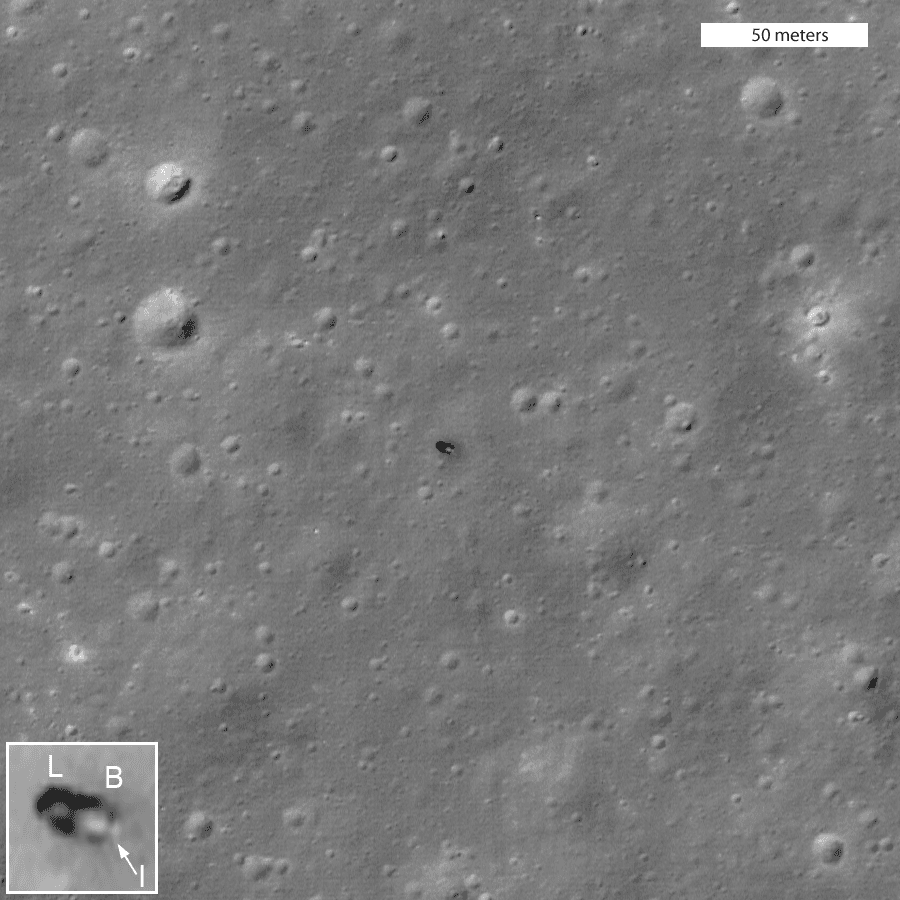
LROC images Lunokhod 2 parked with its lid open, tracks running north across Le Monnier
Jul 2014
Opportunity on Mars passes 40 km, ending Lunokhod 2's 41-year off-world driving record
2017
Karachevtseva et al. remap the full traverse from LROC images at 39.16 km, above the 37 km mission figure
Teal dots: events that physically happened in flight or on the Moon. Grey: announcements, namings, contracts, and targets.
03The mission
Two years after Lunokhod 1 opened the era of driving on another world, the Soviet Union sent its twin. Luna 21 braked into lunar orbit on 12 January 1973 and set down on 15 January inside Le Monnier crater, a lava-flooded bay on the eastern rim of the Sea of Serenity chosen to sample both mare plains and the ancient highland edge, about 170 km north of where Apollo 17's astronauts had worked a month earlier. Lunokhod 2 rolled down the ramps in the small hours of 16 January and started driving almost at once.
It was faster and better equipped than its predecessor. Improved cameras and a third, higher-mounted navigation camera let operators in Crimea drive it harder despite the same maddening light-lag, and in under four lunar days it covered far more ground than Lunokhod 1 had in eleven: 37 km by the mission's own odometry, returning 86 panoramas and more than 80,000 television pictures along with magnetometer, soil-mechanics and X-ray fluorescence data. That was an off-world driving record, and it held for 41 years.
The end was self-inflicted and quick. On 9 May 1973, working near a steep crater wall, the rover's open solar lid brushed the slope and picked up a load of loose regolith. When the lid was closed, that dust, an excellent insulator, fell onto the radiator that shed the vehicle's daytime heat. By the next session the interior had climbed to around 47 C, the rover was overheating, and contact was lost. TASS announced the mission over on 3 June. It had not worn out or run out of Sun: a machine that drove 39 km was killed by a smear of Moon dust.
Orbiters later corrected the record. When LRO photographed Le Monnier in 2012 it caught Lunokhod 2 parked with its lid still open and its tracks running north, and by tracing those tracks in the images Karachevtseva and colleagues remeasured the full route in 2017 at 39.16 km, longer than the 37 km logged on the surface. That larger figure is the one Opportunity actually had to beat when it took the off-world distance record on Mars in July 2014. The French corner-cube reflector on the rover, meanwhile, never went silent the way Lunokhod 1's did; its position stayed known, and after years of faint returns the Grasse station in France pulled near-full-strength signals back from it using an infrared laser in 2015 and 2016.
The strangest chapter came on Earth. In December 1993, the cash-strapped Lavochkin Association put the Luna 21 lander and Lunokhod 2 rover, still sitting in Le Monnier crater, up for auction at Sotheby's in New York, and computer-games designer Richard Garriott bought both for $68,500, complete with a deed of transfer. He argues he owns the hardware and, by extension, the ground it rests on. Space-law scholars disagree, pointing out that under the 1967 Outer Space Treaty no state could claim that lunar territory in the first place, so there was no ground to sell. Either way, a derelict robot on the Moon remains, on paper, private property.
04In pictures
Tap a photo to enlarge.
05Sources
- NSSDCA Master Catalog: Luna 21 / Lunokhod 2 (1973-001A)
- Wikipedia: Lunokhod 2
- Wikipedia: Luna 21
- LROC Featured Image: Lunokhod 2 Revisited (13 Mar 2012)
- LROC Featured Image: Trundling Across the Moon (Lunokhod 2 traverse, ~39 km)
- Karachevtseva et al. 2017, Cartography of the Luna-21 landing site and Lunokhod-2 traverse (Icarus)
- NASA JPL: Long-Lived Mars Opportunity Rover Sets Off-World Driving Record (2014)
- Smithsonian Air & Space: The Day a Soviet Moon Rover Refused to Stop (mission end)
- Courde et al. 2017, Lunar laser ranging in infrared at the Grasse laser station (A&A)
- Space.com: Who owns the Moon? One man's lunar claim (Garriott / Lunokhod 2)
- The Planetary Society: Trundling Across the Moon (Lunokhod 2 traverse)
azmth is independent and is not affiliated with or endorsed by NASA, CNSA, Roscosmos, ISRO, JAXA, or any other space agency or company named on this page.