Luna 20
USSR · Sample return · 1972Success
Success: returned about 55 g from the Apollonius highlands, 14 to 25 February 1972, the first sample of lunar highland soil brought back by a robot.
TL;DR· 5 min read
Luna 20 soft-landed in the Apollonius highlands on 21 February 1972 and drilled up about 55 g of soil, 50 to 60% of it ancient anorthosite: the first sample of the lunar highlands returned by a robot. The capsule parachuted into Kazakhstan on 25 February, two months before Apollo 16 reached Descartes, and portions were traded to NASA in the March 1973 sample exchange. It came down close to where Luna 18 had crashed five months earlier chasing the same rock.
Luna 20 is usually sold as the mission that returned the Moon's first highland sample, and that is not quite true: Apollo 14 (Fra Mauro) and Apollo 15 (the Apennine Front) had already carried home highland and anorthositic material in 1971. What Luna 20 actually did in February 1972 was land a robot in the rugged terra between two seas and drill up the first automated sample of the ancient anorthositic crust, two months before Apollo 16 landed at Descartes to study exactly that terrain. It landed almost on top of a grave: five months earlier, Luna 18 had crashed into the same highland border chasing the same rock.
Facts as of July 20, 2026, from the sources listed below.
~55g
of highland regolith returned (Vinogradov, 1972)
50-60%
anorthosite grains, the first robotic highland soil
2nd
robotic sample return in history, after Luna 16
11days
from Baikonur launch to sample capsule on Earth
Commonly wrong. The headline that Luna 20 returned "the first lunar highland sample" is an overstatement. Apollo 14 had already sampled the Fra Mauro formation and Apollo 15 the Apennine Front (including the anorthositic "Genesis Rock") in 1971. Luna 20's real firsts are narrower and still important: it was the first sample of the lunar highlands returned by a robotic spacecraft, and the first soil dominated (50 to 60%) by anorthosite, delivered two months before Apollo 16 landed at Descartes. Two smaller errors also recur. The returned mass is usually printed as 55 g (Vinogradov, 1972), but NSSDCA says 30 g and the Lunar Sample Compendium about 50 g, so the record offers a range and no settled number. And Luna 20 did not launch "days after" the failure of its predecessor: Luna 18 crashed on 11 September 1971, roughly five months before Luna 20 launched, at nearly the same highland site.
01Mission facts
Launch
14 February 1972, 03:27:58 UTC, Proton from Tyuratam (Baikonur Cosmodrome)↗
Lunar orbit insertion
18 February 1972, into an approximately 100 x 100 km orbit at 65 degrees inclination↗
Landing
21 February 1972, soft-landed in the Apollonius highlands near Mare Fecunditatis, about 120 km from where Luna 16 had landed↗
Landing coordinates
3.7863 N, 56.6242 E, as listed in the NSSDCA Master Catalog↗
Sample
About 55 g of loosely compacted highland soil collected by a 90 cm extendable drill arm (Vinogradov, 1972); NSSDCA states 30 g and the Lunar Sample Compendium about 50 g↗
Composition
50 to 60% of the rock particles were ancient anorthosite (feldspar-rich highland crust), unlike Luna 16's mare basalt with roughly 1 to 2% anorthosite↗
Ascent
22 February 1972, the 520 kg ascent stage fired its single-burn KRD-61 engine (one 53-second firing) for a direct ascent trajectory to Earth↗
Earth return
25 February 1972 at 19:19 UT, the capsule parachuted onto an island in the Karkingir River, about 40 km N of Dzhezkazgan, Kazakhstan↗
Spacecraft
Ye-8-5 bus, 3.96 m tall; 1,880 kg dry landed mass, 5,600 to 5,750 kg fueled at launch; return capsule 50 cm diameter, 39 kg↗
The failed predecessor
Luna 18 crashed into the same highland border on 11 September 1971 (signals ceased at impact in mountainous terrain), five months before Luna 20 landed nearby and succeeded↗
Sample exchange with NASA
March 1973: NASA traded 3 g each of Apollo 16 and Apollo 17 material for portions of the Luna 16 and Luna 20 samples↗
LROC imaging
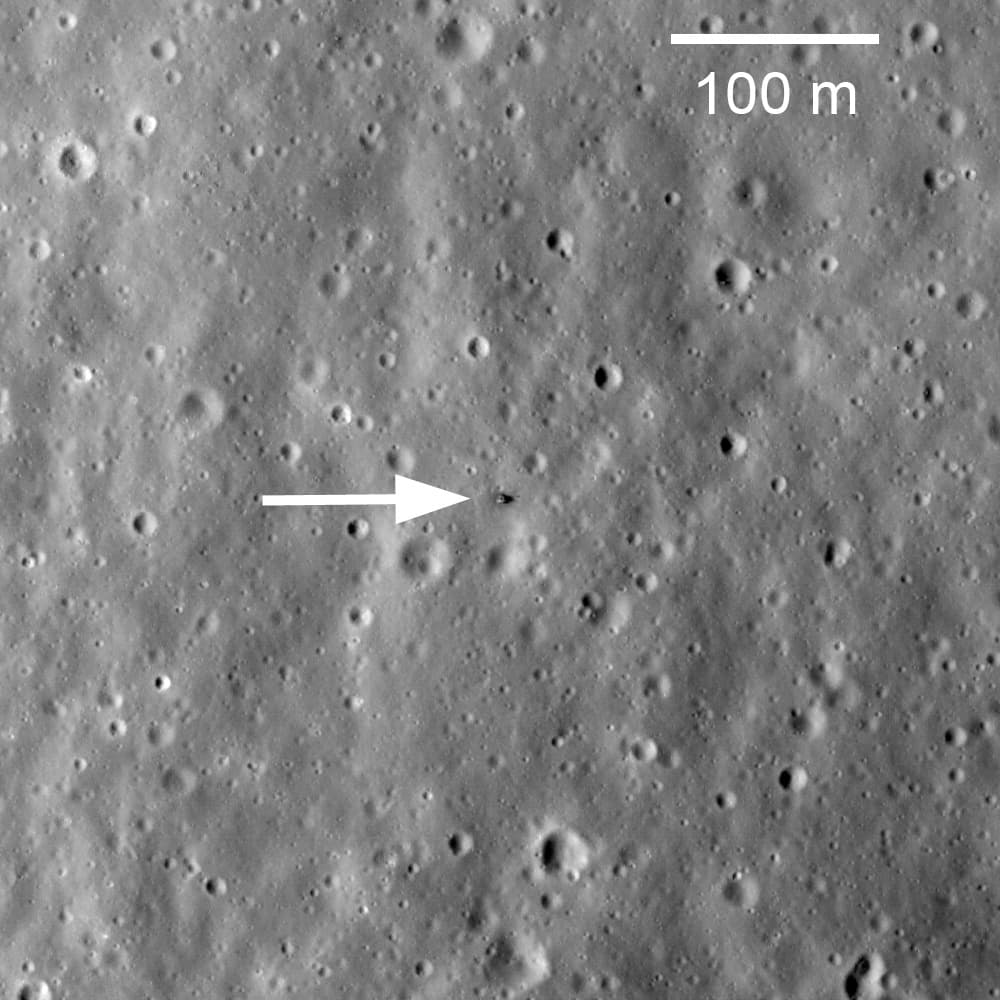
The Luna 20 descent stage was photographed by NASA's Lunar Reconnaissance Orbiter on 30 January 2010 (NAC frame M119482862RE); the shadow of the sampling arm is visible↗
Site: 3.7863°N, 56.6242°E · Apollonius highlands (Terra Apollonius), between Mare Fecunditatis and Mare Crisium, ~120 km N of Luna 16 (source)
02Mission timeline
11 Sep 1971
Luna 18, the previous sample-return attempt, crashes in the same highland border region; its signals stop at impact
14 Feb 1972
Launch on Proton from Tyuratam (Baikonur)
18 Feb 1972
Enters an approximately 100 km circular lunar orbit at 65 degrees inclination
21 Feb 1972
Soft-lands in the Apollonius highlands, ~120 km from Luna 16; the drill collects about 55 g of anorthositic soil
22 Feb 1972
Ascent stage lifts off the Moon with the sealed sample capsule on a direct trajectory home
25 Feb 1972
Capsule lands at 19:19 UT on an island in the Karkingir River near Dzhezkazgan, Kazakhstan, with the first robotic highland sample
Apr 1972
Apollo 16 lands at Descartes, the first crewed mission dedicated to the lunar highlands, sampling the terrain Luna 20 had just previewed
Mar 1973
NASA and the USSR exchange samples: 6 g of Apollo material for portions of the Luna 16 and Luna 20 soil
15 Mar 2010
LROC publishes orbital images pinpointing the Luna 20 descent stage in the highlands, with the sampling-arm shadow visible
Teal dots: events that physically happened in flight or on the Moon. Grey: announcements, namings, contracts, and targets.
03The mission
Luna 20 was a mission built out of a fresh failure. In September 1971, Luna 18 had aimed for the rugged highland border between Mare Fecunditatis and Mare Crisium, a scientifically tempting patch of ancient crust, and had crashed: its signals stopped at the instant of impact, and Soviet officials conceded that the mountainous terrain had proven unfavorable. Rather than retreat to easier mare ground, the designers sent Luna 20 back to almost the same coordinates five months later, betting that a Ye-8-5 automatic station could thread the same needle Luna 18 had missed.
Launched on a Proton on 14 February 1972, Luna 20 entered lunar orbit on 18 February and soft-landed on 21 February in the Apollonius highlands, about 120 km from where Luna 16 had touched down in the mare a year and a half earlier. A 90 cm extendable arm carried a rotary drill to the surface, but the highland regolith was loosely packed and gave up less material than Luna 16's mare soil: the sealed capsule carried home roughly 55 grams (the exact figure is disputed, with values from 30 to 55 g in the record). The ascent stage lifted off on 22 February on a single 53-second engine burn, and on 25 February the return sphere parachuted onto an island in the Karkingir River near Dzhezkazgan, Kazakhstan.
What made those grams matter was their mineralogy. Where Luna 16's soil was mare basalt, 50 to 60% of Luna 20's particles were anorthosite, the feldspar-rich rock of the ancient lunar highlands. This was the first anorthosite-dominated soil returned by a robot, and it arrived at a pointed moment: two months later Apollo 16 would land at Descartes as the first crewed mission dedicated to the highlands. Luna 20 gave Soviet and, through a 1973 sample exchange, American and other scientists an early, independent read on the composition of the Moon's oldest crust.
The mission also became a small monument to Cold War scientific contact. In March 1973, at the height of superpower rivalry, NASA and the USSR swapped lunar material: three grams each of Apollo 16 and Apollo 17 soil for portions of the Luna 16 and Luna 20 samples. Luna 20's highland grains thus ended up in laboratories on both sides of the Iron Curtain, cross-checked against Apollo's own highland returns.
Decades later, NASA's Lunar Reconnaissance Orbiter closed the loop. On 30 January 2010 its Narrow Angle Camera photographed the Luna 20 descent stage still standing in the highlands, a bright dot inside a faint blast halo, with a long shadow that the LROC team read as the sampling arm frozen in place. The image, published that March, fixed the landing site to within meters and turned Luna 20 from a set of disputed 1972 numbers into a spacecraft you can point to on the Moon.
04In pictures
Tap a photo to enlarge.
05Sources
- NSSDCA Master Catalog: Luna 20 (1972-007A)
- LROC Featured Image: Soviet Union Lunar Sample Return Missions (Luna 20 site, 15 Mar 2010)
- Lunar Sample Compendium: Luna 20 Drill Core (C. Meyer, LPI/NASA)
- Vinogradov, Preliminary data on lunar soil collected by Luna 20 (Geochim. Cosmochim. Acta, 1973; trans. from Geokhimiya, 1972)
- Wikipedia: Luna 20 (orbit, composition, mission summary)
- Wikipedia: Luna 18 (failed predecessor, crash 11 Sep 1971)
- The Planetary Society: Luna 20 lander on the Moon (return-capsule landing details)
- NASA History: Apollo 17 post-mission activities (1973 US-USSR sample exchange)
azmth is independent and is not affiliated with or endorsed by NASA, CNSA, Roscosmos, ISRO, JAXA, or any other space agency or company named on this page.