Kaguya (SELENE)
JAXA (Japan) · Orbiter · 2007Success
Controlled impact near Gill crater Jun 10, 2009, 18:25 UT, after about 20 months at the Moon; subsatellite Okina impacted the far side Feb 12, 2009; Ouna was left in lunar orbit at the end of its mission.
TL;DR· 7 min read
Kaguya was a three-spacecraft Japanese flagship that JAXA billed as the largest lunar mission since the Apollo program, flying 15 instruments from September 2007 to its controlled impact in June 2009. It measured the first genuinely global map of the Moon's shape, made the first direct gravity measurement of the far side by relaying through the subsatellite Okina, and filmed the first high-definition Earth-rise. Its maps later fed the targeting of LCROSS and the choice of SLIM's landing site.
Kaguya is the mission that reopened the Moon: a three-spacecraft Japanese flagship that JAXA billed as the largest lunar mission since the Apollo program (a description NASA's mission page repeats), it flew 15 instruments, filmed the first high-definition Earth-rise, and measured the first genuinely global map of the Moon's shape. English memory keeps the pretty video and forgets the cartography, which is backwards: Kaguya's maps fed the targeting of LCROSS and, fifteen years later, the choice of SLIM's landing site, and its far-side gravity measurement through the relay satellite Okina was a world first.
Facts as of July 20, 2026, from the sources listed below.
15
instruments on what JAXA billed as the largest lunar mission since Apollo
3
spacecraft: the Kaguya orbiter plus subsatellites Okina and Ouna
19.81km
total relief in the first sub-half-degree global topographic map of the Moon
412,627
names and messages carried to the Moon on engraved sheets
Commonly wrong. Three recurring errors in English coverage. (1) The Earth-rise is treated as a lunar sunrise equivalent, something a Moon base would watch daily. JAXA's own 2007 release corrects this: Earth hangs at nearly a fixed point in the Moon's sky, so an Earth-rise can only be seen from a moving spacecraft, as with Apollo 8 and Kaguya. (2) "Kaguya crashed into Gill crater." The June 10, 2009 impact was a planned, controlled deorbit at the end of a fully successful mission, and JAXA's wording is near Gill crater, at 65.5 S, 80.4 E on the southeastern near side, which places the impact outside the crater itself. (3) The instrument count wobbles between 13 and 15 across sources depending on whether the HDTV camera and the relay/VLBI radio experiments are counted; NASA and JAXA's ISAS both say 15, and the frequently repeated "largest lunar mission since Apollo" is JAXA's framing of that payload (NASA's mission page repeats it as what the Japanese called the mission), worth attributing rather than asserting bare.
01Mission facts
Launch
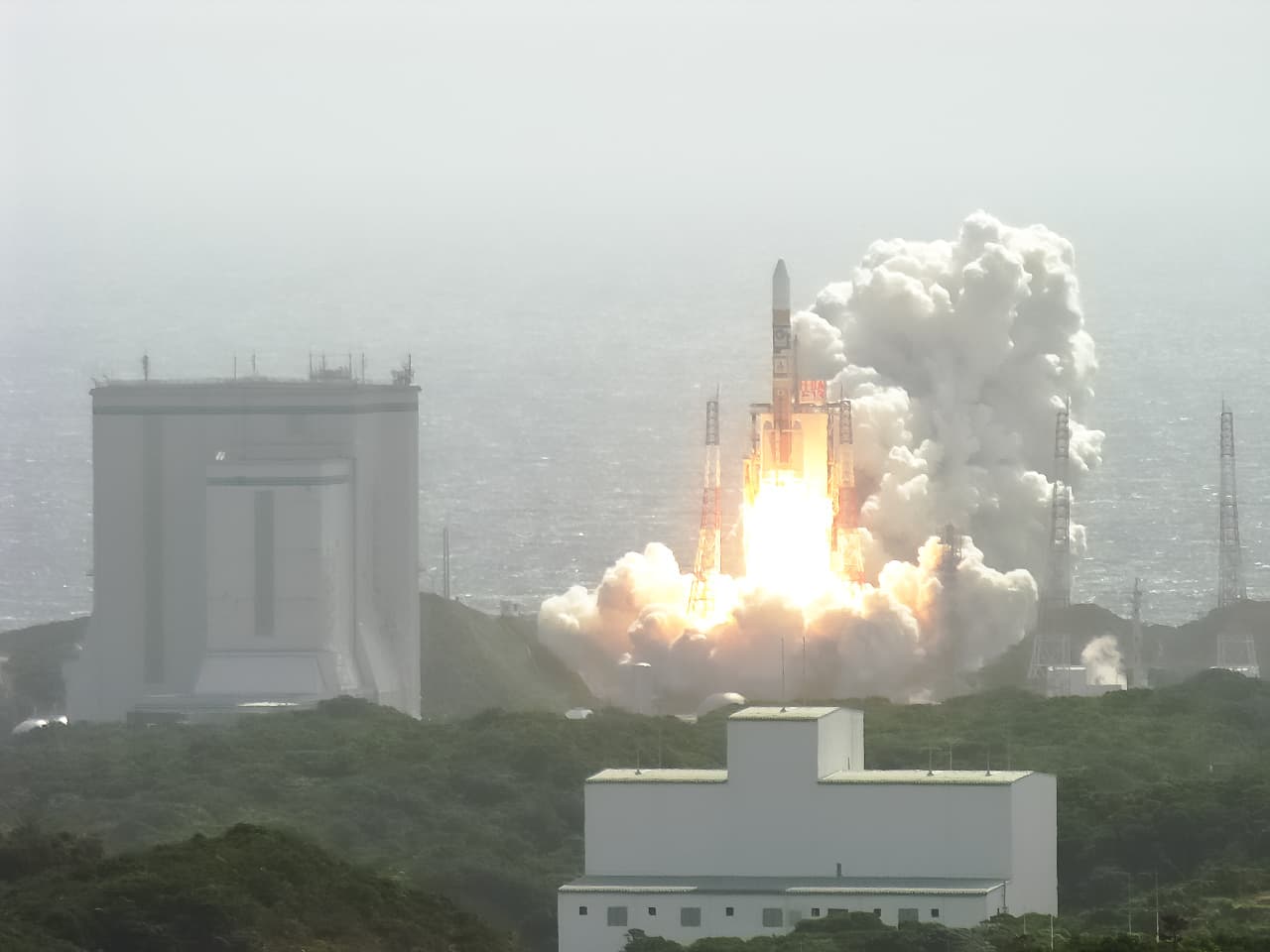
September 14, 2007, at 10:31:01 a.m. JST (01:31:01 UT) on H-IIA Flight 13 from Tanegashima Space Center↗
Scale
About 2,900 kg at launch with 15 scientific instruments; JAXA billed SELENE as the largest lunar mission since the Apollo program, a description NASA's mission page repeats↗
Subsatellites
Okina (Rstar, relay) and Ouna (Vstar, VLBI radio source), about 53 kg each, released October 9 and 12, 2007; the names mean honorable elderly man and woman, the couple who raise Princess Kaguya in the Tale of the Bamboo Cutter↗
HDTV Earth-rise
November 7, 2007: the NHK-developed HDTV camera filmed an Earth-rise and an Earth-set, the world's first high-definition Earth images taken from about 380,000 km away (JAXA/NHK)↗
Global topography
The LALT laser altimeter produced a global topographic map at finer than 0.5 degree resolution, measuring about 19.81 km of total relief with the lowest point inside Antoniadi crater (Araki et al., Science, Feb 13, 2009)↗
Far-side gravity
Four-way Doppler tracking relayed through Okina produced the first direct gravity-field measurements of the lunar far side, revealing ring-like anomalies and a more rigid far-side lithosphere (Namiki et al., Science, Feb 13, 2009)↗
Shackleton crater
Kaguya made the first optical observation of the permanently shadowed interior of Shackleton crater at the lunar south pole↗
Lava tube skylight
Terrain Camera and Multi-band Imager frames revealed a 65 m wide, 80 to 88 m deep vertical hole in the Marius Hills, the first known lunar lava tube skylight (Haruyama et al., GRL, 2009)↗
Okina impact
The relay satellite Okina impacted the lunar far side at 7:46 p.m. JST on February 12, 2009 (10:46 UT), its gravity-relay work complete↗
Main orbiter impact
June 10, 2009, 18:25 UT (3:25 a.m. June 11 JST): controlled impact on the southeastern near side at 65.5 S, 80.4 E, near Gill crater, in local shadow↗
Impact flash observed
The 1.2 m telescope at Mt Abu Observatory, India, caught the impact flash in the near infrared (2.12 micron narrow-band filter) in a sequence of images taken one second apart↗
Names aboard
Sheets engraved with names and messages from 412,627 people, collected in the Wish upon the Moon campaign, were attached to the spacecraft on June 5, 2007, and rode to the Moon↗
Site: 65.5000°S, 80.4000°E · Near Gill crater, southeastern near side (source)
02Mission timeline
5 Jun 2007
Name sheets carrying 412,627 names and messages from the Wish upon the Moon campaign are fitted to the spacecraft at Tanegashima
14 Sep 2007
Launch at 10:31:01 a.m. JST on H-IIA Flight 13 from Tanegashima Space Center
4 Oct 2007
First lunar orbit injection maneuver completed; Kaguya is captured into lunar orbit
9 and 12 Oct 2007
Relay satellite Okina, then VRAD satellite Ouna, released into their elliptical orbits
18 Oct 2007
Main orbiter settles into its circular polar observation orbit about 100 km above the surface
31 Oct 2007
The NHK HDTV camera films the lunar surface in high definition for the first time
7 Nov 2007
HDTV films Earth-rise and Earth-set: the world's first high-definition Earth images from about 380,000 km
1 Feb 2009
Extended mission lowers the observation orbit from about 100 km to about 50 km; from April 16 the perilune comes down further, to between 10 and 30 km
12 Feb 2009
Okina impacts the lunar far side at 7:46 p.m. JST, its four-way Doppler relay mission complete
13 Feb 2009
Science runs four Kaguya papers in one issue: sub-half-degree global topography, the first direct far-side gravity field, radar soundings of buried lava layers, and far-side volcanism persisting to about 2.5 billion years ago
10 Jun 2009
Controlled impact near Gill crater at 65.5 S, 80.4 E, 18:25 UT (3:25 a.m. Jun 11 JST); the flash is caught in the near infrared by the 1.2 m telescope at Mt Abu, India
1 Nov 2009
Kaguya observation data begins public release on the internet
Nov 2009
The Marius Hills skylight discovery, a 65 m hole spotted in Terrain Camera and Multi-band Imager frames, is published in Geophysical Research Letters
20 Jan 2024
JAXA's SLIM lands near Shioli crater at 00:20 JST (Jan 19 UTC), a site chosen because SELENE data showed exposed olivine on its slopes
Teal dots: events that physically happened in flight or on the Moon. Grey: announcements, namings, contracts, and targets.
03The mission
Kaguya was Japan's bet that the Moon deserved a flagship. Launched on September 14, 2007, on H-IIA Flight 13 from Tanegashima, the roughly 2,900 kg SELENE (SELenological and ENgineering Explorer) carried 15 instruments and two 53 kg subsatellites, a payload JAXA billed as the largest lunar mission since the Apollo program, a description NASA's mission page still repeats. The names came from Japan's oldest folk tale, the Tale of the Bamboo Cutter: Kaguya for the Moon princess, Okina and Ouna for the elderly couple who raise her. Bolted under the solar paddle rode sheets engraved with 412,627 names and messages collected in the Wish upon the Moon campaign. After orbit insertion on October 4, 2007, the spacecraft dropped Okina and Ouna into elliptical orbits and settled into its own circular polar orbit about 100 km up.
The mission's core product was measurement. The LALT laser altimeter built the first global topographic map of the Moon at finer than half-degree resolution, putting 19.81 km between the highest ground and the floor of Antoniadi crater; the Terrain Camera imaged the surface in stereo at 10 m per pixel; and the radar sounder profiled lava layers hundreds of meters beneath the maria. The cleverest trick belonged to the subsatellites. Because a spacecraft behind the Moon cannot be tracked from Earth, the far side's gravity had never been measured directly; Kaguya solved this by relaying its Doppler signal through Okina, and the resulting far-side gravity map, published in a four-paper Kaguya special in Science on February 13, 2009, was a world first. The same issue reported that far-side volcanism had continued to about 2.5 billion years ago, and the Terrain Camera also delivered the first optical peek into the permanently shadowed interior of Shackleton crater at the south pole.
What the public remembers is the video. The HDTV camera, developed with broadcaster NHK, filmed the lunar surface in high definition on October 31, 2007, and on November 7 captured an Earth-rise and an Earth-set, the world's first high-definition Earth images taken from about 380,000 km away, received at the Usuda Deep Space Center and processed by NHK. JAXA's own release includes the physics footnote most coverage drops: an Earth-rise is only visible from a moving spacecraft, because an observer standing on the Moon sees Earth hang at nearly the same point in the sky forever. Kaguya's footage became the modern era's answer to Apollo 8's 1968 photograph, and it did for lunar exploration's image what its altimeter did for lunar maps.
The endgame was deliberate. On February 1, 2009, the extended mission lowered the orbit from about 100 km to about 50 km, and from April 16 the perilune came down to between 10 and 30 km for close-up observation; Okina, its relay job done, struck the far side on February 12, 2009. On June 10, 2009, at 18:25 UT (3:25 a.m. June 11 in Japan), controllers flew the main orbiter into the southeastern near side at 65.5 S, 80.4 E, near Gill crater. The impact point was in shadow, and the flash was caught from Earth: the 1.2 m telescope at Mt Abu Observatory in India recorded it through a 2.12 micron narrow-band filter, frame by frame, one second apart. Ouna, the quiet second subsatellite, had already finished its radio-science observations and was simply left in lunar orbit; no impact was ever commanded or announced for it.
Kaguya's afterlife is unusually long for a two-year mission. Its data went public in November 2009 and still anchors lunar work: the SELENE Terrain Camera model was later merged with LRO's laser altimetry into the SLDEM2015 elevation model that much of the field navigates by, Kaguya observations were among the datasets weighed when NASA switched LCROSS's 2009 impact target to Cabeus, and the 65 m Marius Hills skylight it discovered seeded today's lava-tube exploration concepts. The most poetic payoff came on January 20, 2024 (JST), when JAXA's SLIM lander touched down beside Shioli crater, a landing site chosen because SELENE data had spotted exposed olivine there. Kaguya mapped the Moon; Japan's first successful lunar lander came down on a spot its maps had circled.
04In pictures
Tap a photo to enlarge.
05Sources
- JAXA press release, Jun 11, 2009: KAGUYA (SELENE) impact to the Moon (date, time, coordinates, Gill crater, data release plan)
- NASA Science: Kaguya mission page (launch time, 2,900 kg, 15 instruments, subsatellite names and masses, Okina impact, largest-since-Apollo description attributed to the Japanese)
- JAXA KAGUYA site, Information page (JST dates for launch, orbit insertion, subsatellite releases, Okina impact; 412,627 names)
- JAXA/NHK press release, Nov 13, 2007: Image Taking of Earth-Rise by HDTV (world's first HD Earth images from 380,000 km; Earth-rise physics note)
- JAXA press release, Sep 14, 2007: Launch result of the KAGUYA by H-IIA F13
- JAXA press release, Feb 13, 2009: KAGUYA special edition research reports in Science (topography, far-side gravity, radar sounder, far-side volcanism)
- Araki et al. 2009, Science: Lunar Global Shape and Polar Topography Derived from Kaguya-LALT Laser Altimetry
- Namiki et al. 2009, Science: Farside Gravity Field of the Moon from Four-Way Doppler Measurements of SELENE (Kaguya) (first direct far-side gravity mapping; negative anomaly rings)
- Haruyama et al. 2009, GRL: Possible lunar lava tube skylight observed by SELENE cameras (65 m Marius Hills hole)
- eoPortal: SELENE (instrument suite, subsatellite orbits, mission phases)
- JAXA ISAS: KAGUYA spacecraft page (3 t class orbiter, 15 instruments, Feb 1, 2009 descent to 50 km and Apr 16, 2009 perilune lowering, impact on southeastern near side)
- ESA Science and Technology: Kaguya impact flash observed from Mt Abu Observatory (1.2 m telescope, 2.12 micron filter)
- ESA Science and Technology: SMART-1/AMIE view of Kaguya impact point (site terrain imaged Jan 31, 2006)
- The Planetary Society: SLIM mission page (Shioli site chosen for olivine exposure found in SELENE data; landing Jan 19, 2024 UTC / Jan 20 JST)
- NASA release via Phys.org, Sep 2009: LCROSS target switch weighed hydrogen and terrain data including Kaguya's
- JAXA ISAS Cosmos, 2017: At the threshold of a lunar renaissance, the SELENE mission 10 years later (JAXA's largest-since-Apollo framing, data tools KADIAS and 3D GIS)
- Barker et al. 2016, Icarus: A new lunar digital elevation model from LOLA and SELENE Terrain Camera (SLDEM2015)
- JAXA KAGUYA site: Mission mark page (logo design and designer; MissionMark.gif)
azmth is independent and is not affiliated with or endorsed by NASA, CNSA, Roscosmos, ISRO, JAXA, or any other space agency or company named on this page.