Luna 10
USSR · Orbiter · 1966Success
Entered lunar orbit 3 Apr 1966, the first artificial satellite of another world; 460 orbits and 219 radio sessions before batteries died 30 May 1966; later crashed at an unknown date and place.
TL;DR· 5 min read
Luna 10 became the first artificial satellite of the Moon, and of any world beyond Earth, on 3 April 1966, converted from a lander in about two months to meet the 23rd Party Congress deadline. It carried no camera, but its instruments found surface radioactivity comparable to terrestrial basalt and only a very weak magnetic field. The Internationale played to the Congress on 4 April was a tape of the previous night's rehearsal, a substitution kept secret for about 30 years.
Luna 10 became the first artificial satellite of the Moon, and of any world beyond Earth, on 3 April 1966, rushed into existence in about two months so the feat could be announced at the 23rd Communist Party Congress. Its most famous moment, playing The Internationale to the Congress "live from lunar orbit" on 4 April, was actually a tape of the previous night's rehearsal, a substitution kept secret for three decades.
Facts as of July 20, 2026, from the sources listed below.
1st
artificial satellite of the Moon (or any world beyond Earth)
460
lunar orbits completed
219
radio sessions in 56 days of operation
2h 58m
orbital period, 350 x 1,017 km at 71.9 degrees
Commonly wrong. Three corrections. (1) The Internationale was not broadcast live: playback worked in the 3 April rehearsal, but in the morning test on 4 April an oscillator failure dropped a note, so controllers played the rehearsal recording to the Congress while presenting it as live; the substitution stayed secret for about 30 years, until the 1996 Babakin biography. (2) The oft-copied English line that Luna 10 provided "the first evidence of mascons" is retrospective at best: contemporary Soviet analyses of its tracking data reported no major gravity anomalies, and the canonical mascon discovery came in 1968, when JPL's Muller and Sjogren analyzed Lunar Orbiter tracking data. (3) Several NASA-derived pages date the orbit insertion to 4 April 1966; the braking burn was 3 April at 18:44 UT (21:44 Moscow time, still 3 April). The 4th was the day of the broadcast; the burn had come the evening before. Also note the mass figures: Luna 10 in lunar orbit was a roughly 245-249 kg sealed satellite, while ~1,584 kg is the mass of the whole launch stack.
01Mission facts
Launch
31 March 1966, 10:46:59 UT (13:46:59 Moscow), Molniya-M from Baikonur, via an Earth-orbit parking platform↗
Spacecraft
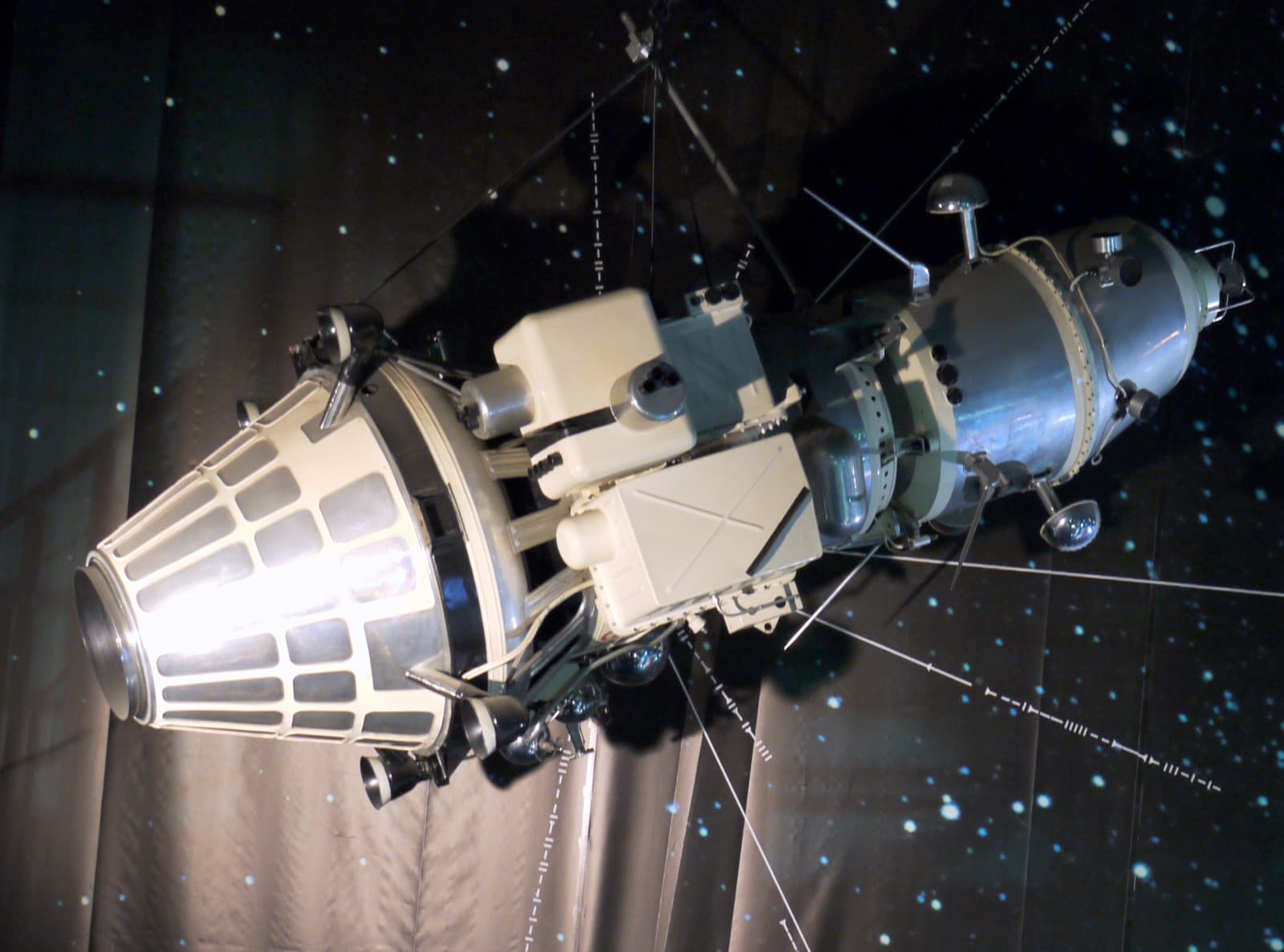
E-6S (No. 210), an E-6 landing bus modified to carry a detachable sealed instrument satellite of 248.5 kg (about 245 kg in some NASA sources); launch mass about 1,584 kg; no camera aboard↗
Lunar orbit insertion
3 April 1966, 18:44 UT: 57-second braking burn; the satellite separated at 18:45:39 UT↗
Initial orbit
350 x 1,017 km, inclination 71.9 degrees, period about 2 h 58 min↗
Instruments
Gamma-ray spectrometer (0.3-3.0 MeV NaI(Tl)), triaxial magnetometer, micrometeorite detectors, charged-particle traps, gas-discharge counters, infrared detector, X-ray photon counters↗
The Internationale
Played to the 23rd Party Congress on 4 April 1966 at 10:00 Moscow time; after an oscillator dropped a note in the morning test, controllers routed the previous night's rehearsal recording to the hall, a secret for about 30 years↗
Sister craft
The first E-6S (No. 204) launched 1 March 1966, was stranded in Earth orbit by an attitude-control failure as Kosmos 111, and reentered 3 March 1966↗
Operations
460 lunar orbits and 219 radio sessions over 56 days; battery-powered, last contact 30 May 1966↗
Fate
Orbit eventually decayed; Luna 10 crashed on the Moon at an unknown date and location, so there is no landing-site pin↗
02Mission timeline
3 Feb 1966
Luna 9's landing frees the E-6 bus for a rush conversion to a lunar orbiter, targeting the Party Congress opening in late March
1 Mar 1966
First E-6S attempt fails in Earth orbit as Kosmos 111; it reenters two days later
29 Mar 1966
The 23rd Congress of the Communist Party opens in Moscow, the political deadline driving the schedule
31 Mar 1966
Luna 10 launches at 10:47 UT from Baikonur on a Molniya-M
3 Apr 1966
18:44 UT: 57-second braking burn: the first spacecraft ever to orbit another world; the 248.5 kg satellite separates at 18:45:39 UT
4 Apr 1966
The Internationale rings through the Kremlin Palace of Congresses, presented as live from lunar orbit but actually the overnight rehearsal tape
30 May 1966
Batteries exhausted after 460 orbits and 219 radio sessions; radio contact ends
14 Aug 1966
NASA's Lunar Orbiter 1 becomes the first US spacecraft to orbit the Moon, four and a half months later
Unknown date
Luna 10's orbit decays and it strikes the Moon at an undetermined location
Teal dots: events that physically happened in flight or on the Moon. Grey: announcements, namings, contracts, and targets.
03The mission
Luna 10 was a sprint. Luna 9's landing on 3 February 1966 left the Soviet lunar program with a proven E-6 delivery bus and a political calendar: the 23rd Congress of the Communist Party would open in Moscow on 29 March, and the leadership wanted a new first to announce. In about two months, engineers converted the E-6 soft-lander into the E-6S, swapping the landing sphere for a detachable, sealed 248.5 kg instrument satellite and drawing on earlier work for Korolev's E-7 orbiter concept. The haste showed: the first E-6S, launched 1 March 1966, lost attitude control, never left Earth orbit, and was buried under the cover name Kosmos 111.
The second attempt flew on 31 March 1966 at 10:46:59 UT on a Molniya-M from Baikonur. On 3 April at 18:44 UT the braking engine burned for 57 seconds, and at 18:45:39 UT the little satellite separated into a 350 x 1,017 km orbit inclined 71.9 degrees, circling the Moon every 2 hours 58 minutes. For the first time in history, a human-made object was orbiting another world. NASA's first Lunar Orbiter followed in August 1966.
The mission's most famous moment was partly theater. Luna 10 carried solid-state oscillators programmed to play The Internationale, and in a rehearsal on the night of 3 April the anthem came down from lunar orbit flawlessly. In the morning test on 4 April, though, an oscillator failure swallowed a note. Rather than risk a flub in front of the assembled Congress, controllers played the previous night's recording into the Kremlin Palace of Congresses at 10:00 Moscow time while the delegates believed they were hearing the Moon live. The substitution stayed secret for roughly 30 years, until it surfaced in the 1996 biography of designer Georgy Babakin.
Luna 10 carried no camera, which is why the mission left no pictures of the Moon; its seven instruments measured everything else. The gamma-ray spectrometer showed the surface's radioactivity was comparable to terrestrial basalt rather than granite, an early clue to the composition of the maria. The magnetometer found only a very weak field, of order tens of gammas. Detectors profiled cosmic radiation, solar plasma, and a locally elevated micrometeoroid flux, and tracking of the orbit began the study of the Moon's lumpy gravity field, though the analyses of the day reported no major anomalies.
Battery-powered and never designed to last, Luna 10 completed 460 lunar orbits and 219 radio sessions over 56 days before falling silent on 30 May 1966. Its orbit eventually decayed and the first satellite of another world hit the Moon at a date and place no one recorded, which is why this entry, unlike most in the catalog, has no pin on the globe.
04In pictures
Tap a photo to enlarge.
05Sources
- NSSDCA Master Catalog: Luna 10 (1966-027A)
- RussianSpaceWeb: Luna-10 (Anatoly Zak)
- NASA HEASARC: The Luna 10 & 12 satellites
- Wikipedia: Luna 10 (cross-check for launch time, orbit, fate)
- For All Moonkind Moon Registry: Luna 10
azmth is independent and is not affiliated with or endorsed by NASA, CNSA, Roscosmos, ISRO, JAXA, or any other space agency or company named on this page.