Luna 9
USSR · Lander · 1966Success
Landed in Oceanus Procellarum 3 Feb 1966, transmitted until 6 Feb 1966; exact resting place still unconfirmed as of July 2026, with two rival candidate sites identified in early 2026.
TL;DR· 6 min read
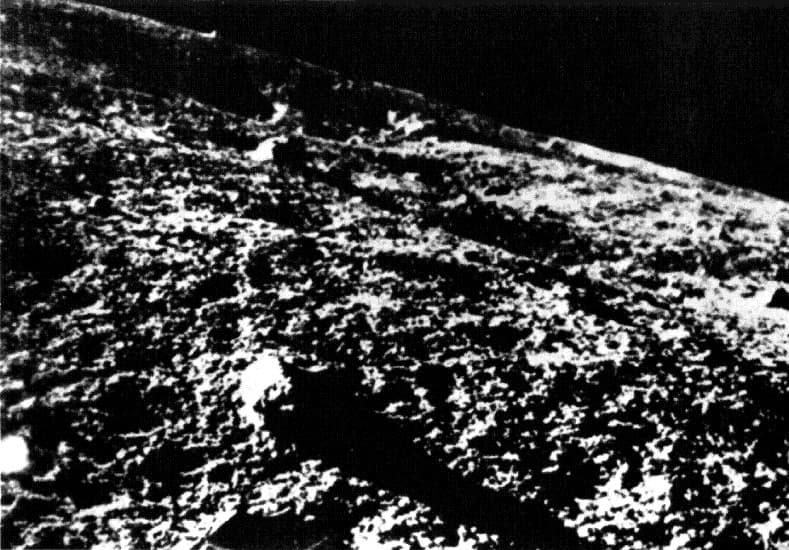
Luna 9 made the first survivable landing on another world, bouncing to a stop in Oceanus Procellarum on 3 February 1966 and sending back the first photographs taken from the surface of another world. It also settled an argument: the ground bore the lander's weight, so the Moon was not buried in deep dust. Jodrell Bank intercepted the pictures on a borrowed Daily Express fax machine and British papers printed them first. Its exact resting place has still never been confirmed.
Luna 9 was not the first spacecraft to reach the Moon (Luna 2 hit it in 1959) but it was the first to land on another world and survive, and the first to send back photographs from an alien surface, on 3 February 1966. Sixty years later its exact resting place has still never been confirmed in orbital imagery: as of July 2026 an AI study and a crowdsourced search have proposed two different candidate sites, both awaiting verification.
Facts as of July 20, 2026, from the sources listed below.
1st
survivable landing on another world
12th
Soviet soft-landing attempt, and the first to succeed
8h 05m
of radio transmissions from the lunar surface
22km/h
impact speed the airbag capsule survived
Commonly wrong. Three recurring errors. (1) "First spacecraft to land on the Moon": Luna 2 impacted the Moon in 1959; Luna 9 was the first to land survivably and transmit afterward. (2) Maps and articles present 7.08 N, 64.37 W as Luna 9's location, but that is the official Soviet-era estimate, never confirmed: the lander has never been identified in orbital imagery, and as of July 2026 there are two competing, unconfirmed candidates (a 21 Jan 2026 npj Space Exploration AI study near 7.03 N, 64.33 W, and Vitaly Egorov's crowdsourced candidate about 25 km away, which RussianSpaceWeb lists as 7.86159 N, 296.14438 E). Planetary cartographer Phil Stooke is not convinced by either. (3) English retellings often credit Bernard Lovell with decoding the photos; the tracking history hosted on Jodrell Bank's own site (written by Sven Grahn) instead records press officer Reginald Lascelles claiming he was the one who recognized the characteristic facsimile signal, a relayed self-attribution that Grahn himself hedges, and because the borrowed Daily Express machine did not match the Soviet scan proportions, the famous first newspaper images were printed with a stretched aspect ratio.
01Mission facts
Launch
31 January 1966, 11:41:37 UT (14:41:37 Moscow), Molniya-M (8K78M) from Site 31, Baikonur (Tyuratam)↗
Landing
3 February 1966, 18:45:30 UT, Oceanus Procellarum west of Reiner and Marius craters, approx. 7.08 N, 64.37 W (official estimate)↗
Landing capsule (ALS)
99 kg sealed sphere, 58 cm diameter, airbag-cushioned; ejected at about 5 m altitude and hit at 22 km/h, bouncing several times↗
Full spacecraft
1,538 kg total at launch, 2.7 m tall (lander plus descent/cruise stage)↗
Program context
The USSR's 12th attempt at a lunar soft landing; chief designer Sergei Korolev died 14 January 1966, 17 days before launch↗
Surface operations
Petals opened about 4 minutes after touchdown; 7 radio sessions totaling 8 h 5 min and three series of TV pictures; first panorama transmission began 4 February at 01:50 UT↗
Jodrell Bank interception
Signals tracked from 16:29 UT on 3 February; pictures decoded 4 February 15:30-16:55 UT on a facsimile receiver borrowed from the Daily Express and published in Britain before the Soviet release↗
Last contact
6 February 1966, 22:55 UT↗
2026 site search
npj Space Exploration paper (published 21 January 2026) flags a candidate object near 7.03 N, 64.33 W with confidence scores up to 77%; a separate crowdsourced candidate lies about 25 km away; both unconfirmed↗
Site: 7.0800°N, 64.3700°W · Oceanus Procellarum (Ocean of Storms), west of Reiner and Marius craters; official Soviet-era coordinates, never confirmed in orbital imagery (source)
02Mission timeline
14 Jan 1966
Sergei Korolev, the chief designer behind the Luna program, dies during surgery in Moscow
31 Jan 1966
Launch at 11:41 UT on a Molniya-M from Site 31 at Baikonur, the twelfth Soviet attempt at a lunar soft landing
3 Feb 1966
16:29 UT: Jodrell Bank's Mark I telescope locks onto the descent signals
3 Feb 1966
18:45:30 UT: The 99 kg capsule is ejected at about 5 m, hits at 22 km/h, bounces, and comes to rest in Oceanus Procellarum: the first survivable landing on another world
4 Feb 1966
01:50 UT: First panorama transmission of the lunar surface begins
4 Feb 1966
15:30 UT: Jodrell Bank prints the incoming pictures on borrowed Daily Express fax gear; British papers publish them before Moscow does
6 Feb 1966
22:55 UT: Last contact after seven radio sessions totaling 8 h 5 min
2 Jun 1966
NASA's Surveyor 1 achieves the first US soft landing, about four months after Luna 9
21 Jan 2026
npj Space Exploration paper (Pinault et al., UCL) proposes a candidate lander near 7.03 N, 64.33 W using the YOLO-ETA machine-learning detector on LRO imagery
Mar 2026 (planned)
India's Chandrayaan-2 orbiter was slated to image both candidate sites at 0.25 m resolution; results not yet public (as of Jul 2026)
Teal dots: events that physically happened in flight or on the Moon. Grey: announcements, namings, contracts, and targets.
03The mission
Luna 9 arrived at the end of a brutal losing streak. It was the Soviet Union's twelfth attempt at a lunar soft landing, and it flew just 17 days after Sergei Korolev, the chief designer who had driven the program since Sputnik, died on an operating table in Moscow on 14 January 1966. Launched on 31 January 1966 at 11:41 UT on a Molniya-M from Site 31 at Baikonur, the 1,538 kg spacecraft was a cruise stage carrying a 99 kg, 58 cm sealed sphere: the automatic lunar station that would actually do the landing.
The landing on 3 February 1966 at 18:45:30 UT was survivable rather than gentle. A retrorocket killed most of the descent speed, vernier engines took over below about 150 m, and at roughly 5 m a contact probe triggered ejection of the airbag-cushioned sphere, which hit the surface at about 22 km/h, bounced several times, and rolled to a stop in Oceanus Procellarum west of Reiner and Marius craters. About four minutes later the airbags were cast off and four petals opened, righting the station and freeing its antennas. The first panorama transmission began at 01:50 UT on 4 February. Beyond the pictures, Luna 9 settled a live scientific argument: the surface bore the lander's weight, so the Moon was not covered in a deep, swallowing dust layer as some models predicted.
The pictures reached the public by an unplanned route. Jodrell Bank had tracked the descent from 16:29 UT, and when the post-landing signal changed character it was recognized as facsimile transmission, resembling the Echo II transatlantic facsimile experiments; in the account on Jodrell Bank's own site (written by historian Sven Grahn), press officer Reginald Lascelles, a former newspaperman, claimed he was the one who identified it. A standard fax receiver was rushed over from the Daily Express in Manchester, and during the 4 February session (15:30 to 16:55 UT) the first photograph ever taken from the surface of another world scrolled out in Cheshire. British newspapers ran it before Moscow released its own copies, to considerable Soviet irritation; because the machine assumed standard scan proportions, the published images were noticeably stretched. Luna 9 transmitted for seven sessions totaling 8 hours 5 minutes before its batteries gave out; last contact came on 6 February at 22:55 UT.
Remarkably, nobody knows exactly where Luna 9 sits. The official coordinates, about 7.08 N, 64.37 W, were never confirmed, and the 58 cm sphere is at the edge of what LRO's cameras can resolve, so unlike nearly every other lander there is no LROC "here it is" frame. In a paper published 21 January 2026 in npj Space Exploration, Lewis Pinault of UCL and colleagues trained a lightweight computer-vision detector (YOLO-ETA, adapted from TinyYOLOv2 and trained on Apollo landing sites) on LRO imagery and flagged a candidate artifact near 7.03 N, 64.33 W with confidence scores up to 77%. Separately, science journalist Vitaly Egorov's eight-year crowdsourced search settled on a spot about 25 km away. Veteran lunar cartographer Phil Stooke is skeptical of both. India's Chandrayaan-2 orbiter, whose camera resolves 0.25 m, was slated to image both sites in March 2026; no results had been made public as of July 2026.
Luna 9's legacy is simple: it proved a spacecraft could land on another world, survive, and show us what it saw. NASA's Surveyor 1 followed with a throttled, three-legged touchdown about four months later, on 2 June 1966, and every lander since, from Apollo to Chang'e to the commercial fleet of the 2020s, descends to a surface Luna 9 proved was solid.
04In pictures
Tap a photo to enlarge.
05Sources
- NSSDCA Master Catalog: Luna 9 (1966-006A)
- RussianSpaceWeb: Luna-9 (Anatoly Zak)
- Jodrell Bank Centre for Astrophysics: early space tracking, part 2
- Pinault et al., npj Space Exploration (21 Jan 2026): Possible identification of the Luna 9 landing site
- Smithsonian Magazine (12 Feb 2026): candidate Luna 9 sites and Chandrayaan-2 follow-up
- Phys.org (Feb 2026): AI and the Luna 9 landing-site mystery
- NASA History: Sergei P. Korolev biography
- For All Moonkind Moon Registry: Luna 9
azmth is independent and is not affiliated with or endorsed by NASA, CNSA, Roscosmos, ISRO, JAXA, or any other space agency or company named on this page.