Lunar Orbiter Program
NASA (US) · Orbiter · 1966Success
Five orbiters flown 1966 to 1967, all five successful; each was deliberately crashed into the Moon at the end of its mission, the last on January 31, 1968.
TL;DR· 7 min read
Five Lunar Orbiters flown in 1966 and 1967 photographed 99% of the Moon at 60 meters or better, using a Kodak system that exposed 70mm film, developed it onboard, scanned it and radioed it home. All five succeeded, and by April 1967 their imagery had narrowed Apollo's options to eight preliminary landing sites. Lunar Orbiter 1 took the first photograph of Earth from the vicinity of the Moon on August 23, 1966. Each orbiter was then deliberately crashed into the surface.
Everyone remembers Apollo 8's color "Earthrise" of December 1968. Almost nobody remembers that a robotic film-scanning spacecraft beat it by more than two years: Lunar Orbiter 1 photographed Earth rising over the Moon on August 23, 1966. That was the program's real character. Five Lunar Orbiters quietly mapped 99% of the Moon with a Kodak camera derived from spy-satellite hardware that developed 70mm film onboard, scanned it, and radioed it home, and every one of the five worked, an almost unheard-of clean sweep in an era when Ranger and Surveyor were losing spacecraft. Then, to keep their dead radios from confusing the next orbiter, NASA drove all five into the surface on purpose.
Facts as of July 20, 2026, from the sources listed below.
99%
of the lunar surface mapped for Apollo landing-site selection
5 / 5
orbiters flown 1966 to 1967, every one successful
60m
mapping resolution or better, down to about 1 m at low altitude
Aug 1966
first photograph of Earth from the Moon, 28 months before Apollo 8
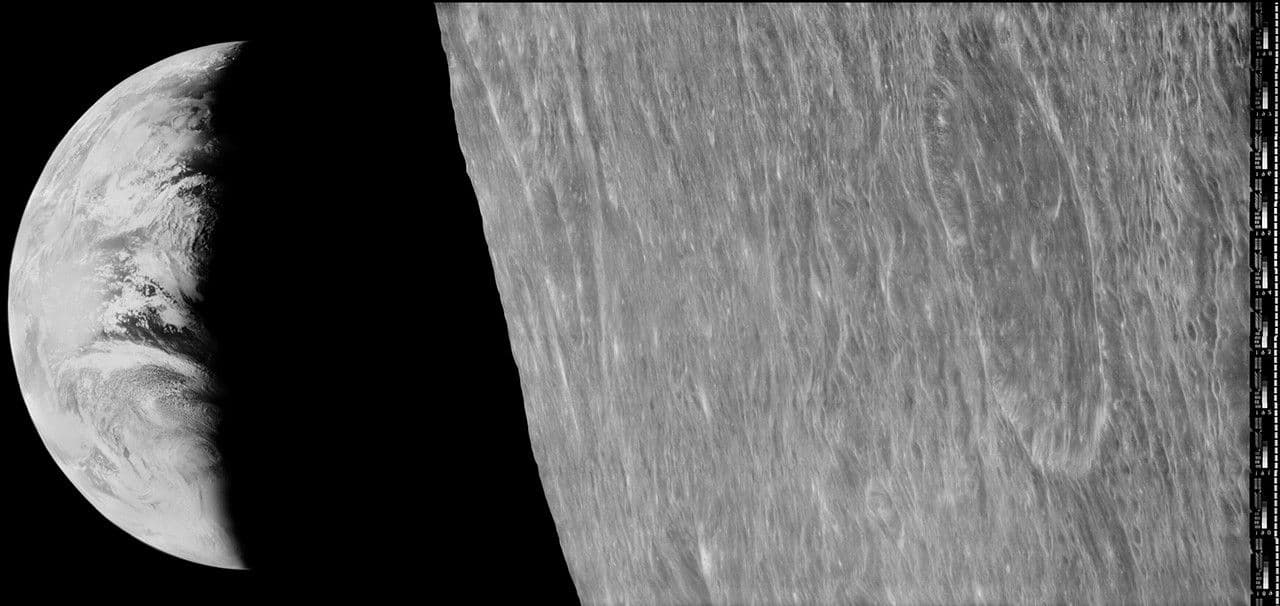
Commonly wrong. The biggest myth is that Apollo 8's December 1968 "Earthrise" was the first image of Earth from the Moon. Lunar Orbiter 1 photographed Earth over the lunar limb on August 23, 1966, and Lunar Orbiter 5 shot the first full Earth on August 8, 1967. The honest distinction is that Apollo 8's was the first in color and taken by human hands; the Lunar Orbiter shots were black-and-white, made by a robotic film-develop-and-scan system. Two more recurring errors: the cameras used photographic film developed onboard, with no digital or television sensor involved; and Lunar Orbiter 1's impact point is cited inconsistently (NSSDCA's 6.35 N, 160.72 E versus NASA's mission-page rounding to 6 degrees 42 minutes N, 162 degrees E). Finally, do not lump the program in with Ranger and Surveyor's failure records: all five Lunar Orbiters succeeded.
01Mission facts
Program approval
Approved by NASA Associate Administrator Robert C. Seamans on August 30, 1963; managed by NASA's Langley Research Center in Hampton, Virginia↗
Builder
The Boeing Company of Seattle won the contract on May 7, 1964 to build five spacecraft, each about 850 pounds (386 kg) with a 145-pound imaging system, four solar panels and a 36-inch dish antenna↗
Camera system
Eastman Kodak built the dual-lens imaging system (610mm narrow-angle plus 80mm wide-angle) based on classified military reconnaissance-satellite technology; it exposed 70mm film, developed it onboard with a Kodak Bimat semidry process, scanned it, and radioed the images to Earth↗
Coverage
The five orbiters photographed 99% of the Moon at a resolution of 60 meters or better, including the far side, with high-resolution detail down to about 1 meter at the lowest passes↗
Outcome
All five missions succeeded and met their objectives, an unusual clean sweep for a 1960s US lunar program (Ranger and Surveyor both lost spacecraft)↗
Two-phase plan
The first three orbiters surveyed 20 candidate Apollo landing sites from low-inclination orbits; the last two switched to broad scientific mapping from high near-polar orbits, with Lunar Orbiter 4 imaging the entire near side and Lunar Orbiter 5 completing far-side coverage↗
Lunar Orbiter 1 firsts
Launched August 10, 1966; became the first US spacecraft to orbit the Moon on August 14, 1966, and on August 23, 1966 took the first photograph of Earth from the vicinity of the Moon, an unplanned shot on its 16th orbit↗
Copernicus image
Lunar Orbiter 2's oblique view of the crater Copernicus, taken in November 1966 from about 28 miles up, was dubbed by the news media "one of the great pictures of the century" for revealing the Moon as a world of dramatic topography rather than a flat map↗
First full Earth
Lunar Orbiter 5 captured the first photograph of the whole Earth from space on August 8, 1967, from lunar orbit↗
Why they were crashed
Each orbiter was deliberately commanded to impact the Moon at end of mission so its transmitter could not interfere with tracking and communications for the next Lunar Orbiter and to clear the orbital environment↗
Lunar Orbiter 1 impact
Impacted the far side on October 29, 1966 during its 577th orbit; NSSDCA lists the site as about 6.35 degrees N, 160.71 degrees E (NASA's mission page gives another published figure, 6 degrees 42 minutes N, 162 degrees E)↗
Site selection payoff
By April 1967 planners had narrowed the Moon to eight preliminary Apollo landing sites from Lunar Orbiter imagery, including the site that became Apollo 11's Tranquility Base↗
Site: 6.3500°N, 160.7100°E · Lunar far side (Lunar Orbiter 1 commanded impact, 577th orbit) (source)
02Mission timeline
30 Aug 1963
NASA approves the Lunar Orbiter program to scout Apollo landing sites; Langley Research Center will manage it
10 Aug 1966
Lunar Orbiter 1 launches on an Atlas-Agena D from Cape Canaveral
14 Aug 1966
Lunar Orbiter 1 enters lunar orbit, the first US spacecraft to circle the Moon
23 Aug 1966
Lunar Orbiter 1 takes the first photograph of Earth from the vicinity of the Moon, more than two years before Apollo 8's color Earthrise
29 Oct 1966
Lunar Orbiter 1 is deliberately crashed into the far side on its 577th orbit, near 6.35 N, 160.71 E, so its radio cannot interfere with Lunar Orbiter 2
6 Nov 1966
Lunar Orbiter 2 launches
24 Nov 1966
Lunar Orbiter 2's oblique view of Copernicus, later called "one of the great pictures of the century," is taken from about 28 miles up
5 Feb 1967
Lunar Orbiter 3 launches; it later photographs the Surveyor 1 lander sitting on the surface
4 May 1967
Lunar Orbiter 4 launches into a high near-polar orbit and maps essentially the entire lunar near side
1 Aug 1967
Lunar Orbiter 5, the last of the series, launches to finish far-side mapping and survey later Apollo sites
8 Aug 1967
Lunar Orbiter 5 photographs the whole Earth from lunar orbit, the first full-Earth image from space
31 Jan 1968
Lunar Orbiter 5 is deliberately crashed into the Moon, the last of the five commanded impacts, near 2.79 S, 83.01 W
2008 to 2014
The Lunar Orbiter Image Recovery Project at NASA Ames restores the original data tapes and re-releases the Earthrise and other frames at modern quality
Teal dots: events that physically happened in flight or on the Moon. Grey: announcements, namings, contracts, and targets.
03The mission
The Lunar Orbiter program was the reconnaissance arm of the race to the Moon, and it is the quietest of the three US robotic programs that cleared the way for Apollo. Where Ranger crashed on purpose to take close-ups and Surveyor set down to test the soil, Lunar Orbiter did the mapping. NASA approved it on August 30, 1963, handed management to the Langley Research Center, and in May 1964 gave Boeing the contract to build five spacecraft. Each carried an Eastman Kodak imaging system adapted from classified military reconnaissance-satellite technology: a dual-lens camera that exposed 70mm film, developed it onboard with a semidry Bimat process, scanned the negatives with a moving spot of light, and radioed the result to Earth. It was, in effect, a robotic film lab flung into lunar orbit.
The plan split cleanly in two. The first three orbiters flew low-inclination orbits and photographed twenty candidate Apollo landing sites at high resolution, hunting for terrain flat enough and clear enough for a lunar module. The last two climbed into high near-polar orbits and mapped the Moon wholesale: Lunar Orbiter 4 covered essentially the entire near side, and Lunar Orbiter 5 finished the far side and surveyed sites for the later Apollo landings. Between them the five spacecraft photographed 99% of the Moon at a resolution of 60 meters or better, resolving detail down to roughly a meter at their lowest passes. By April 1967 planners had used the imagery to narrow the surface to eight preliminary landing sites, one of which became Apollo 11's Tranquility Base.
The program's most famous single frame was never on the schedule. On August 23, 1966, on its sixteenth orbit and about to slip behind the Moon, Lunar Orbiter 1 was turned to catch Earth rising over the lunar limb. The result, grainy and black-and-white, was the first photograph of Earth from the vicinity of the Moon, more than two years before the Apollo 8 crew shot the color version everyone remembers. Lunar Orbiter 5 went further on August 8, 1967, returning the first image of the entire Earth from space. Lunar Orbiter 2 contributed the era's other showpiece: an oblique view of the crater Copernicus, taken from about 28 miles up in November 1966, that newspapers called one of the great pictures of the century because it made the Moon look like a real, mountainous world rather than a flat chart.
What sets the program apart is that it simply worked. All five spacecraft launched successfully, reached lunar orbit, returned their images, and met their objectives, a clean five-for-five record that neither Ranger nor Surveyor came close to matching in the same years. That reliability is why Lunar Orbiter rarely makes the headlines: there was no dramatic failure, no lost spacecraft, no near-miss to narrate. The imagery it produced underpinned lunar maps for the next quarter century, including a comprehensive Moon map published by the National Geographic Society in 1969.
The endings were deliberate. Because a still-transmitting orbiter could confuse the tracking and communications of the next one, and to clear the orbital environment, NASA commanded each Lunar Orbiter to crash into the Moon once its work was done. Lunar Orbiter 1 was driven into the far side on October 29, 1966, on its 577th orbit; the last, Lunar Orbiter 5, was brought down on January 31, 1968. The published impact coordinates make these among the earliest human-made objects with known resting places on another world. Decades later the images had a second life: from 2008 to 2014 the Lunar Orbiter Image Recovery Project at NASA Ames coaxed the original analog data tapes back to life on refurbished 1960s FR-900 drives and recovered the Earthrise and other frames at a quality the 1966 hardware could never display.
04In pictures
Tap a photo to enlarge.
05Sources
- NASA Science: Lunar Orbiter Program overview (99% coverage, all five successful, two-phase plan)
- NASA History: 60 Years Ago, NASA Approves the Lunar Orbiter Program (approval, Boeing, Kodak camera, milestones)
- NASA Science: Lunar Orbiter 1 (first US lunar orbiter, first Earthrise, impact reason and coordinates)
- NASA Science: Lunar Orbiter 2 (Copernicus "picture of the century")
- NASA Science: Lunar Orbiter 5 (launch, full Earth, final impact)
- NSSDCA: Lunar Orbiter 1 spacecraft record (impact date and coordinates 6.35 N, 160.71 E)
- NASA Science / Earth Observatory: Earthrise 1966 (LOIRP restoration, 2008 to 2014)
- Wikipedia: Lunar Orbiter program (per-mission launch and impact dates, camera and film details)
- Wikipedia: Lunar Orbiter 5 (impact 2.79 S, 83.01 W, January 31, 1968)
azmth is independent and is not affiliated with or endorsed by NASA, CNSA, Roscosmos, ISRO, JAXA, or any other space agency or company named on this page.