Surveyor 1
NASA (US) · Lander · 1966Success
First US soft lunar landing, June 2, 1966, Oceanus Procellarum; operated until final contact on January 7, 1967.
TL;DR· 5 min read
Surveyor 1 made the first American soft landing on the Moon on June 2, 1966, in Oceanus Procellarum, and it worked on the program's first attempt. Its radar-guided, throttled-vernier descent was a rehearsal of how Apollo would land, and it returned 11,240 photographs, including one of its own footpad showing the surface could bear a lander's weight. The USSR's Luna 9 had soft-landed four months earlier, on February 3, 1966. Final contact came on January 7, 1967.
Surveyor 1 was not the first soft landing on the Moon (the USSR's Luna 9 got there four months earlier, on February 3, 1966), but it was the first American one, and unlike its Soviet rival it worked on the program's very first attempt. Its radar-guided, throttled-vernier descent was essentially a rehearsal of how Apollo would land, and its 11,240 surface photos and soil data settled the question of whether the Moon could bear a lander's weight.
Facts as of July 20, 2026, from the sources listed below.
11,240images
photos returned from the surface
63.6h
hours from launch to touchdown
3.4m/s
touchdown speed (about 7.5 mph)
219days
days from landing to final contact
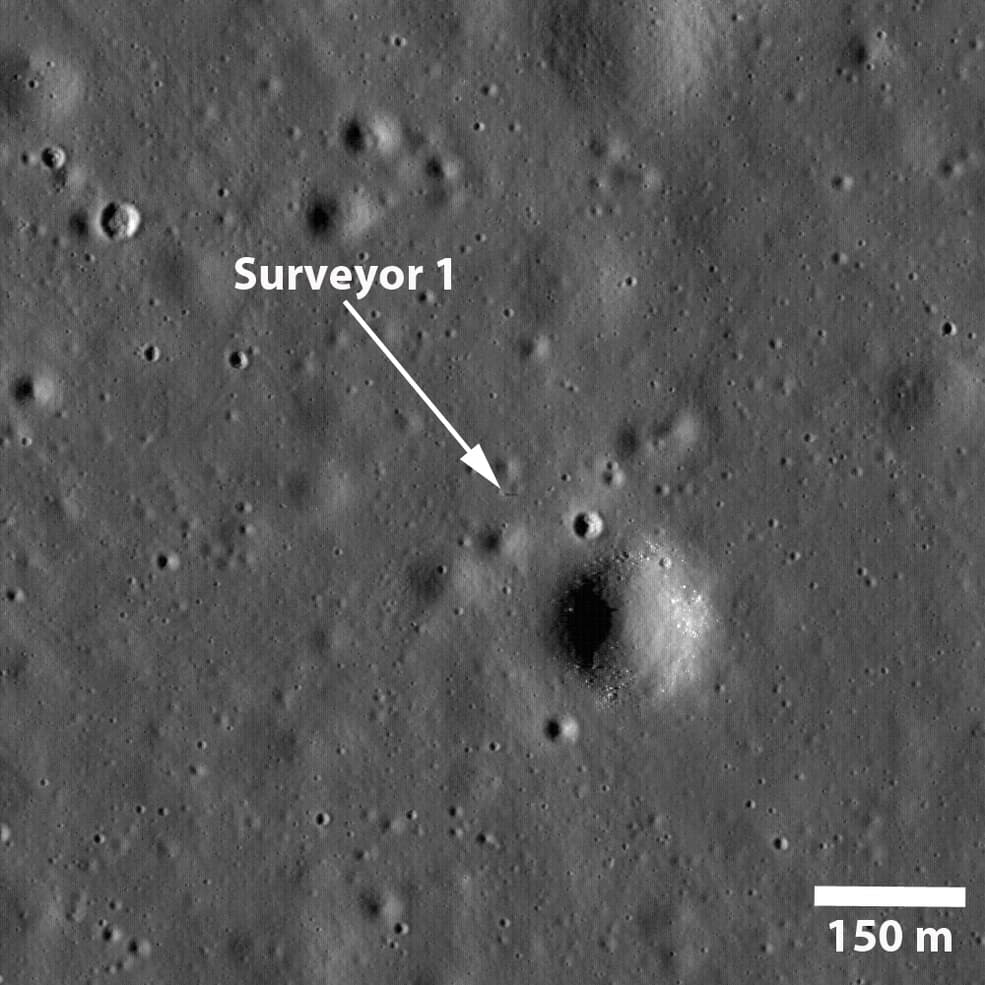
Commonly wrong. English sources routinely promote Surveyor 1 to 'the first soft landing on the Moon' (a San Diego Air and Space Museum exhibit does; even LROC's own caption calls it 'the first US spacecraft to land on another planet'). It was the first US soft landing; the USSR's Luna 9 soft-landed on February 3, 1966, four months earlier. The honest superlative is that Surveyor 1 succeeded on its program's first attempt, where Luna 9 followed years of failed Soviet tries. Also stale: photo counts. NASA's own pages disagree on the day-by-day split (JPL 1966: 10,338 + 812 = 11,150; NASA History 2021: 10,622 + 618 = 11,240). 11,240 is NASA's current total.
01Mission facts
Launch
May 30, 1966, 14:41:01 UT, on Atlas-Centaur AC-10 from Cape Canaveral Launch Complex 36A↗
Launch vehicle milestone
First operational Atlas-Centaur mission, flown direct-ascent to the Moon after eight experimental Centaur development flights↗
Landing
June 2, 1966, 06:17:36 UT, 63.6 hours after launch↗
Landing site (LROC-measured)
2.4745 S, 316.6602 E (43.34 W); LROC 2016 update (Wagner et al. 2017) uncertainty ±5.6 m, value unchanged in the LROC PDS anthropogenic-objects shapefile updated September 2025 (uncertainty 5.4 m)↗
Landing accuracy
About 9 miles (14 km) from the planned target↗
Mass
995.2 kg at launch; 294.3 kg on the surface after retrorocket jettison and propellant use↗
Descent profile
Solid retrorocket ignited 2 min 46 s before touchdown at 46.75 mi altitude and 5,840 mph; verniers throttled by the RADVS radar cut off about 10 ft up at 2.8 mph; touchdown at about 7.5 mph↗
First surface image
Transmitted 36 minutes after landing↗
Images returned
11,240 total per NASA's current pages (10,622 in the first lunar day to June 14, plus 618 in the second, July 6 to 13); JPL's contemporary release counted 11,150 (10,338 + 812)↗
Lunar night survival
Survived surface temperatures from +250 F to -260 F and answered ground commands again on July 6, 1966 after the first lunar night↗
End of mission
Primary mission completed July 14, 1966; final contact January 7, 1967↗
Program context
First of 7 Surveyor missions (1966 to 1968), of which 5 landed successfully (Surveyors 1, 3, 5, 6, 7)↗
Site: 2.4745°S, 43.3398°W · Oceanus Procellarum, inside the Flamsteed Ring (Flamsteed P) (source)
02Mission timeline
30 May 1966
Launch, 14:41:01 UT: Atlas-Centaur AC-10 lifts off from Cape Canaveral LC-36A on the first operational Atlas-Centaur, flying a direct-ascent trajectory
2 Jun 1966
Soft landing, 06:17:36 UT: touches down in Oceanus Procellarum at about 7.5 mph, 63.6 hours after launch; first US soft landing on the Moon
2 Jun 1966
First image: first surface photo transmitted 36 minutes after touchdown
14 Jun 1966
First lunar sunset: night falls after 10,622 images returned in the first lunar day (NASA History count)
6 Jul 1966
Survives the night: responds to commands after two weeks of minus 260 F lunar night
13 Jul 1966
Second imaging session ends: sunset ends the second lunar day after 618 more images
14 Jul 1966
Primary mission complete
7 Jan 1967
Final contact, 219 days after landing
1967
Seen from orbit: Lunar Orbiter III photographs Surveyor 1 as a bright speck on the mare, the first US lander imaged from lunar orbit
2009
LRO revisit: LRO's narrow-angle camera resolves the lander and its long shadow at low sun
Teal dots: events that physically happened in flight or on the Moon. Grey: announcements, namings, contracts, and targets.
03The mission
Four months after the Soviet Union's Luna 9 proved a spacecraft could survive touching the Moon, the United States answered with something arguably harder: a fully controlled, radar-guided soft landing that worked on the program's first try. Surveyor 1 launched on May 30, 1966 at 14:41:01 UT on Atlas-Centaur AC-10, the first operational flight of the Centaur high-energy upper stage after eight experimental development flights, and flew a direct-ascent trajectory that delivered it to the Moon just 63.6 hours later.
The landing sequence on June 2, 1966 was a dress rehearsal for Apollo in miniature. A 9,000-pound-thrust solid retrorocket ignited 2 minutes 46 seconds before touchdown, with the spacecraft 46.75 miles up and moving at 5,840 mph. After the spent retro casing was dropped, three throttleable vernier engines took over, steered by the RADVS radar altimeter and Doppler velocity sensor, and cut off about 10 feet above the surface at 2.8 mph. Surveyor 1 hit at roughly 7.5 mph (3.4 m/s), bounced a few inches, and settled upright at 06:17:36 UT, about 14 km from its aim point, inside the Flamsteed Ring: a 100 km ghost crater in Oceanus Procellarum almost completely buried by mare lavas. LRO's camera team later measured the lander's position at 2.4745 S, 316.6602 E to within about 6 m (Wagner et al. 2017), a value unchanged through LROC's September 2025 data release.
Thirty-six minutes after landing, the first picture was on its way to Earth. The survey television camera, with its rotating mirror head and red, green and blue filter wheel, returned 10,622 images before the first lunar sunset on June 14 (NASA's current count; JPL's 1966 release said 10,338). The solar-powered spacecraft then endured two weeks of minus 260 F darkness it was never required to survive, and answered ground commands again on July 6. A second imaging session added 618 frames through July 13, the primary mission closed on July 14, and engineers kept coaxing responses from the lander through several more lunar nights until final contact on January 7, 1967, 219 days after landing.
The science mattered as much as the landing itself. One of Surveyor 1's most consequential photos was of its own footpad sitting firmly on the regolith, direct proof that the surface was not a deep dust trap and could bear a lander's weight. Its imagery, soil-mechanics data, temperatures and radar reflectivity measurements fed straight into Apollo lunar module design and site selection. Surveyor 1 was the first of seven Surveyors flown between May 1966 and January 1968, five of which landed successfully.
The lander has been photographed twice from lunar orbit: in 1967 by Lunar Orbiter III, which caught it as a small bright patch on the mare, and in 2009 by the Lunar Reconnaissance Orbiter, whose narrow-angle camera resolved the 3.3 m spacecraft and, at low sun, the roughly 15 m shadow it still casts across Oceanus Procellarum. The 60th anniversary of the landing passed on June 2, 2026.
04In pictures
Tap a photo to enlarge.
05Sources
- NASA Science: Surveyor 1 mission page
- NASA History: 55 Years Ago, Surveyor 1 Makes a Soft Landing on the Moon (2021)
- JPL News: Surveyor I Mission (contemporary release)
- LROC Featured Image: Surveyor 1, America's first soft lunar landing
- LROC Spacecraft Related Coordinates, 2016 Update (Wagner et al. 2017; position source, value confirmed by the Sept 2025 LROC PDS shapefile)
- NASA Science: Lunar Rangers and Surveyors program page
- NASA History: Centaur, America's Workhorse in Space
- NTRS: Atlas-Centaur Flight Performance for Surveyor Mission A (AC-10)
- NASA Image Library: Surveyor 1 photographed by Lunar Orbiter III (LRC-1967-B701_P-04028)
azmth is independent and is not affiliated with or endorsed by NASA, CNSA, Roscosmos, ISRO, JAXA, or any other space agency or company named on this page.